Grumpy opinions about everything.

Category: History Page 8 of 9

Grumpy opinions about American history

The Agony of Presidental Elections

Over the past several months I have become increasingly discouraged as I watch the sad spectacle of the presidential election play out in the newspapers and on the electronic media. It seems the candidates are more interested in serving themselves than in serving the people. Each is convinced that he is the only one who can save the country. While one is obsessed with regaining the power of the president, the other is reluctant to relinquish it.

This has left me wondering if there’s not a better way to elect the president. As everyone knows we elect a president for four years and then they can be reelected for an additional four years. But this was not always the way our electoral process has been structured.

A brief history of presidential terms

Perhaps second only to slavery, the office of president was one of the most controversial subjects at the 1787 Constitutional Convention. There were extensive debates about the structure of the office, the power of the chief executive, and even if it should be a single person.  There was a proposal put forward by Edmund Randolph of Virginia for a three-person executive committee to head the government. 

There were proposals for a short-term presidency of one or two years, arguing that more frequent elections would ensure the chief executive was more responsible to the people. There were also proposals for longer terms such as 7 or even 15 years. The intent of longer terms was to provide the president with independence from the influence of special interests and provide for more stable government.

There is a popular misconception that Alexander Hamilton favored a president for life. While he advocated for a strong presidency with certain aspects of a monarch, he also recognized the importance of a fixed term and the provision for impeachment to safeguard the country against abuse of power.

After it became clear to most delegates that George Washington would become the first president, the convention decided on a four-year term for the president. The constitution as originally adopted did not explicitly state that the president can be reelected, nor did it prohibit reelection.  Not all delegates were in favor of allowing the president to be reelected because they felt it would result in too much power being consolidated the hands of the single person.  As often happens in politics, no decision was made, and the Constitution as adopted was silent on reelection.

The issue of term length did not end with the ratification of the constitution. The first proposed constitutional amendment to change the length of the presidential term was introduced in 1808. Since then, multiple amendments have been proposed to extend the term to five, six, seven or even eight years. By the early 1900s the single six-year term had become the dominant idea being proposed. Amendments to change the term of the presidential office were introduced as late as the 1990s. Although persistent in their reappearance, none have ever had any realistic chance of being approved.

 George Washington set the precedent of serving only two terms by retiring to Mount Vernon at the end of eight years in office. This pattern was followed until Franklin Roosevelt ran for a third and then a fourth term.  After Roosevelt’s death, the 22nd Amendment to the Constitution was passed by Congress in 1947, and ratified in 1951, limiting the president to two total terms in office. 

Other countries have different patterns for their chief executive’s term of office. Parliamentary countries have no set term. Elections can be called, and the chief executive removed from office whenever confidence in the government has fallen, and the public demands a change.  Other countries such as Mexico, the Philippines and Chile have a single six-year term for president.

If we were to consider a single six-year term for the US president how would that change things. Let’s look at a few of the pros and cons.

The arguments in favor of a single six-year term

The president would be relieved of the burden of an almost constant reelection campaign. With a single term, a president can focus on policy and governance without being distracted by the next election cycle. This may lead to bolder, more decisive leadership, unencumbered by the need to cater to special interest groups. Those groups may be less inclined to make large political contributions knowing that they hold no future sway over the actions of the president.

There may be potential for greater continuity in policymaking. Presidents could be more inclined to tackle unpopular long-term challenges head-on, rather than deferring them to a second term or even to their successor. The president may be more likely to engage in bipartisan programs knowing that there is no need to appease party radicals during a reelection process.  The president could be more likely to engage in long term planning rather than worry about what will look good in the polls in the short term. This may result in fewer political decisions made just to improve reelection chances.

Not having to run for reelection would also give the president more time to work for the country and the citizens. The time and the effort put into planning campaigns, making speeches, and attending reelection events could be spent improving the government and the country. If the president has more time to work closely with Congress, then there could be less gridlock in Washington.  In sum, the single six-year term may allow the president to be the statesman they all claim to be.

The arguments against a single six-year term

A single six-year term could diminish the accountability of the president to the electorate. In a traditional two-term system, presidents are incentivized to deliver on their promises and perform effectively to secure re-election. With only one term to serve, there may be less pressure for a president to maintain high levels of performance throughout their tenure. This could result in complacency or a lack of motivation to pursue ambitious reforms, knowing there won’t be a chance for the electorate to hold them accountable.

A single six-year term could disrupt the balance of power between the executive and legislative branches. With the absence of a potential second term, presidents may become more inclined to bypass Congress and govern through executive orders and unilateral actions. This could lead to increased polarization and gridlock, as Congress may resist executive overreach, exacerbating tensions between branches of government.

If the president proves to be inept or not acting in the best interests of the people and the nation, six years is a long time for that person to be in office. The only option would be impeachment and we know from recent experience that impeachment is a long and painful process frequently generating more ill will than good results.

And in conclusion…

So, would a single six-year presidential term be a good thing or a bad thing?  Would it help us get out of our current political mess?

Perhaps it would have no impact at all. Perhaps it’s not the length of the presidential term, the number of terms the president serves, or even how we elect the president. Perhaps the real problem lies with us. It doesn’t matter how we elect our president if we don’t do a better job deciding who the candidates will be. It’s been said many times that people get the government they deserve. We all complain about it and yet we continue voting for the same type of people year after year. 

Of all the people to blame for the current political situation, the one in the mirror is the one to whom we should look first.  Because, after all, that’s the only person we can control.

And that is my grumpy opinion.

New Myths Arise

So why should we consider myths as anything but an anachronistic curiosity since we consider ourselves a rational and scientific society? Because the willingness to believe in myths is as strong today as it has ever been. While belief in Olympian gods, elves, and fairies has faded away new myths have arisen. Since the late 1800s, at least two new myths have spread in the United States.

The Golden Age of America

Our political situation today has much to do with belief in the Myth of the Golden Age of America. I strongly believe that the United States has been and continues to be the best hope for personal freedom in the world today. But the idea that at some time in the recent past everything was wonderful for everyone is a myth. In this “Golden Age” to which some people wish to return, women, minorities, gays, and the disabled were clearly discriminated against.

One key contributor to the Golden Age Myth was the economic boom that followed World War II. The United States was a global industrial leader and the economy showed significant gains in jobs, wages, and consumer goods. The middle class was expanded, college education rose due to the GI Bill, and home ownership reached new levels. However, these advantages did not reach all members of our society.

Racial minorities continued to be actively discriminated against. Segregation, particularly under the Jim Crow laws in the South, limited economic, social, and political opportunities for our Black citizens.
Women’s roles and opportunities similarly were significantly constrained. Women were expected to take a domestic role over professional or personal aspirations. Even women who obtained advanced college degrees were expected to stay at home and raise their family or to take “appropriate” jobs such as secretaries, teachers, or nurses.

Reaction to the Golden Age Myth led to movements such as women’s liberation and the civil rights movement, both followed shortly by gay rights and the advocacy for the disabled. The Golden Age seems to have existed principally in popular television shows such as Ozzie and Harriet or Father Knows Best. In short, this “Golden Age” was not golden for everyone.

The Lost Cause

This myth arose in the South in the late 19th and early 20th centuries though it had its origins while the war still raged. According to the Myth of the Lost Cause, the Civil War had nothing to do with slavery. It had to do with the southern states fighting for their individual state rights and their prerogatives of self-government. They were fighting against northern aggression that was trying to destroy the southern way of life. Most Confederate soldiers were poor farmers who neither owned nor could afford slaves. They had to be convinced that they were fighting for their way of life against a malicious union army that was intent on invading their homes and forcing “northern ways” on them. The soldiers had to be distracted from the fact that they were fighting, suffering, and dying to protect the way of life of the wealthy slave owning aristocracy.

The evolution of legend was also involved in the creation of this myth. Robert E. Lee and Stonewall Jackson were idealized as true southern gentlemen struggling in a glorious but doomed battle against overwhelming odds.

Of course, it completely ignores the fact that the southern way of life and those state rights were predominantly based on slavery. A critical element in this myth is that slavery was good for the slaves. We continue to hear this stunning falsehood from politicians today as they try to describe slavery as a little more than job training.

Many historians today agree this myth is an intentional distortion of historical facts. The Lost Cause Myth reached its fully developed form in the years surrounding the turning of the 20th century and was intended to change the historical narrative of the South’s role in the Civil War by minimizing the central role of slavery in the origin of the conflict. This revisionism was part on the broader social effort used to justify segregation, Jim Crow laws, and white supremacy.

The Lost Cause is a compelling example of history being reshaped by myth and legend. It shows how over time people can come to accept those things that most support their personal beliefs despite evidence to the contrary. It continues to dominate much of our current debate about race relations, voting rights and social welfare policies. However, today open advocacy of the Lost Cause Myth is in the background and it is seldom mentioned by name though its tenents are reflected in the opinions and statements of many .

Why believe in myths?

So why do we have a widespread belief in these myths? There are several reasons people persist in a false belief even after it has been largely disproven.

The most obvious reason is that myths meet emotional needs. They can be deeply ingrained in a person’s identity, beliefs, and values. When the myth is tied to political or religious beliefs people will be resistant to change even in the face of contradictory evidence. Admitting a previous error of belief is, in some ways, viewed as a form of weakness.

There is also a condition called confirmation bias. People are inclined to seek out and accept without question things that confirm their pre-existing beliefs and opinions. They ignore anything that is not consistent with an already held position.

When presented with information that conflicts with previously held opinions, people can experience what is known as cognitive dissonance. This is the emotional distress that people feel when attempting to hold two contradictory ideas or when trying to reconcile new information that challenges their behaviors or previously held ideas. To reduce this distress people either ignore or in some cases violently reject anything that conflicts with what they previously believed.

Critical thinking skills involve objectively evaluating evidence, identifing inconsistencies, and appling reasoning skills. Critical thinking isn’t always a natural process. When I was in high school, we were expected to memorize facts and then duplicate them on tests. I don’t remember even hearing the term critical thinking until I was in graduate school. Even then, I’m not really sure I understood how important it is to develop a personal understanding of facts and events and how difficult it would be to aquire those skills.

Teachers now make an effort to teach critical thinking skills. But it can be difficult for students to translate those skills into their life outside the classroom. Perhaps many of them may think of critical thinking the way they think of algebra, something they must do in school but won’t ever use in their everyday life. A well-informed citizenship requires all of us to encourage critical thinking practices. We need to ensure that our young people are reading and listening and using those skills outside the classroom. It’s easy to say, but venturing out of our comfort zone can take strength and purpose for all of us.

We can quickly fall into the habit of listening to or reading only a narrow range of opinions from a limited number of sources. It is particularly easy when those sources don’t challenge us to think or to analyze. It is too easy to reject new information rather than trying to evaluate and reconcile it with our previously held beliefs.

Obviously, these reasons are not mutually exclusive and are melded into a continuum of reasons for the rejection of fact in favor of myth.

Both the Lost Cause Myth and the Golden Age Myth arose much quicker and for a more limited purpose than did the classic myths. In this way the evolution of these myths has much in common with the concepts of propaganda. In my next post I will be looking at the difference between lies and myths and how both relate to propaganda and how it has evolved in modern times.

The Power of Myth and Legend

A brief history of myths and legends

This is the first in a series of posts on myths, legends, lies, and propaganda. Above are illustrated Thor, Paul Bunyon, and Zeus. Instinctively we know Thor and Zeus are myths and Paul Bunyan is a legend. But how do we know that?

Let’s start with the Merriam-Webster definitions.
Myth: “a usually traditional story of ostensibly historical events that serves to unfold part of the world view of a people or explain a practice, belief, or natural phenomenon”. Legend: “a story that comes from the past, especially one that is popularly regarded as historical but not verifiable. Legends are also traditional but unfounded stories that explain the reason for a current custom, belief, or fact of nature.”

As with many dictionary definitions, these are broad and give the general concept without developing any detail. One important element is included in the definition of both; they are based on traditional stories that have evolved through shared historical experiences and understandings. They are generally not created as a single fully developed narrative. Almost all cultures have a tradition of myth and legend. For example, the “creation” myth is surprisingly similar among diverse societies.

So, how do we differentiate between the two?

Myths are primarily religious or spiritual in nature and evolve to help people understand the mysteries of the physical universe. They typically involve supernatural beings represented as “gods”. For example, early people did not understand that the rotation of the earth caused night and day. As a way of dealing with this they created the myth of a god driving a flaming chariot across the sky.

Legends, on the other hand, are usually based on a historical person or are, perhaps, a synthesis of several people into a single legendary figure. They are less about the supernatural or divine but more about human heroes who accomplished extraordinary deeds. Legends evolve over time with the hero frequently accomplishing great feats that reflect the concerns of the population at the time. The legends are intended to inspire and to contribute to societal cohesion. The legend can have variations in many areas over many years. The classic example of this is the King Arthur legend which comes in many forms in different countries spanning several centuries. Daniel Boone and Davy Crockett are examples of historic Americans who have evolved into near legendary status.

As you might expect, myths and legends can overlap and can even melt into one another. They can also be incorporated into propaganda and can be used to support false narratives of history and society. For the rest of this post, I’m going to principally look at myths because of their similarity to legends and because sometimes it may be less clear that the origins of some belief may be steeped in mythology or legend.

More About Myths

Myths serve a variety of purposes. They are used to explain natural events that are not well understood. A variety of “gods” were created to help people feel they had a sense of control in a world that seemed very dangerous to them. They helped people feel there is a purpose to existence.

Myths also help shape cultural and social identities. They give people a sense of shared history and reflect community values and customs. The myths frequently contain ethical and moral lessons. Myths help create unity in times of difficulty and can be a source of inspiration. Myths can also be used as an object lesson about what could happen to those who don’t respect community values.

In preliterate societies, myths performed a service of historical or cultural preservation, particularly as it relates to behavior and beliefs. Myths frequently use symbolic language and narrative to enhance societal cohesion. They reinforce a feeling of belonging within the group.

Myths can have an emotional appeal and are more engaging than a dry listing of facts. They can often provide a simple answer to complex problems. Societies find comfort in the stability that an underlying myth can provide even if there is no empirical evidence to support it. Myths can become so embedded in a society’s religion, art, and literature that some people often have trouble separating the myth from the reality of the world around them.

The belief in myths is not always consistent among groups and cultures. In some societies, myths are taken literally while in others they are taken allegorically. The belief in myths has changed over time as societies have evolved knowledge and scientific understanding. But they all share an attempt to transform the metaphysical to the literal.

While the evolution and perpetuation of myths was of great value to early societies, continued reliance on myths as a source of knowledge often hampered scientific development. Throughout history, there have been persecutions of people who proposed new scientific knowledge or philosophical opinions that varied from society’s foundational myths.

We tend to think of myths as having arisen in the mystic past. We think of them as entertaining stories with little relation to our lives. However, myths continue to evolve, and new myths are continually created. In my next post, New Myths Arise, I’ll talk about two myths particular to the United States that have risen within the last 150 years and still have a continuing impact on our society.

Who Were The Huguenots?

François de La Nouea, a Huguenot Captain

Today’s post is a guest column by my wife Margie. This first appeared in the January 2024 issue of the newsletter of the Daniel Boone Chapter of the Sons of the American Revolution.


One day I received an interesting text from my cousin, Mary. She had been accepted into the Huguenots Society and said that due to our lineage, I could be a member. So, with her help, I am now a member. The Huguenots were French Protestants who were active in the 16th and 17th centuries. They were forced to flee France due to religious and political persecution. The Huguenot Society of America was founded in 1883 to perpetuate the memory of Huguenot settlers in America. George Washington was the grandson of a Huguenot on his mother’s side. I am a descendant of Barbara de Barrette who was a Huguenot and lived in Valenciennes, France, around 1657. She married Garrett Van Swearingen and they settled in Maryland. Last October John and I enjoyed going to the 2023 Huguenot Society of America Conference in Macon, Georgia. We had never been to Macon and enjoyed meeting fellow members and visiting historic landmarks such as the Hay House and the Cannonball House and, of course, eating great southern cuisine. Check the internet to find out more about the Huguenots. It is very interesting reading and who knows, you, too, may qualify as a member!

If you would like to contribute a guest post, please contact me. The Grumpy Doc can always use a little help from his friends.

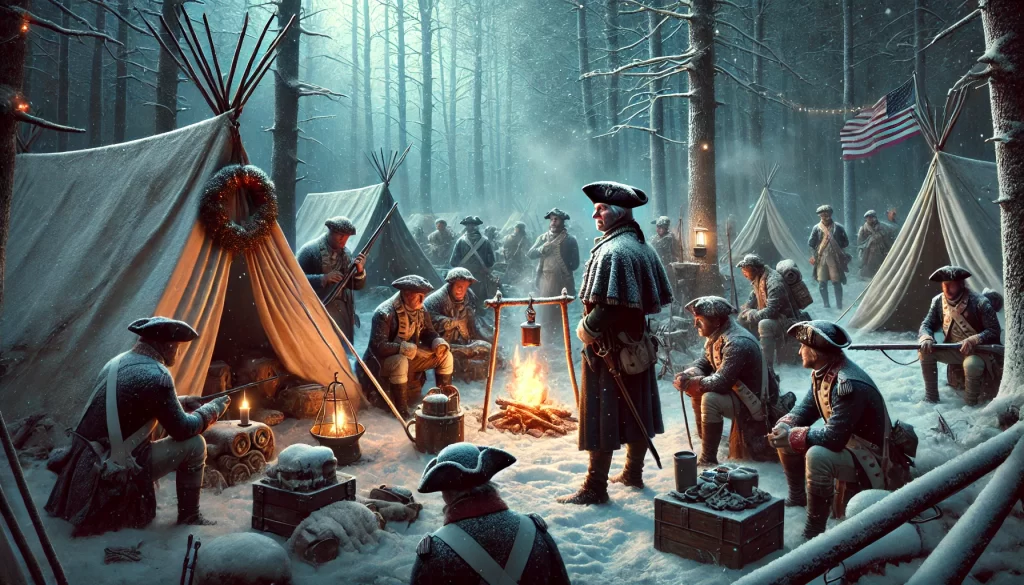
Christmas in Colonial America

In the United States today, we have a very expansive view of what constitutes Christmas celebrations. We don’t find it at all unusual to see an inflatable Santa Claus next to a manger scene. The wisemen are as likely to be following neon snowflakes as yonder star. This combination of religious and secular is something that we just accept without a whole lot of thought. But it wasn’t always the case. In colonial America Christmas was celebrated in a mostly religious fashion when it was celebrated at all.

Colonial New England

Colonial New England was settled in large part by Puritans. They even extended their influence to areas that they did not initially settle. They went so far as to banish, and in some cases even execute people who did not agree with them. They were determined to create a society dominated by Puritan beliefs.

The Puritans did not favor Christmas celebration; they believed there was no scriptural basis for acknowledging Christmas beyond doing so in prayer. In 1621 Governor William Bradford of Plymouth Colony criticized some of the settlers who chose to take the day off from work because as Puritans he felt that they could best serve God by being productive and orderly.

The celebration of Christmas was outlawed in most of New England. Calvinist Puritans and some other protestants abhorred the entire celebration and likened it to pagan rituals and “Popish” observances. In 1659, the General Court of Massachusetts forbade, under the fine of five shillings per offense, the observance “of any such day as Christmas or the like, either by forebearing of labour, feasting, or any such way.” The Assembly of Connecticut, in the same period, prohibited the reading of the Book of Common Prayer, the keeping of Christmas and saints’ days, the making of mince pies, the playing of cards, or performing on any musical instruments. These statutes remained in force until they were repealed early in the nineteenth century.

It is important to note that Puritan hostility to Christmas was not because they did not believe in the divinity of Jesus Christ. They objected to the way the holiday was being celebrated. They disliked the excesses of Yuletide festivities in England. Christmas had become a time for the working class to drink, gamble, and party. The Puritans would not tolerate any sign of disorder and believed that it was an affront to God.

They tried to protest Christmas revelries while still living in England but had little impact. Once they moved to the New World where they were able to exert control, they would not condone any form of excess. Except, perhaps, an excess of piety and self-righteousness.

Any form of Christmas observance that did occur took the shape of fasting, prayer, and religious service. Even the famous New England cleric Increase Mather loathed Christmas and believed the holiday was derived from the excesses of the pagan Roman holiday Saturnalia. We shouldn’t think that Mather was completely humorless; he once called alcohol. “a good creature of God “. Drinking wasn’t bad, but like all things it must be done in moderation with complete self-control. That’s probably good advice for everyone, whether they’re a Puritan or not.

Middle Atlantic Colonies

Many of the traditions that we now consider part of the American Christmas have their origins in the middle Atlantic colonies, most notably in Pennsylvania. Many of these were brought by settlers of German heritage as well as some traditions brought by the Scots and the Dutch.

In Pennsylvania there were two quite different Christmas traditions, one of the protestant groups and another of the Quakers. They differed considerably in their approach to Christmas.

Some colonists celebrated Christmas by importing English customs such as drinking, feasting, mumming and wassailing. Mumming involved wearing masks and costumes and going door-to-door singing carols or performing short plays in exchange for food or drink. Wassailing was a tradition where people would go from house to house singing carols and drinking toasts to the health of their neighbors. Some non-Puritan New Englanders also continued these traditions but kept them private to avoid attracting the attention of the Puritan officials.

Many of the Christmas traditions that we think of as being a quintessentially American are derived from the settlers of German descent who were known as the Pennsylvania Dutch. These include celebration of the advent season, the decoration of the Christmas tree, singing of Christmas carols, the display of nativity scenes, and the exchange of gifts on Christmas Eve or Christmas morning. We can’t imagine Christmas without these things, but we seldom remember that it was our German American ancestors who gave us these wonderful traditions.

To me the most interesting and probably most significant tradition passed on by the Pennsylvania Dutch was what led to our current concept of Santa Claus. During the colonial period, they had the tradition of Beltznickle. He is depicted as a man wearing furs and a mask and having a long tongue. He’s usually shown as being very ragged and wearing dirty clothes. He had a pocketful of cakes, candies and nuts for good children, but he also carried a switch or a whip with which to beat naughty children. Beltznickle took the naughty and nice list very seriously.

He was a long way from Clement Clark Moore’s jolly old elf in ‘Twas the Night Before Christmas and the jovial Santa Claus that we know today from the original Coca-Cola ads of 1930.

Quakers had a much different approach to Christmas. They did not celebrate it at all. It is not that they were opposed to Christmas as were the Puritans. It’s just that they did not celebrate any holidays, Easter, birthdays or any other holidays. They had no set liturgical calendar, so they did not have an advent, or an Easter season or any other religious holiday. There is no central Quaker authority to set beliefs or doctrines. Each Quaker is free to decide how to observe religious traditions. They focus on spiritual reflection and social justice.

Non-Quakers did not always understand their religious beliefs or practices. Here is an example of how Quaker practices were seen by outsiders. Swedish naturalist Peter Kalm visited Philadelphia in 1747 and recorded the following observation in his diary:
Christmas Day. . . .The Quakers did not regard this day any more remarkable than other days. Stores were open, and anyone might sell or purchase what he wanted. . . .There was no more baking of bread for the Christmas festival than for other days; and no Christmas porridge on Christmas Eve! One did not seem to know what it meant to wish anyone a merry Christmas. . . at first the Presbyterians did not care much for celebrating Christmas, but when they saw most of their members going to the English church on that day, they also started to have services.
Apparently, Presbyterians were much quicker to adopt popular practices then were the Quakers.

Southern Colonies

Celebration of Christmas was similar throughout all of the southern colonies. We’ll consider Colonial Williamsburg as a proxy for the rest of the southern colonial region. This is largely because there is more information available about Williamsburg than other areas and because it represented what was the majority of practices at the time. The major religion of the southern colonies was Church of England and they followed those practices.

Religious services were a central part of their celebration. The majority of the religious observances were during the advent season, the four weeks leading up to Christmas which were a period of reflection on the significance of the coming of Christ. The southern colonies usually held Christmas Eve services although occasionally Christmas Day services were held. Christmas Day was considered a day of celebration and family feasting.

It should be noted that the Christmas celebration was only for the white population. If the enslaved people received a holiday for Christmas, it was only because the weather was too bad to work in the fields. And of course, the house slaves were expected to attend to all the needs of the Christmas celebration.

Margie and I decided to visit Colonial Williamsburg in December of 2019, the period we refer to as BC (before COVID). We’ve always had a special affinity for Williamsburg because that’s where we spent our honeymoon 52 years ago. I’m not sure exactly what I was expecting, perhaps a large inflatable George Washington holding a Christmas wreath. But it was much more understated than what I had anticipated.

According to our tour guide, even those low-key decorations were probably more than would have been evident in the colonial era. People typically decorated their homes on the day before Christmas and removed the decorations the day after Christmas. Decorations were usually limited to candles in the window and pine boughs on the tables and mantle pieces. Pine boughs were used to decorate the church in what was known as “sticking the church”.

At Colonial Williamsburg we saw many displays that included fresh fruits and pineapples. Our tour guide told us that those were too precious to actually have been used as decorations and might have been included as part of a table display to be consumed during the Christmas feast. Some people would even rent a pineapple to display on their table as a sign of their wealth.

The first Christmas tree did not make its appearance in Williamsburg until 1848.

The southern colonists were very social people. They enjoyed wassailing as did the people of the mid Atlantic colonies. They also considered Christmas as a time for feasting, dancing, and celebrations. Men of the upper class celebrated Christmas with fox hunts and other outdoor activities. Men of the working classes frequently celebrated Christmas with shooting matches and drinking parties. Women, of course, were expected to stay at home and prepare the meals. Christmas Balls were a common practice among the upper class of the southern colonies. They were often elaborate and included large banquets with musicians, dancing and occasionally masquerades.

Present exchange was not standard practice in the southern colonies. However, it was common to give children small presents of nuts, fruit, candy, and small toys. Adults generally did not exchange presents.

Virginian Phillip Fithians writing in his journal in 1773 gave the following description of a gather just before Christmas: When it grew to dark to dance. . . . we conversed til half after six; Nothing is now to be heard of in conversation, but the Balls, the Fox-hunts, the fine entertainments, and the good fellowship, which are to be exhibited at the approaching Christmas.

Life in colonial America could be hard, but that did not stop them from having a joyous Christmas celebration.

Hamilton And Lincoln Still Have Something To Tell US

Objections and Answers respecting the Administration
of the Government

Alexander Hamilton 18 August 1792

“The truth unquestionably is, that the only path to a subversion of the republican system of the Country is, by flattering the prejudices of the people, and exciting their jealousies and apprehensions, to throw affairs into confusion, and bring on civil commotion…

When a man unprincipled in private life, desperate in his fortune, bold in his temper, possessed of considerable talents, having the advantage of military habits—despotic in his ordinary demeanour—known to have scoffed in private at the principles of liberty—when such a man is seen to mount the hobby horse of popularity—to join in the cry of danger to liberty—to take every opportunity of embarrassing the General Government & bringing it under suspicion—to flatter and fall in with all the non sense of the zealots of the day—It may justly be suspected that his object is to throw things into confusion that he may “ride the storm and direct the whirlwind.””

Speech to the Young Men’s Lyceum of Springfield

Abraham Lincoln 1838

   Is it unreasonable then to expect, that some man possessed of the loftiest genius, coupled with ambition sufficient to push it to its utmost stretch, will at some time, spring up among us? And when such a one does, it will require the people to be united with each other, attached to the government and laws, and generally intelligent, to successfully frustrate his designs….

Distinction will be his paramount object, and although he would as willingly, perhaps more so, acquire it by doing good as harm; yet, that opportunity being past, and nothing left to be done in the way of building up, he would set boldly to the task of pulling down….

I first came across these quotations in an article by Jeffery Rosen published in the Wall Street Journal.  The Grumpy Doc does not need to add anything further to them and will leave them for your thought and consideration.

Civil War Trivia

On January 12, 1864, President Lincoln went to Fort Stevens north of Washington, DC to observe military actions by the soldiers defending the capital against the Confederate cavalry of General Jubal Early. Lincoln became the only sitting United States President to come under direct fire from enemy troops. Reportedly, a young officer named Oliver Wendell Holmes (a future Supreme Court Justice) said to Lincoln “Get down you, damn fool”.

Ulysses S. Grant was the first army officer to hold the rank of Lieutenant General since George Washington.

One of General Grant’s ongoing problems was political generals. Because the army expanded so quickly, many people with little or no military experience were commissioned as officers because of political connections. Former senators, congressmen and governors frequently became generals. A number of these were placed in critical combat commands. Many of the early union setbacks can be partially attributed to the ineptitude of political generals who either were unable or unwilling to follow the orders of the professional army. (It must also be admitted that a few regular army generals were inept, but they were easier to set aside.) It wasn’t until late in the war that Grant finally had sufficient influence to be able to dismiss a number of these political generals.

Future Confederate General James Longstreet was a groomsman at the wedding of Ulysses and Julia Grant. He was a West Point friend of Grant’s and Julia’s cousin as well.

Lincoln first offered command of the Army of the Potomac to Robert E Lee. Lee refused, resigned his commission in the United States Army, and returned to Virginia where he swore allegiance to the Confederacy. The first official commander of the Army of the Potomac was General George B. McClellan. General Irwin McDowell commanded the union forces at the first battle of Bull Run, but those forces had not been designated as the Army of the Potomac at that time.

Lee was not the first choice for command of the army of Northern Virginia. The first commander of what would eventually become the army of Northern Virginia was General P. G. T. Beauregard. Interestingly, he also designed the Confederate battle flag which is today widely considered as the “Confederate flag”. It was designed because of the confusion between the Confederate national flag, the stars and bars, and the United States flag. General Beauregard relinquished command to General Joseph E. Johnston when his army was combined with Johnston’s larger army group. Lee did not become commander of the army of Northern Virginia until Johnston was wounded in battle and unable to continue.

The Civil War did not end with the surrender at Appomattox Courthouse on April 9, 1865. On April 26th, Joseph E. Johnston surrendered his larger army of 90,000 soldiers. On May 26th General Kirby Smith surrendered the Army of the Trans-Mississippi, the largest confederate force still operating on land. The last Confederate flag was lowered when the open ocean raider CSS Shenandoah surrendered to the British in Liverpool on November 6th. Interestingly, almost half of the Shenandoah ‘s victories over merchant ships occurred after the surrender at Appomattox.

The surrender at Appomattox Courthouse occurred in the home of Wilmer McLean. In one of those interesting coincidences of history, McLean originally lived near Manassas VA and his property was part of the battlefield of Bull Run. He moved to Appomattox Courthouse to try to get as far away from the fighting as he could.

At the beginning of the Civil War, Ulysses S. Grant was not even in the army. Initially, despite being a West Point graduate, he was refused a commission in the regular army and his first Civil War commission was in the militia.

Grant and wife were initially scheduled to be in the box with President and Mrs. Lincoln at Ford’s Theater on the night the President was assassinated. At the insistence of Julia, the Grants left Washington that afternoon. There’s been much speculation about why they did not attend the theater. Among the many reasons put forward are: Julia missed her children whom she had not seen for almost three months; Julia did not wish to spend time with Mrs. Lincoln whom she found disagreeable and with whom she had several contentious meetings; and one which seems most interesting, she was reported as being very worried about someone that she thought had been watching her all that day and she felt they needed to get away. The assassins did report that Grant had been one of their initial targets so this may be a true report.

Emancipation Proclamation only freed slaves in Confederate held territory. Slavery was not officially abolished in the entire United States until December 6, 1865, with the ratification of the 13th amendment.

Counting both northern and southern casualties, more Americans died in the Civil War than in all other American wars combined. The most recent estimate of the number of Civil War deaths on both sides is placed at about 750,000. Of that number, almost 2/3 died from disease.

At the end of the Civil War the United States had the largest army in the world. In 1860 the US Army had been about 16,000. At the end of the Civil War, it is estimated the army was slightly over one million. It is estimated that a total of about 2.6 million served in the US Army during the Civil War. There are no reliable estimates of the total number to have served in the Confederate Army.

Grant’s drinking was largely overstated. The stories of his dinking stem from a period, early in his career, when Grant was assigned to an isolated fort on the West Coast and his family remained on the East Coast. He suffered depression and loneliness. Throughout his life he had anxiety when separated from his family. While in the west, he began bouts of binge drinking. He missed his family to the point that he resigned from the army even though he had no job prospects at the time. There is very little report of any drinking by Grant’s following his return to the army during the Civil War, although rumors were plentiful. When given reports of supposed excessive drinking on Grant’s part, Lincoln is reported to have said “Find out what whiskey he drinks and send a case to all of my generals”.

Grant smoked up to 20 cigars a day and admirers from all over the country mailed him boxes of cigars. He eventually died of cancer of the throat and tongue.

The poet Walt Whitman worked as a volunteer in union hospitals.

Lew Wallace, author of Ben Hur, was a general in the Union Army. By most reports he was a better author than general.

The last verified Civil War veteran died in 1956. He was Albert Woolson who served in the Union Army as a drummer boy. There were three men who claimed to be Confederate veterans who lived longer than Woolson; however, one of those has been completely debunked and no confirmation of service of the other two has ever been found.

Things You May Not Know About George Washington

We all know a lot about George Washington. Or do we really? And is everything we think we know true? We all know he was the first president, but was he really? He was the commander in chief of the Continental Army, and there is no question about that. He is often called the father of his country. But did you know that he never had any children?
The fanciful tales about George Washington began to circulate while he was still alive. Everyone has heard the story of the chopping down of the cherry tree and how the young George Washington could not tell a lie and that he did it with his little hatchet. Did you know that this story was created for one of the first biographies circulated about George Washington? It was a best seller written by Parson Mason Weems who was more interested in promoting morality than in historical accuracy. We also have the story of how Washington threw a silver dollar across the Potomac. Even though money went further in those days, it is unlikely since the river is about a mile wide at that point.

Presidential Dentures


We’ve all heard how Washington had wooden false teeth. It’s true that he had false teeth; he suffered with dental problems his entire life. But they weren’t made of wood. Washington began to lose his teeth in his early 20s. He had several sets of dentures made throughout his life, including one that incorporated hippopotamus ivory. He also had a set that incorporated human teeth. In the 18th century dentists were known to purchase healthy teeth from living donors who were in need of cash. The dentist would then incorporate these teeth into dentures for their clients. The dentures were cumbersome things that involved metal plates and gold wiring. Can you imagine having these in your mouth?

The First Entrepreneur
George Washington owned and operated one of the largest commercial distilleries in the early United States. Following his presidency, he began work on his distillery at Mount Vernon. He produced mostly rye whiskey, and it was quite profitable. So, not only was Washington first in war and first in peace but he was first in cocktails as well. (That makes him even more of a hero to me!) Margie and I visited Washington’s distillery as recreated at Mount Vernon. I even bought a bottle of his Mount Vernon whiskey that you can see below on my bookcase.

I haven’t yet tried it. The distiller told me it was considered to be very smooth for its day. When I asked him what we would consider it in our day, he said “Pretty rough.” Perhaps some year, on the anniversary of the Battle of Brooklyn Heights, I’ll use it to make a Mount Vernon Manhattan (or not).
Even though Washington owned a major distillery, rye whiskey was not his favorite drink. When at dinner or sitting around the fire with friends he enjoyed a glass of Madeira. It is a fortified wine made on the Portuguese island of Madeira. Washington began ordering Madeira from his London agents in 1759 and continued ordering throughout his life. He usually ordered wine in “pipes” of 150 gallons. He seldom traveled without a large supply of Madeira.
We’ve all been taught to think of George Washington as a planter. But now we know he was distiller as well. Will it surprise you to learn that he was also a commercial fisherman?
When tobacco prices started to fall, Washington looked for ways to diversify his income. He had almost 10 miles of shoreline on the Potomac River. He bought boats and nets and set his enslaved workers to the task of catching shad, herring, perch, and sturgeon. The fish were cleaned, packed in salt, and sold all over the colonies and even shipped to Europe. He went so far as to buy a sailing schooner that he used to ship his fish to such places as Portugal and Jamaica.

A Mountaineer?

Would you believe that George Washington was once a major landowner in what is now West Virginia? Washington received major land grants for his service in the French and Indian war and he also purchased grants from others who were not interested in developing their wilderness land. He owned land at the mouth of the Kanawha River in the area that is now Point Pleasant, West Virginia. He also owned land along the Kanawha River from the mouth of Coal River up to the area that now includes Charleston. So, we can honestly say George Washington was a West Virginian.

The Traveler?
George Washington only made one trip out of what would become the United States. He had been largely raised by his older half-brother Lawrence after his father died. Lawrence had been suffering from tuberculosis and was advised to spend the winter in the tropics. Nineteen-year-old George agreed to go with him on a trip to Barbados. Two important things happened while he was there. He had the opportunity to meet British Army officers and study fortifications and learn about British military armaments and drill. This was the beginning of his lifelong love of all things military.
But perhaps the most important and least well-known portion of this trip was that Washington contracted and recovered from smallpox, leaving him with lifelong immunity. Smallpox had ravaged the colonies for several years and was devastating many units of the Continental Army. Imagine the fate of the revolution had Washington died of smallpox in 1777.
As a result of the epidemic, he issued one of the first public health orders from the American government. He ordered that all recruits arriving in Philadelphia for the Continental Army be inoculated against smallpox. This practice was soon spread across all colonies and even veteran soldiers who had not yet had smallpox were inoculated.
There are many more fascinating things about George Washington, and I will include them in a future post entitled Even More Things You May Not Have Known About George Washington.

The First Question and Final Answer
In case you think I’ve forgotten my question about the first president, Washington was the first president, under the constitution. However, prior to the adoption of the Constitution, while under the Articles of Confederation there were eight men who held the title of President of the Congress and whom some historians consider to be Presidents of the United States. But, unless you’re a true history nerd, you’ve never heard of John Hanson, first president under the Articles of Confederation. It’s The Grumpy Doc’s opinion that his lack of accomplishments earned him his well deserved obscurity.

For even more interesting facts about Washington, see the website www.MountVernon.org.

Presidential Trvia

Who Am I?

Two of my favorite subjects are American history and trivia. When Margie and I first got married one of our favorite ways to spend time with friends was to play the then popular game Trivial Pursuit. That’s when I discovered that I am the master of useless information, the repository of all things that will never earn me any money. But it’s still fun and when I can combine my love of trivia with my love of American history, so much the better. This is the first of what I hope will be a series of posts about American history trivia. We’ll start with the presidents. A subject that most of us know a fair amount about but maybe not as much as we think.

Before I go into the questions, we’ll start with the mystery man above. That’s James Buchanan, the 15th president of the United States. Now The Grumpy Doc must admit that he did recognized this fellow. If you did, bonus points for you. However, no prize for beating The Grumpy Doc beyond a sense of satisfaction that comes from besting the master. Did I mention that not only am I grumpy, but I’m also cheap?

The first question should be an easy one.

  1. Who was the first president to have a full beard while in office?
  2. Who was the last president to have a full beard while in office?
  3. What president had the first telephone installed in the White House?
  4. What two presidents had only a letter for a middle name?
  5. What president established the first National Park?
  6. Who was the first president to serve in the Navy?
  7. Who was the first president to write a best seller?
  8. Who was the only president to remain a bachelor throughout his life?
  9. Who was the first divorced president? (Should be another easy one.)
  10. What president had the most children?
  11. Who was the first president to ascend to the presidency from the vice presidency upon the death of the president?
  12. Who was the first president to have impeachment charges filed against him?
  13. Who was the only president to commit treason against the United States?
  14. And now, a question of great national significance. What president installed the first bathtub in the White House?
  15. Who was the first president born in a hospital?
  16. What presidents attended military academies?
  17. Who was the last president not to have a college degree?
  18. A final question with significance to current events. Who was the only president to have completely paid off the national debt during a period of his administration. I don’t mean balance the budget; I mean zero national debt.

ANSWERS

  1. Abraham Lincoln was the first president to have a full beard while in office.
  2. Benjamin Harrison was the last president to have a full beard throughout his term of office. However, there is a slight trick to this question. Harry Truman, during a vacation in 1948, briefly sported a goatee. However, it was gone by the time he returned to Washington.
  3. Rutherford B. Hayes had the first telephone installed in the White House. Not only did he have it installed, he was so fascinated by it he frequently answered it himself.
  4. Both Ulysses S. Grant and Harry S. Truman had S for a middle name. However, the story behind the S is significantly different. Grant was born Hiram Ulysses Grant. The congressman who signed his recommendation for West Point mistakenly listed his name as Ulysses S. Grant. Grant never disputed it and retained the S throughout his life. Biographers have reported that this was because he did not like the initials that spelled HUG. The rumor spread that the S stood for Simpson, his mother’s maiden name, but it never really stood for anything. Harry Truman’s middle name at birth was S. Both his maternal and paternal grandfathers had names that began with S and a significant family conflict arose about who he would be named after. The compromise was the initial.
  5. Although it is widely believed that Teddy Roosevelt established the first National Park, it was Ulysses S. Grant who signed the legislation creating Yellowstone. The National Park Service was created by legislation signed by Woodrow Wilson.
  6. The first US president to serve in the Navy was John F. Kennedy. Interestingly, the next four presidents also served in the Navy, three of them in World War Two.
  7. Teddy Roosevelt was a best-selling author before he became president. He wrote histories, biographies, essays, and memoirs. His books were widely distributed and very popular. And this was in the era before presidents “wrote” their memoirs as a way of supplementing their post presidential income.
  8. This was our mystery man, James Buchanan who never married.
  9. The first man elected president who had previously been divorced was Ronald Reagan.
  10. John Tyler had 15 children with two wives.
  11. Once again, John Tyler. He was elected as vice president with William Henry Harrison. He became president when Harrison died shortly after assuming office. At the time, no one was sure if the vice president would become president or simply assume the duties. Tyler solved the problem by quickly having himself administered the oath of office. Tyler was never popular with his party and was referred to as “His Accidency”. He was not nominated for an independent term of office and left after his first term.
  12. This is one The Grumpy Doc missed. I thought it would be Andrew Johnson. But, once again it was John Tyler. The charges were not successful, although surprisingly they were brought by his own party, and he completed the term.
  13. You may have noticed a trend here; this was our old friend John Tyler. He was elected to the Confederate House of Representatives but died before actually taking office.
  14. The first permanently installed bathtub was during the administration of Millard Fillmore. This may be the most significant thing that happened during the administration of this otherwise undistinguished president.
  15. Jimmy Carter, born in 1924, was the first president born in a hospital.
  16. Both President Grant and President Eisenhower graduated from the U. S. Military Academy at West Point and President Carter graduated from the U. S. Naval Academy at Annapolis.
  17. President Truman was the last president without a college degree. He attended business school and law school but did not graduate from either. At that time, it was possible to attend law school without an undergraduate degree.
  18. Andrew Jackson achieved his campaign promise of completely paying off the national debt on January 8th, 1835. However, this proved not to be a good thing. The practices he implemented to pay off the debt led directly to the panic of 1837, one of the worst recessions in U.S. history and a significant increase in national debt.

There is a lot more presidential trivia, but this is enough for our first go around. Please send me comments about your success in answering these questions. My score was right around 70%. Hopefully some of you can do better. But of course, if you do, The Grumpy Doc will never admit to having been beaten.

The Best President Ever

As we get closer to the upcoming presidential election, I’m looking forward to the latest round of articles about “the best president ever”. These lists usually include Abraham Lincoln, FDR and Thomas Jefferson somewhere in the top three or four depending on where in the cycle of historic popularity their reputations happen to be. Other presidents such as Teddy Roosevelt, Wilson, Truman, Eisenhower and Reagan will go on and off the list depending on the whims and the political orientations of the list makers. JFK has occasionally been on the list of best presidents since shortly after his assassination. The more recent a president, the more likely he is to show up on these lists. This is due partly to the fact that we tend to give higher regard to those things about which we have firsthand knowledge. Any list done over the last 15 to 20 years may include Clinton or Obama or Trump, although, given the polarization of the political process today it’s unlikely that all three would be on the same list.

But what exactly does “best president” mean? How would you come up with quantitative measures that can be used to grade presidents and create a reproducible list? Of course, being “best “ largely depends on the severity of the problems faced by the president and the success of his solutions. It also seems to me that all such lists must be subjective and influenced by the political ideology, social position, financial status, education, and region of the country of the list maker. Personally, I don’t know how to even begin to rate a best president.

While I may not know who the best president was, I strongly believe I can tell you who the most important president was and always will be, that is George Washington. To borrow a phrase from historian James Flexner, Washington was the indispensable man. He had the combination of experience, strength and dignity that was necessary to guide this country through those first critical years. Without his initial leadership it’s possible that the country may have disintegrated it into several smaller bickering independent states that likely would have been annexed by the European powers. George Washington is the man who turned These United States with an emphasis on States into The United States with an emphasis on United.

George Washington’s importance began before there was a presidency or even a formal government. Without his leadership as the commanding general of the Continental Army there likely never would have been a United States at all.

Washington was never a great tactical general. He had very few battlefield victories, although his victories at Trenton and Princeton came at an important time for the fledgling revolution. They might even be considered strategic victories and it was his role as a strategic general that led to eventual victory.

Washington recognized that he did not have to win on the battlefield but only had to maintain the Continental Army as a field force and outlast the British will to conduct an overseas war. At a time when others were urging him to meet the British in a large European style battle, he recognized that losing decisively on a battlefield may have been enough to shatter the Continental Army and with it the entire Revolution. If you are not familiar with the many attempts early in the Revolutionary War to oust Washington from command, it will be well worth your time to read more about it.

At the end of the Revolution, Washington returned his Commission to the Continental Congress and retired to Mount Vernon. He expected to spend the rest of his days managing his estates. But his country was not yet done with him.

After the Revolution, the country was governed under the Articles of Confederation, a document that Washington called …” a rope of sand.” Multiple attempts were made to revise the articles, including a failed convention in Annapolis in 1786, to which only five states sent representatives.

When another convention was called in Philadelphia in 1787, Washington initially declined to participate, believing it would be no more successful than the Annapolis convention had been. Finally, James Madison and Henry Knox persuaded him to attend.

Washington arrived in Philadelphia and was promptly elected president of the convention. It was his presence that largely influenced every state except Rhode Island to send delegates. His presence also emboldened the delegates to embark on the creation of a new Constitution, rather than a simple revision of the articles as they had been tasked by their states.

As president of the convention, Washington maintained a non-partisan role. He seldom participated in debate and generally joined in the voting without comment. He felt it was his role to maintain the decorum of the convention, something he could do only by remaining above the fray.

Currently, there is much debate about the three-fifths clause and the role of slavery in the shaping of the Constitution. At the time, this was not the only contentious issue being debated. The role of a chief executive had the potential to be equally divisive.

Having just fought a revolution against a monarchy, many of the delegates had a strong distrust of centralized power. An initial proposal was to place executive power in a three man board. Prolonged discussion revolved around how to choose the board and how it would function. As it became clear that Washington could be the first president under a new constitution, support solidified behind the single chief executive. Without his presence, there may never have been a presidency at all.

Much has been made about the role of the Federalist Papers in the ratification of the Constitution. While they undoubtedly influenced the wealthy and the well-educated, the knowledge that Washington supported the Constitution and would be, without doubt, the first president was more important to the average citizen.

Washington was so popular at the time that some even suggested he be made “King of America”; an idea he would never even acknowledge.

In sum, even before he took the oath of office, George Washington was indeed our most important president.

Further reading:
Washington: A Life, Ron Chernow.

George Washington: The Political Rise of America’s Founding Father, David O. Stewart.

Washington: The Indispensable Man, James Thomas Flexnor.

George Washington’s Journey: The President Forges a New Nation, T. H. Breen.

The Summer of 1787: The Men Who Invented the Constitution, David O. Stewart.

George Washington: A Biography, Douglas Southall Freeman. This seven-volume set is the gold standard of Washington biographies.

Page 8 of 9

Powered by WordPress & Theme by Anders Norén