
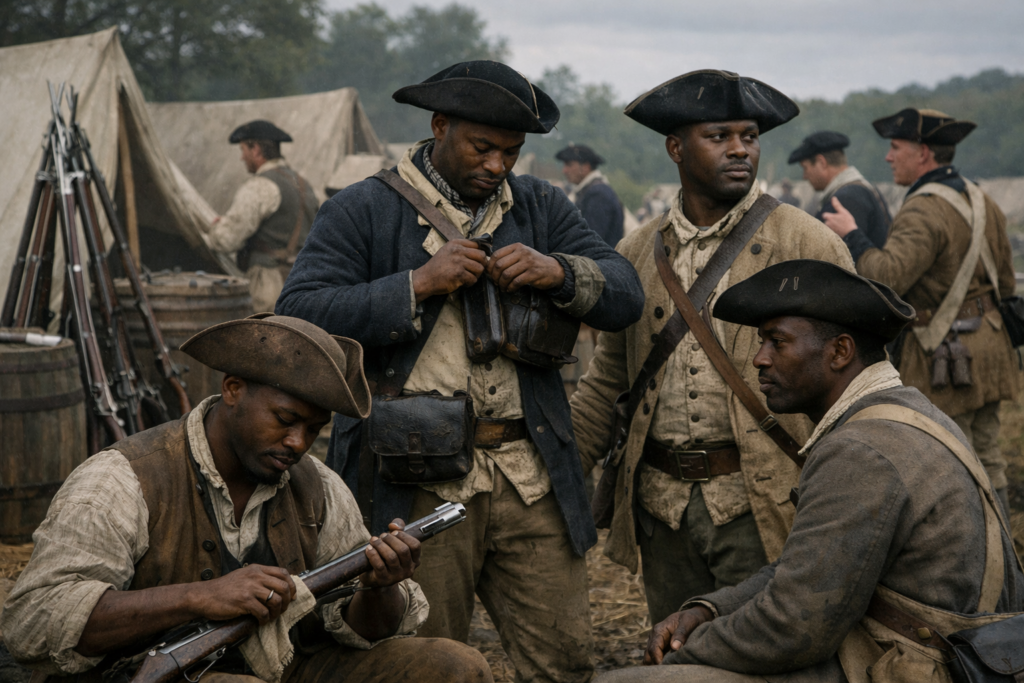
When we picture the American Revolution, we often imagine Continental soldiers in blue coats facing off against British redcoats—but this image leaves out thousands of crucial participants. Between 5,000 and 8,000 Black men fought for the Patriot cause, while an estimated 20,000 joined the British forces. Their stories reveal the war’s profound contradictions and the complex choices Black Americans faced when white colonists fought for “liberty” while holding hundreds of thousands of people in bondage. Their participation reflected the Revolution’s central paradox: a war waged in the name of liberty within a society deeply dependent on slavery.
The irony wasn’t lost on anyone at the time. As Abigail Adams wrote in 1774, “it always appeared a most iniquitous scheme to me to fight ourselves for what we are daily robbing and plundering from those who have as good a right to freedom as we have”.
For most Black participants, the key question was which side offered the clearest path out of bondage rather than abstract allegiance to King or Congress. The tension between revolutionary rhetoric and the reality of slavery shaped every decision Black Americans made about which side to support. This dynamic meant that enslaved people frequently escaped to British forces, while free Blacks (especially in New England) were more likely, though not exclusively, to enlist with the Patriots where they already had tenuous civic footholds
The British Offer: “Liberty to Slaves”
In November 1775, Virginia’s royal governor Lord Dunmore made a move that sent shockwaves through the colonies. With his military position deteriorating and losing men under his command, Dunmore issued a proclamation offering freedom to any enslaved person who abandoned their Patriot masters and joined British forces. The proclamation declared “all indented servants, Negroes, or others (appertaining to rebels) free, that are able and willing to bear arms”.
The response was immediate. Within a month, an estimated 300 Black men had enlisted in what Dunmore called the “Royal Ethiopian Regiment,” eventually growing to about 800 men. Their uniforms were emblazoned with the provocative words “Liberty to Slaves.” The name “Ethiopian” wasn’t random—it referenced ancient associations of Ethiopia with wisdom and nobility. These soldiers saw action at the Battle of Kemp’s Landing, where—in a moment rich with symbolic meaning—one previously enslaved soldier captured his former master, militia colonel Joseph Hutchings.
Dunmore’s promise came with devastating costs. The regiment’s only other major battle was the disastrous British defeat at Great Bridge in December 1775. Far worse was the disease that ravaged the Black soldiers’ ranks. As the Virginia Gazette reported in March 1776, “the jail distemper rages with great violence on board Lord Dunmore’s fleet, particularly among the negro forces”. Disease ultimately killed more of Dunmore’s recruits than combat, as was common among all armies of the time. By 1776, Dunmore was forced to flee Virginia, taking only about 300 survivors with him.
The Patriot Response: Reluctant Acceptance
The Continental Army’s relationship with Black soldiers was complicated from the start. Black men fought at Lexington and Concord. They also distinguished themselves at Bunker Hill, where Black patriot Salem Poor performed so heroically that fourteen officers petitioned the Massachusetts legislature to recognize his “brave and gallant” service.
But in November 1775, just days after Dunmore’s Proclamation, George Washington—himself a Virginia slaveholder—banned the recruitment of all Black men. The ban didn’t last long. The British continued recruiting Black soldiers, and Washington faced a simple reality: he desperately needed troops. By early 1778, after the brutal winter at Valley Forge had decimated his forces, Washington grudgingly allowed states to enlist Black soldiers. Rhode Island led the way with legislation that promised immediate freedom to any “able-bodied negro, mulatto, or Indian man slave” who enlisted, with the state compensating slaveholders for their “property”.
The result was the 1st Rhode Island Regiment, which became known as the “Black Regiment.” Of its roughly 225 soldiers, about 140 were Black or Native American men. The regiment fought at the Battle of Rhode Island in August 1778, where they held their position against repeated British and Hessian charges—a performance that earned them, according to Major General John Sullivan, “a proper share of the day’s honors”. They went on to fight at Yorktown, where they stood alongside southern militiamen whose peacetime job had been hunting runaway slaves.
Throughout the Continental Army, Black soldiers generally served in integrated units. One French officer estimated that a quarter of Washington’s army was Black—though historians believe 10 to 15 percent is more accurate. As one historian noted, “In the rest of the Army, the few blacks who served with each company were fully integrated: They fought, drilled, marched, ate and slept alongside their white counterparts.”
Naval service—on both sides—was often more racially integrated than the army. Black men served as sailors, gunners, and marines in the Royal Navy and the Continental Navy. Maritime labor traditions had long been more flexible on race, and skill mattered more than status.
Free Blacks in northern towns could enlist much like white common citizens, sometimes motivated by pay, local patriotism, and the hope that visible service would strengthen claims to equal rights after the war. Enslaved men rarely chose independently; Patriot masters often enlisted them as substitutes to avoid service, while Loyalist masters sometimes allowed or forced them to join British units. In both cases emancipation promises were unevenly honored.
Some enslavers freed men in advance of service, others promised manumission afterward and reneged, while still others simply collected bounties or commutation while trying to retain control over Black veterans. On the British side, imperial policy also vacillated, with some officers fully supporting freedom for Black refugees tied to rebel masters, and others quietly returning runaways to Loyalist owners or exploiting them as unpaid labor.
The Promise and the Betrayal
As the war ended, the gulf between British and American treatment of their Black allies became stark. In 1783, as British forces prepared to evacuate New York, General George Washington demanded the return of all formerly enslaved people as “property” under the Treaty of Paris. British commander Sir Guy Carleton refused. Instead, he created the “Book of Negroes”—a ledger documenting about 3,000 Black Loyalists who were granted certificates of freedom and evacuated to Nova Scotia, England, Germany, and British territories.
The Book provides glimpses of individual journeys. Boston King, who had escaped slavery in South Carolina to join the British, was evacuated with his wife Violet to Nova Scotia. Their entry simply notes Violet as a “stout wench”—a reminder that even their liberators viewed them through racist lenses. Harry Washington, who had escaped from George Washington’s Mount Vernon plantation, also reached Nova Scotia and later became a leader in the resettlement to Sierra Leone.
Nova Scotia proved no paradise. Black Loyalists received inferior land—rocky and infertile compared to what white Loyalists received. They faced discrimination, exploitation, and broken promises about land grants. By 1792, nearly 1,200 Black Loyalists—about half of those in Nova Scotia—accepted an offer to resettle in Sierra Leone, where they founded Freetown.
For Black Patriots, the outcome was often worse. While some white soldiers received up to 100 acres of land and military pensions from Congress, Black soldiers who had been promised freedom often received nothing beyond freedom—and some didn’t even get that. As one historian put it, they were “dumped back into civilian society”. In June 1784, thirteen veterans of the Rhode Island Regiment had to hire a lawyer just to petition for their back pay. The state responded with an act that classified them as “paupers, who heretofore were slaves” and ordered towns to provide charity.
Lieutenant Colonel Jeremiah Olney, who commanded the Rhode Island Regiment after Christopher Greene’s death, spent years advocating for his former soldiers—fighting attempts to re-enslave them and supporting their pension claims. Some soldiers, like Jack Sisson, finally received pensions decades later in 1818—forty years after they’d enlisted, and often too late. Many died before seeing any recognition.
Even more cruelly, many Black soldiers who had been promised freedom by their masters were returned to slavery after the war. Some remained enslaved for a few years until their owners honored their promises; others remained enslaved permanently, having fought for a freedom they would never experience.
It is plausible that the widespread participation of Black soldiers subtly accelerated Northern emancipation by making slavery harder to justify ideologically, even as Southern resistance hardened.
The Larger Meaning
The American Revolution was the last time the U.S. military would be significantly integrated until President Truman’s Executive Order 9981 in 1948. In 1792, Congress passed legislation limiting military service to “free, able-bodied, white male citizens”—a restriction that would last for generations.
Yet the Revolutionary War period saw more enslaved people gain their freedom than any other time before the Civil War. Historian Gary Nash estimates that between 80,000 and 100,000 enslaved people escaped throughout the thirteen colonies during the war—not all joined the military, but the war created opportunities for flight that many seized.
As historian Edward Countryman notes, the Revolution forced Americans to confront a question that Black Americans had been raising all along: “What does the revolutionary promise of freedom and democracy mean for African Americans?” The white founders failed to answer that question satisfactorily, but the thousands of Black soldiers who fought—on both sides—had already answered it with their lives. They understood that liberty was worth fighting for, even when the people promising it had no intention of extending it to everyone.
Image generated by author using ChatGPT.
Sources
- “African Americans in the Revolutionary War,” Wikipedia.
- Museum of the American Revolution, “Black Patriots and Loyalists” and “Black Founders: Black Soldiers and Sailors in the Revolutionary War.”
- Gilder Lehrman Institute, “African American Patriots in the Revolution.”
- National Archives blog, “African Americans and the American War for Independence.”
- Douglas R. Egerton, Death or Liberty: African Americans and Revolutionary America (individual stories on both Patriot and Loyalist sides).
- Edward Countryman, The American Revolution.
- Gary B. Nash, The Forgotten Fifth: African Americans in the Age of Revolution.
- Alan Gilbert, Black Patriots and Loyalists: Fighting for Emancipation in the War for Independence.
- DAR, Forgotten Patriots – African American and American Indian Patriots in the Revolutionary War: A Guide to Service, Sources, and Studies).
- NYPL LibGuide, “Black Experience of the American Revolution”
- American Battlefield Trust, “10 Facts: Black Patriots in the American Revolution.”
- Massachusetts Historical Society, “Revolutionary Participation: African Americans in the American Revolution.”
- Fraunces Tavern Museum, “Enlistment of Freed and Enslaved Blacks in the Continental Army.”
- American Independence Museum, “African-American Soldiers’ Service During the Revolutionary War.”
- Encyclopedia Virginia, “Lord Dunmore’s Ethiopian Regiment.”
- Mount Vernon, “Dunmore’s Proclamation and Black Loyalists” and “The Ethiopian Regiment.”
- American Battlefield Trust, “Lord Dunmore’s Ethiopian Regiment”
- Lord Dunmore’s Proclamation (1775), in transcription with context at Gilder Lehrman, Encyclopedia Virginia, and Mount Vernon.
- “Book of Negroes” (1783 evacuation ledger of Black Loyalists to Nova Scotia; digital copies and discussions via BlackPast and Dictionary of Canadian Biography).
- Boston King, “Memoirs of the Life of Boston King, a Black Preacher,” Methodist Magazine (1798)
- NYPL “Black Experience of the American Revolution”
- 1st Rhode Island Regiment, World History Encyclopedia
Leave a Reply