Perhaps I’m overly sensitive, but it seems that the Internet has lumped everyone over the age of 60 into the monolithic group known as “Boomers“. It not only includes those of us in the baby boom generation is also catches the older Gen X people as well. It seems that we all have the same opinions about everything, at least in the minds of the young blog writers. The internet is flooded with articles with titles such as “Crazy Things that Boomers Eat”, “Stupid Things that Boomers Still Believe”, “10 phrases that Boomers Won’t Understand”, and, my all-time favorite, “15 Things that Show Boomers only Care about Themselves “. If I were to write these same articles using “Gen Z” in place of “Boomers”, I’d be accused of being an out of touch old fossil.
Many young people assume that all seniors form a single uniform conservative voting bloc. According to the Pew Research Center in a 2026 party affiliation survey, adults 65 and older are almost evenly split, 51% favoring Republicans and 46% favoring Democrats. But even that is somewhat misleading, many of us, older folks who report favoring Republicans still think of ourselves as belonging to the Republican Party of Nelson Rockefeller, fiscally conservative, and socially moderate. This was the Republican Party before MAGA or the Tea Party. I know because I was once one of those Republicans. While I no longer identify as a Republican, I don’t identify as a Democrat either.
The Boomers led the protest against the Vietnam War. Some of us turned out by the thousands to protest against what many viewed as an unjust war. Of course, there were many of us who served because we felt it was our duty to our country, not because we felt that the government was always right. This was the first time the people actually began to distrust their government. While it’s a common sentiment now it was an alien concept to us at the time.
I haven’t noticed large numbers of the younger, progressive members of our society protesting any of the recent wars. Personally, I believe that since there is no draft, war doesn’t touch them individually, so as a group they don’t have the motivation to protest. I’ve been to the No Kings rallies and it’s unusual to see anyone under 60 and people under 50 are rare. So, the idea that seniors blindly support the government just doesn’t hold up.
There is a common misconception among young people that Boomers are technologically inept. They mistake unfamiliarity with a lack of understanding. The 20-year-old who takes great pride in their ability to post TikTok videos likely has little or no understanding of the science that makes social media possible. Of course, there are some older people who really don’t understand technology just as there are younger people who don’t. But this is the generation that was a major force in the development of laptop computers, cellular technology and smartphones, the Internet, Wi-Fi, and most of the convivences of the digital age that young people take for granted. We had to repeatedly learn new technology and adapt as science evolved. Younger people grew up with cell phones and computers and have not had to adapt to never before seen technical advances. Saying that we Boomers don’t understand technology it’s the same thing as saying our parents’ generation who put a man on the moon didn’t understand technology because they didn’t have a laptop computer and had to rely on a slide rule.
Boomers are typically painted as being sexually repressed and homophobic. But this is the generation that led away in the sexual revolution, women’s liberation, and the gay pride movement. We had slogans such as “free love “ and “make love not war“. This was a generation that took part in the “Stonewall Riots” that first drew national attention to police abuse of gay people. It’s also the generation that led the way for same-sex marriage and for gay couples to adopt.
Support for same-sex marriage is a good model for understanding how Boomer’s opinions have evolved. Gallup survey data from the 1990s showed this age group to be largely opposed to same-sex marriage, but by 2016 these same surveys showed a majority approving, and the approval rate has continued to climb. This shift in attitudes has been slow, but most of the Boomers grew up at a time when homosexuality was widely condemned, was almost never discussed publicly, and people could even be criminally charged. People in their late 80s in early 90s are the least likely to have shifted positions on gay rights issues but they are the ones who were raised in the times of the harshest attitudes.
Boomers are usually identified with racial prejudice, and this may be the clearest example of the generational divide. To provide some historical framework, many of us older members of the generation were born and came of age during the waning days of racial segregation. This had a profound effect on both Black and White Boomers as we saw racial hatred and violence played out on our television and argued about in our living rooms. For some it heightened their racial animosity while others were incensed at the unfair treatment of their fellow citizens.
Many young White college students joined with Black students at civil rights rallies, voter registration drives, and as freedom riders. Unfortunately, many also joined groups opposed to civil rights and some even engaged in violence against minorities.
Surveys over the past 25 years have shown a generally positive, though slight, shift in the attitudes of White Boomers on racial issues and support for programs to improve racial equality and address the lingering effects of past discrimination. But the positive shift has not been universal. Older White citizens who strongly identify with conservative causes have shown an increasing resistance to programs to support minority rights as demonstrated by their almost universal opposition to Diversity, Equity, and Inclusion.
It is still important to recognize that a Black middle-class family has more in common with a White middle-class family than either one has with a billionaire, regardless of race. The increasing recognition of this commonality hopefully will lead to improving relations across all levels of society.
The younger generation seems to reserve its strongest criticism of the Boomers for issues related to the economy. They see older citizens as a Greedy Gray Army out to steal their future, and keep all the wealth for ourselves. They fail to recognize that we spent our entire lives working and saving. We paid income taxes. We paid Social Security taxes. We paid Medicare taxes. We invested in IRAs and retirement accounts. We are not stealing anything from anyone. We are not being given anything. We earned it. We deserve it. And we expect to receive it.
Looking at it from the perspective of older Americans, we see younger people demanding student loan forgiveness and affordable—subsidized—housing and healthcare. Many of us believe that we’re asking for what we worked for and it’s the young who want a transfer of wealth. At the same time many older people are raising their grandchildren and even great grandchildren and providing significant financial support to their adult children.
Putting all seniors in a single group is no more accurate than saying that all young people lack respect, have no work ethic, and are only concerned with physical appearance and the number of likes they get on social media. It is true, that if you look at “average” polling data it will tell you that the average 75-year-old has different opinions than the average 25-year-old. But that’s a long way from saying all 75-year-olds have the same opinion. It seems that ageism may be the only acceptable prejudice left in American society.
To any young people who have made it this far in this article, I just want to say: “We are all individuals with our own opinions. You’re going to be old someday and the younger generation will look at you as a bunch of out-of- touch old fossils.”
It seems that hardly a week goes by that I don’t see one or more articles about some aspect of the “generation gap”. Usually, they have something to do with old folks complaining about how the younger generation has no manners, respect, or work ethic and the younger people complaining about how the old fogeys—usually referred to as Boomers—just don’t understand technology, social media, or whatever the hot item of the day is. Of course, they expect us old folks to benefit from the vast experience gained in their two and a half decades of life. I’m always reminded of an old saying, “all old people were young once, but no young person has ever been old.” Of course, there I go again, another Boomer wandering back into the past.
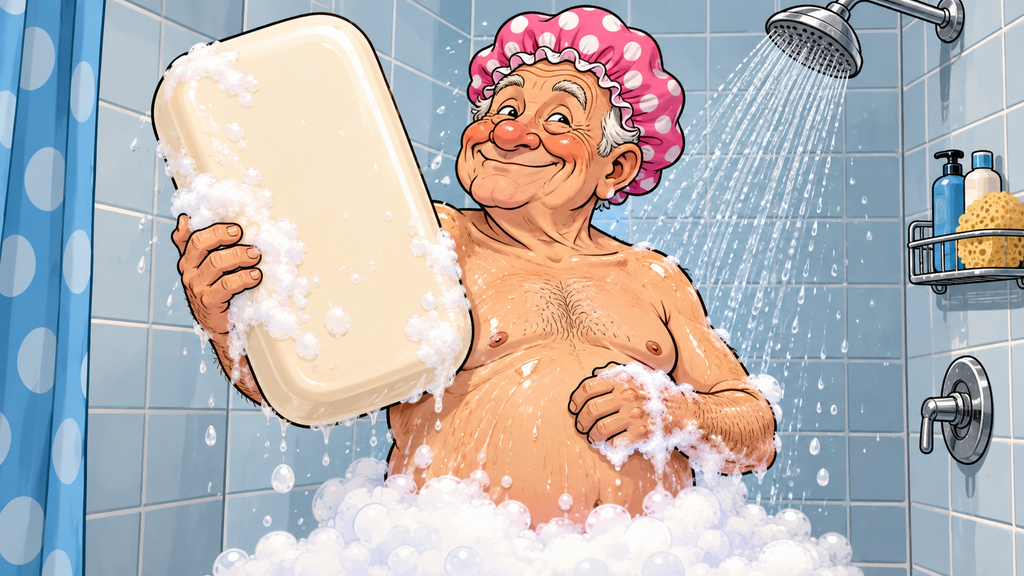
But there is a real generation gap, and it is “bar soap versus shower gel.” It’s hard to believe, but somebody actually did a survey on this subject and found that 65% of older people prefer bar soap while about 75% of younger people preferred shower gel.
It actually surprised me to learn that all that soap in the squeeze bottles isn’t the same. There is shower gel and then there is body wash. Apparently, body wash is more moisturizing while gel is better for oily skin. I just know that I don’t care for either one of them and I always feel like they never get completely rinsed off.
My wife and I have been doing a lot of traveling this summer and it seems that hotels have almost all completed their transition from bar soap to that liquid stuff in a dispenser hanging on the wall. From what little research I’ve done, apparently this went into full swing during COVID. The claim was that the shower gel is less likely to transmit infection. Although I don’t understand how a dispenser that sits there all the time and is handled by everyone is less a threat of infection than an individually wrapped bar of soap that only I handle. I think it’s just cheaper.
I only ask one thing from a bar of soap and that’s to get me clean. It’s a pretty simple process. You pick it up. You use it. You put it down. You can hold it in one hand. You’re not trying to open a slippery bottle with wet hands. In between showers the soap just sits in a dish waiting for its next job.
It seems to me that life with shower gel is much more complicated. You can’t take a shower until you have a collection of bottles and a personal development plan. You must have one bottle for your hair, one bottle for your face, and another bottle for your body. You have your energizing body wash for the mornings and a calming body wash for evenings. You also have a body wash with botanical extracts for when you need to reconnect with nature. It’s important to have a selection of body washes to be sure that one will match your mood. And don’t even get me started on exfoliating.
If you ask, “Which one is soap?”, you get the answer “It’s not soap, it’s a hydrating shower gel.” You then ask, “Does it get you clean?” And the answer is “Yes.” You respond, “Then it’s soap.” Although I suppose that may be considered an insensitive line of questioning.
I know when my bar of soap is about to fade away, it keeps getting smaller. With shower gel you don’t discover the bottle is empty until you’re standing there soaking wet and trying to squeeze out the last little bit. Maybe it’s just me, but I’d prefer a little advance notice.
And then there’s the whole thing about fragrances. I prefer my soap to smell something like soap. With shower gel there is a whole range of everything from cedarwood to spice to cinnamon to coastal sage to citrus fruit. I can’t even begin to guess what Morning Breeze is supposed to smell like.
I suppose that there’s room for coexistence. I’ll keep my bar of soap, and they can keep their collection of squeezables. But it’s going to take a much larger soap dish. Just so no one expects me to try their brand new $20 bottle of eucalyptus body wash.
Beyond “OK, Boomer” — Why Stereotyping Seniors Gets It Wrong
By John Turley
On October 30, 2026
In Commentary
Perhaps I’m overly sensitive, but it seems that the Internet has lumped everyone over the age of 60 into the monolithic group known as “Boomers“. It not only includes those of us in the baby boom generation is also catches the older Gen X people as well. It seems that we all have the same opinions about everything, at least in the minds of the young blog writers. The internet is flooded with articles with titles such as “Crazy Things that Boomers Eat”, “Stupid Things that Boomers Still Believe”, “10 phrases that Boomers Won’t Understand”, and, my all-time favorite, “15 Things that Show Boomers only Care about Themselves “. If I were to write these same articles using “Gen Z” in place of “Boomers”, I’d be accused of being an out of touch old fossil.
Many young people assume that all seniors form a single uniform conservative voting bloc. According to the Pew Research Center in a 2026 party affiliation survey, adults 65 and older are almost evenly split, 51% favoring Republicans and 46% favoring Democrats. But even that is somewhat misleading, many of us, older folks who report favoring Republicans still think of ourselves as belonging to the Republican Party of Nelson Rockefeller, fiscally conservative, and socially moderate. This was the Republican Party before MAGA or the Tea Party. I know because I was once one of those Republicans. While I no longer identify as a Republican, I don’t identify as a Democrat either.
The Boomers led the protest against the Vietnam War. Some of us turned out by the thousands to protest against what many viewed as an unjust war. Of course, there were many of us who served because we felt it was our duty to our country, not because we felt that the government was always right. This was the first time the people actually began to distrust their government. While it’s a common sentiment now it was an alien concept to us at the time.
I haven’t noticed large numbers of the younger, progressive members of our society protesting any of the recent wars. Personally, I believe that since there is no draft, war doesn’t touch them individually, so as a group they don’t have the motivation to protest. I’ve been to the No Kings rallies and it’s unusual to see anyone under 60 and people under 50 are rare. So, the idea that seniors blindly support the government just doesn’t hold up.
There is a common misconception among young people that Boomers are technologically inept. They mistake unfamiliarity with a lack of understanding. The 20-year-old who takes great pride in their ability to post TikTok videos likely has little or no understanding of the science that makes social media possible. Of course, there are some older people who really don’t understand technology just as there are younger people who don’t. But this is the generation that was a major force in the development of laptop computers, cellular technology and smartphones, the Internet, Wi-Fi, and most of the convivences of the digital age that young people take for granted. We had to repeatedly learn new technology and adapt as science evolved. Younger people grew up with cell phones and computers and have not had to adapt to never before seen technical advances. Saying that we Boomers don’t understand technology it’s the same thing as saying our parents’ generation who put a man on the moon didn’t understand technology because they didn’t have a laptop computer and had to rely on a slide rule.
Boomers are typically painted as being sexually repressed and homophobic. But this is the generation that led away in the sexual revolution, women’s liberation, and the gay pride movement. We had slogans such as “free love “ and “make love not war“. This was a generation that took part in the “Stonewall Riots” that first drew national attention to police abuse of gay people. It’s also the generation that led the way for same-sex marriage and for gay couples to adopt.
Support for same-sex marriage is a good model for understanding how Boomer’s opinions have evolved. Gallup survey data from the 1990s showed this age group to be largely opposed to same-sex marriage, but by 2016 these same surveys showed a majority approving, and the approval rate has continued to climb. This shift in attitudes has been slow, but most of the Boomers grew up at a time when homosexuality was widely condemned, was almost never discussed publicly, and people could even be criminally charged. People in their late 80s in early 90s are the least likely to have shifted positions on gay rights issues but they are the ones who were raised in the times of the harshest attitudes.
Boomers are usually identified with racial prejudice, and this may be the clearest example of the generational divide. To provide some historical framework, many of us older members of the generation were born and came of age during the waning days of racial segregation. This had a profound effect on both Black and White Boomers as we saw racial hatred and violence played out on our television and argued about in our living rooms. For some it heightened their racial animosity while others were incensed at the unfair treatment of their fellow citizens.
Many young White college students joined with Black students at civil rights rallies, voter registration drives, and as freedom riders. Unfortunately, many also joined groups opposed to civil rights and some even engaged in violence against minorities.
Surveys over the past 25 years have shown a generally positive, though slight, shift in the attitudes of White Boomers on racial issues and support for programs to improve racial equality and address the lingering effects of past discrimination. But the positive shift has not been universal. Older White citizens who strongly identify with conservative causes have shown an increasing resistance to programs to support minority rights as demonstrated by their almost universal opposition to Diversity, Equity, and Inclusion.
It is still important to recognize that a Black middle-class family has more in common with a White middle-class family than either one has with a billionaire, regardless of race. The increasing recognition of this commonality hopefully will lead to improving relations across all levels of society.
The younger generation seems to reserve its strongest criticism of the Boomers for issues related to the economy. They see older citizens as a Greedy Gray Army out to steal their future, and keep all the wealth for ourselves. They fail to recognize that we spent our entire lives working and saving. We paid income taxes. We paid Social Security taxes. We paid Medicare taxes. We invested in IRAs and retirement accounts. We are not stealing anything from anyone. We are not being given anything. We earned it. We deserve it. And we expect to receive it.
Looking at it from the perspective of older Americans, we see younger people demanding student loan forgiveness and affordable—subsidized—housing and healthcare. Many of us believe that we’re asking for what we worked for and it’s the young who want a transfer of wealth. At the same time many older people are raising their grandchildren and even great grandchildren and providing significant financial support to their adult children.
Putting all seniors in a single group is no more accurate than saying that all young people lack respect, have no work ethic, and are only concerned with physical appearance and the number of likes they get on social media. It is true, that if you look at “average” polling data it will tell you that the average 75-year-old has different opinions than the average 25-year-old. But that’s a long way from saying all 75-year-olds have the same opinion. It seems that ageism may be the only acceptable prejudice left in American society.
To any young people who have made it this far in this article, I just want to say: “We are all individuals with our own opinions. You’re going to be old someday and the younger generation will look at you as a bunch of out-of- touch old fossils.”
Image generated by author using ChatGPT.