Grumpy opinions about everything.

Tag: Military History

Black Soldiers on Both Sides: The Complex Story of African Americans in the Revolutionary War

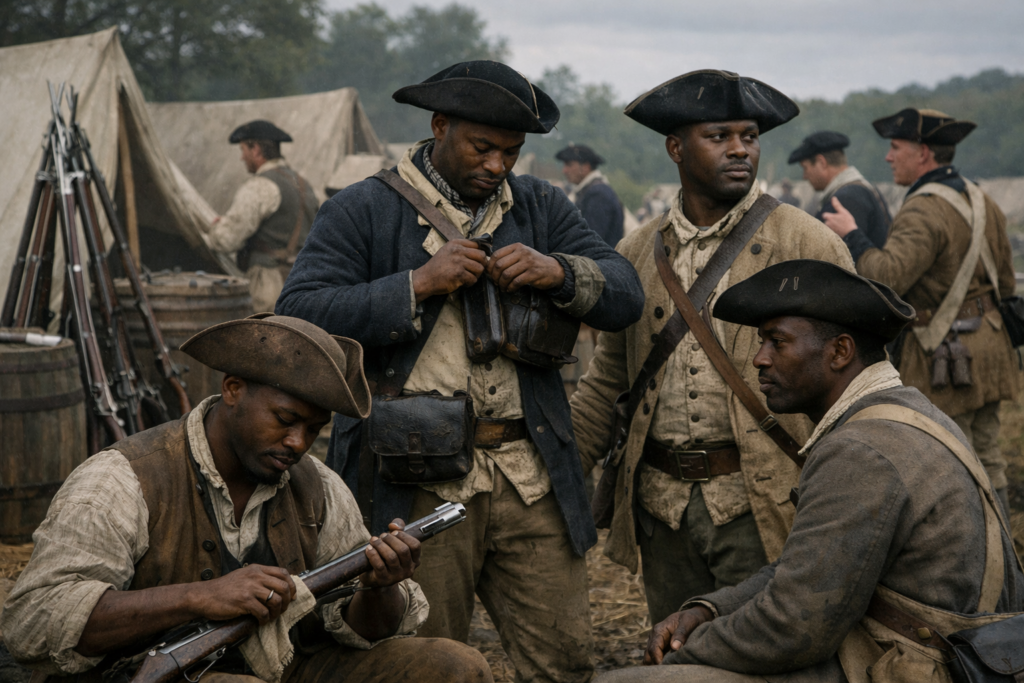
When we picture the American Revolution, we often imagine Continental soldiers in blue coats facing off against British redcoats—but this image leaves out thousands of crucial participants. Between 5,000 and 8,000 Black men fought for the Patriot cause, while an estimated 20,000 joined the British forces. Their stories reveal the war’s profound contradictions and the complex choices Black Americans faced when white colonists fought for “liberty” while holding hundreds of thousands of people in bondage. Their participation reflected the Revolution’s central paradox: a war waged in the name of liberty within a society deeply dependent on slavery.

The irony wasn’t lost on anyone at the time. As Abigail Adams wrote in 1774, “it always appeared a most iniquitous scheme to me to fight ourselves for what we are daily robbing and plundering from those who have as good a right to freedom as we have”.

For most Black participants, the key question was which side offered the clearest path out of bondage rather than abstract allegiance to King or Congress.  The tension between revolutionary rhetoric and the reality of slavery shaped every decision Black Americans made about which side to support.  This dynamic meant that enslaved people frequently escaped to British forces, while free Blacks (especially in New England) were more likely, though not exclusively, to enlist with the Patriots where they already had tenuous civic footholds

The British Offer: “Liberty to Slaves”

In November 1775, Virginia’s royal governor Lord Dunmore made a move that sent shockwaves through the colonies. With his military position deteriorating and losing men under his command, Dunmore issued a proclamation offering freedom to any enslaved person who abandoned their Patriot masters and joined British forces. The proclamation declared “all indented servants, Negroes, or others (appertaining to rebels) free, that are able and willing to bear arms”.

The response was immediate. Within a month, an estimated 300 Black men had enlisted in what Dunmore called the “Royal Ethiopian Regiment,” eventually growing to about 800 men.  Their uniforms were emblazoned with the provocative words “Liberty to Slaves.” The name “Ethiopian” wasn’t random—it referenced ancient associations of Ethiopia with wisdom and nobility. These soldiers saw action at the Battle of Kemp’s Landing, where—in a moment rich with symbolic meaning—one previously enslaved soldier captured his former master, militia colonel Joseph Hutchings.

Dunmore’s promise came with devastating costs. The regiment’s only other major battle was the disastrous British defeat at Great Bridge in December 1775. Far worse was the disease that ravaged the Black soldiers’ ranks. As the Virginia Gazette reported in March 1776, “the jail distemper rages with great violence on board Lord Dunmore’s fleet, particularly among the negro forces”. Disease ultimately killed more of Dunmore’s recruits than combat, as was common among all armies of the time. By 1776, Dunmore was forced to flee Virginia, taking only about 300 survivors with him.

The Patriot Response: Reluctant Acceptance

The Continental Army’s relationship with Black soldiers was complicated from the start. Black men fought at Lexington and Concord.  They also distinguished themselves at Bunker Hill, where Black patriot Salem Poor performed so heroically that fourteen officers petitioned the Massachusetts legislature to recognize his “brave and gallant” service.

But in November 1775, just days after Dunmore’s Proclamation, George Washington—himself a Virginia slaveholder—banned the recruitment of all Black men. The ban didn’t last long. The British continued recruiting Black soldiers, and Washington faced a simple reality: he desperately needed troops. By early 1778, after the brutal winter at Valley Forge had decimated his forces, Washington grudgingly allowed states to enlist Black soldiers. Rhode Island led the way with legislation that promised immediate freedom to any “able-bodied negro, mulatto, or Indian man slave” who enlisted, with the state compensating slaveholders for their “property”.

The result was the 1st Rhode Island Regiment, which became known as the “Black Regiment.” Of its roughly 225 soldiers, about 140 were Black or Native American men. The regiment fought at the Battle of Rhode Island in August 1778, where they held their position against repeated British and Hessian charges—a performance that earned them, according to Major General John Sullivan, “a proper share of the day’s honors”. They went on to fight at Yorktown, where they stood alongside southern militiamen whose peacetime job had been hunting runaway slaves.

Throughout the Continental Army, Black soldiers generally served in integrated units. One French officer estimated that a quarter of Washington’s army was Black—though historians believe 10 to 15 percent is more accurate. As one historian noted, “In the rest of the Army, the few blacks who served with each company were fully integrated: They fought, drilled, marched, ate and slept alongside their white counterparts.”

Naval service—on both sides—was often more racially integrated than the army. Black men served as sailors, gunners, and marines in the Royal Navy and the Continental Navy. Maritime labor traditions had long been more flexible on race, and skill mattered more than status.

Free Blacks in northern towns could enlist much like white common citizens, sometimes motivated by pay, local patriotism, and the hope that visible service would strengthen claims to equal rights after the war.  Enslaved men rarely chose independently; Patriot masters often enlisted them as substitutes to avoid service, while Loyalist masters sometimes allowed or forced them to join British units. In both cases emancipation promises were unevenly honored.

Some enslavers freed men in advance of service, others promised manumission afterward and reneged, while still others simply collected bounties or commutation while trying to retain control over Black veterans. On the British side, imperial policy also vacillated, with some officers fully supporting freedom for Black refugees tied to rebel masters, and others quietly returning runaways to Loyalist owners or exploiting them as unpaid labor.​

The Promise and the Betrayal

As the war ended, the gulf between British and American treatment of their Black allies became stark. In 1783, as British forces prepared to evacuate New York, General George Washington demanded the return of all formerly enslaved people as “property” under the Treaty of Paris. British commander Sir Guy Carleton refused. Instead, he created the “Book of Negroes”—a ledger documenting about 3,000 Black Loyalists who were granted certificates of freedom and evacuated to Nova Scotia, England, Germany, and British territories.

The Book provides glimpses of individual journeys. Boston King, who had escaped slavery in South Carolina to join the British, was evacuated with his wife Violet to Nova Scotia. Their entry simply notes Violet as a “stout wench”—a reminder that even their liberators viewed them through racist lenses. Harry Washington, who had escaped from George Washington’s Mount Vernon plantation, also reached Nova Scotia and later became a leader in the resettlement to Sierra Leone.

Nova Scotia proved no paradise. Black Loyalists received inferior land—rocky and infertile compared to what white Loyalists received. They faced discrimination, exploitation, and broken promises about land grants. By 1792, nearly 1,200 Black Loyalists—about half of those in Nova Scotia—accepted an offer to resettle in Sierra Leone, where they founded Freetown.

For Black Patriots, the outcome was often worse. While some white soldiers received up to 100 acres of land and military pensions from Congress, Black soldiers who had been promised freedom often received nothing beyond freedom—and some didn’t even get that. As one historian put it, they were “dumped back into civilian society”. In June 1784, thirteen veterans of the Rhode Island Regiment had to hire a lawyer just to petition for their back pay. The state responded with an act that classified them as “paupers, who heretofore were slaves” and ordered towns to provide charity.

Lieutenant Colonel Jeremiah Olney, who commanded the Rhode Island Regiment after Christopher Greene’s death, spent years advocating for his former soldiers—fighting attempts to re-enslave them and supporting their pension claims. Some soldiers, like Jack Sisson, finally received pensions decades later in 1818—forty years after they’d enlisted, and often too late. Many died before seeing any recognition.

Even more cruelly, many Black soldiers who had been promised freedom by their masters were returned to slavery after the war. Some remained enslaved for a few years until their owners honored their promises; others remained enslaved permanently, having fought for a freedom they would never experience.

It is plausible that the widespread participation of Black soldiers subtly accelerated Northern emancipation by making slavery harder to justify ideologically, even as Southern resistance hardened.

The Larger Meaning

The American Revolution was the last time the U.S. military would be significantly integrated until President Truman’s Executive Order 9981 in 1948. In 1792, Congress passed legislation limiting military service to “free, able-bodied, white male citizens”—a restriction that would last for generations.

Yet the Revolutionary War period saw more enslaved people gain their freedom than any other time before the Civil War. Historian Gary Nash estimates that between 80,000 and 100,000 enslaved people escaped throughout the thirteen colonies during the war—not all joined the military, but the war created opportunities for flight that many seized.

As historian Edward Countryman notes, the Revolution forced Americans to confront a question that Black Americans had been raising all along: “What does the revolutionary promise of freedom and democracy mean for African Americans?” The white founders failed to answer that question satisfactorily, but the thousands of Black soldiers who fought—on both sides—had already answered it with their lives. They understood that liberty was worth fighting for, even when the people promising it had no intention of extending it to everyone.

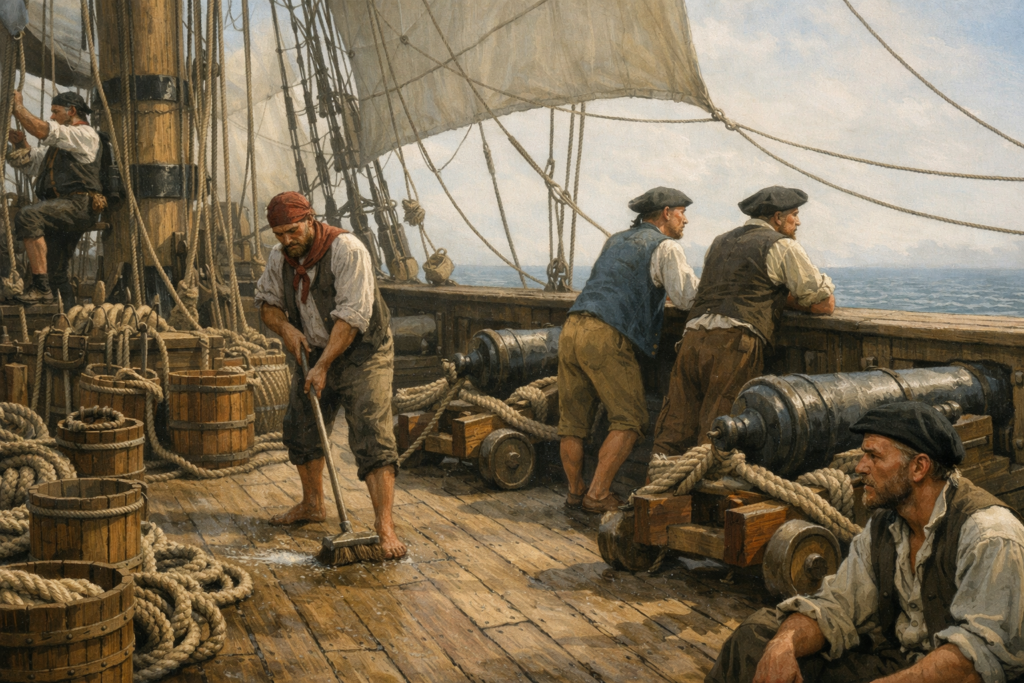
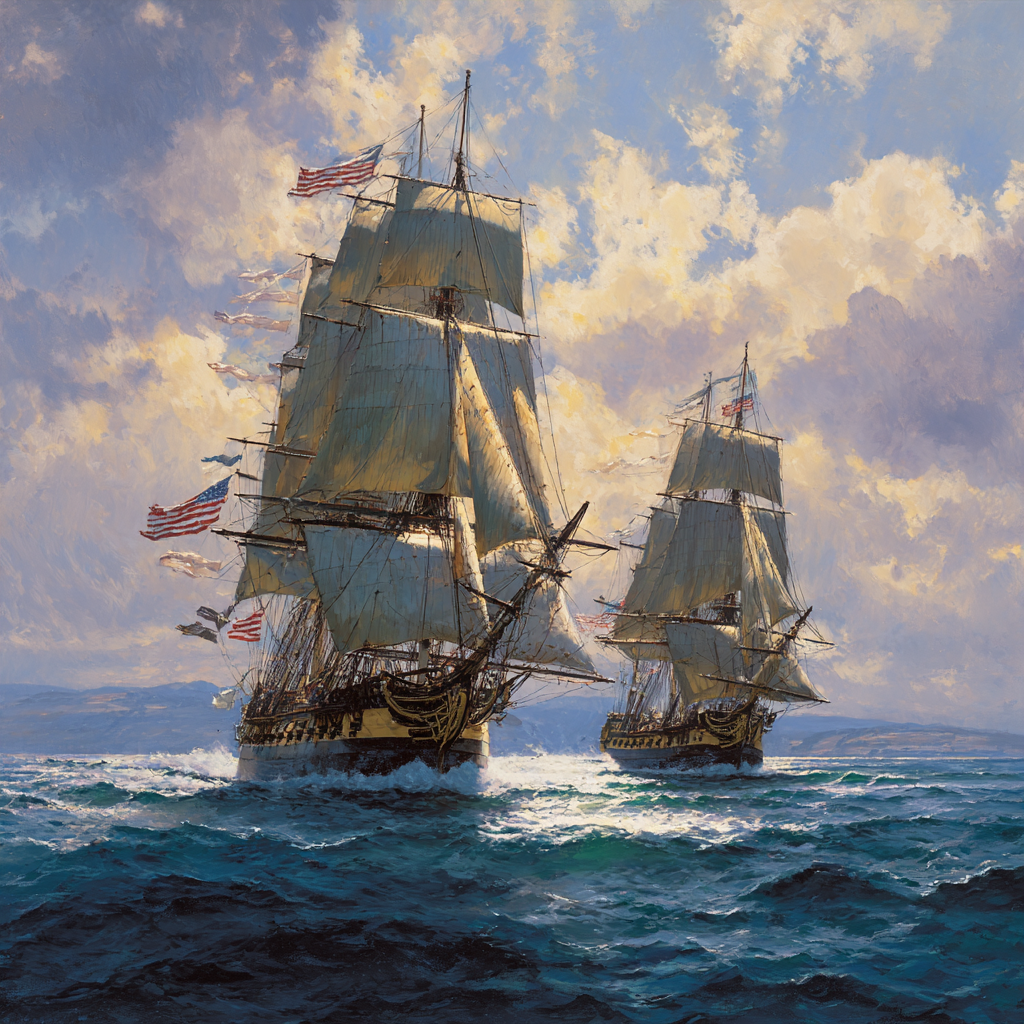
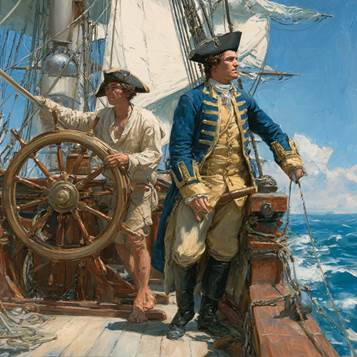
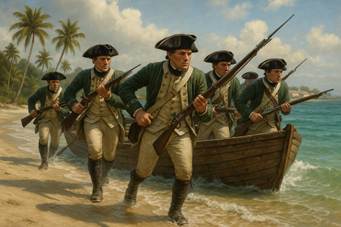
Image generated by author using ChatGPT.

Sources

  • “African Americans in the Revolutionary War,” Wikipedia.
  • Museum of the American Revolution, “Black Patriots and Loyalists” and “Black Founders: Black Soldiers and Sailors in the Revolutionary War.”​
  • Gilder Lehrman Institute, “African American Patriots in the Revolution.”​
  • National Archives blog, “African Americans and the American War for Independence.”​
  • Douglas R. Egerton, Death or Liberty: African Americans and Revolutionary America (individual stories on both Patriot and Loyalist sides).
  • Edward Countryman, The American Revolution.
  • Gary B. Nash, The Forgotten Fifth: African Americans in the Age of Revolution.
  • Alan Gilbert, Black Patriots and Loyalists: Fighting for Emancipation in the War for Independence.​
  • DAR, Forgotten Patriots – African American and American Indian Patriots in the Revolutionary War: A Guide to Service, Sources, and Studies).​
  • NYPL LibGuide, “Black Experience of the American Revolution”
  • American Battlefield Trust, “10 Facts: Black Patriots in the American Revolution.”​
  • Massachusetts Historical Society, “Revolutionary Participation: African Americans in the American Revolution.”
  • Fraunces Tavern Museum, “Enlistment of Freed and Enslaved Blacks in the Continental Army.”​
  • American Independence Museum, “African-American Soldiers’ Service During the Revolutionary War.”​
  • Encyclopedia Virginia, “Lord Dunmore’s Ethiopian Regiment.”​
  • Mount Vernon, “Dunmore’s Proclamation and Black Loyalists” and “The Ethiopian Regiment.”​
  • American Battlefield Trust, “Lord Dunmore’s Ethiopian Regiment”
  • Lord Dunmore’s Proclamation (1775), in transcription with context at Gilder Lehrman, Encyclopedia Virginia, and Mount Vernon.​
  • “Book of Negroes” (1783 evacuation ledger of Black Loyalists to Nova Scotia; digital copies and discussions via BlackPast and Dictionary of Canadian Biography).​
  • Boston King, “Memoirs of the Life of Boston King, a Black Preacher,” Methodist Magazine (1798)
  • NYPL “Black Experience of the American Revolution”
  • 1st Rhode Island Regiment, World History Encyclopedia
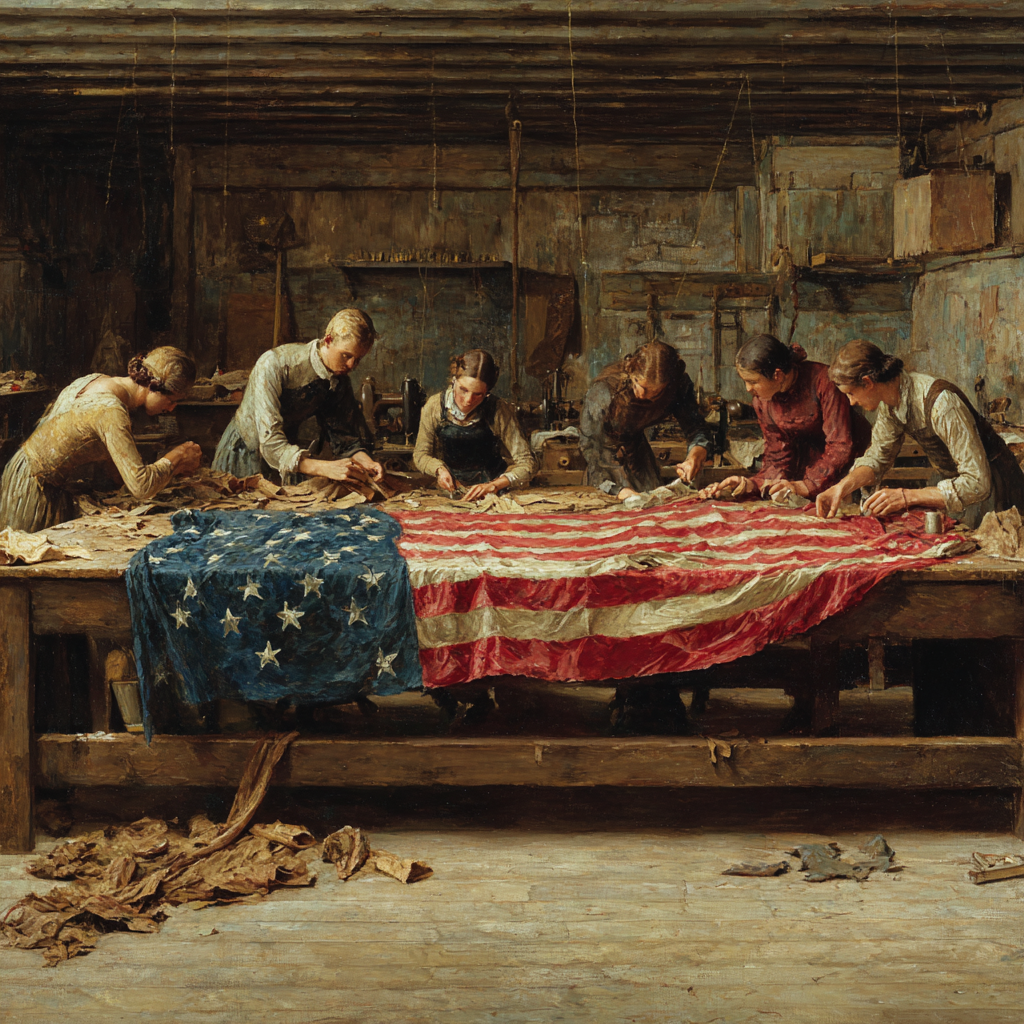
13 Stars, Betsy Ross and the Story of the American Flag

On a steamy June day in 1777, the Continental Congress took a brief break from the monumental task of running a revolution to deal with something that seems surprisingly simple in retrospect: what should the American flag look like? The resolution they passed on June 14th was refreshingly concise, stating that “the flag of the United States be thirteen stripes, alternate red and white; that the union be thirteen stars, white in a blue field, representing a new constellation.”

That poetic phrase about a “new constellation” turned out to be both inspiring and maddeningly vague. Congress didn’t specify how the stars should be arranged, how many points they should have, or even whether the flag should start with a red or white stripe at the top. This ambiguity led to one of the interesting aspects of early American flag history—for decades, no two flags looked exactly alike.

The 1777 resolution came out of Congress’s Marine Committee business, and at least some historians caution that it may have been understood initially as a naval ensign, not a fully standardized “national flag for all uses.”

A Constellation of Designs

The lack of official guidance meant that flag makers exercised considerable artistic freedom. Smithsonian researcher Grace Rogers Cooper found at least 17 different examples of 13-star flags dating from 1779 to around 1796, and flag expert Jeff Bridgman has documented 32 different star arrangements from the era. Some makers arranged the stars in neat rows, others formed them into a single large star, and still others created elaborate patterns that spelled out “U.S.” or formed other symbolic shapes.  An official star pattern would not be specified until 1912 and versions of the 13-star flag remained in ceremonial use until the mid-1800s.

The most famous arrangement, of course, is the Betsy Ross design with its circle of 13 stars. What many people don’t realize is that experts date the earliest known example of this circular pattern to 1792—in a painting by John Trumbull, not on an actual flag from 1776.

Did the Continental Army Actually Use This Flag?

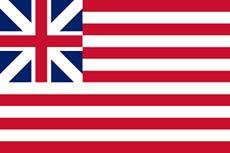
Here’s where things get interesting and a bit murky. The short answer is: not much, and not right away. The Continental Army had been fighting for over two years before Congress even adopted the Stars and Stripes, and by that point, individual regiments had already developed their own distinctive colors and banners. These regimental flags served practical military purposes—they helped units identify each other in the chaos of battle and gave soldiers something to rally around.  Additionally, the Continental Army frequently used the Grand Union Flag (13 stripes with a British Union in the canton), which predates the 13-star design.

What’s more revealing is a series of letters from 1779—two full years after the Flag Resolution—between George Washington and Richard Peters, Secretary of the Board of War. In these letters, Peters is essentially asking Washington what flag he wants the army to use. This correspondence raises an obvious question: if Congress had settled the flag issue in 1777, why was Washington still trying to figure it out in 1779? The evidence suggests that variations of the 13-star flag were primarily used by the Navy in those early years, while the Army continued to use various regimental standards.

Navy Captain John Manley expressed this confusion perfectly when he wrote in 1779 that the United States “had no national colors” and that each ship simply flew whatever flag the captain preferred. Even as late as 1779, the War Board hadn’t settled on a standard design for the Army. When they finally wrote to Washington for his input, they proposed a flag that included a serpent and numbers representing different states—a design that never caught on.

National “stars and stripes” banners did exist during the late war years and appear in some period art and descriptions, but clear, securely dated 13‑star Army battle flags are rare and often disputed.13‑star flags are better documented in early federal service such as maritime and lighthouse use in the 1790s than they are in Continental Army field service before 1783.

The Betsy Ross Question

Now we come to one of America’s most enduring flag legend. The story is familiar to most Americans: in 1776, George Washington, Robert Morris, and George Ross visited Philadelphia upholsterer Betsy Ross and asked her to sew the first American flag. She suggested changing the six-pointed stars to five-pointed ones, demonstrated her one-snip technique for making a perfect five-pointed star, and she then produced the first Stars and Stripes.

It’s a great story. There’s just one problem: historians have found virtually no documentary evidence to support it. The tale didn’t surface publicly until 1870—nearly a century after the supposed event—when Betsy Ross’s grandson, William Canby, presented it in a speech to the Historical Society of Pennsylvania. Canby relied entirely on family oral history, including affidavits from Ross’s daughter, granddaughter, and other relatives who claimed they had heard Betsy tell the story herself. But Canby himself admitted that his search through official records revealed nothing to corroborate the account.

Historians don’t dispute that Betsy Ross was a real person who did real work. Documentary evidence shows that on May 29, 1777, the Pennsylvania State Navy Board paid her a substantial sum for “making ships colours.” She ran a successful upholstery business and continued making flags for the government for more than 50 years. But as historian Marla Miller puts it, “The flag, like the Revolution it represents, was the work of many hands.” Modern scholars generally view the question not as whether Ross designed the flag—she almost certainly didn’t—but whether she may have been among the many people who produced early flags.

Who Really Designed It?

If not Betsy Ross, then who? The strongest candidate is Francis Hopkinson, the New Jersey delegate to the Continental Congress who also helped design the Great Seal of the United States and early American currency. In 1780, Hopkinson sent Congress a bill requesting payment for his design work, specifically mentioning “the flag of the United States of America.”    He likely designed a flag with the stars arranged in rows rather than circles, and his bills for payment submitted to Congress mentioned six-pointed stars rather than the five-pointed ones that became standard.

 Unfortunately for Hopkinson, Congress refused to pay him, arguing that he wasn’t the only person on the Navy Committee and therefore shouldn’t receive singular credit or compensation.

The irony is rich: Hopkinson was asking for a quarter cask of wine or £2,700 for designing what would become one of the world’s most recognizable symbols.  Congress essentially told him, “Thanks, but we’re not paying.” There’s a lesson about government contracts in there somewhere.

What Survived

Of the hundreds of flags made and carried during the Revolutionary War, only about 30 are known to survive today. These rare artifacts offer fascinating glimpses into how Americans visualized their new nation. The Museum of the American Revolution brought together 17 of these original flags in a 2025 exhibition—the largest gathering of such flags since 1783.

The most significant surviving 13-star flag is probably Washington’s Headquarters Standard, a small blue silk flag measuring about two feet by three feet. It features 13 white, six-pointed stars on a blue field and descended through George Washington’s family with the tradition that it marked the General’s presence on the battlefield throughout the war. Experts consider it the earliest surviving 13-star American flag. Due to light damage, it can only be displayed on special occasions.

Other surviving flags tell different stories. The Brandywine Flag, used at the September 1777 battle of the same name, is one of the earliest stars and stripes—the flag is red, with a red and white American flag image in the canton.

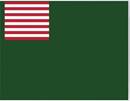
 The Dansey Flag, captured from the Delaware militia by a British soldier, was taken to England as a war trophy and remained in his family until 1927. The flag features a green field with 13 alternating red and white stripes in the upper left corner signifying the 13 colonies.

These and other flags weren’t just military equipment—they were powerful symbols that people fought under and, sometimes, died defending.

The Bigger Picture

What makes the story of the 13-star flag so compelling isn’t really about who sewed it or exactly when it first flew. It’s about what the flag represented in an era when the very concept of the United States was still being invented. The June 1777 resolution called for stars forming “a new constellation”—a beautiful metaphor for a new nation finding its place among the powers of the world.

The fact that no two early flags looked exactly alike might seem like a problem from our standardized modern perspective, but it tells us something important about the Revolution itself. Just as the colonies were learning to act as united states while maintaining their individual identities, flag makers across the new nation were interpreting a simple congressional resolution in their own ways, creating variations on a shared theme.

As historian Laurel Thatcher Ulrich points out, there was no “first flag” worth arguing over. The American flag evolved organically, shaped by the practical needs of the Navy, the Army, militias, and civilian flag makers who each contributed to its development. Whether Betsy Ross made one of those early flags or not, her story endures because it captures something Americans want to believe about our origins: that ordinary citizens, working in small shops and homes, helped create the symbols of the new republic.

Sources:

History.com: https://www.history.com/this-day-in-history/june-14/congress-adopts-the-stars-and-stripes

Flags of the World: https://www.crwflags.com/fotw/flags/us-1777.html

Wikipedia Flag of the United States: https://en.wikipedia.org/wiki/Flag_of_the_United_States

Museum of the American Revolution: https://www.amrevmuseum.org/

American Battlefield Trust: https://www.battlefields.org/learn/articles/short-history-united-states-flag

US History (Betsy Ross): https://www.ushistory.org/betsy/

Library of Congress “Today in History”: https://www.loc.gov/item/today-in-history/june-14/

Flag images from Wikimedia Commons

Life Below Deck: Enlisted Sailors in America’s Continental Navy

When the Continental Congress established America’s first navy in October 1775, they faced a daunting challenge: how do you build a fleet from scratch when you’re fighting the world’s most powerful naval force? The Continental Navy peaked at around 3,000 men serving on approximately 30 ships, a tiny force compared to Britain’s massive Royal Navy. But who were these sailors who were willing to risk their lives for a fledgling republic?

Where They Came From

The colonial maritime community had extensive seafaring experience, as much of British trade was carried in American vessels, and North Americans made up a significant portion of the Royal Navy’s seamen. Continental Navy sailors came primarily from port cities along the Atlantic coast, particularly New England communities where maritime trades were a way of life. Many had worked as merchant sailors, fishermen, or privateers before joining.

The naval service was notably diverse for its time, including native-born Americans, British deserters, free and enslaved Black sailors, and European immigrants. Unlike the Continental Army, which had periods of banning Black soldiers or sometimes placing them in segregated regiments, the Continental Navy was mostly integrated. At sea, there was less distinction between free and enslaved sailors, and those held in bondage had opportunities to work toward freedom. This maritime tradition of relative equality distinguished naval service from other Revolutionary War experiences.

Getting Into the Service

Recruiting sailors proved to be one of the Continental Navy’s biggest headaches. Navy boards supervised appointing petty officers and enlisting seamen, though these duties were chiefly performed by ship commanders or recruiting agents. The first Marine recruiting station was located at Tun’s Tavern, a bar in Philadelphia.

Enlistment was generally voluntary, though the line between volunteering and impressment—forced service—was sometimes blurred. Recruiting parties would scour port towns seeking able-bodied men, advertising not only pay but also the possibility of capturing British prizes for sale, with proceeds shared among the crew—a powerful incentive.

The problem was competition. Privateering—private ships licensed by congress to seize enemy vessels—was far more attractive to sailors because cruises were shorter and pay could be better. With over 2,000 privateers operating during the war, the Continental Navy struggled constantly to maintain adequate crew sizes. Continental captains often found themselves unable to man their ships due to privateers’ superior inducements.

Landsmen, Seamen, and Petty Officers

At the bottom rung of a Navy crew stood the landsman—a recruit with little or no sea experience. Many were farm boys or tradesmen who had never set foot on a ship. Their days were filled with the hardest labor: hauling ropes, scrubbing decks, and learning basic seamanship.

Above them were ordinary seamen, who had some experience afloat, and the more skilled able seamen who knew their way around sails, rigging, and naval gunnery. These sailors formed the backbone of the Continental Navy. Sailors skilled in managing the ship’s rigging were said to “know the ropes.” Without their knowledge of wind, tide, and timber, ships would have been little more than floating platforms.

The most experienced enlisted men were promoted to petty officers. These weren’t commissioned officers but rather specialists and leaders—boatswain’s mates directing rigging crews, gunner’s mates overseeing cannon fire, and carpenters’ mates keeping the wooden hulls afloat. They were the Navy’s “non-commissioned officers,” long before the U.S. Navy had a formal NCO corps.

Most Continental Navy ships also carried detachments of Continental Marines. These enlisted men were soldiers at sea, tasked with keeping order on deck, manning small arms in combat, and leading boarding parties.

What They Wore

Unlike officers who had prescribed uniforms, enlisted sailors received no standard clothing from the Continental Navy. Due to meager funds and lack of manufacturing capacity, sailors generally provided their own clothing, usually consisting of pantaloons often tied at the knee or knee breeches, a jumper or shirt, neckerchief, short waisted jacket, and low crowned hats. Most sailors went barefoot, and a kerchief was worn either as a sweat band or as a simple collar closure. The short trousers served a practical purpose—they didn’t interfere with climbing the ship’s rigging. This lack of uniforms reflected the Continental Navy’s financial struggles, where everything from ships to ammunition took priority over standardized clothing.

Daily Life at Sea

Shipboard duties for enlisted sailors were grueling and dangerous. Landsmen cleaned the deck, helped raise or lower the anchor, worked in the galley, and assisted other crew members. More experienced sailors handled the complex work of managing sails, operating guns during combat, standing watch, and maintaining the vessel. Specialized roles were filled by experienced hands, and most sailors worked long shifts in harsh conditions, often enduring crowded, wet, and unsanitary quarters below deck.

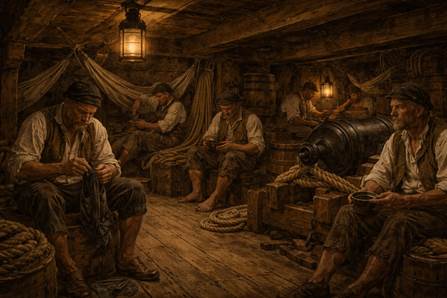
Living conditions were cramped. Sailors lived in close quarters with limited privacy, shared hammocks on the lower decks, and endured monotonous food rations. Meals were simple, based on salted meat, ship’s biscuit, and whatever could be supplemented from local ports or captured prizes. Leisure was rare, and recreation was often limited to singing, storytelling, or gambling. The work was physically demanding and accidents were common—falling from rigging, being crushed by shifting cargo, or drowning were constant risks.

Discipline and Relations with Officers

Discipline in the Continental Navy was deeply influenced by the British Royal Navy and the “ancient common law of the sea.” The Continental Congress issued articles governing naval discipline, empowering officers to maintain strict order and punish infractions including drunkenness, blasphemy, theft, or disobedience. Punishments included wearing a wooden collar, spending time in irons, receiving pay deductions, confinement on bread and water, or, for serious offenses, flogging.

Flogging was often done with a multi-thonged whip known as the cat o’ nine tails. The most common flogging consisted of between 12 and 24 lashes, though mutineers might receive sentences in the hundreds of lashes—often becoming a death sentence.

Even though officers held absolute authority aboard their vessels, the Continental Navy sometimes suffered from severe discipline problems. Some commanders found it impossible to maintain control over squadrons made up of crews recruited from one area and commanded by officers from another. The relationship between officers and enlisted men reflected the social hierarchies of the time, with a clear divide between the educated officer class and working-class sailors. However, the shared dangers of combat and the sea could create bonds that transcended these divisions.

A Brief but Important Legacy

Enlisted sailors of the Continental Navy came from diverse and often hardscrabble backgrounds, shaped by the hard labor and hazards of maritime life. These men, whose names are mostly lost to history, formed the foundation of America’s first navy and contributed profoundly—through sacrifice and service—to the establishment of American independence.

Of approximately 65 vessels that served in the Continental Navy, only 11 survived the war, and by 1785 Congress had disbanded the Navy and sold the remaining ships. Despite its short existence and limited impact on the war’s outcome, the sailors of the Continental Navy created a foundation for American naval tradition and provided trained seamen who would serve in future conflicts.

Sources:

Personal note: The Grumpy Doc proudly served as an enlisted sailor in the U.S. Navy from 1967 to 1974.

“America’s First Fleet: How the Continental Navy Fought for Independence”

The Continental Navy, established during the American Revolution, represented the colonies’ first organized attempt to challenge British naval supremacy. Though vastly outnumbered and outgunned by the Royal Navy, this fledgling force played a crucial role in securing American independence through daring raids, strategic disruption of British supply lines, and pivotal battles that helped turn the tide of war.

Congressional Acts and Political Support

The Continental Navy’s creation stemmed from military necessity rather than long-term naval planning. On October 13, 1775, the Continental Congress passed the first naval legislation, authorizing the fitting out of two vessels to intercept British supply ships carrying munitions to loyalist forces. This modest beginning expanded rapidly when Congress passed additional acts on October 30, 1775, calling for the construction of thirteen frigates and establishing the foundation of American naval power.

The Navy’s primary champions in Congress came from maritime colonies that understood sea power’s importance. John Adams of Massachusetts emerged as the Navy’s most vocal advocate, arguing that naval forces were essential for protecting American commerce and challenging British control of coastal waters. Recognizing that their states’ economic survival depended on maintaining sea access Samuel Chase of Maryland and Christopher Gadsden of South Carolina (designer of the Gadsden Flag) also provided crucial support. Rhode Island’s Stephen Hopkins, whose state had a rich maritime tradition, consistently voted for naval appropriations and expansion.

Opposition came primarily from other southern agricultural colonies that viewed naval expenditures as wasteful diversions from land-based military needs. Virginia’s delegates, despite their state’s extensive coastline, often questioned the wisdom of directly challenging Britain’s naval supremacy. These political divisions reflected deeper disagreements about military strategy and resource allocation during the war.

Ship Acquisition and Fleet Development

The Continental Navy acquired vessels through multiple methods, reflecting the revolution’s improvisational nature. Congress initially authorized the purchase and conversion of merchant ships, transforming trading vessels into warships through the addition of cannons and other military equipment. The frigates Cabot and Andrew Doria began as merchant vessels before receiving naval modifications.

New construction was the Navy’s most ambitious undertaking. The thirteen frigates authorized in 1775 were built in shipyards from New Hampshire to Georgia, spreading construction contracts across multiple colonies to ensure political support and reduce vulnerability to British attacks. These ships, including the Hancock and Randolph—named after prominent patriots to increase support—varied in size from 24 to 32 guns and represented state-of-the-art naval architecture.

Captured British vessels were also added to the fleet. American naval forces seized numerous enemy ships during the war, with some converted to Continental Navy service. The most famous capture occurred when John Paul Jones took HMS Serapis during his epic battle aboard Bonhomme Richard, though ironically, his own ship sank shortly after the victory.

Private vessels operating under letters of marque also supplemented the official navy. These privateers, while not technically part of the Continental Navy, operated under congressional authorization and contributed significantly to disrupting British commerce.  Although, many considered privateers to be little more than questionably legal piracy.

Officer and Sailor Recruitment

Recruiting qualified officers proved challenging for a nation lacking naval traditions. Congress appointed many officers based on political connections and regional representation rather than solely on maritime experience. However, several appointees possessed substantial seafaring backgrounds. John Paul Jones, a Scottish-born merchant captain, brought extensive seafaring experience. Esek Hopkins, the Navy’s first commander-in-chief, had commanded privateers during the French and Indian War.

Other members of the officer corps reflected colonial society’s diversity. Captains came from various backgrounds, including merchant marine service, privateering, and even some Royal Navy officers. Congress attempted to maintain geographic balance in appointments, ensuring that all colonies felt represented in the naval leadership.

Sailor recruitment proved more difficult. The Continental Navy competed with privateers, merchant ships, and the army for manpower. Privateering offered potentially greater financial rewards through prize money, making it difficult to attract sailors to regular naval service. The navy relied on bounties, promises of prize shares, and appeals to patriotism to fill crew rosters. 

Many sailors were drawn from coastal communities with maritime traditions. New England provided the largest contingent, given its extensive fishing and merchant fleets. However, the navy also recruited inland farmers, artisans, and even some former British naval personnel who had deserted or been captured.

The Continental Navy rarely resorted to impressment which was little more than kidnapping, though the few sailors who were impressed were paid and usually were released after completion of a single voyage.

Major Naval Battles and Strategic Impact

The Continental Navy’s most famous engagement occurred on September 23, 1779, when John Paul Jones commanding the Bonhomme Richard fought the HMS Serapis off the English coast. During this brutal three-and-a-half-hour battle the British called upon Jones to surrender and he reportedly replied, “I have not yet begun to fight!” His eventual victory provided a massive morale boost and international recognition of American naval capabilities.

The capture of New Providence in the Bahamas during March 1776 marked the navy’s first major operation. Esek Hopkins led a fleet of eight vessels in this successful raid, seizing gunpowder and military supplies desperately needed by Washington’s army. This victory demonstrated the navy’s potential for strategic operations beyond American coastal waters.

Naval battles along the American coast proved equally significant. The Delaware River battles of 1777 saw Continental Navy vessels attempting to prevent British naval forces from supporting the occupation of Philadelphia. Though ultimately unsuccessful, these engagements delayed British operations and demonstrated American willingness to contest enemy naval movements.

The most strategically important naval operations involved disrupting British supply lines and commerce. Continental Navy vessels captured hundreds of British merchant ships, depriving the enemy of supplies while providing America with desperately needed materials. These operations forced Britain to divert warships from other duties to provide convoy protection, reducing pressure on American forces ashore.

The Continental Navy also operated in partnership with French forces after the 1778 alliance. Joint operations extended American reach and contributed to key turning points in the war. French naval victories, especially at the Battle of the Chesapeake in 1781, indirectly sealed the fate of Cornwallis’s army at Yorktown by cutting off British reinforcements. Although this victory was French, it fulfilled the strategic vision the Continental Congress had first imagined in 1775—a sea power capable of shaping the war’s outcome.

Great Lakes Naval Operations

During the Revolution, both sides recognized the Great Lakes’ strategic importance for controlling the northwestern frontier. The British maintained naval superiority on these waters through their base at Detroit and control of key shipbuilding facilities. American forces attempted to challenge this dominance through the construction of small naval vessels on Lake Champlain and other waterways.

The most significant Revolutionary War naval action on inland waters occurred on Lake Champlain in October 1776. Benedict Arnold, commanding a small American fleet built on site, engaged a superior British force in a desperate delaying action. Though Arnold’s fleet was largely destroyed, the battle forced the British to postpone their invasion plans until the following year, providing crucial time for Americans to consolidate defenses and contributing to the American victory at Saratoga.

Trials and Transformations

Despite its courage, the Continental Navy faced constant hardship. Its ships were outgunned, its officers underpaid, and its crews plagued by desertion and disease. Many vessels were captured or scuttled to avoid seizure. The Alfred, the Navy’s first flagship, was taken by the British in 1778; others, like the Reprisal and Lexington, were lost at sea.

After the Treaty of Paris (1783), Congress was burdened by debt and saw no need for a standing blue-water navy. The last remaining ship, USS Alliance, was sold on August 1, 1785, marking the formal end of the Continental Navy, two years after the Revolutionary War ended.

It was not long before increasing attacks on American merchant ships by Barbary corsairs pushed Congress to pass the 1794 Naval Act, authorizing construction of six frigates. This was the first step in rebuilding the naval force, though it wasn’t yet a fully independent service.

On April 30, 1798, Congress created the Department of the Navy, taking naval affairs out of the War Department and officially re-establishing the United States Navy as a separate, permanent institution.

Legacy and Impact on Revolutionary Success

The Continental Navy’s impact on the Revolutionary War extended far beyond what its modest size might suggest. By challenging British naval supremacy, even unsuccessfully at times, the Continental Navy forced Britain to maintain large fleet deployments in American waters, reducing British naval availability for operations elsewhere and increasing the war’s cost.

More importantly, Continental Navy operations helped secure the French alliance that proved decisive in achieving independence. French officials were impressed by American naval courage and potential, viewing the Navy as evidence of serious commitment to independence. Naval victories like Jones’s triumph over HMS Serapis provided powerful propaganda tools for American diplomats seeking European support.

The Continental Navy also established important precedents for American naval development. The officer corps trained during the Revolution provided leadership for subsequent naval expansion. Naval yards and facilities developed during the war became foundations for future fleet construction.

Despite its relatively small size and limited resources, the Continental Navy demonstrated that determined naval forces could challenge even the world’s most powerful fleet. Through courage, innovation, and strategic thinking, America’s first navy helped secure the independence that made possible the nation’s eventual emergence as a global naval power. The lessons learned and traditions established during these formative years continued to influence American naval development long after the Revolution’s end.

Military Purges and Democratic Stability: Why History Still Matters

When political power is on the line, history shows that the military often becomes the make-or-break institution. Authoritarian leaders—from Hitler to Erdogan—have long understood that a professional military answers to the state, not to any one person. That independence can be inconvenient for leaders who want fewer limits to their power. So, the classic move is simple: replace seasoned, independent officers with people whose primary loyalty is personal rather than constitutional.

This isn’t speculation; it’s a familiar historical pattern.

How Authoritarians Reshape Militaries

Professional militaries promote based on experience, training, and merit. They’re built to resist illegal orders and to stay out of domestic politics. For an authoritarian-leaning leader, military professionalism is a potential obstacle. Purges serve a purpose: clear out officers who take institutional norms seriously, and elevate those who won’t push back.

Two cases illustrate how this works.

Hitler and the German Army

After consolidating political power, Hitler moved aggressively to dominate the military. In 1934, the army was pressured to swear a personal oath of loyalty to him—not to the state or constitution.

By 1938 he removed two top commanders, Werner von Blomberg and Werner von Fritsch, through trumped-up scandals after they questioned his rush toward war. Dozens of senior generals were pushed out soon after.

The goal was not efficiency—it was control.

Turkey After the 2016 Coup Attempt

Following the failed coup, President Erdogan launched the largest purge in modern Turkish history. Tens of thousands across the military, police, and judiciary were arrested or fired, including nearly half of Turkey’s generals.

Later reporting showed that many dismissed officers had no link to the coup at all; they were targeted for being politically unreliable or pro-Western.

These cases differ in scale and context, but the pattern is strikingly similar: the professional military is reshaped to serve the leader.

What Healthy Civil–Military Relations Look Like

In stable democracies, civilian leaders set policy, but the military retains professional autonomy. Officers swear loyalty to the constitution. Promotions are merit-based. And there’s a bright line between national service and political allegiance.

One important safeguard: every member of the U.S. military is obligated to refuse unlawful orders and swears an oath to do so. It’s not optional—it’s core to American military ethics.

Research consistently shows that professional, apolitical militaries strengthen democracies, while politically entangled militaries make coups and repression more likely.

The Current U.S. Debate

Since early 2025, Defense Secretary Pete Hegseth’s removal or sidelining of more than two dozen generals and admirals has raised alarms within the military and among lawmakers. It includes the unprecedented firing of a sitting Chairman of the Joint Chiefs of Staff and significant cuts to senior officer billets.

Hegseth has framed these moves as reforms—streamlining, eliminating “woke politicization,” and aligning leadership with the administration’s national-security priorities.

Many inside the services describe the environment as unpredictable and politically charged. Officers report confusion about why certain leaders are removed and others promoted, and some say the secretary’s rhetoric has alienated the very institution he’s trying to lead. Public reporting describes an “atmosphere of uncertainty and fear” inside the officer corps.

Similarities and Differences to Classic Purges

Where patterns overlap

  • Large-scale personnel changes in a short time
  • Emphasis on loyalty to a person rather than institutional norms
  • Limited transparency in the selection and removal process
  • Signals that dissent or disagreement are disqualifying

Where the U.S. still differs

  • Congress can investigate and slow actions
  • Courts remain independent (for now)
  • Officers swear loyalty to the Constitution, not the president
  • No arrests, detentions, or manufactured scandals
  • The press is free to report and criticize

Why This Matters

Institutional Readiness

Purges can weaken the military by removing seasoned leaders and creating gaps in institutional memory.

Professionalism

If officers think advancement depends on political alignment instead of performance, the talent pipeline changes. Some of the best people simply leave.

Civil–Military Trust

The relationship between elected leaders and the military rests on mutual respect. Reports of intimidation or political litmus tests damage that trust.

Democratic Stability

Democracies depend on militaries that stay out of politics. History shows that once political loyalty becomes the main metric for advancement, the slope toward politicization—and eventually erosion of democratic norms—gets much steeper.

The Real Question

It’s not whether current events equal Turkey in 2016 or Germany in 1938. They don’t.

The real question is much simpler:

Will we maintain a military that is professional, apolitical, and loyal to the Constitution—or move toward a military where career survival depends on political loyalty?

That direction matters far more than any single personnel decision.

Bottom Line

History shows that authoritarianism doesn’t arrive all at once; it arrives incrementally. One of the clearest patterns is reshaping the military to reward personal loyalty over constitutional loyalty.

The United States still has strong guardrails: congressional oversight, rule of law, open media, and a military culture steeped in constitutional commitment. But those guardrails only work if they’re maintained—by political leaders, by officers, and by citizens paying attention.  Many are concerned that the deployment of military forces in American cities and their use to destroy purported drug traffickers is a way to acclimate senior officers to following questionable orders.

Watching these trends isn’t alarmist. It’s simply responsible.  It’s our duty as citizens

250 Years Strong!

The Continental Marines: Birth of America’s Amphibious Warriors

When most people think of the American Revolution, they picture Continental soldiers marching across snowy battlefields or patriot militias defending their homes. But there’s another group that played a crucial role in securing American independence: the Continental Marines. These amphibious warriors served in America’s nascent naval force and proved their worth on both land and sea during the eight-year struggle for independence.

The Continental Marines, established in 1775, served as America’s first organized marine force during the Revolutionary War before being disbanded in 1783, laying the foundation for what would eventually become the modern U.S. Marine Corps.  Though short-lived, the original Marine Corps played a significant role in America’s fight for independence, setting precedents that the modern Marine Corps still honors today.

The Legislative Foundation

By the fall of 1775, the American colonies were no longer engaged in mere protest—they were in open rebellion against the British Empire. Battles had already been fought at Lexington, Concord, and Bunker Hill. The Continental Congress, led by figures like John Adams, had begun to organize a Continental Army under George Washington’s command. But many in the Congress, especially Adams, believed a navy was also essential to challenge British power at sea and disrupt its supply lines.

With a navy, it was reasoned, must come Marines—soldiers trained to serve aboard ships, conduct landings, enforce discipline, and fight in close quarters during boarding actions. This model was based on the British Royal Marines, a corps with a long and respected tradition.

The Continental Marines came into existence through a resolution passed by the Second Continental Congress on November 10, 1775. This date, which Marines still celebrate today as their birthday, marked a pivotal moment in American military history.

The Continental Marine Act of 1775 decreed: “That two battalions of Marines be raised consisting of one Colonel, two lieutenant-colonels, two majors and other officers, as usual in other regiments; that they consist of an equal number of privates as with other battalions, that particular care be taken that no persons be appointed to offices, or enlisted into said battalions, but such as are good seamen, or so acquainted with maritime affairs as to be able to serve for and during the present war with Great Britain and the Colonies.”

The legislation was part of Congress’s broader effort to create a Continental Navy capable of challenging British naval supremacy. The resolution was drafted by future U.S. president John Adams and adopted in Philadelphia. This wasn’t just about creating another military unit—Congress recognized that naval warfare required specialized troops who could fight effectively both on ships and on shore. The concept wasn’t entirely new—European navies had long employed marines for similar purposes—but the Continental Marines represented America’s first organized attempt to create a professional amphibious force, though the term amphibious didn’t come into use in a military setting until the 1930s—they would likely have been informally referred to as a naval landing force.

Recruitment: From Taverns to the Fleet

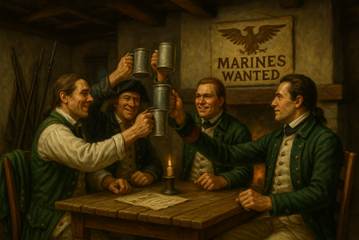
The recruitment of the Continental Marines has become the stuff of legend, particularly the story of their traditional birthplace at Tun Tavern in Philadelphia. Though legend places its first recruiting post at Tun Tavern, historian Edwin Simmons surmises that it may as likely have been the Conestoga Waggon [sic], a tavern owned by the Nicholas family. Regardless of which tavern served as the primary recruiting station, the Marines can claim the unique distinction of being the only military branch “born in a bar”.

The first Commandant of the Marine Corps was Captain Samuel Nicholas, and his first Captain and recruiter was Robert Mullan, the owner of Tun Tavern. Samuel Nicholas, a Quaker-born Philadelphia native and experience mariner, was commissioned on November 28, 1775, becoming the Continental Marines’ senior officer and only commandant throughout their existence. While his background as a Philadelphia tavern keeper may seem unusual for a military leader, his connections in the maritime community proved invaluable for recruiting. The requirement for maritime experience shaped the character of the force from its inception.

The Marines faced immediate recruitment challenges. Originally, Congress envisioned using the Marines for a planned invasion of Nova Scotia.  They expected the Marines to draw personnel from George Washington’s Continental Army.  However, Washington was reluctant to part with his soldiers, forcing the Marines to recruit independently, primarily from the maritime communities of Philadelphia and New York.

By December 1775, Nicholas had raised a battalion of approximately 300 men, organized into five companies, though this fell short of the original plan for two full battalions. Robert Mullan, helped to assemble the fledgling fighting force. Plans to form the second battalion were suspended indefinitely after several British regiments-of-foot and cavalry landed in Nova Scotia, making the planned naval assault impossible.

Organization for Dual Service

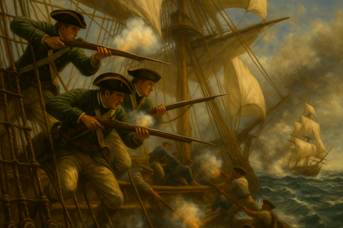
The Continental Marines were organized as a flexible force capable of serving both aboard ships and on land. For shipboard service, Marines were organized into small detachments that could be distributed across the Continental Navy’s vessels. Their organization reflected their multi-purpose mission: they served as security forces protecting ship officers, repelling boarders and joining boarding parties during naval engagements, and as assault troops for amphibious operations. Marksmanship received particular emphasis—a tradition that continues to this day—as Marines often served as sharpshooters in naval engagements, targeting enemy officers and sailors from the rigging and fighting tops of ships.

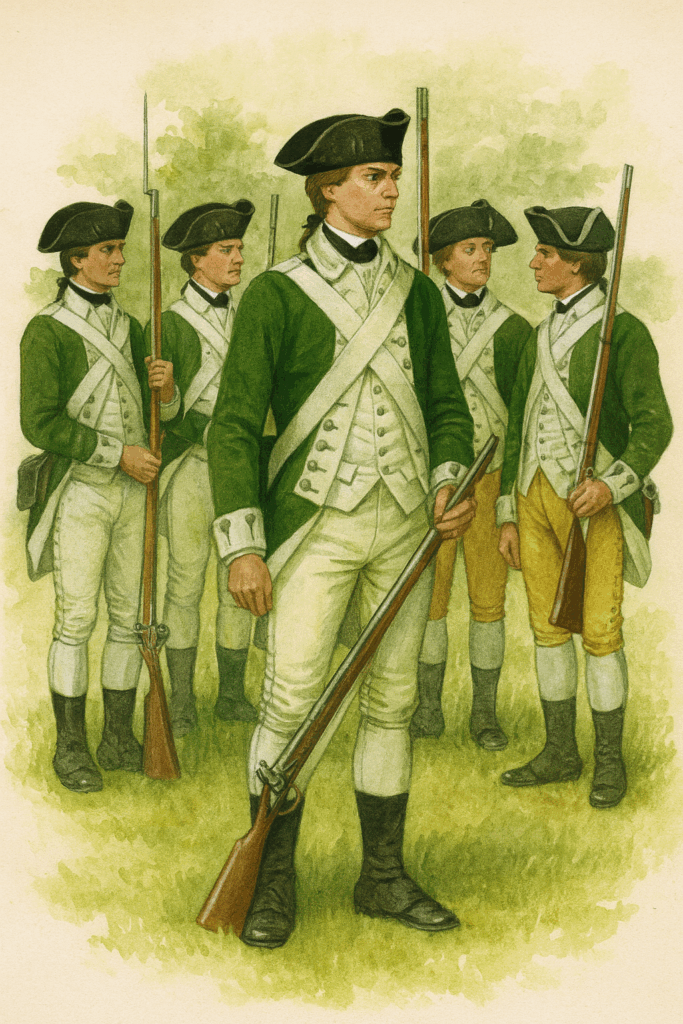
During the Revolutionary War, the Continental Marines uniform directives specified a green jacket with white facings and cuffs.   However, when the first sets of uniforms were actually ordered and delivered, red facings were substituted for white. The likely reason was supply availability: red cloth was easier to obtain from Continental or captured British stores. The most authoritative description comes from Captain Samuel Nicholas, who wrote from Philadelphia in 1776 that Marines were outfitted in “green coats faced with red, and lined with white”

The uniform also included a high leather collar, or stock, to ostensibly protect the neck against sword slashes, although there is some evidence that may actually have been intended to improve posture. This distinctive uniform item helped establish their identity as an elite force and eventually lead to their treasured nickname “leathernecks”.

Shipboard Service and Naval Operations

The Continental Marines’ role aboard ship was multifaceted and crucial to naval operations. Their most important duty was to serve as onboard security forces, protecting the captain of a ship and his officers. During naval engagements, in addition to manning the cannons along with the crew of the ship, Marine sharp shooters were stationed in the fighting tops of a ship’s masts specifically to shoot the opponent’s officers and crew. These duties reflected centuries of naval tradition and drew on the example of the British Marines.

The Marines’ first major naval operation came in early 1776 when five companies joined Commodore Esek Hopkins’ Continental Navy  squadron, on its first cruise in the Caribbean. This deployment demonstrated their value as both shipboard security and assault troops, setting the pattern for their service throughout the war.

Major Land-Based Actions

Despite their naval origins, the Continental Marines proved equally effective in land combat. Their most famous early action was the landing at Nassau on the Island of New Providence in the Bahamas in March 1776. The landing was the first by Marines on a hostile shore.  It was led by Captain Nicholas and consisted of 250 marines and sailors. After 13 Days the Marines had captured two forts, the Government House, occupied Nassau and captured cannons and large stores of supplies. While they missed capturing the gunpowder stores (which had been evacuated before their arrival), the raid demonstrated American capability to strike British positions anywhere.

Though modest in scale, this operation had a major symbolic weight and established the Marines as America’s premier amphibious force. The operation did not decisively alter the balance of the war, but it foreshadowed the Marines’ enduring identity as a seafaring, expeditionary force. Today, the Battle of Nassau is remembered less for the supplies seized than for what it represented: the moment the Continental Marines stepped onto the world stage.

Other notable operations included raids on British soil itself. In April of 1778, Marines under the command of John Paul Jones made two daring raids, one at the port of Whitehaven, in northwest England, and the second later that day at St. Mary’s Isle. These operations brought the war directly to British territory, demonstrating American reach and resolve.  While the battles had no strategic impact on the outcome of the war, they were a great moral booster when reports, though largely exaggerated, reached the rebellious colonies

Official Marine Corps history also acknowledges Marine participation in the Battle of Princeton, though it wasn’t a major Marine engagement. Marines from Captain William Shippen’s company, who had been serving aboard Continental Navy ships, participated in this battle as a part of Cadwalader’s Brigade on Washington’s flank.  Some Marines were detached to augment the artillery, with a few eventually transferring to the army.  However, the Marines’ role was relatively minor compared to their more significant naval actions during this period.

The Gradual Decline

As the Revolutionary War progressed, the Continental Marines faced increasing challenges. Financial constraints plagued the Continental forces throughout the war, and the Marines were no exception. The Continental Congress struggled to fund and supply all military branches, and the relatively small Marine force often found itself at a disadvantage competing for resources with the larger Continental Army and Navy.

Recruitment became increasingly difficult as the war dragged on. After the early campaigns, Nicholas’s four-company battalion discontinued independent service, and remaining Marines were reassigned to shipboard detachments.  Their number had been reduced by transfers, desertion, and the loss of eighty Marines through disease.

The Continental Navy also faced severe challenges that directly impacted the Marines. Many ships were captured, destroyed, or sold, leaving Marines without their primary operational platform. As the naval war shifted toward privateering and smaller-scale operations, the need for organized Marine units diminished.

Beginning in February 1777 two companies of Marines either transferred to Morristown to assume the roles in the Continental artillery batteries or left the service altogether. This transfer of Marines to army artillery units reflected the practical reality that their specialized skills were needed elsewhere as the Continental forces adapted to changing circumstances.

Disbanded at War’s End

The end of the Revolutionary War marked the end of the Continental Marines as an organized force. Both the Continental Navy and Marines were disbanded in April 1783. Although a few individual Marines briefly stayed on to provide security for the remaining U.S. Navy vessels, the last Continental Marine was discharged in September 1783.

The last official act of the Continental Marines was escorting a stash of French Silver Crowns (coins) from Boston to Philadelphia—a loan from Louis XVI to establish of the Bank of North America. This final mission, conducted in 1781, symbolically linked the Marines to the new nation’s financial foundations even as their military role ended.

The disbanding reflected broader American attitudes toward standing military forces. Having won their independence, Americans were skeptical of maintaining large military establishments that might threaten republican government. The Continental Congress, facing financial pressures and political opposition to permanent military forces, chose to disband both the Navy and Marines.

Legacy

The Continental Marines’ contribution to American independence was significant despite their small numbers. In all, over the course of 7 years of battle, the Continental Marines had only 49 men killed and just 70 more wounded, out of a total force of roughly 130 Marine Officers and 2,000 enlisted. These relatively low casualty figures reflected both their effectiveness and the limited size of the force.

Rising tensions with Revolutionary France in the late 1790s led to the Quasi-War, prompting Congress to reestablish the Navy in 1798. On July 11 of that year, President John Adams signed legislation formally creating the United States Marine Corps as a permanent branch of the military, under the jurisdiction of the Department of the Navy. This new Marine Corps inherited the traditions, mission, and esprit de corps of its Revolutionary War predecessors.  Despite the gap between the disbanding of the Continental Marines and the establishment of the new United States Marine Corps, Marines honor November 10, 1775, as the official founding date of their Corps.

The Continental Marines established precedents that would shape American military doctrine for more than two centuries. The Revolutionary War not only led to the founding of the United States (Continental) Marine Corps but also highlighted for the first time the versatility for which Marines have come to be known. They fought on land, they fought at sea on ships, and they performed amphibious assaults.

The Continental Marines represented a crucial innovation in American military organization. Born from congressional resolution and tavern recruitment, these maritime warriors proved their worth in battles from the Caribbean to the British Isles. Though disbanded with the war’s end, their legacy lives on in the traditions and spirit of the modern Marine Corps. While their numbers were small and their existence brief, their impact on American military tradition proved lasting and significant.

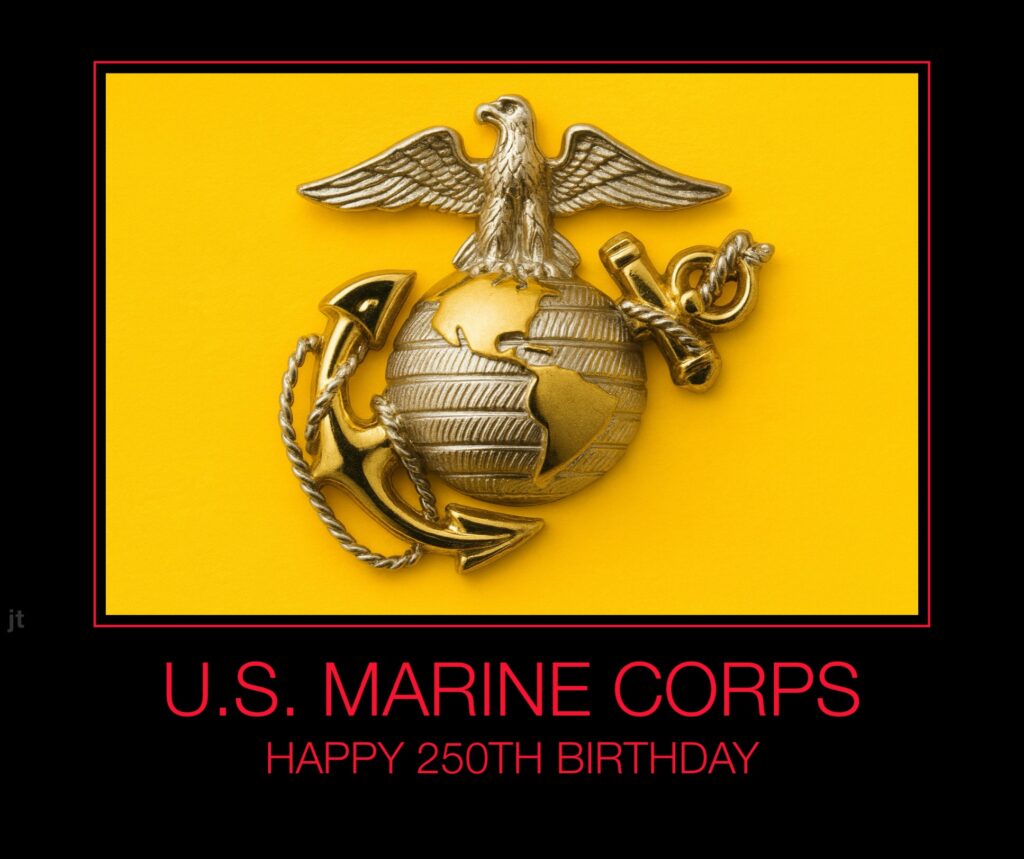
The Eagle, Globe, and Anchor

How the Marine Corps Found Its Symbol

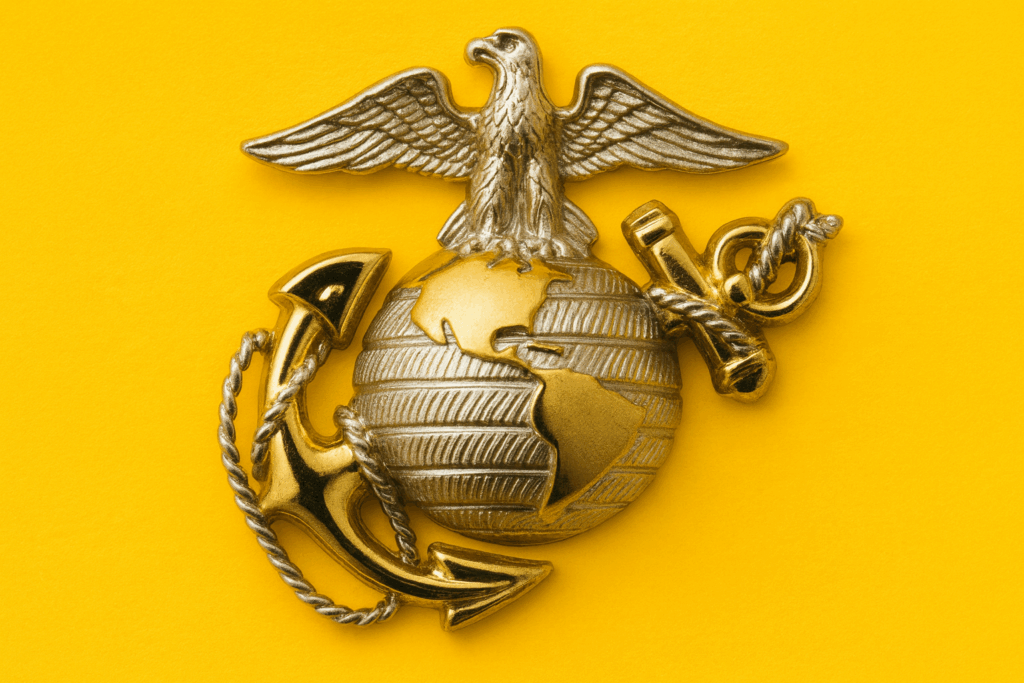
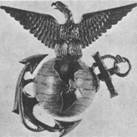
Few military emblems carry as much history and pride as the Marine Corps’ Eagle, Globe, and Anchor, better known as the EGA or simply as the emblem. New recruits and officer candidates work intensely to earn the right to wear this symbol. It is a source of immense pride for every Marine who achieves that distinction.

When entering the Corps, I encountered World War II veterans who affectionately called the EGA the “Birdie on the Ball.” But only Marines can take such liberties—outsiders risk offense if they use the term.

The emblem is instantly recognizable, yet few realize its deep historical roots or appreciate the transformations it has undergone to become the symbol every Marine wears today.

From Anchors to Eagles: The Early Years (1776–1868)

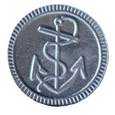
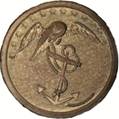
At its inception in 1776, the Continental Marines lacked any formal insignia. Some Marines, predominantly officers, adopted maritime icons such as the fouled anchor—an anchor entwined with rope—often emblazoned on buttons or hat plates. This design echoed the British Royal Navy and underscored their naval identity, but it was never standardized.

Uniform innovations began in the early 1800s. By 1804, Marines were using brass eagles mounted on square plates. During the War of 1812, octagonal plates appeared, embossed with eagles, anchors, drums, shields, and flags. Later designs were simplified to feature metal letters “U.S.M.” (United States Marines), reflecting the shift towards a national identity.

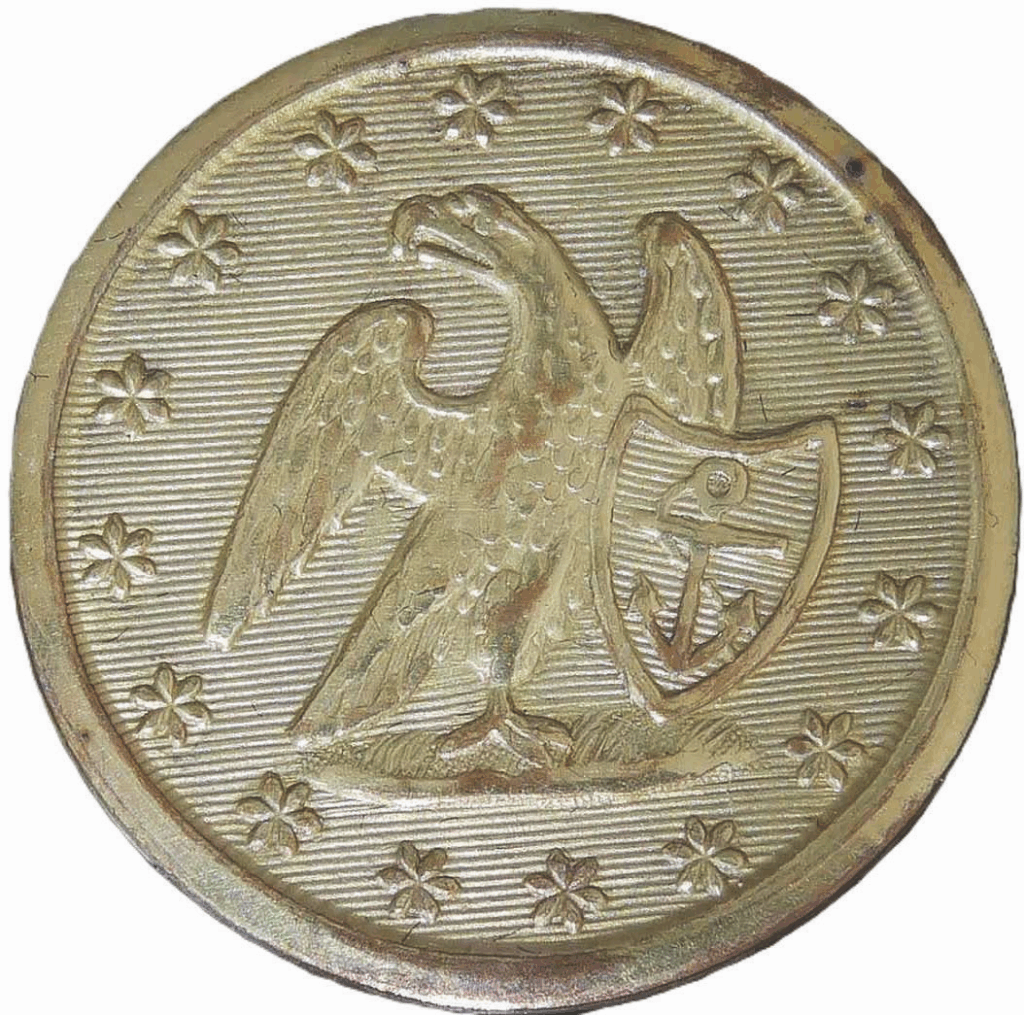
The example below is an officer’s coat button circa 1805-1820.

A more distinctive step came in 1821: the Corps adopted an eagle perched on a fouled anchor encircled by 13 stars, a motif featured on buttons for nearly four decades. However, similar symbols were also used by the Army and Navy, making it less than unique.

Following the Civil War, Marine Corps leadership under Brigadier General Jacob Zeilin, the seventh Commandant, sought a truly unique insignia for the service.

The Zeilin Board and the Birth of the Modern EGA (1868)

On November 12, 1868, Zeilin established a board of officers “To decide and report upon the various devices of cap ornaments of the Marine Corps.” They wasted no time: by November 19, the Secretary of the Navy, Gideon Welles, had approved the new emblem.

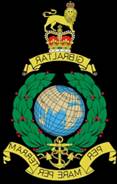
The board drew inspiration from the British Royal Marines’ “Globe and Laurel” emblem.

The American version added a few important touches:

  • Globe showing the Western Hemisphere: Representing the Corps’ defense of the Americas and a global presence.
  • Fouled anchor: Honoring the Corps’ naval origins.
  • Eagle: Symbolizing national service and pride.

Zeilin described the new emblem as representing the Corps’ “readiness to serve anywhere, by sea or land.”

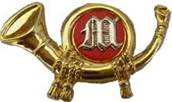
At the same time, a distinct emblem was also created for Marine Corps musicians, still seen today on the formal red and gold uniforms of the U.S. Marine Band—“The President’s Own”.

The Motto and Later Refinements

The Latin motto, Semper Fidelis (“Always Faithful”), was introduced in 1883 under Commandant Charles McCawley, replacing previous mottoes such as Fortitudine (“With Fortitude”). Semper Fidelis became central to the Marine Corps’ ethos.

The emblem saw many variations over the decades. Initial designs featured a crested eagle—borrowed from European heraldry. Semper Fidelis appeared on a scroll held in the eagle’s beak on some versions of the emblem.

Only in 1954, with President Dwight D. Eisenhower’s Executive Order 10538, did the American bald eagle with a scroll officially become part of the emblem. This finalized the design used today.

Officer and Enlisted Differences

Since 1868, design distinctions have marked officer and enlisted EGA emblems. Officers’ original emblems were elaborate—frosted silver hemispheres with gold-plated Americas, crowned by a solid silver eagle. Enlisted emblems were brass, emphasizing practicality.

Modern officers wear a multi-piece, high-relief insignia with fine rope detailing, while enlisted Marines use a one-piece emblem. Notably, officers’ globes omit Cuba to strengthen the emblem structurally.  A running joke among enlisted personnel is that officers couldn’t find Cuba on a map.

Before WWII, officers often purchased insignia from jewelers like Bailey, Banks & Biddle, resulting in stylistic inconsistency. One museum curator quipped, “World War I eagles looked like fat turkeys.” Eventually, standardization brought the crisp, clean look seen today.

A Legacy That Endures

From 18th-century anchors to the refined Eagle, Globe, and Anchor of today, the emblem tracks the Corps’ evolution from shipboard security to a global expeditionary force. Over centuries, its form has varied—engraved by jewelers, stamped for wartime, and cast in silver for dress blues—but its meaning remains constant.

Every Marine who earns the EGA joins a tradition stretching back 250 years, defined by courage, loyalty, and the enduring promise to remain Always Faithful.

The Real Enemy of the Revolution: Disease

When you think about the American Revolution, you probably picture dramatic battles like Bunker Hill or the crossing of the Delaware. But here’s something that might surprise you: the biggest killer during the war wasn’t British muskets—it was disease. And it’s not even close.

The Numbers Tell a Grim Story

Let’s talk numbers for a second. On the American side, about 6,800 soldiers died from battlefield wounds. Sounds terrible, right? Well, disease killed an estimated 17,000 to 20,000. That’s roughly three times as many. The British and their Hessian allies faced similar odds: around 7,000 combat deaths versus 15,000 to 25,000 disease deaths.

Think about that for a moment. You were actually safer charging into battle than hanging around camp. In some regiments, disease wiped out more than a third of the troops before they even saw their first fight.

Why Was Disease So Deadly?

Picture yourself in a Revolutionary War military camp. Hundreds of men crammed together in makeshift shelters, no running water, primitive latrines dug too close to where everyone lives, and basically zero understanding of what we’d call “germ theory” today. It’s a perfect storm for infectious disease.

The big killers were:

Smallpox was the heavyweight champion of camp diseases. This virus killed about 30% of people it infected and spread like wildfire through packed military camps. Soldiers tried to protect themselves through a risky practice called inoculation—basically giving themselves a mild case of smallpox on purpose by rubbing infected pus into cuts on their skin. Without proper quarantine procedures, though, this sometimes made outbreaks worse instead of better.

Typhus (called “camp fever” back then) spread through lice and fleas. If you’ve ever been to a prolonged camping trip and felt gross after a few days, imagine that times a hundred. Soldiers lived in the same clothes for weeks, rarely bathed, and the parasites just had a field day. The fever, headaches, and diarrhea that came with typhus made it one of the most dreaded camp diseases.

Dysentery (charmingly nicknamed “bloody flux”) came from contaminated water and poor sanitation. When your latrine is 20 feet from your water source and you don’t understand how disease spreads, this becomes pretty much inevitable. The severe diarrhea weakened soldiers to the point where many couldn’t fight even if they wanted to and it made them even more susceptible to other diseases.

Malaria was especially important in the South, where mosquitoes thrived in the humid climate. This one actually played a fascinating role in how the war ended—but more on that in a bit.

When Disease Changed Everything

The 1776 invasion of Canada was a disaster largely because of smallpox. Out of 3,200 American soldiers in the Quebec campaign, 1,200 fell sick. You can’t mount much of an offensive when more than a third of your army is flat on their backs with fever. Similarly, during the siege of Boston, Washington couldn’t effectively engage the British because so many of his troops were sick with smallpox. These weren’t just setbacks—they were strategic catastrophes.

This is what pushed George Washington to make one of his boldest decisions in 1777: he ordered a mass inoculation of the Continental Army. This was controversial and dangerous at the time, but it worked. Washington had survived smallpox himself as a young man, so he understood both the risks and the benefits. The inoculation program probably saved the army from complete collapse.

Medical “Treatment” Was Often Worse Than Nothing

Here’s where things get really grim. Eighteenth-century medicine was basically medieval. Doctors believed in “balancing the humors” through bloodletting—literally draining blood from already weakened soldiers. They also gave powerful laxatives to people who were already suffering from diarrhea. Yeah, let that sink in.

Pain relief meant opium-based drinks or just straight alcohol. Some doctors used herbal remedies, but results were inconsistent at best. Quinine helped with malaria, though nobody really understood why. Mostly, if you got seriously sick, your survival came down to luck and a strong constitution.

Valley Forge: The Turning Point

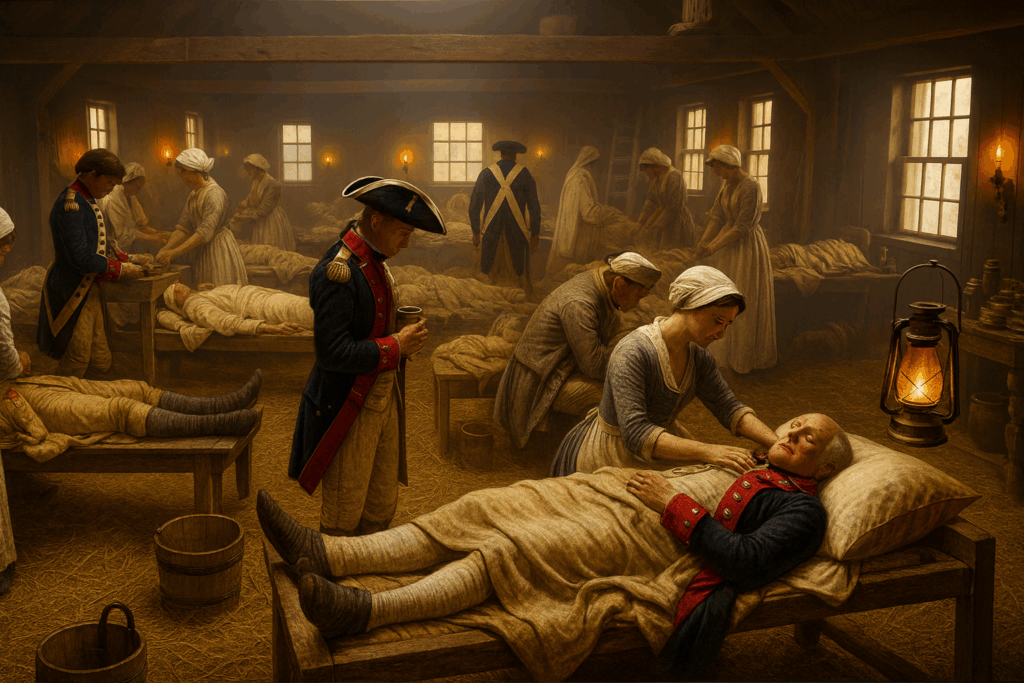
Valley Forge is famous for being a brutal winter encampment, and disease was a huge part of why it was so terrible. Scabies left nearly half the troops unable to serve. Dysentery and camp fever killed somewhere between 1,700 and 2,000 soldiers during that single winter—and remember, these weren’t battle casualties. These men died from preventable diseases in what was supposed to be a safe encampment.

But Valley Forge taught the Continental Army a crucial lesson. After that nightmare winter, military leaders started taking sanitation seriously. They began focusing on camp hygiene, protecting water supplies, placing latrines away from living areas, and making sure soldiers could bathe and wash their clothes and bedding.

Baron von Steuben is famous for teaching the Continental Army how to march and drill, but he also deserves credit for implementing serious sanitation reforms. These changes helped prevent future disease outbreaks and kept the army functional for the rest of the war.

The Secret Weapon at Yorktown

Here’s one of my favorite historical details: mosquitoes may have helped win American independence. At Yorktown, roughly 30% of Cornwallis’s British army was knocked out by malaria and other diseases during the siege. The British commander was trying to hold off the American and French forces while also dealing with the fact that almost a third of his troops were too sick to fight.

Many American soldiers from the southern colonies had grown up with malaria and had some partial immunity. The British? Not so much. Some historians even think Cornwallis himself might have been suffering from malaria, which could have affected his decision-making. His second-in-command, Brigadier General Charles O’Hara, was definitely seriously ill during the siege. Fighting a war while you can barely stand is a pretty significant handicap.

The Bigger Picture

The American Revolution shows us something important: wars aren’t just won on battlefields. They’re won by the side that can keep its soldiers alive and healthy. Disease shaped strategic decisions, determined the outcomes of campaigns, and killed far more men than any British regiment ever did.

Washington’s decision to inoculate the army was genuinely revolutionary (pun intended). It showed a willingness to embrace controversial medical practices for the greater good. The sanitation reforms that came out of Valley Forge laid groundwork for modern military medicine and influenced public health policies in the new United States.

So next time someone mentions the American Revolution, remember: while we celebrate the military victories, one of the most important battles was fought against an enemy you couldn’t see—and for most of the war, nobody really knew how to fight it.

The casualty figures and major disease outbreaks are well-documented in historical records. The specific percentages and numbers are estimates based on historical research, as precise record-keeping was limited during this period. The overall narrative about disease being the primary cause of death is strongly supported by multiple historical sources.

Always Faithful: A Brief History of the Marine Corps Motto

When I started training as a Marine more than 50 years ago one of the first things we were taught was the call and response “Semper Fi” followed quickly by “Do or Die”.  But to Marines, Semper Fi, Semper Fidelis—Always Faithful—is more than just a motto. It becomes a personal belief system, a statement of individual integrity and a way of life.  Faithful to country, faithful to the Corps, faithful to fellow Marines, faithful to duty.  It reflects your faith in the Marine Corps and your fellow Marines.

How did Marines come to adopt this distinctly non martial motto?  Other more military sounding mottos and nicknames come to mind: “Devil Dogs”, “First to Fight”, and “Leathernecks”.  But Semper Fidelis has become the way Marines see themselves, so much so that their greeting to one another is “Semper Fi”.  The same ethos is embodied in an unofficial Marine Corps motto, “No Man Left Behind”.

But what is the origin of this motto that seems to sum up the entire philosophy of the Marine Corps?

The United States Marine Corps is known for its discipline, dedication, and fierce loyalty, qualities that are symbolized by Semper Fidelis. Translated from Latin, the phrase means “Always Faithful.” But like many traditions within the military, the motto is rooted in a rich history that stretches back hundreds of years.

The Marine Corps was established in 1775 as the Continental Marines, but the famous motto did not appear until more than a century later. By the early 19th century, several mottos had been associated with the Marines, including “Fortitudine” (With Fortitude) and “By Sea and by Land.” While these phrases captured elements of the Marines’ mission, they lacked the enduring emotional impact that would ultimately come with Semper Fidelis.

It was in 1883 that the motto was formally adopted under the leadership of the 8th Commandant, Colonel Charles McCawley. Colonel McCawley likely chose that motto because it embodies the values of loyalty, faithfulness and dedication that he believed should define every Marine.  Unfortunately, we will never know his exact reason for choosing this specific motto because he did not leave any documentation about his thought process.  Regardless, from that point on, the motto became inseparable from the identity of the Corps.

The phrase “Semper Fidelis” has much older origins than its Marine Corps adoption. It’s believed to have originated from phrases used by senators in ancient Rome, with the earliest recorded use as a motto dating back to the French town of Abbeville in 1369. The phrase has been used by various European families since the 16th century, and possibly as early as the 13th century.

The earliest recorded military use was by the Duke of Beaufort’s Regiment of Foot, raised in southwestern England in 1685. The motto also has connections to Irish, Scottish, and English nobility, as well as 17th-century European military units, some of whose members may have emigrated to American colonies in the 1690s

The choice of the Latin phrase by Colonel McCawley was likely deliberate. Latin carries with it a sense of permanence and tradition, and its concise wording communicated volumes in only two words. “Always Faithful” perfectly captured the bond that must exist between Marines and the responsibilities they shoulder. Marines are expected to remain faithful to the mission, to their comrades in arms, and to the United States, regardless of the personal cost. It is this idea of unshakable fidelity that has come to define what it means to wear the Eagle, Globe, and Anchor.

Since its adoption, Semper Fidelis has carried Marines through every conflict the United States has faced. From the battlefields of World War I, where Marines earned the name “Devil Dogs,” to the grueling island campaigns of the Pacific in World War II, to the frozen battle fields of Korea, to the steaming jungles of Vietnam, Marines have demonstrated again and again what it means to be “Always Faithful.” In modern times, whether in Iraq, Afghanistan, or in humanitarian missions across the globe, this motto continues to serve as a reminder of the Corps’ unwavering commitment.

The phrase has also influenced the broader culture of the Marines, inspiring the title of the official Marine Corps march, “Semper Fidelis,” composed by John Philip Sousa in 1888, which remains a powerful symbol of pride and esprit de corps.

The motto’s meaning extends beyond active service. Marines pride themselves on being “once a Marine, always a Marine,” and Semper Fidelis reflects that lifelong bond. Even after leaving the uniform behind, Marines carry that sense of loyalty into civilian life, honoring the values and traditions of their service. For many, it becomes a central guiding principle throughout their lives.  Marine veterans always say “I was a Marine”.

In the end, the motto “Semper Fidelis” is far more than a catchy phrase. It is both a promise and a challenge—a pledge of unwavering loyalty and a challenge to live up to the highest standards of duty, honor, and fidelity. When Marines declare “Semper Fi,” they acknowledge not only their devotion to the Marine Corps, but also the unbreakable loyalty that binds them together as brothers and sisters in arms.

The celebration of the 250th anniversary of the signing of the Declaration of Independence is coming up next year on July 4th. But what about the events leading up to this? What about the men and women who helped make this happen? There are events coming up to commemorate the 250th anniversary of the founding of the Continental Navy and the Continental Marines in 1775. We will be holding commemorative celebrations here in West Virginia and there will be a national event in Philadelphia in October of this year.

Powered by WordPress & Theme by Anders Norén