
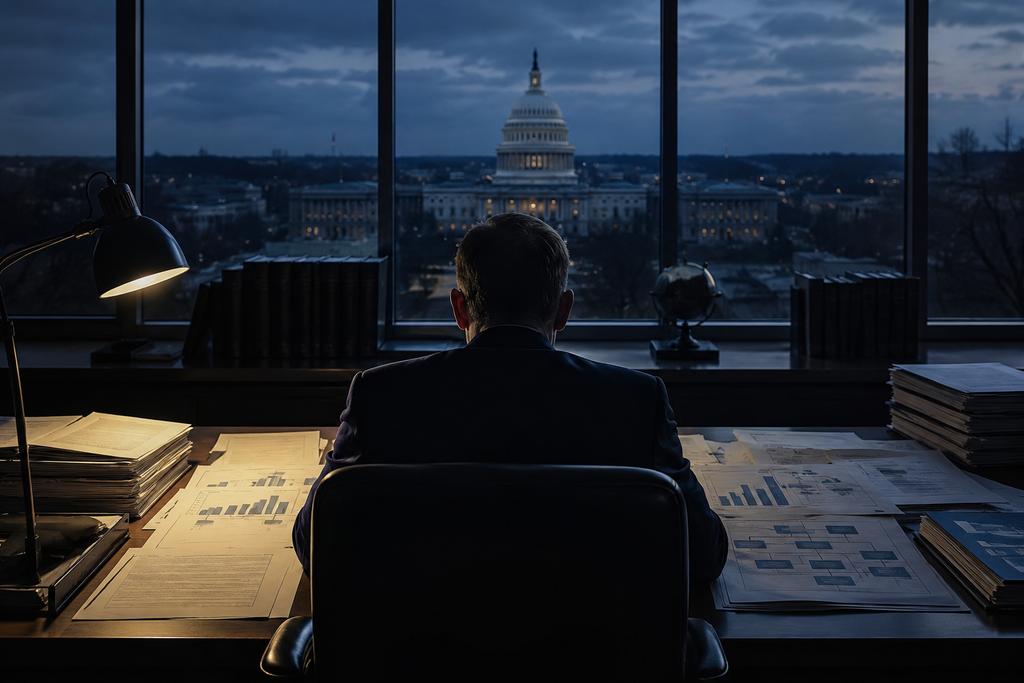
Of all the figures who populate Donald Trump’s second administration, few operate with less name recognition and more raw institutional power than Russell Vought. He does not command troops like the Secretary of Defense, he does not prosecute cases like the Attorney General, nor does he dominate health news like RFK Jr. Yet as director of the Office of Management and Budget (OMB), Vought sits astride the single path through which every dollar appropriated by Congress must pass before it reaches an agency, a court, a hospital, or a family. That chokepoint, combined with Vought’s explicit authorship of the government-dismantling blueprint known as Project 2025, has led critics to call him the “shadow president” and, more provocatively, the most destructive force in the administration. Whether you accept that label depends on what you take “destructive” to mean — destructive of the liberal vision of the administrative state, or destructive of the state’s basic capacity to function at all. Let’s look at Vought’s role, his authorship of Project 2025, and the specific programs and institutions he has targeted as OMB director, then weighs the case for and against the “most destructive” designation.
Who Is Russell Vought, and What Does He Control?
Vought is currently the Director of the OMB, the West Wing-adjacent agency that, on paper, sounds simply bureaucratic. It reviews agency budgets, writes regulations, and controls the timing of federal spending but in practice it functions as one of the most powerful levers in the executive branch. He held the same job at the end of Trump’s first term, from mid-2020 to January 2021, after serving as deputy director starting in 2018.
What’s unusual this time is how many hats he’s worn, most at the same time. Since being confirmed in February 2025, Vought has also served as acting director of the Consumer Financial Protection Bureau and, for several months in mid-to-late 2025, he was acting administrator of USAID while that agency was being dismantled. In practice, that means one person has simultaneously controlled the government’s checkbook, the main federal consumer-finance watchdog, and the country’s foreign aid apparatus.
Vought and Project 2025
Before returning to government, Vought ran a think tank called the Center for Renewing America, and in that role, he became one of the central figures behind Project 2025, the Heritage Foundation’s 900-plus-page transition blueprint for a second Trump term. He personally wrote the chapter on the Executive Office of the President, and by most accounts he was also deeply involved in a separate, less public “180-Day Playbook” designed to help the new administration move fast before opposition could organize.
Vought’s own language, captured on hidden camera by researchers with the Centre for Climate Reporting in 2024, is probably the most-quoted material about him. He described spending roughly 80 percent of his time on “destroying” the sense of independence exhibited by some executive branch agencies. He said he wanted federal employees to be “traumatically affected” by the changes he had planned. He referred to Trump’s public distancing from Project 2025 during the campaign as “graduate-level politics,” implying it wasn’t sincere. He has also spoken about reviving “Schedule F,” a first-term proposal that would strip job protections from a large swath of career civil servants and make it easier to them fire for political reasons.
None of that is speculation on my part; it’s drawn directly from his own recorded remarks and from the Project 2025 chapter he authored. Whether you read it as candid strategic planning or as something more alarming is a judgment call.
What He’s Cutting or Eliminating
This is the part of the story with the most concrete paper trail, because OMB’s decisions show up in court dockets, congressional hearings, and the government’s own funding apportionment documents.
Days before Vought’s confirmation, an OMB memo closely tied to him ordered a sweeping freeze on federal grants, loans, and cooperative agreements, citing a need to root out spending on “wokeness” and “Green New Deal social engineering.” The freeze briefly disrupted payment portals for Medicaid, Head Start, Meals on Wheels, and community health centers before a federal judge intervened and the memo was rescinded.
USAID and Foreign Aid
As acting USAID administrator, Vought oversaw the agency’s near-total shutdown, including a freeze on foreign assistance that a federal judge blocked in part in February 2025. House Democrats published a report attributing roughly 600,000 preventable deaths worldwide to the cuts, a figure Vought has disputed without offering his own count. In June 2026 Senate Democrats separately objected to OMB withholding another $3.2 billion in already-appropriated humanitarian and development aid.
The Education Department
Through 2026, OMB left roughly three dozen Education Department programs marked “unallocated” in official apportionment documents. This means the department technically wasn’t authorized to spend congressionally appropriated funds on them. That produced a lawsuit in June 2026 from Protect Democracy and several education groups, and a separate revolt from ten Republican senators over a summer-program funding freeze they said contradicted the president’s own stated goals.
The Consumer Financial Protection Bureau
As acting director, Vought moved almost immediately to halt CFPB operations, close its headquarters, and pursue mass layoffs. He targeted roughly 90 percent of the workforce, later scaled back to about two-thirds under court pressure. A federal judge blocked the initial plan, and litigation (National Treasury Employees Union v. Vought) was still working through the D.C. Circuit as of mid-2026. The bureau’s union president put it bluntly: “Everyone knows Vought doesn’t want CFPB to exist at all.” Vought has said the cuts follow directly from a roughly 50 percent reduction Congress made to the bureau’s funding cap in 2025’s reconciliation bill.
Climate, Environmental-justice, and Infrastructure Funding
Vought also announced the cancellation of nearly $8 billion in climate-related grants across 16 Democratic-leaning states, describing them on social media as “Green New Scam funding,” and placed a hold on roughly $18 billion in New York City infrastructure funding due to his objections to “unconstitutional DEI principles”.
Broader impoundment and “pocket rescissions”
The most structurally significant fight is over whether OMB can simply decline to spend money Congress has appropriated, a practice called impoundment that is prohibited by a 1974 law. Vought has argued publicly that many of these actions are “programmatic delays,” not impoundments, and that the Impoundment Control Act’s restrictions are unconstitutional. Critics, including House Appropriations Committee Democrats and two dozen state attorneys general, say OMB has used the apportionment process to delay the routine paperwork that releases funds to agencies creating a chokepoint to freeze billions in spending without following the law’s formal rescission procedure. A related, roughly $9 billion “pocket rescission” package targeting foreign aid and public broadcasting (including PBS and NPR funding) passed the Senate in 2026 after Vice President Vance broke a tie.
The Federal Workforce
Beyond any single agency, Vought’s OMB has pushed reductions in force across the government, including a September 2025 memo instructing agencies to use that fall’s government shutdown as an “opportunity” to eliminate programs. House Democrats on the Judiciary and the Appropriations committees called that a misuse of shutdown authority, and a court issued a temporary restraining order blocking some of the resulting layoffs.
The Case for the Defense
It’s worth noting that Vought and his allies don’t dispute most of these facts — they dispute the framing. Their argument is that OMB is doing what it’s statutorily supposed to do: enforce fiscal discipline, cut waste and duplication, and give the president control over an executive branch that Vought and others believe has become too autonomous. Senator John Cornyn, backing Vought’s 2025 confirmation, praised his first-term record of regulatory rollback and called him “the right choice” to get federal agencies “back on track.” Vought himself has repeatedly said these are the first of several planned rounds of cuts, framing the approach as accountability to taxpayers rather than sabotage of government functions.
A Closing Thought
History will ultimately judge which interpretation proves more accurate. What seems increasingly clear is that Russell Vought has become one of the defining figures of the second Trump administration. His influence extends well beyond annual budgets. Through Project 2025 and his leadership of the Office of Management and Budget, he has sought to redefine how the federal government operates, who exercises power within it, and what authority the federal government should exert over American society.
Image generated by the author using ChatGPT.
Sources
1. Ballotpedia — confirmation background and career timeline. https://ballotpedia.org/Confirmation_process_for_Russell_Vought_for_director_of_the_Office_of_Management_and_Budget
2. Wikipedia — Russell Vought, overview of concurrent roles (OMB, CFPB, USAID). https://en.wikipedia.org/wiki/Russell_Vought
3. ABC News — on Vought’s Project 2025 authorship and vetting. https://abcnews.com/US/trump-vetting-project-2025-architect-top-administration-post/story?id=115993180
4. Forbes — Vought’s Senate confirmation and Project 2025 ties. https://www.forbes.com/sites/alisondurkee/2025/02/06/project-2025-author-russell-vought-confirmed-by-senate-here-are-all-the-trump-officials-with-ties-to-policy-agenda/
5. Critical Resistance (Substack) — hidden-camera remarks and “radical constitutionalism.” https://criticalresistance.substack.com/p/russ-vought-and-the-paperwork-revolution
6. The Hill — House hearing on USAID cuts and preventable-deaths estimate. https://thehill.com/homenews/house/5947905-vought-clashes-democrats-spending-cuts/
7. The Hill — USAID close-out funds and withheld humanitarian aid. https://thehill.com/policy/international/5870587-usaid-funds-19b-closeout/
8. Education Week — frozen Education Department apportionments. https://www.edweek.org/policy-politics/white-house-blocks-2-billion-for-education-see-all-the-affected-programs/2026/05
9. Protect Democracy — lawsuit over withheld education funding. https://protectdemocracy.org/work/congressionally-mandated-education-programs/
10. Federal News Network — CFPB staffing-cut plan and union response. https://federalnewsnetwork.com/management/2026/04/white-house-scales-back-plan-to-dismantle-the-cfpb-but-still-wants-to-slash-staff-by-two-thirds/
11. HousingWire — CFPB layoffs update and Vought’s stated intent to eliminate the bureau. https://www.housingwire.com/articles/cfpb-vought-new-nomination/
12. House Appropriations Committee (Democrats) — background on impoundment and apportionment tactics. https://democrats-appropriations.house.gov/news/fact-sheets/background-unlawful-impoundment-president-trumps-executive-orders
13. The Conference Board — legal analysis of the Impoundment Control Act dispute. https://www.conference-board.org/research/ced-policy-backgrounders/adiministration-view-on-impoundment
14. House Judiciary Committee (Democrats) — letter on shutdown-era RIF memo. https://democrats-judiciary.house.gov/media-center/press-releases/litigation-task-force-leaders-raskin-neguse-delauro-and-garcia-slam-russell-vought-for-exploiting-republican-shutdown-to-implement-unlawful-purge-of-federal-workforce
15. Office of Rep. Kamlager-Dove — articles of impeachment and funding-freeze allegations. https://kamlager-dove.house.gov/media/press-releases/kamlager-dove-introduces-articles-impeachment-against-omb-director-russell
16. Office of Sen. Cornyn — statement supporting Vought’s confirmation. https://www.cornyn.senate.gov/news/cornyn-votes-to-confirm-russ-vought-for-omb-director


The President’s Private Prosecutor
By John Turley
On June 10, 2026
In Commentary, Politics
How Trump Turned the Department of Justice into a Tool of Personal Revenge
There is an old maxim in law: fiat justitia ruat caelum — let justice be done though the heavens fall. It reflects the principle that the law belongs to everyone equally and is not meant to serve personal grudges. Critics argue that Donald Trump’s second administration has embraced a very different view: that the Department of Justice can be used to pursue those who have challenged, investigated, or defeated him.
This is not simply a partisan accusation. It is based on a pattern in which Trump publicly identifies enemies and calls for action against them, followed by Justice Department investigations or prosecutions. The targets have included former administration officials, prosecutors, election experts, and individuals who prevailed against Trump in court.
The Guardrails Come Off
Trump’s first term provided occasional glimpses of this tendency, but institutional resistance often limited its reach. His second term began with far fewer constraints.
The selection of Pam Bondi as attorney general was widely viewed as a signal that loyalty would take precedence over the traditional independence of the Justice Department. During her confirmation hearing, Bondi declined to assure senators that the White House would remain separate from prosecutorial decision-making. That exchange foreshadowed what followed.
Within months, Trump directed investigations into former administration officials Miles Taylor and Christopher Krebs. Taylor had authored the anonymous 2018 op-ed describing internal resistance within the administration. Krebs, Trump’s former cybersecurity chief, had publicly stated that the 2020 election was secure. Trump accused Taylor of “treason” while signing an executive memorandum ordering an investigation.
Whether or not either man had committed any wrongdoing, the sequence was striking: public presidential condemnation followed by federal scrutiny.
More consequential were the cases involving figures directly connected to Trump’s legal battles.
The Letitia James Case
Perhaps no public official has drawn Trump’s anger more consistently than Letitia James, the New York attorney general whose civil fraud case resulted in a massive judgment against Trump and his business organization.
In October 2025, James was indicted on bank fraud charges shortly after Trump publicly urged Bondi to move against his political opponents. The circumstances surrounding the case raised immediate questions.
According to reports, the original prosecutor assigned to the matter concluded that evidence was insufficient to support criminal charges and declined to proceed. He was replaced by Lindsey Halligan, a former member of Trump’s personal legal team who had no prosecutorial experience. Within weeks, Halligan secured an indictment.
The legal process that followed was unusual. The indictment was later dismissed. Subsequent efforts to obtain new indictments reportedly failed before grand juries, an outcome that is relatively rare given the traditionally high success rate prosecutors enjoy in grand jury proceedings.
Yet the investigation continued.
Critics saw the episode as evidence that prosecutorial decisions were being driven not by evidence but by determination to target a political adversary. Supporters countered that investigations should continue if legitimate questions remained unresolved.
Regardless of one’s interpretation, the case illustrates a recurring theme: Trump publicly demands action against an opponent, and federal law enforcement soon responds.
The Comey Prosecution
James Comey has been a target of Trump’s anger since his dismissal as FBI director in 2017. That conflict entered a new phase in September 2025 when Comey was indicted on charges of making false statements and obstruction.
The indictment arrived only days after Trump publicly called for prosecution on social media. Trump later suggested that he hoped there would be “others.”
Comey pleaded not guilty and moved to dismiss the case, arguing that he was the victim of selective and vindictive prosecution. Civil liberties advocates condemned the prosecution as an abuse of presidential power.
Whether the charges ultimately survive judicial scrutiny remains to be seen. But the timing reinforced the perception that DOJ actions increasingly followed Trump’s personal grievances. The ongoing “86 47” prosecution further emphasizes the appearance of political vengeance.
E. Jean Carroll: From Plaintiff to Target
No case better illustrates the concerns surrounding Trump’s Justice Department than that of E. Jean Carroll.
Carroll sued Trump for defamation after he denied her allegations that he sexually assaulted her in a Manhattan department store decades earlier. Two juries ruled in her favor, awarding her a combined $88.3 million in damages.
In May 2026, the Justice Department opened a criminal investigation into Carroll herself.
The investigation centers on statements Carroll made during civil litigation regarding funding for her legal expenses. Prosecutors are examining whether financial assistance connected to a nonprofit associated with LinkedIn co-founder Reid Hoffman was disclosed accurately and whether any false statements were made under oath.
Carroll is now 82 years old. She successfully sued Trump and won two jury verdicts. The federal government headed by the man she defeated in court is investigating whether to charge her with federal crimes.
The optics are difficult to ignore.
Carroll’s attorneys argue that the investigation lacks substantive merit and represents retaliation against a successful plaintiff. Legal observers note that if charges are eventually filed, Carroll would likely argue that the case constitutes vindictive prosecution — the use of prosecutorial power to punish someone for exercising a legal right.
Whatever the ultimate outcome, the sequence is extraordinary: a citizen sues a powerful public figure, wins twice before juries, and then becomes the subject of a federal criminal investigation under that same figure’s administration.
A Larger Pattern
Individually, each case can be debated on its merits. Together, they form a pattern that has become increasingly difficult for critics to dismiss as coincidence.
Many of the administration’s highest-profile investigations involve people who share one characteristic: they challenged Trump politically, legally, or personally. Former election officials. Former administration insiders. Prosecutors. Investigators. Civil plaintiffs.
The pattern is often the same. Trump publicly attacks an individual. He demands action. An investigation follows. Organizations tracking retaliatory government actions have documented numerous examples of this sequence. Legal scholars frequently identify such timing as one of the warning signs associated with selective prosecution.
The concern is not merely whether individual targets are guilty or innocent. The larger issue is whether prosecutorial decisions are being made independently or whether they are increasingly shaped by presidential preferences.
That distinction matters because the Department of Justice possesses powers unlike those of any other federal agency. It can investigate, indict, and imprison citizens. Its legitimacy depends heavily on public confidence that those powers are exercised fairly and consistently.
The Cost of the Process
Defenders of the administration argue that investigations should not be immune from scrutiny simply because targets claim political persecution. That is true. Public officials, former officials, and private citizens alike should be subject to the law.
But critics respond that the problem is not accountability. It is selectivity.
Even unsuccessful investigations impose significant costs. Legal defense can consume hundreds of thousands of dollars. Grand jury investigations create stress, uncertainty, and reputational damage. Years of litigation can disrupt careers and lives regardless of whether convictions are ultimately obtained.
The process itself becomes a punishment.
Courts and grand juries have occasionally pushed back. Several high-profile cases have encountered significant legal obstacles. But judicial intervention often occurs only after substantial personal and financial costs have already been imposed.
The Weaponization Paradox
Perhaps the greatest irony is that Trump’s political rise was fueled in part by his claim that the justice system had been weaponized against him.
For years, he argued that prosecutors, investigators, and political opponents used government institutions to pursue personal or partisan objectives. That argument resonated with many Americans because the principle involved is important. The justice system should not be used as a political weapon.
The challenge for Trump’s administration is that the same characteristics he identified as evidence of weaponization now appear in cases initiated by his own Justice Department.
He argued that prosecutors were motivated by personal animus rather than evidence. Critics now make the same allegation about prosecutions involving Letitia James, James Comey, and E. Jean Carroll.
He argued that the process itself was punishment. His opponents now make the same claim.
He argued that political pressure shaped prosecutorial decisions. Critics point to repeated examples in which Trump’s public demands appear to precede DOJ action.
Whether one accepts those comparisons or rejects them, the contradiction is difficult to ignore.
A Democracy’s Stress Test
The Justice Department was designed to serve the public interest rather than the interests of any single president. That principle became especially important after Watergate, when both parties embraced reforms intended to insulate law enforcement from political interference.
The durability of those norms is now being tested.
The central question is not whether every investigation discussed here will ultimately succeed or fail. Courts will decide that. The more important question is whether Americans will continue to believe that justice is being administered independently.
If citizens come to believe that criminal investigations are triggered by personal loyalty or presidential anger, confidence in the rule of law inevitably suffers.
The power to prosecute is among the most formidable powers government possesses. In a constitutional democracy, that power must belong to institutions, not individuals.
Whether that principle remains intact may prove to be one of the defining questions of Trump’s second term.
Image generated by author using ChatGPT
Sources
• Just Security — Chronology of Trump/DOJ Targeting (Oct. 2024)
• PBS NewsHour — Comey Indictment & Trump Vows More Prosecutions (Sept. 2025)
• Slate — Trump’s Vengeance Tour (May 2026)
• Time — Trump Vows to Prosecute Political Enemies (March 2026)
• Protect Democracy — Retaliatory Action Tracker (ongoing)
• Yahoo/AP — Trump Directs DOJ to Investigate Taylor & Krebs (2025)
• Time — DOJ Launches Criminal Investigation into E. Jean Carroll (May 28, 2026)
• Axios — DOJ Probes Reid Hoffman Nonprofit Over Carroll Funds (May 28, 2026)
• CNN — Carroll and the Pattern of Trump Retribution (May 28, 2026)
• MS NOW — Vindictive Prosecution Analysis (May 28, 2026)
• Newsweek — Timeline of Carroll’s Legal Battles with Trump
• CNBC — Trump DOJ Intervenes in Carroll Case (Oct. 2020)
• CNBC — DOJ Fails Second Time to Indict Letitia James (Dec. 2025)
• ABC News — Letitia James Indicted (Oct. 2025)
• PBS — Full Indictment of Letitia James
• House Judiciary Democrats — Investigation into DOJ Retaliation Against Letitia James (March 2026)
• 19th News — From Letitia James to Comey, Trump’s DOJ as Instrument of Revenge
• Sen. Whitehouse Letter to Barr re Carroll (Sept. 2020)