
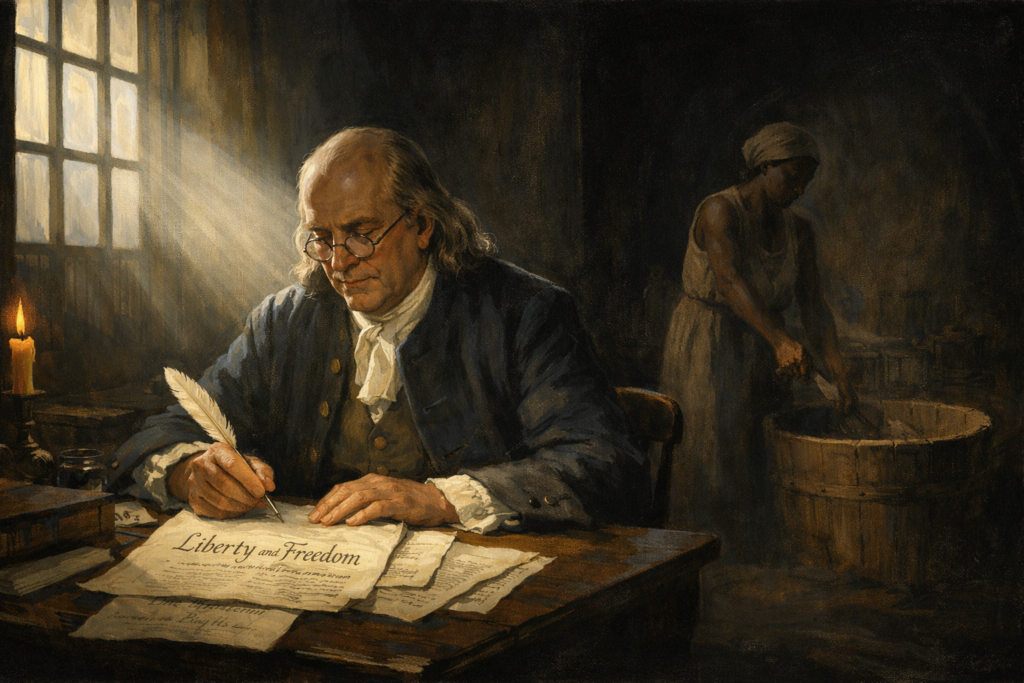
Few figures in American history are as celebrated — or as contradictory — as Benjamin Franklin. Founding Father, inventor, diplomat, and philosopher. Franklin is remembered for just about everything except the uncomfortable truth that he was also, for much of his life, a slave owner. His relationship with slavery is a study in the slow, painful moral evolution of a brilliant but flawed man — one who spent decades benefiting from the institution he would spend his final years fighting to abolish.
The Slaveowner
Franklin was a slave owner beginning around 1735, and he owned enslaved people until at least 1785 when he freed two slaves after his return from France. Over the course of his life, there were up to seven named slaves in the Franklin household, including Peter, his wife Jemima, their son Othello, and George, John, and King.
Franklin’s complicity in slavery extended beyond personal ownership. As editor of the Pennsylvania Gazette, Franklin benefited financially from advertisements for runaway slaves and slave auctions that were paid for by slave owners and traders. He also used his printing press to publish content that supported the slave trade and, as a British colonial agent, sought to have the British government accept Georgia’s slave code. In short, slavery wasn’t just a private matter for Franklin — it was woven into his professional and financial life. At the same time, he printed Quaker antislavery tracts, a sign that his professional role placed him at the intersection of both pro‑slavery commerce and early antislavery movements.
What little we know about how Franklin treated his enslaved people comes mostly from letters and financial records. In part this is because northern slaveholders kept fewer detailed records of slave families, births, and deaths than large southern planters. His enslaved servants lived within his household and were integrated into domestic routines, a common arrangement in urban slavery that still left them legally and socially unfree.
When Franklin traveled to London in 1757, he brought two enslaved men, Peter and King, who lived and worked at 36 Craven Street. Peter remained with Franklin until their departure in 1762, but King ran away sometime in 1758 and was later found living in Suffolk, having been taken in by a Christian woman who taught him to read and write. The fact that King fled at the first opportunity tells its own story about the nature of slavery, whatever Franklin’s personal demeanor may have been.
His Evolving Written Views
Franklin’s early writings on slavery were at best ambivalent and at worst openly racist. In his 1751 essay “Observations Concerning the Increase of Mankind,” Franklin argued that slave labor wasn’t economically efficient in part because enslaved people pilfered from their owners, writing that “almost every Slave [being] by Nature a Thief.” His concern about slavery in this period was largely economic rather than moral — he worried that it would hurt poor white laborers and enriched a wealthy elite, not that it was a profound violation of human dignity.
By the 1760s, something began to shift. His perspective began to change following a 1759 visit arranged by his friend Samuel Johnson to one of Dr. Bray’s schools for Black children. He also met Anthony Benezet, who had started a school in Philadelphia and would later co-found the Abolition Society. By 1763, Franklin wrote that African “shortcomings” were not inherent but came from lack of education, slavery, and negative environments — and that he saw no difference in learning ability between African and white children.
While in London in the 1760s, he supported black education projects and in 1770 anonymously published “Conversations between an Englishman, a Scotchman, and an American,” a piece that criticized both the slave trade and the broader institution. In 1782 he circulated “A Thought Concerning the Sugar Islands,” condemning the African wars that fed the trade, the horrors of the Middle Passage, and the “numbers that die under the severities of slavery,” arguing that even sugar was morally tainted by blood.
By the late 1780s, Franklin’s language had become openly abolitionist. In 1787 he signed a public antislavery appeal declaring that the Creator had made “of one flesh, all the children of men,” and in 1789–1790 he wrote essays insisting that slavery was an “atrocious debasement of human nature.” He also argued that formerly enslaved people needed education, moral instruction, and employment to make the transition from bondage to full participation in civil society.
This was a meaningful intellectual leap for the era. Franklin was moving from a view of enslaved people as economic units toward recognizing their common humanity and the role that oppression itself played in creating the inequalities he had previously attributed to nature.
Franklin the Constitutional Convention and the Three-Fifths Compromise
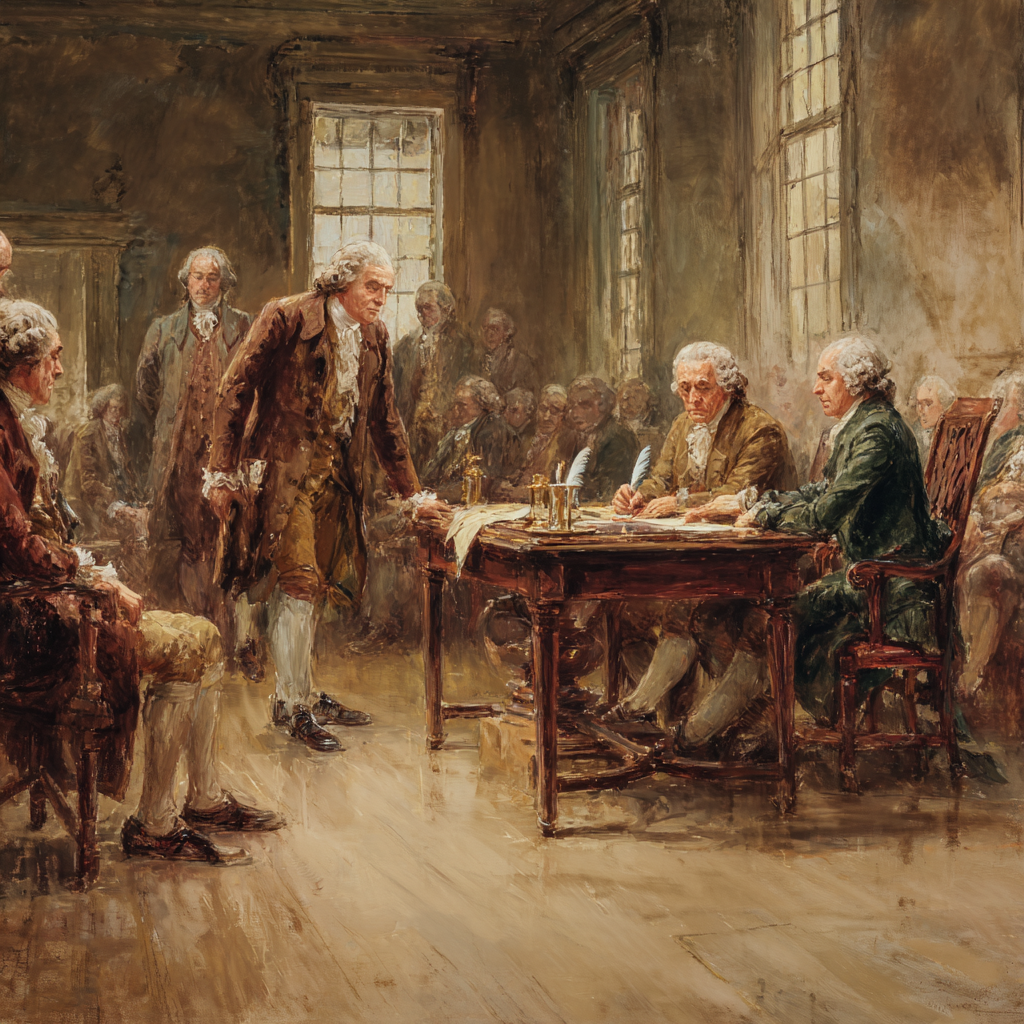
By the time of the 1787 Constitutional Convention in Philadelphia, Franklin. then 81 years old, was a delegate from Pennsylvania. The Three-Fifths Compromise — which counted enslaved people as three-fifths of a person for purposes of congressional representation and taxation — was one of the most contentious issues at the Convention. The compromise was formally proposed by delegate James Wilson and seconded by Charles Pinckney.
Franklin’s specific role in the Three-Fifths Compromise itself is limited. His more direct contribution to the Convention’s structural debates was to the Great Compromise about proportional representation and spending rather than the slavery count.
Notably, just weeks before the Convention began, Franklin signed a public antislavery appeal stating that “the Creator of the world” had made “of one flesh, all the children of men.” Yet he ultimately signed a Constitution that embedded protections for slavery, including the Three-Fifths Compromise and a provision preventing Congress from banning the slave trade until 1808. Franklin’s acquiescence reflected his broader pragmatic calculation, shared by many Northern founders, that preserving the Union required compromise with the slaveholding South, even at a terrible moral cost. This is partly speculative — Franklin left few direct written statements about his reasoning on this specific tradeoff at the Convention.
The Abolitionist
Whatever compromises Franklin made at Philadelphia, the years that followed saw him embrace abolitionism with increasing conviction and urgency. In 1787, he began serving as President of the Pennsylvania Society for Promoting the Abolition of Slavery — the oldest abolitionist organization in the country — which had originally formed in 1775 and was reorganized and incorporated by Pennsylvania in 1789.
In 1789, Franklin wrote and published several essays supporting abolition, including a public address dated November 9th of that year in which he called slavery an “atrocious debasement of human nature.” He called for practical support for emancipated people, including education and employment — ideas that were radical for the time and would remain largely unaddressed for generations.
His final public act was perhaps his most consequential. On February 3, 1790, Franklin signed a petition to the first Congress on behalf of the Abolition Society, asking lawmakers to “devise means for removing the Inconsistency from the Character of the American People” and to “promote mercy and justice toward this distressed Race.” The petition was immediately denounced by pro-slavery congressmen and referred to a committee, which ultimately concluded that the Constitution prevented Congress from acting on the matter until 1808.
Franklin died in April 1790, just weeks after these debates, leaving a legacy that combined early complicity in slavery with later, forceful advocacy for abolition and Black education. As part of his will, he directed all remaining enslaved people in his household be freed upon his death, although it is unclear if he still owned slaves at the time and this may have been a symbolic declaration that he hoped others would follow. His life illustrates both the pervasiveness of slavery in colonial America — even among its most famous reformers — and the possibility, however belated, of moral and political transformation on the issue.
What to Make of It All
Franklin’s association with slavery resists easy conclusions. He spent roughly four and a half decades owning enslaved people, profiting from the slave trade through his newspaper, and diplomatically defending slavery when it served colonial interests. His evolution toward abolitionism was real, but it was also late — and driven partly by visits to schools for Black children and Quaker friendships rather than a spontaneous moral awakening.
At the same time, his final years represent one of the most prominent Founding Fathers publicly and passionately challenging the institution while other contemporaries remained silent or actively defended it. As historian David Waldstreicher has cautioned, Franklin’s antislavery credentials have sometimes been “remembered backwards” and exaggerated — but that doesn’t mean the later evolution wasn’t genuine.
What Franklin’s story offers isn’t a story of redemption so much as a realistic portrait of moral growth under the weight of self-interest, social norms, and political pragmatism. He was, as one observer put it, a man who showed himself to be “thoughtful, open, teachable” — eventually. The tragedy is how long it took, how few followed his lead, and how much damage was done in the meantime.
Illustration generated by author using ChatGPT.
Sources:
Benjamin Franklin House – Franklin and Slavery
https://benjaminfranklinhouse.org/education/benjamin-franklin-and-slavery/
Benjamin Franklin House – The Philadelphia Household 1735–1790
https://benjaminfranklinhouse.org/franklin-and-slavery-the-philadelphia-household-1735-1790/
Online Library of Liberty – Benjamin Franklin and Slavery, Part One
https://oll.libertyfund.org/publications/reading-room/2023-07-05-ealy-franklin-slavery-part-one
Benjamin Franklin Historical Society – Slavery and the Abolition Society
http://www.benjamin-franklin-history.org/slavery-abolition-society/
National Archives – Benjamin Franklin’s Anti-Slavery Petitions to Congress
https://www.archives.gov/legislative/features/franklin
Penn & Slavery Project – Benjamin Franklin
https://pennandslaveryproject.archives.upenn.edu/2025/07/09/benjamin-franklin/
Commonplace: The Journal of Early American Life – Benjamin Franklin, Slavery, and the Founders
https://commonplace.online/article/benjamin-franklin-slavery/
U.S. History – Ben Franklin and the Vexing Question of Race in America
https://www.ushistory.org/franklin/essays/franklin_race.htm
Wikipedia – Benjamin Franklin
https://en.wikipedia.org/wiki/Benjamin_Franklin
Wikipedia – Three-Fifths Compromise
https://en.wikipedia.org/wiki/Three-fifths_Compromise
Britannica – Three-Fifths Compromise
https://www.britannica.com/topic/three-fifths-compromise
U.S. Senate – Equal State Representation and the Great Compromise
https://www.senate.gov/about/origins-foundations/senate-and-constitution/equal-state-representation.htm
Wikipedia – Connecticut Compromise
https://en.wikipedia.org/wiki/Connecticut_Compromise
Teaching American History – The Constitutional Convention: The Three-Fifths Clause
https://teachingamericanhistory.org/document/the-constitutional-convention-the-three-fifths-clause/

The Contradictory Life of Thomas Jefferson
By John Turley
On March 18, 2023
In Commentary, History
Part I, Liberty and Slavery
We hold these truths to be self-evident, that all men are created equal, that they are endowed by their Creator with certain unalienable Rights, that among these are Life, Liberty and the pursuit of Happiness.
These stirring words that Thomas Jefferson used in the Declaration of Independence put forth a clear statement of his political philosophy. Unfortunately, the man behind the words is not nearly so self-evident. To borrow a phrase from Winston Churchill, he is a riddle wrapped in a mystery, wrapped in an enigma. Biographer Joseph Ellis referred to him as The American Sphinx.
He was a man of the enlightenment, but he was also a man clearly bound to the brutal slave economy. He dreamed of a bucolic America peopled by hardworking yeoman farmers while he lived the life of a wealthy British aristocrat. He abhorred the thought of banks and bankers but spent his entire life mired in debt. He wrote and spoke often of the need to avoid factionalism in politics but was a skillful practitioner of political intrigue. He constantly argued against expansion of governmental power but as President, without having the authority, he undertook to expand the United States to more than double its size.
So, how do we reconcile the words with the man? Perhaps we don’t. Perhaps the best we can do is try to understand the world in which he lived and the circumstances that led him to take such contradictory positions in his political and personal life. Tens of thousands of pages have been written trying to understand and explain Thomas Jefferson. Now, I’m only going to look briefly at his relationship to slavery. In a later post I’ll be looking at Thomas Jefferson as the master of political manipulation.
Of the many contradictions in Thomas Jefferson’s life, his relationship to slavery is the most difficult to reconcile. One of his first cases after becoming a lawyer was to represent a slave seeking his freedom on the grounds that his grandmother was a mulatto which would require him to be in bondage only until age 31. In an argument to the Virginia court Jefferson said, “Everyone comes into this world with the right to his own person, this is what is called personal liberty and is given them by the author of nature, under the law we are all born free.”
Both the judge and the jury were outraged that Jefferson would propose freeing a slave. The judge refused to hear any further such talk and ruled against Jefferson’s client. According to historian Winston Groom the fact that Jefferson had such a position at that time (1770) is considered significant and was a milestone in the evolution of his thought.
About that same time Jefferson was elected to the House of Burgesses and he introduced an act that would allow masters to govern emancipation of their slaves rather than having to seek the permission of the courts and the royal officers. This was met with strong opposition and did not pass. It is significant that Jefferson did not pursue either the court case or the legislation.
As a member of the Continental Congress, Jefferson prepared an amendment to the Ordinance of 1784 (a precursor to the Northwest Ordinance) stipulating the freedom of all children born to slaves after a certain date but requiring that they be deported to either the Caribbean or Africa. This amendment failed by a single vote in Congress. Reflecting on the decision Jefferson wrote: “Thus we see the fate of millions unborn hanging on the tongue of one man and heaven was silent in that awful moment”. But Jefferson was to remain silent as well!
To Jefferson it was unimaginable that free whites and free blacks could live together peaceably. Even years later when writing about it he said that it was “inconceivable [then] that the public mind would bear this proposition, nor will it bear at this day”. He also wrote “Yet the day is not distant when it must bear and adopt it or worse will follow, nothing is more surely written in the book of fate than that these people are to be free.” According to Jefferson’s biographer Jon Meacham, he was never able to move public opinion on slavery and his powers failed him and they failed America.
As president, Jefferson signed a law making it a crime to import slaves. But at the same time, he believed that if slaves were set free, they must be deported to Africa or the Caribbean. Most of his contemporaries agreed; they felt that American slavery was equivalent to “holding the ear of a tiger”, but they saw no way to let go.
So again, we return to the question of how to reconcile Jefferson the philosopher with Jefferson the enslaver. Jefferson was a man who enjoyed luxury and the finer things in life. Today he is viewed as a wealthy planter. However, he was what we would now consider cash poor. All his wealth was tied up in property and his slaves were a large portion of that property. His land was heavily mortgaged, and his slaves were his collateral. Jefferson’s wife was the daughter of a wealthy man and when her father died Jefferson inherited his 135 slaves and his land, which was also heavily mortgaged. He also inherited his father-in-law’s other considerable debts. He worried constantly about his financial status, yet he could not control his lavish spending. Freeing his slaves would have lost him the collateral against which his many loans were guaranteed.
Jefferson recognized the evil of slavery but also benefited greatly from it. He was unable to give up his comfortable life even while bemoaning the institution which made it possible. His relationship with Sally Hemmings has been a subject of much debate and is beyond what I can address here but if you are familiar with her story, you know that this a singular example of Jefferson’s inability to subordinate his desires to his principles.
During his lifetime he freed only two of his slaves and in his will, he freed only an additional three. This compares to some other founders who freed all their slaves in their wills. Perhaps he recognized that freeing his slaves would have resulted in an immediate foreclosure on his beloved Monticello.
It is long been axiomatic among historians that people should be judged by the time in which they lived. Jefferson was a man of his times, an exceptional man without doubt. However, his was a time that was consumed by one of the great evils of history. And that evil will always reflect on his memory. Each of us will have to make our own decision about Thomas Jefferson.
Further reading:
Thomas Jefferson the Art of Power, John Meacham
Jefferson and Hamilton the Rivalry That Forged a Nation, John Ferling
The Patriots, Winston Groom
Thomas Jefferson: An Intimate History, Fawn Brody