Mammals have evolved with an internal thermostat that does a remarkably good job maintaining a consistent body temperature. We humans evolved in a warm climate, so we are physiologically more adapted for shedding heat than for retaining it. Our body runs best when we maintain an internal (core) temperature between 97°F and 99°F.
Our internal thermostat adjusts blood flow, metabolism, sweating, and muscle activity to maintain our internal temperature balance, also known as homeostasis. When we’re exposed to high heat the blood vessels near the skin expand, allowing heat to escape. Sweating increases to cool the body. When we’re exposed to extreme cold, blood vessels narrow to conserve our body heat and we start to shiver to generate additional heat.
Extreme heat or cold can overwhelm the ability of our thermostats to regulate our internal temperature and we begin to experience discomfort, confusion and eventually organ injury, unconsciousness, and even death.
Extreme Heat
Our body’s main defense against extreme heat is sweating. It’s not so much the sweat itself as it is evaporation that cools us. Sweat evaporates efficiently on a hot dry day, but when the air is saturated with moisture, sweating is much less effective. A temperature that would be tolerable in a dry environment can rapidly become unbearable in a humid one. As it turns out, those people who have always said, “it’s the humidity not the temperature“ were at least partially correct.
Sweating works fine for a while, but in extreme heat, it can quickly lead to dehydration. While your body struggles to keep you cool, blood flow shifts towards the skin to give up additional heat. This causes more stress on the heart and the circulatory system. People with underlying heart disease, vascular disease, lung disease, or even diabetes, and kidney disease can be under significant stress from heat. Heat can also affect the brain’s functioning and potentially worsen mental illnesses such as anxiety and schizophrenia.
As a body’s internal temperature increases, it can lead to confusion which can cause accidents and impaired judgment. When the temperature passes 104°F it can even lead to loss of consciousness. This isn’t just a bad day in the sun; it’s a true medical emergency.
I covered specific heat injuries, including their symptoms, diagnosis, prevention, and treatment in my post “When the Sun Bites Back“.
Extreme Cold
Extreme cold presents a different problem. As our body begins to lose heat faster than it can generate it, our internal thermostat works to retain heat rather than shed it. The primary goal becomes preserving internal body temperature. Blood flow shifts to the core, often sacrificing the extremities to protect vital organs.
The initial response is constricting blood vessels near the surface of the skin to reduce heat loss. We then began shivering, involuntary, rapid contractions that can generate considerable heat in the short run. But shivering requires energy and can soon deplete our reserves.
It’s not just the temperature that causes problems. Wind increases heat loss from exposed skin, giving us the well known wind-chill. Water exposure, whether from heavy rain, melting snow, or direct immersion increases heat loss dramatically.
Excessive cold creates symptoms similar to heat, confusion, poor judgment, and slowed thinking set in initially, making it difficult for most people to recognize that they are in the midst of a medical emergency.
The heart is especially vulnerable to extreme cold. As our core body temperature drops, the heart’s electrical conduction system becomes increasingly unstable. This increases the risk of dangerous arrhythmias. The potential for cardiac arrest raises considerably when core body temperature falls below 90°F. What most people think of as “freezing to death” is caused primarily by cardiac arrest.
I will be covering specific cold injuries, including their diagnosis, symptoms, treatments, and prevention in a future post.
Which Is More Dangerous?
Extreme heat seems to get the most notice; a heat wave never fails to make the news. But epidemiological studies tell a different story. Two large-scale studies in Europe in the last twenty years have found deaths from cold to be between nine and seventeen times greater than those from heat. We are less aware of cold deaths because they are spread out over time and location, rather than being the result of a single weather event.
The future may tell a different story. As the climate warms, the rate of heat- related deaths is increasing compared to cold. This is significant because heat waves kill quickly and in large numbers; a 2003 European heat wave is estimated to have caused at least 70,000 excess deaths.
Who Is At Greatest Risk?
Interestingly, the risk factors for heat and cold related injuries and death are almost identical. Obviously, people with significant environmental exposure, outdoor workers, emergency responders, and farmers, are at increased risk.
Age is common risk factor. Infants have limited ability to regulate their internal temperature, and young children heat up and cool off faster than adults. Older adults have a spectrum of problems that increase their risk. As we age, the body can lose its ability to adapt to temperature changes. Cardiovascular reserve can lessen, reducing the ability to respond to the stress of extreme temperatures. Many older people are taking medications that may alter hydration or temperature regulation. Additionally, many older adults have mobility problems or lack reliable transportation or social support to enable them to escape temperature extremes.
Use of drugs or alcohol can contribute to dehydration and heat loss. They also can impair judgement or mentation, increasing the susceptibility to temperature extremes.
Our Human Thermostat
We have evolved with an amazing ability to regulate our internal temperature, but the range is surprisingly narrow. Our adaptability can give us a false sense of security. As our thermostat begins to fail, our judgement and mental status become altered, leaving us even more valuable.
Awareness, planning and prevention are the most important parts of preventing temperature related injuries.
Illustration generated by author using ChatGPT.
Sources
1. Harvard Health Publishing, “Heat Stroke (Hyperthermia).” https://www.health.harvard.edu/preventive-care/heat-stroke-hyperthermia-a-to-z
3. “Impact of hyper- and hypothermia on cellular and whole-body physiology,” PMC. https://www.ncbi.nlm.nih.gov/pmc/articles/PMC11727703/
4. “Heat stroke: Pathogenesis, diagnosis, and current treatment,” ScienceDirect. https://www.sciencedirect.com/science/article/abs/pii/S1568163724002277
5. American Academy of Family Physicians, “Hypothermia and Cold Weather Injuries.” https://www.aafp.org/pubs/afp/issues/2019/1201/p680.html
6. “Out of the cold: management of hypothermia and frostbite,” PMC (CMAJ). https://pmc.ncbi.nlm.nih.gov/articles/PMC140473/
7. Connecticut Department of Public Health, “Frostbite and Hypothermia.” https://portal.ct.gov/dph/communications/crisis-and-emergency-risk-communication/frostbite-and-hypothermia
8. Gasparrini A, et al., “Mortality risk attributable to high and low ambient temperature: a multicountry observational study,” The Lancet, 2015. https://www.ncbi.nlm.nih.gov/pmc/articles/PMC4521077/
9. Zhao Q, et al., “Global, regional, and national burden of mortality associated with non-optimal ambient temperatures from 2000 to 2019,” The Lancet Planetary Health, 2021. https://www.thelancet.com/journals/lanplh/article/PIIS2542-5196(21)00081-4/fulltext
10. “Are there more cold deaths than heat deaths?” The Lancet Planetary Health, 2025. https://www.thelancet.com/journals/lanplh/article/PIIS2542-5196(25)00054-3/fulltext
11. ScienceDaily, “Cold weather kills far more people than hot weather.” https://www.sciencedaily.com/releases/2015/05/150520193831.htm
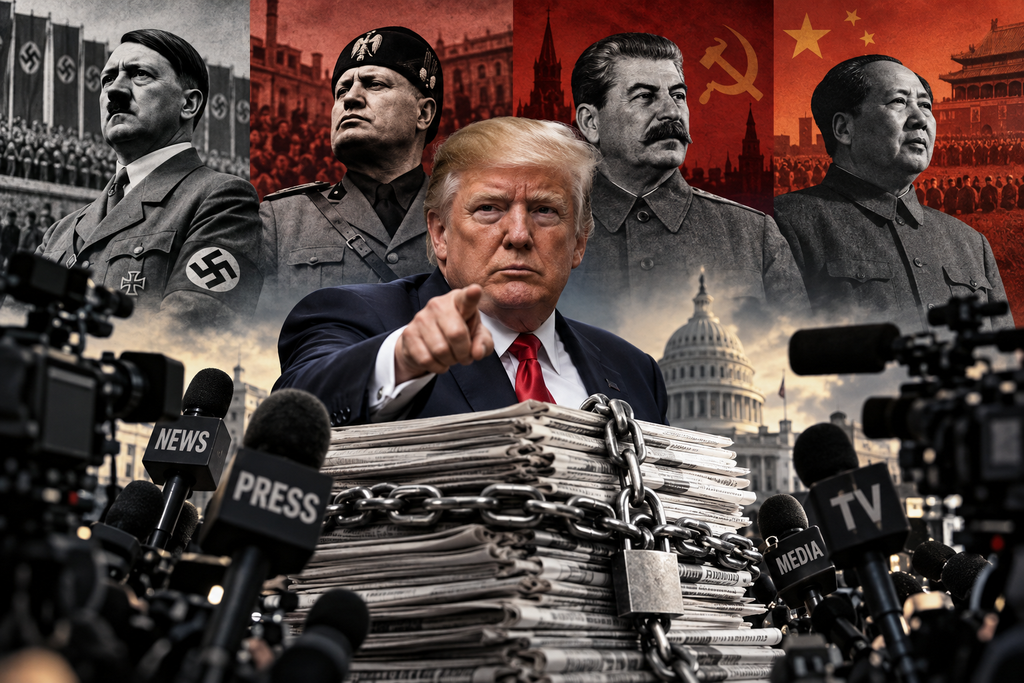
Donald Trump’s recent battle with CNN, MS NOW, and Politico is just the latest in a long list of conflicts with the press over what he views as unfavorable or inaccurate coverage. Many people believe his actions are becoming increasingly authoritarian. Some are quick to reach for the term Nazi or fascist when describing his actions. I know this can be tempting because I’ve done it myself.
While his actions are becoming increasingly authoritarian-like, have they really reached the level of previous totalitarian dictatorships? Let’s look at a few totalitarian regimes from the last 100 years and see how the Trump administration’s approach to the press stacks up against theirs. While there are many examples to choose from, I’m going to look at two familiar and one not so familiar example — Nazi Germany, Communist China, and Viktor Orbán’s Hungary.
Nazi Germany
Prior to Hitler’s rise to power, Germany had a free and diverse press. In 1933 there were more than 4,700 newspapers in Germany covering almost every political, social and religious segment of society. Less than three percent of newspapers were controlled or heavily influenced by the Nazis.
Hitler rapidly seized control of the German press through a series of emergency decrees and laws he justified through a series of trumped-up events such as the infamous Reichstag fire. Hitler blamed the fire on the communists despite any clear evidence that they were involved.
Hitler also used it to justify mass arrests of political opponents and to issue emergency decrees suspending basic civil liberties and he made it illegal to criticize the government. Within just a few months, communist and social democratic newspapers had been shut down and their printing presses confiscated. Independent newspapers faced increasing pressure to comply “voluntarily” with government restrictions on their reporting.
In March 1933, the Nazis created the Reich Ministry of Public Enlightenment and Propaganda under Joseph Goebbels. He quickly took control of film, radio, theater, and newspapers. The Editor’s Law of October 1933 required every editor and journalist to register with the government. It excluded Jews and anyone married to a Jew, or anyone considered politically or racially unacceptable from taking part in either newspaper writing or publishing.
Editors were given specific instructions about what they would be allowed to report and how stories should be prepared. They were ordered to omit anything “calculated to weaken the strength of the Reich abroad or at home.” Acceptable content was provided through weekly press conferences in Berlin and was relayed to local newspapers. Those who didn’t comply could lose their jobs or even face the concentration camps. By the middle of 1941, the Nazis controlled approximately 80% of German newspapers. By the beginning of 1942, independent newspapers had virtually ceased to exist.
Communist China
China is an important example of media control in the digital age. They have found an effective way of controlling information in a society where almost everyone has a smartphone and almost anyone can post content.
China is not new to the game of media control. The Chinese Communist Party first established the Central Propaganda Department in 1921 and has been in total control of the country’s media since 1949. It found a way to effectively control a commercial media market by allowing some private ownership of closely controlled media companies.
What China has created is an effective system of self-censorship where media outlets employ their own in-house content managers who review all published items based on censorship guidelines from the Central Propaganda Department that are updated on a weekly basis. Publication rights can be granted, revoked, or restricted at the discretion of the party. There is no appeal of decisions.
The party has the “Great Firewall” that blocks foreign platforms and scrubs all sensitive topics from the Chinese internet. Websites can be blocked, social media posts removed, and accounts deleted. In 2016 Xiao Jinping stated, “all the work by the party’s media must reflect the party’s will, safeguard the party’s authority, and safeguard the party’s unity.”
According to nonprofit democracy watchdog groups, Freedom House, and The Committee to Protect Journalists, China has the world’s most restrictive media environment, and it is the world’s most aggressive jailer of journalists, holding at least 50 in prisons.
Hungary
Hungary is important to consider because it is a 21st century example of a state attempting to establish authoritative style control over national media. It’s equally important because it’s an example of an authoritative style government being voted out of office and actually leaving office.
Viktor Orbán used a strategy in Hungary this been referred to as “media capture”. He used organizations meant to provide oversight and protection for journalists and society at large and turned them into instruments of political influence; it’s the way he built and maintained his political power.
He cultivated friendly relationships with wealthy media owners, he made targeted advertising expenditures, and he exerted pressure on independent journalists. He assisted wealthy supporters in acquiring media organizations and provided them with favorable regulatory decisions. Without ever formally banning the opposition press, he wound up with indirect but nonetheless effective control of about 75% of the Hungarian media.
Orbán also worked tirelessly spreading propaganda through news outlets. His government regularly portrayed the opposition media as spreading false information and working for foreign governments. He seems to have a particular fascination with the Hungarian-born American businessman and philanthropist George Soros, something he shares with many American Republicans.
Media outlets that were favorable to Orbán enjoyed institutional and financial support. Critical organizations operated with greater difficulty. The combination of friendly ownership, public spending, and reduced regulatory authority gave an advantage to Orbán’s supporters. While Orbán made sure the competition was unequal, Hungary still retained some independent journalism as is evidenced by his recent election defeat.
How Trump Fits The Pattern
To be fair, I cannot say that Trump is completely replicating the authoritarian management of the press seen in countries such as Nazi Germany, fascist Italy, the Soviet Union, or modern authoritarian states. The legal, regulatory, and social environment in the United States makes that kind of overt government control of the press extremely difficult. But within the constraints of the American legal and political system, I believe Trump is applying some of the same principles wherever possible.
One example is his effort to control access to news events. The White House does not control reporters or what they write, but it has considerable control over who gets access to the president and his administration. It can influence who attends certain press events, who travels aboard Air Force One, and who receives interviews with the president, cabinet members, and other high-ranking officials. Privileged access is a powerful tool for rewarding friendly coverage and discouraging hostile reporting.
Trump has also benefited from the growing importance of friendly media ownership. Wealthy individuals and corporations increasingly control major news organizations, and their political and business interests can potentially influence editorial decisions. Jeff Bezos’s ownership of The Washington Post and the Ellison family’s influence over CBS and its corporate parent have raised questions about how ownership may affect coverage. An even more direct example is Truth Social, Trump’s preferred social-media platform, in whose parent company he holds a substantial financial interest.
Trump is also skilled at using delegitimizing language, a favorite tactic of authoritarian governments. Repeated attacks on journalists and news organizations can weaken the public’s willingness to defend an independent press. Trump’s frequent use of terms such as “fake news” and “the enemy of the American people” does not, by itself, facilitate the creation of an authoritarian program and rhetoric alone does not create a dictatorship. Historically, however, authoritarian movements have often attacked the credibility and legitimacy of the independent press before attempting to restrict its influence or bring it under greater control.
Perhaps the strongest parallel is the use—or threatened use—of government licensing, regulation, investigations, and litigation as instruments of pressure. Even when direct government action does not follow, repeated threats of lawsuits, license challenges, investigations, or adverse regulatory decisions can influence the behavior of media executives. Companies with billions of dollars at stake in mergers, licenses, acquisitions, and other government decisions may become more cautious about pursuing stories or commentary likely to antagonize the administration.
No single action constitutes government control of the press, and many individual actions may fall within existing law. But when media companies make concessions to the government while seeking favorable regulatory decisions, settling lawsuits, or protecting other corporate interests, the cumulative effect can be significant. Control of the press does not necessarily arrive through censorship laws or government seizure of newspapers and television stations. It can develop gradually, as economic pressure, political intimidation, restricted access, and regulatory uncertainty encourage media organizations to become increasingly cautious and compliant.
How He Doesn’t Fit
The most significant way Trump does not fit the traditional authoritarian pattern is legal. Authoritarian governments typically move quickly to suppress or abolish a free press, either by law or decree. In the United States, however, the First Amendment remains intact, and—for now—the courts continue to serve as an important check on presidential power. Numerous actions by the Trump administration have been challenged in court, and the administration does not have the legal authority simply to abolish freedom of the press. This is an essential distinction that cannot be ignored, even by those who are highly critical of Trump’s attempts to influence the news media.
There is also no equivalent in the United States to the systematic physical coercion employed by many authoritarian governments. Totalitarian regimes have imprisoned journalists, closed newspapers and broadcasting facilities, seized printing presses, and, in some cases, tolerated or encouraged violence against journalists. Whatever the seriousness of Trump’s attacks on the press, the United States has not reached that point.
Most authoritarian governments also attempt to establish centralized control over propaganda, censorship, and the distribution of information. The fragmented nature of the American media makes that extraordinarily difficult. Competing newspapers, television networks, radio stations, internet publications, podcasts, social media, and independent journalists provide Americans with an enormous variety of information. The ready availability of foreign news sources provides another safeguard against any government effort to monopolize information.
There is also an important difference in the speed and effectiveness of government action. Authoritarian regimes often move rapidly against an independent press. The Bolsheviks began closing opposition newspapers within days of taking power, while the Nazis largely brought the German press under their control within the first few years of Hitler’s rule. By contrast, Trump’s efforts to exert greater influence over the American media have encountered resistance from the courts, journalists, media organizations, political opponents, and civil society. The historical pattern of a rapid conquest of the press has not occurred in the United States, and it remains more of an ongoing contest.
Most importantly, Americans keep the ability to change their government through elections. Trump continues to have a substantial political base, but opposition parties and candidates remain free to organize, campaign, criticize the president, and compete for political power. As long as genuinely competitive elections, an independent judiciary, and constitutional protections for speech and the press remain intact, there are substantial barriers to comprehensive media control.
Where Do We Go From Here?
The more relevant comparison for the future may be not Nazi Germany or China, but Viktor Orbán’s Hungary, creating an American version of “media capture.”
The Trump administration may continue moving in that direction. It could place pressure on media owners through regulatory decisions, licensing disputes, government investigations, or the threat of litigation. Lawsuits and threatened lawsuits may also make media organizations more cautious about particularly aggressive coverage. Efforts to reduce or eliminate federal support for public broadcasting could further alter the media landscape.
Several potential developments deserve particularly close attention. Will the administration comply with adverse court rulings, or will it attempt to circumvent or delay them through prolonged litigation? Will the FCC use licensing or regulatory authority in ways that appear connected to the political content of news coverage? Will the Justice Department investigate or prosecute journalists for legitimate news gathering activities rather than for conduct involving clearly established violations of law? And will government power increasingly be used to reward friendly media organizations while imposing economic or regulatory costs on hostile ones?
These questions matter because authoritarian control of the press does not necessarily arrive in a single dramatic act. It can develop gradually as political leaders weaken independent institutions, intimidate critics, reward friendly owners, and make journalists increasingly cautious about challenging those in power.
For that reason, the most useful approach is neither to declare that the United States has already become an authoritarian state nor to assume that its constitutional protections make such a development impossible. It is better to watch what happens to the institutions that stand between political power and control of information: the courts, independent media organizations, regulatory agencies, opposition parties, and ultimately the electorate.
Trump’s relationship with the press clearly does not duplicate Hitler, Mussolini, Stalin, Mao, or Orbán. The question is whether the safeguards that distinguish the American system from those regimes remain strong enough to resist political pressure.
Illustration generated by author using ChatGPT
Sources
Committee to Protect Journalists. “Alarm Bells: Trump’s First 100 Days Ramp Up Fear for the Press, Democracy.” May 12, 2025.
Associated Press. “Paramount Settles with Trump for $16 Million over ’60 Minutes’ Interview.” July 2, 2025.
Reuters. “Democratic FCC Commissioner Blasts Paramount Settlement with Trump as ‘Desperate’ Move.” July 2, 2025.
Reuters. “CNN, MS NOW and Politico Sue Trump, Challenging White House Ban.” September 21, 2026.
Reuters. “White House Media Ban Faces Long Odds in Court, Legal Experts Say.” September 22, 2026.
Associated Press. “A White House Press Ban Was Lifted This Week. But the …” September 25, 2026.
American Civil Liberties Union. “Trump’s Attacks on Press Freedom Escalate: NPR, PBS Funding Cuts Explained.” August 5, 2025.
United States Holocaust Memorial Museum. “The Press in the Third Reich.” Holocaust Encyclopedia.
United States Holocaust Memorial Museum. “Nazi Propaganda and Censorship.” Holocaust Encyclopedia.
United States Holocaust Memorial Museum. “Editors Law.” Holocaust Encyclopedia.
United States Holocaust Memorial Museum. “What Was Nazi Propaganda?”
Council on Foreign Relations. “Media Censorship in China.”
Freedom House. “China: Freedom in the World 2025 Country Report.”
Freedom House. “China: Freedom on the Net 2025 Country Report.”
U.S.-China Economic and Security Review Commission. Censorship Practices of the People’s Republic of China. Prepared by Exovera’s Center for Intelligence Research and Analysis. February 20, 2024.
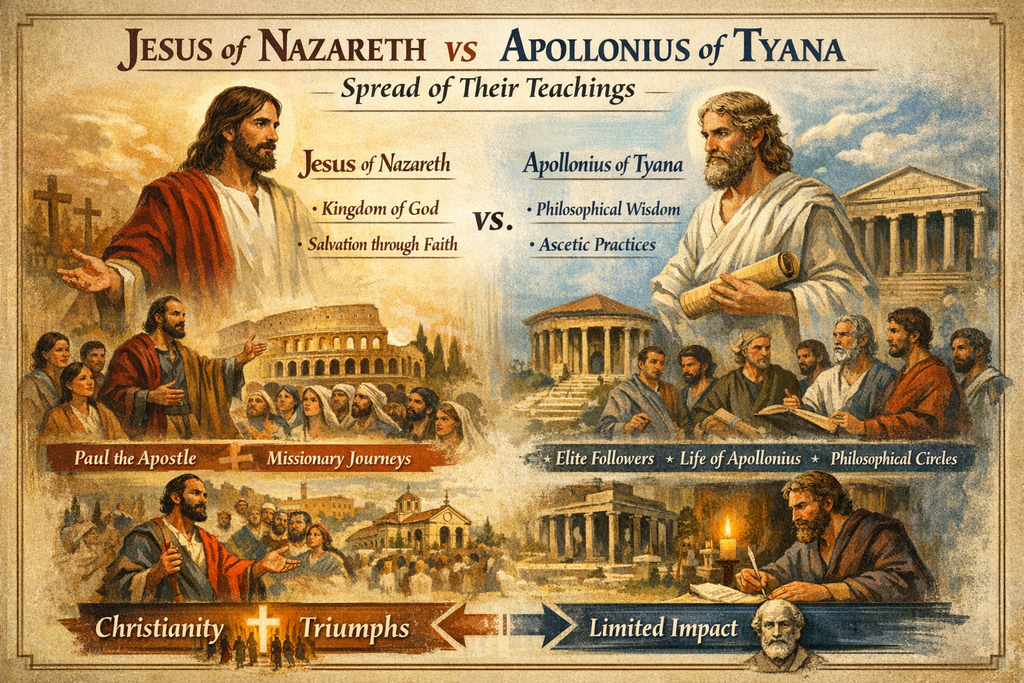
Comparing Jesus of Nazareth and Apollonius of Tyana
One of my particular interests is the history of religions. Every few months I come across an article that starts out describing an itinerant first century philosopher, teacher, healer, and miracle worker. We get to the end of the article and then the big reveal. Surprise, it’s not Jesus, it’s Apollonius of Tyana. Almost every one of these articles presents this as if they were the first one to discover Apollonius and they want to debunk the story of Jesus and point out that he was only one of many first century miracle workers and teachers. Their thesis seems to be that Jesus was no different than the rest, he just had better PR and now that they have revealed the truth, Christianity will crumble.
This strikes me as a facile and quite frankly dubious comparison
Both men lived in the first-century Roman Empire at about the same time. Both were regarded by their followers as miracle workers. Both taught virtues, challenged the powerful, and attracted disciples. Both are said to have ascended directly into heaven after death.
But that’s where the similarity ends. Only one of them launched a movement that reshaped the entire history of Western civilization. The other faded into obscurity; remembered today mainly as a footnote in attempts to discredit the other guy. The story of Jesus of Nazareth and Apollonius of Tyana is one of the most fascinating side-by-side comparisons in religious history.
Jesus of Nazareth
Jesus was a Jewish teacher from Galilee who began his public ministry around 28–30 CE. His movement grew out of Judaism, and he operated within that tradition. He quoted Hebrew scriptures, observed Jewish festivals, and preached to predominantly Jewish audiences. He gathered twelve close disciples, spoke to common people in everyday language, taught in parables, and performed healings. He often challenged religious and social authorities. He was crucified under the Roman governor Pontius Pilate around 30–33 CE. Soon after his death, his followers proclaimed that he had risen from the dead. That claim became the cornerstone of a new faith.
What makes Jesus important historically is the speed with which written accounts of his life appeared. Multiple authors, Matthew, Mark, Luke, and John, recorded his life and teachings within a few decades of his death, while eyewitnesses were still alive. Non-Christian sources, including the Jewish historian Josephus and the Roman historian Tacitus, also mention Jesus, providing independent corroboration of his existence and execution.
Apollonius of Tyana
Apollonius was a Greek philosopher from Tyana in Cappadocia (modern-day Turkey). He lived from roughly 15 CE to about 100 CE. He was a follower of the Neo-Pythagorean school of philosophy, a tradition that blended the belief of Pythagorus in the purification of the soul with elements of Platonism, Stoicism, and Eastern religious thought. He was reported to be celibate, vegetarian, and committed to a life of extreme asceticism. He traveled widely, to Greece, Egypt, Mesopotamia, and reportedly even India.
There is one important difference. Almost everything we know about Apollonius comes from a single source, a biography called the Life of Apollonius of Tyana, written by the Greek sophist Philostratus somewhere around 220–230 CE, roughly 120 to 150 years after Apollonius died. Philostratus claimed to be working from notebooks kept by a disciple named Damis, but those notebooks are lost and many scholars doubt they ever existed.
Some scholars have suggested that Philostratus may have used the Christian gospels as a source for the Life of Apollonius to create a kind of pagan counterpoint to Jesus by presenting a Greek philosopher who possessed many of the same extraordinary qualities.
The Teachings of Jesus
Jesus’s core message was that the Kingdom of God will transform the social and spiritual order in the present world. His ethical teachings were radical even by modern standards: love your enemies, forgive without limit, care for the poor, humble yourself before others. The essence of his teaching was summed up by the Sermon on the Mount. Jesus also claimed to have a unique personal relationship with God and to be the Son of God. He presented faith in himself as the path to salvation and eternal life.
Jesus’s teaching was revolutionary in its inclusiveness. He broke bread with tax collectors and prostitutes. He praised a despised Samaritan as a moral example. He welcomed women as disciples in a culture that largely excluded them from religious leadership. And he consistently inverted social hierarchies: the last shall be first, the meek shall inherit the earth. This was more than just nice philosophy; it was a direct challenge to the social order of the Roman world.
The Teachings of Apollonius
Apollonius’s message was rooted in Pythagorean philosophy, an intellectual, aristocratic tradition that emphasized mathematical harmony, spiritual purity, and the ascent of the soul through rigorous self-discipline. He preached vegetarianism and celibacy as paths to ritual purity. He taught that God was pure intellect, so far above human concerns that the only appropriate way to approach the divine was through the mind, not through prayer, sacrifice, or emotional devotion. He reformed religious practices in the cities he visited, arguing against animal sacrifice and promoting a more spiritualized form of worship.
Apollonius was a moral reformer who criticized tyrants, corrupt officials, and hypocritical priests, and counseled cities on just governance and social harmony. His ethical teachings urged moderation, justice, and respect for traditional civic life. These were admirable ideas, but they were fundamentally elitist. His teachings required education, leisure, and a philosophical temperament. This was wisdom for the learned few, not a message for the masses.
Beliefs About Jesus
The followers of Jesus made claims that were, by the standards of any religious tradition, audacious. They didn’t just say he was a great teacher or a holy man, they proclaimed that he was the Son of God, the Jewish Messiah, and the savior of all humanity. They believed the resurrection was not merely symbolic, but that it was a historical event witnessed by hundreds of people. The Apostle Paul, writing within twenty years of the crucifixion, lists specific individuals who had seen the risen Jesus, including a five hundred people who witnessed him as a group.
Christian theology also offered something emotionally powerful: a personal God who loves individual human beings, who forgives sin, and who promises eternal life to those who believe. The teachings of Jesus marginalized all other gods and powers, including Caesar, producing a strong internal cohesion and an identity distinct from other religions.
The resurrection provided an answer to the most universal human fear: death. The community that formed around this belief was unusually welcoming. It crossed lines of ethnicity, social class, and gender that were nearly impermeable in Roman society.
Beliefs About Apollonius
Followers of Apollonius regarded him as a divinely inspired sage, a ‘theios aner,’ or divine man, in the Greek tradition. This was a recognized category in pagan culture: a human being elevated by wisdom and virtue to something approaching the divine. Philostratus’s biography depicts him as a miracle worker who could heal the sick, raise the dead, and predict the future. After his death, stories circulated that he had appeared to a doubting follower in a vision, and that he had ascended directly to heaven.
But the theological claims about Apollonius were part of a different philosophical structure. In polytheistic Greek thought, becoming divine was a matter of degree; there were gods, demigods, heroes, divine men, and ordinary humans, arranged in a kind of spiritual hierarchy. Apollonius didn’t claim to be God, didn’t claim to offer salvation, and didn’t claim to have conquered death on behalf of all humanity. He was an extraordinary man who had achieved extraordinary wisdom, impressive, but not world-changing.
The Spread of Christianity
The early Christian movement spread through a combination of personal testimony, community formation, and relentless missionary work. The disciples of Jesus fanned out from Jerusalem almost immediately after the resurrection, establishing communities across the Roman Empire. Within a generation, there were Christian churches in Rome, Corinth, Ephesus, Antioch, and Alexandria. By the end of the first century, Roman officials were commenting on this new religion. Pliny the Younger, writing around 112 CE, described Christians in Bithynia as meeting before dawn to sing hymns to Christ “as to a god,” although he also described their religion as “depraved, excessive superstition.“
What made this spread so effective was the community it created. Christians took care of each other during plagues, rescued abandoned infants, fed the poor, and welcomed social outcasts. In the ancient world, where there was no social safety net, this was profoundly attractive. As historian Will Durant observed, the Christian Church prevailed over paganism because it offered a much more attractive doctrine, and because church leaders addressed human needs better than their rivals.
The Spread of Apollonius’s Legacy
The story of Apollonius spread very differently and much slower. It was essentially a top-down, literary affair. There was no mass movement of devoted followers evangelizing in the streets. The primary vehicle for Apollonius’s story was Philostratus’s biography, written around 220 CE at the commission of the Empress Julia Domna. This was a single literary work produced for educated, aristocratic readers and not a grassroots spiritual movement. The biography circulated among intellectuals and pagan philosophers but not among the common people who were searching for spiritual meaning.
Pagan philosophers like Porphyry and Hierocles later used Apollonius as a rhetorical weapon against Christianity. They argued that if Christians could point to Jesus’s miracles, pagans could point to Apollonius’s. But this was an intellectual argument, not a spiritual one. Nobody was gathering weekly to worship Apollonius, nobody was dying for their belief in him, and nobody was going door-to-door in the cities of the Roman Empire inviting strangers to believe in his resurrection.
Perhaps the clearest way to understand why Christianity succeeded and the Apollonius movement didn’t is to compare the two men most responsible for spreading each message: Paul of Tarsus and Philostratus of Athens.
Paul: The Missionary
Paul was arguably the most consequential religious missionary in human history. A Pharisee who had personally persecuted early Christians, he experienced a dramatic conversion around 33 CE. He spent the next thirty years traveling tens of thousands of miles across the Roman Empire, establishing Christian communities wherever he went. There are at least seven letters believed to have been directly authored by him and another three likely written by his followers and three of uncertain authorship that were written under his name. Those letters, still read by millions of people today, were written within twenty to thirty years of Jesus’s death, while the events were still fresh in living memory.
Paul’s genius was his ability to translate a Jewish message into Greco-Roman terms without losing its core. He could speak to Pharisees in Jerusalem and to Greek philosophers in Athens on the same topic. He reframed Jesus’s life and death in theological language that resonated across cultural boundaries. He interpreted Jesus’ message for a broader (Gentile) audience, emphasizing salvation through faith rather than adherence to Jewish law.
He also built real communities, churches with leaders, governance structures, and ongoing support networks. When Paul was done, a city had not only heard about Jesus; it had a functioning community organized around belief in him.
Crucially, Paul was willing to suffer for his message. He was beaten, shipwrecked, imprisoned, and ultimately executed. His willingness to die for what he believed gave his testimony a weight that no literary commission could match. He was sharing news about events he personally believed to be true, including his claim of a direct encounter with the risen Jesus.
Philostratus: The Hired Biographer
Philostratus was a talented Greek orator and scholar, but he was not a missionary. He wrote the Life of Apollonius at the explicit request of the Empress Julia Domna, wife of Emperor Septimius Severus, around 217-220 CE. The biography was commissioned by imperial patronage for political and cultural purposes, not a spontaneous work of personal conviction or spiritual revelation. Philostratus himself acknowledged he was working from sources he could not fully verify, and his account is filled with hedged language: ‘it is said that’ and ‘some believe’. Paul’s letters were personal and never employed equivocation.
Furthermore, Philostratus wrote more than a century after Apollonius died, when anyone who had known Apollonius personally had long since passed away. By contrast, Paul was writing within a generation of Jesus’s death, explicitly appealing to living eyewitnesses to verify his claims. The contrast in credibility is stark. Philostratus was producing high-quality literary propaganda. Paul was writing compelling personal testimony.
Paul’s letters were copied, shared, read aloud in communities, and translated to several languages. They circulated among ordinary people, slaves, freedmen, artisans, and merchants. Philostratus’s biography reached philosophers and the wealthy.
One movement went wide; the other stayed narrow.
Why Christianity Won: The Big Picture
The success of Christianity over the Apollonius movement, and over every other spiritual alternative in the Roman world, came down to several advantages.
First, the message was universal. Jesus’s gospel was for everyone: Jew and Greek, slave and free, male and female. Apollonius’s Pythagorean philosophy required education and leisure to be appreciated. Christianity could be grasped by an illiterate farmer in Syria or a senator in Rome.
Second, the community was real. Christian churches were functioning communities that provided mutual aid, social belonging, and shared identity. The Apollonius movement never produced anything like this. As historian Rodney Stark has argued, Christianity replaced paganism largely because it improved the lives of its adherents in concrete, measurable ways.
Third, the documentation was early. Multiple independent accounts of Jesus’s life appeared within decades of his death, while eyewitnesses were alive to confirm or deny them. The Apollonius story appeared 150 years after his death, from a single commissioned source, with no living witnesses.
Fourth, the theological core was transformative. The resurrection of Jesus was not just a claim about one man; it was a promise for every human being who believed in him. Death itself had been defeated. No philosopher, however wise, offered that.
John Remsburg, writing in 1909, put it simply: the religion of Apollonius disappeared because the proper conditions for its development did not exist. Christianity thrived because the existing conditions were favorable and because its message was more powerful.
Finally, Christianity had Paul. One passionate, tireless, theologically sophisticated missionary who planted churches from Jerusalem to Rome is worth a thousand imperial commissions. Philostratus produced a book. Paul changed the world.
It seems that hardly a week goes by that I don’t see one or more articles about some aspect of the “generation gap”. Usually, they have something to do with old folks complaining about how the younger generation has no manners, respect, or work ethic and the younger people complaining about how the old fogeys—usually referred to as Boomers—just don’t understand technology, social media, or whatever the hot item of the day is. Of course, they expect us old folks to benefit from the vast experience gained in their two and a half decades of life. I’m always reminded of an old saying, “all old people were young once, but no young person has ever been old.” Of course, there I go again, another Boomer wandering back into the past.
But there is a real generation gap, and it is “bar soap versus shower gel.” It’s hard to believe, but somebody actually did a survey on this subject and found that 65% of older people prefer bar soap while about 75% of younger people preferred shower gel.
It actually surprised me to learn that all that soap in the squeeze bottles isn’t the same. There is shower gel and then there is body wash. Apparently, body wash is more moisturizing while gel is better for oily skin. I just know that I don’t care for either one of them and I always feel like they never get completely rinsed off.
My wife and I have been doing a lot of traveling this summer and it seems that hotels have almost all completed their transition from bar soap to that liquid stuff in a dispenser hanging on the wall. From what little research I’ve done, apparently this went into full swing during COVID. The claim was that the shower gel is less likely to transmit infection. Although I don’t understand how a dispenser that sits there all the time and is handled by everyone is less a threat of infection than an individually wrapped bar of soap that only I handle. I think it’s just cheaper.
I only ask one thing from a bar of soap and that’s to get me clean. It’s a pretty simple process. You pick it up. You use it. You put it down. You can hold it in one hand. You’re not trying to open a slippery bottle with wet hands. In between showers the soap just sits in a dish waiting for its next job.
It seems to me that life with shower gel is much more complicated. You can’t take a shower until you have a collection of bottles and a personal development plan. You must have one bottle for your hair, one bottle for your face, and another bottle for your body. You have your energizing body wash for the mornings and a calming body wash for evenings. You also have a body wash with botanical extracts for when you need to reconnect with nature. It’s important to have a selection of body washes to be sure that one will match your mood. And don’t even get me started on exfoliating.
If you ask, “Which one is soap?”, you get the answer “It’s not soap, it’s a hydrating shower gel.” You then ask, “Does it get you clean?” And the answer is “Yes.” You respond, “Then it’s soap.” Although I suppose that may be considered an insensitive line of questioning.
I know when my bar of soap is about to fade away, it keeps getting smaller. With shower gel you don’t discover the bottle is empty until you’re standing there soaking wet and trying to squeeze out the last little bit. Maybe it’s just me, but I’d prefer a little advance notice.
And then there’s the whole thing about fragrances. I prefer my soap to smell something like soap. With shower gel there is a whole range of everything from cedarwood to spice to cinnamon to coastal sage to citrus fruit. I can’t even begin to guess what Morning Breeze is supposed to smell like.
I suppose that there’s room for coexistence. I’ll keep my bar of soap, and they can keep their collection of squeezables. But it’s going to take a much larger soap dish. Just so no one expects me to try their brand new $20 bottle of eucalyptus body wash.
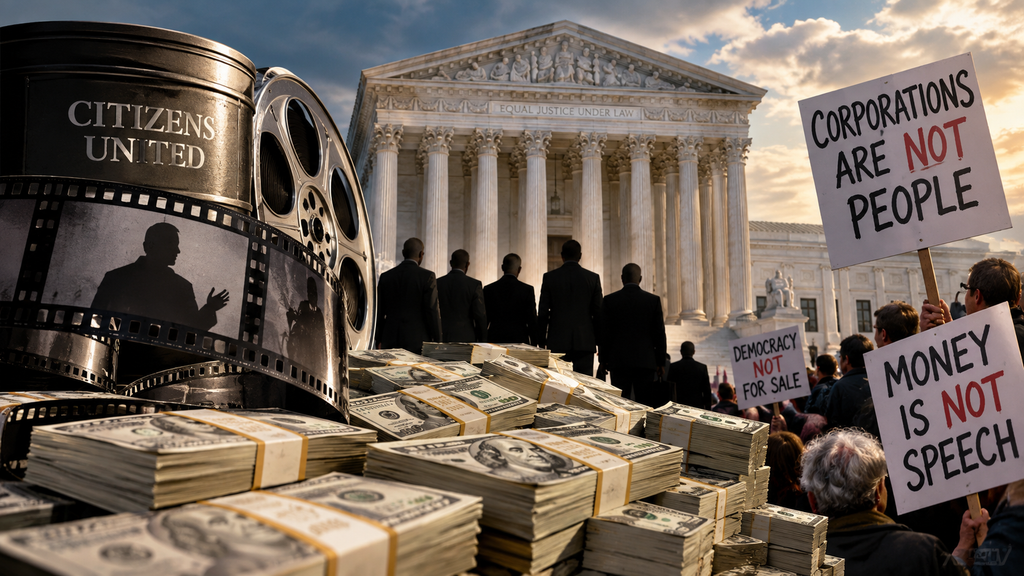
In January 2010, the U.S. Supreme Court issued one of the most consequential and controversial campaign-finance decisions in modern American history: Citizens United v. Federal Election Commission. The 5–4 ruling dramatically altered the regulatory restrictions on political spending. It allowed corporations, labor unions, and nonprofit organizations to spend unlimited amounts of organizational funds to independently support or oppose political candidates.
It was hailed by supporters as an important victory for freedom of speech and condemned by critics as opening American elections to the unprecedented influence of special-interest money. For more than sixteen years, Citizens United has shaped the way political campaigns have been financed and continues to do so as we approach the 2026 midterm elections.
I first published this article a little over a year ago and with the reports of increasing sums of dark money being spent on this election, I decided it was time to update it.
The Origins of the Case
In 2008, Citizens United, a conservative nonprofit organization, produced Hillary: The Movie, a 90-minute documentary highly critical of then-Senator Hillary Clinton, who was seeking the Democratic presidential nomination. Citizens United planned to distribute the film as a video-on-demand during the primary season.
The Bipartisan Campaign Reform Act of 2002, also known as McCain-Feingold, prohibited corporations and labor unions from using their general funds for “electioneering communications” during federal elections. Citizens United challenged the restriction, arguing that it violated the First Amendment.
A three-judge federal district court ruled against Citizens United and the organization appealed to the Supreme Court.
The Supreme Court could have decided the case narrowly; but the justices chose to address the larger question of whether previous precedents restricting corporate political expenditures should be overturned.
The Supreme Court’s Ruling
On January 21, 2010, the Court ruled 5–4 in favor of Citizens United. Justice Anthony Kennedy wrote the majority opinion, joined by Chief Justice John Roberts and Justices Antonin Scalia, Clarence Thomas, and Samuel Alito.
The Court concluded that the government could not restrict independent political expenditure based on the identity of the speaker. Corporations and unions could now use treasury funds to pay for independent communications supporting or opposing candidates.
Kennedy wrote that political speech is “indispensable to decision making in a democracy,” even when the speaker was a corporation.
The decision overturned Austin v. Michigan Chamber of Commerce (1990) and part of the Court’s earlier ruling in McConnell v. Federal Election Commission (2003).
Justice John Paul Stevens wrote a lengthy dissent. He argued that corporations were different from individual citizens in ways that legitimately justify different campaign-finance rules. He warned that the decision would undermine public confidence in democratic government.
The Court did not rule that corporations could contribute unlimited amounts directly to candidates. Limits on direct campaign contributions remained in effect. The ruling concerned independent expenditures—money spent advocating for or against candidates without legally prohibited coordination with their campaigns.
Super PACs
It is misleading to say that Citizens United alone created super PACs, but it certainly laid the groundwork.
Two months after Citizens United, relying on the Supreme Court’s reasoning in that case, the U.S. Court of Appeals for the District of Columbia Circuit decided SpeechNow.org v. FEC. It concluded that the government could not limit contributions to organizations that made only independent expenditures.
The combination of Citizens United and SpeechNow produced the legal foundation for what would become known as the super PAC.
Unlike an ordinary political action committee, a super PAC can accept unlimited contributions from individuals, corporations, unions, and other political committees. It cannot contribute directly to a candidate, and its expenditures must remain legally independent of the candidate it supports.
The distinction sounds significant on paper, but it has become one of the most disputed features of modern campaign finance.
While federal law still prohibits actual coordination as defined by FEC regulations, critics argue that the rules leave considerable room for outside organizations and campaigns to operate in parallel while maintaining the legal fiction of independence. Super PACs can be organized by people who previously worked for a candidate. They can devote all their resources to electing a single candidate. They can conduct advertising and voter-mobilization programs that closely mirror a campaign’s own activities.
The Explosion of Outside Spending
Outside political spending has increased enormously during the post-Citizens United era. According to an OpenSecrets analysis reported after the 2024 election, spending outside reached a record of approximately $4.5 billion. Super PACs accounted for a large portion of that spending.
America PAC, the super PAC closely associated with Elon Musk, reported approximately $263 million in receipts and $261 million in expenditures during 2024. About $174 million of its spending was reported to the FEC as independent expenditures.
While Musk was hardly the only wealthy donor, OpenSecrets estimated that he gave more than $291 million to Republican candidates, political committees, and “unaffiliated” organizations during the 2024 cycle. Five other individuals each contributed more than $100 million to groups supporting Republican candidates and issues. Democrats likewise benefited from wealthy donors though to a significantly lesser degree.
The Rise of Dark Money
The least transparent part of the system is what has become known as “dark money.”
Super PACs themselves generally must disclose their donors. But some nonprofit organizations and shell companies can participate in political spending without publicly revealing the source of their money. These organizations can also contribute money to super PACs, producing situations in which the super PAC discloses the organization that gave it the money without necessarily revealing the original source.
A Brennan Center analysis published in 2025 estimated that at least $1.9 billion in dark money entered federal elections during the 2024 cycle, nearly twice the comparable total for 2020. Approximately $1.3 billion came from nonprofits and shell companies contributing to super PACs.
The researchers cautioned that even the $1.9 billion figure was probably an underestimate because some political activity, particularly certain forms of digital advertising and spending, cannot be fully tracked. They estimated that dark-money organizations probably have spent at least $4.3 billion influencing federal elections since Citizens United.
What About Corruption?
The Court rejected the argument that independent expenditures created the same corruption concerns as direct contributions to candidates. The Court reasoned that if a corporation or individual independently purchases an advertisement supporting a candidate, that expenditure does not create the same potential quid pro quo arrangement as giving money directly to the candidate.
Critics argue that this distinction has little validity in the real world. A donor may give millions of dollars to a super PAC devoted almost entirely to electing one politician. Even without an explicit agreement between donor and candidate, it is hard to believe that such spending doesn’t provide extraordinary access and influence.
Supporters of the decision say that influence is not the same thing as bribery or corruption. Wealthy people, corporations, unions, newspapers, advocacy organizations, and ordinary citizens all have constitutional rights to advocate political ideas. From this perspective, allowing government to decide that some speakers possess too much influence creates its own threat to political expression.
What Americans Think
Public reaction to the ruling has historically been negative, although the best-known nationwide polls are now over a decade old.
A Washington Post–ABC News poll conducted shortly after the 2010 decision found that 80 percent of respondents opposed the ruling, including 85 percent of Democrats, 76 percent of Republicans, and 81 percent of independents. Two years later, Pew Research Center found that 65 percent of registered voters who knew about the new independent spending rules believed they were having a negative effect on the presidential campaign.
Reform Efforts
Some reform advocates favor a constitutional amendment allowing Congress and the states greater authority to regulate campaign spending. Others concentrate on disclosure requirements, arguing that even if independent spending remains unlimited, voters should at least be able to determine who ultimately supplied the money.
Another approach is to restrict contributions to super PACs through legislation designed to invite reconsideration of the constitutional issues by the Supreme Court.
The Abolish Super PACs Act, H.R. 2352, was introduced in the House in March 2025. A Senate version, S. 4602, was introduced by Senator Bernie Sanders in May 2026. Both seek to impose contribution limits on super PACs. As of October 2026, neither has become law.
The prospects for major reform are complicated by the First Amendment principles established in a series of campaign-finance decisions extending back decades. Congress cannot simply reenact the restrictions struck down by the Court and expect them to survive constitutional review by a court that still has many of the justices who made the original ruling.
Citizens United and the 2026 Elections
As November 3, 2026, midterm elections approach, Citizens United remains firmly in place. The super PACs and other outside organizations are still important participants in congressional races.
The enormous sums involved have changed the nature of political campaigns. The individual candidate is no longer the largest financial force in most national and in some state and local elections. A few wealthy donors or organizations can influence the outcome by spending millions of dollars supporting or opposing candidates without ever contributing money directly to any campaign.
It is hotly debated whether this represents an expansion of political freedom or a form of de facto political bribery. This is the fundamental disagreement about Citizens United.
Citizens United did not invent money in American politics. Wealthy donors, corporations, unions, political machines, and special interests have influenced elections since the founding of the republic. The decision didn’t eliminate contribution limits, and it didn’t allow every form of political spending to be kept secret.
It did change one of the rules governing political power. The government can no longer limit independent political expenditure simply because the speaker is a corporation or union. Combined with SpeechNow, it produced a political system in which billions of dollars can be raised and spent outside the traditional campaign structure.
The debate reaches well beyond campaign finance law and asks a question we have struggled with since our first elections. When does protecting political liberty for individuals and organizations begin to conflict with preserving political equality among citizens?
More than sixteen years after Citizens United, we are still trying to answer it.
Images generated by author using ChatGPT.
References
Supreme Court of the United States.Citizens United v. Federal Election Commission, 558 U.S. 310 (2010). The Court’s official published opinion. Supreme Court — Citizens United v. FEC
Federal Election Commission. “SpeechNow.org v. FEC.” Summary of the 2010 D.C. Circuit decision that helped establish the legal basis for independent-expenditure-only committees. FEC — SpeechNow.org v. FEC
Federal Election Commission. “Understanding Independent Expenditures.” Explanation of federal rules governing independent and coordinated spending. FEC — Understanding Independent Expenditures
Federal Election Commission. “Types of Nonconnected PACs.” Explanation of super PACs and hybrid PACs. FEC — Types of Nonconnected PACs
Federal Election Commission. “America PAC — Committee Overview.” Official campaign-finance reports for America PAC. FEC — America PAC
Brennan Center for Justice. Anna Massoglia, “Dark Money Hit a Record High of $1.9 Billion in 2024 Federal Races,” May 7, 2025. Brennan Center — 2024 Dark Money Report
OpenSecrets. Anna Massoglia, analysis of record outside spending in the 2024 federal elections. The analysis calculated approximately $4.5 billion in outside spending. OpenSecrets analysis — 2024 Outside Spending
In July 2025 when Trump descended that famous escalator to announce his candidacy for the Republican presidential nomination, I thought he was just a fading reality TV star trying to increase his brand. I never suspected he would be a serious candidate, but I hoped that he would bring some entertainment to what appeared to be a large but otherwise boring field of Republican candidates. I just hoped he wouldn’t drop out too soon. I never expected nor could even have imagined that this would be the beginning of more than a decade of turmoil, the least of which is Trump‘s relationship to the media.
Interestingly, Trump’s love-hate relationship with the media didn’t begin with his presidential campaign. In the 1970s and 80s when he was a real estate developer, he began courting the press. Like most things in his life, it was transactional. He would trade gossip and insider information about the real estate business in return for favorable publicity about himself and his businesses. He was even known to call reporters using a fake name to praise himself and try to curry more favorable coverage.
Even then he was not above criticizing the press, laying the early groundwork for his much later claims of “fake news “. If a news article listed his net worth as being less than what he claimed or would criticize a real estate project, he would respond with unfailing criticism. He filed a $500 million lawsuit against the Chicago Tribune after an article criticized his 150-story Manhattan skyscraper project as being “one of the silliest things anyone could inflict on New York “. He also filed a $5 billion lawsuit against journalist Timothy O’Brien for his 2005 book Trump Nation which estimated his net worth in between $150 million and $250 million, far below the billions that Trump had claimed. Both of these lawsuits were dismissed. This may have set the stage for Trump’s litigative interaction with the news media. He didn’t have to win to get the attention he was seeking. Later, as president he would have the additional leverage to almost force settlement by the news media who needed his approval for their larger projects.
Trump’s relationship with the media changed with the premiere of The Apprentice in 2004. The show presented Trump as an exceptionally successful and decisive businessman. Since it wasn’t journalism, but was instead entertainment, it was given a factual pass. The Apprentice left him accustomed to mostly favorable coverage, making the media response to his campaign that much more surprising to him.
Back to the escalator.
At first, most of the media treated him as a curiosity, and an entertaining one as well. He could be counted on for a colorful quote or a timely soundbite. Some thought it was a publicity stunt designed to increase his reality TV brand. But early in his campaign for the nomination, his tone turned dark, attacking immigrants, liberals, and his opponents for the nomination. He no longer seemed as amusing.
As reporters began to dig into his finances and business practices and to question the credibility of many of his claims, Trump went on the attack.
He quickly learned that he could dominate a news cycle with provocative statements, outrageous claims, and personal insults. While the coverage was not always positive, it always satisfied his need for attention. He was beginning to refine his persecution narrative that would become a central theme in his personal political brand.
Trump’s first use of his now iconic phrase “fake news” was on December 10th, 2016, in a tweet about a month after he won election. In a January 11th, 2017, news conference Trump refused to answer a question from CNN correspondent Jim Acosta saying, “You are fake news.” He rapidly incorporated that phrase for anything that was critical or with which he disagreed. He went so far as to call much of the media “enemies of the American people”. He was attempting to claim the news outlet critical to him were in fact hostile to the country.
Trump claimed to have invented the term “fake news,” but like many other things associated with him it did not stand up to scrutiny. The Oxford English Dictionary identifies the earliest use of the term as a story in the Milwaukee Daily Journal in 1890. The term “fake news” appeared in numerous newspapers throughout the 1890s and early 1900s. Even earlier, newspapers had used a term “false news” for stories they felt were obviously untrue. This usage was limited to stories that were believed to have been fabricated. Trump morphed it into a criticism of anything he didn’t like.
Trump’s battle with Jim Acosta continued until November 2018 when he revoked Acosta’s White House press credentials. This is the first time that a president’s press office has ever cancelled a reporter’s credentials for anything other than a security or conduct issue.
His battle with the press continued in his second term. He developed a new strategy and began to file defamation and related lawsuits against major news outlets. He filed multiple lawsuits, both against broadcast organizations and the print media, including CBS News, ABC News, the Wall Street Journal, the New York Times, and BBC.
Despite the fact that most legal observers found the suits to be baseless, ABC News and Paramount, the parent company of CBS, settled with Trump almost exclusively on his terms. Many observers thought that this was largely because of his threats, both direct and implied, to their broadcast licenses.
The battle with the media reached its high point in September of 2026 when he announced that CNN, Politico, and MS NOW would be barred from the White House press pool and their reporters’ credentials were cancelled. Those organizations filed suit alleging the administration had violated their 1st and 5th Amendment rights.
Because of the limited space available in the White House pressroom, news organizations have typically rotated to cover news conferences forming a “pool” that will then share information with the other news agencies. News networks, including Fox News, canceled pool television coverage of some events. The New York Times and the Washington Post temporarily stopped photographing White House events.
This dispute is ongoing. All three organizations have regained access to the White House grounds but still find themselves limited in coverage of presidential events.
To be fair, not all of Trump’s complaints were without basis. During his first campaign and subsequent presidential term some stories were based on anonymous sources that later proved incorrect or overstated. Investigation into Russian election interference in 2016 was often based on speculation and political commentary was not always kept separate from news reporting.
Trump has a more cordial relationship with the conservative media, particularly Fox News. Although it is not without its rough patches. When Fox News announced on election night in 2020 that Joe Biden had won in Arizona, Trump reacted angrily. He encouraged his supporters to turn to Newsmax, and One America News Network because they supported him unconditionally and and were willing to accept his unfounded claim of election fraud. Trump often failed to distinguish between Fox’s conventional news operations and its openly partisan opinion programming, believing that any criticism of him, even factual, was fake news.
Even during his battles with mainstream media organizations Trump had an advantage that no other president previously had. He understood social media like no one else before him. Other candidates had assumed that social media was a way just to reach younger voters. Trump realized it could be used to reach across all ages, social and economic classes, and political affiliations. He used social media, particularly Twitter, to attack his enemies, make outrageous statements, and to fire up his supporters.
Trump’s Twitter account was suspended on January 8, 2021, because the company believed his posts posed a “risk of further excitement of violence“ following the January 6 attack on the capital. Twitter said the post violated its policy against glorifying violence. Facebook, Instagram, YouTube, and Snapchat quickly followed suit.
Following his suspension from Twitter, Trump was instrumental in forming his own social media outlet, Truth Social. Even though Trump’s Twitter, now X, account was restored in November 2022, Truth Social remains his principle social media outlet.
Trump turned increasingly to social media as he discovered it freed him from editors, publishers, and most importantly, fact checkers. He began to release policy statements, discuss pending legislation and even fire administration officials via social media. Many of his posts were made obviously without review by advisors, administration officials or attorneys. At times, such as tweets about tariff rates, transgender military personnel, Obama wiretapping Trump Tower, and the now infamous memes, the White House found itself having to give elaborate, sometimes convoluted, explanations of what Trump really meant.
Trump was far from the first president to have difficulties or complaints about the press. George Washington was frequently angered by newspaper attacks. John Adams signed the sedition act of 1798 and used it to prosecute journalists critical of him and the federal government. Abraham Lincoln’s administration put restrictions on some newspapers during the civil war. John Kennedy was publicly friendly with the press but was known to exert backchannel pressure to suppress stories of which he disapproved. Prior to Trump, no president had as hostile a relationship with the press as did Richard Nixon. He maintained an enemy’s list and used Vice President Spiro Agnew as a proxy to attack newspapers and television journalists.
Trump is part of a long history of presidents who were unhappy about their news coverage. What makes him different is his constant personal attacks, direct communication through social media, litigation against news organizations and attempts to directly control access to White House news events. His actions are not merely in response to controversial policies or bad coverage, they are part of his governing philosophy, reinforce the message that established news outlets cannot be trusted and that only he will provide the truth. Unfortunately, it seems to be working.
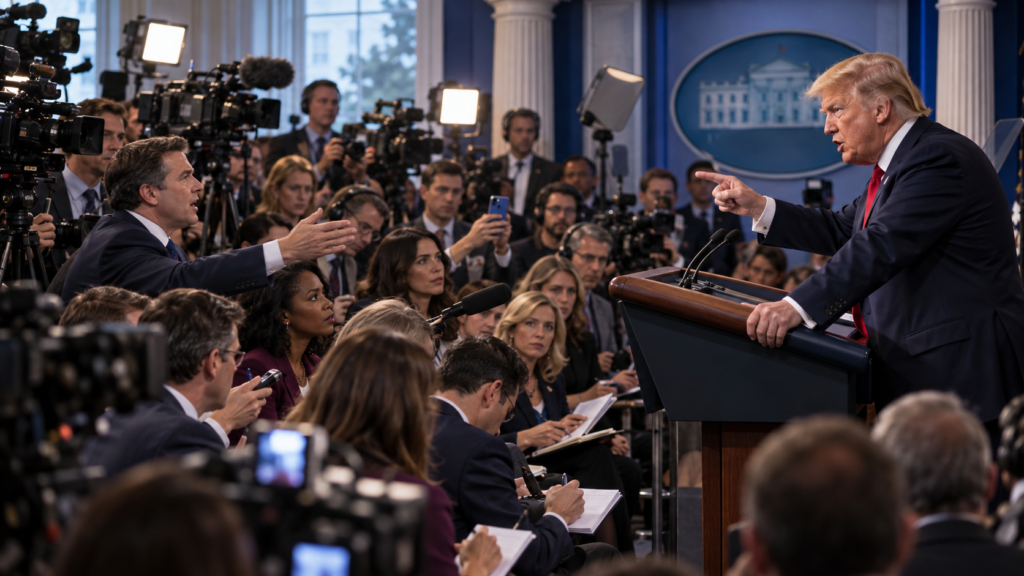
Image generated by author using ChatGPT.
Sources
1. History Hit, “Fake News, Donald Trump’s Relationship With It and Its Chilling Effects Explained” (background on the 2017–2018 Acosta press conferences and the rise of the term “fake news”): https://www.historyhit.com/fake-news-donald-trump/
13. History News Network, review of Harold Holzer, “The Presidents vs. the Press” (historical comparisons involving Adams, Lincoln, T. Roosevelt, Wilson, and Nixon): https://hnn.us/article/177037
Americans have been arguing about the place of religion and government since before the constitution was written. Is this a Christian nation, or did the founders deliberately create a government that was not Christian? The question has never really gone away it has resurfaced in a 224-page draft report from President Trump’s Religious Liberty Commission.
The Founding Generation
The Declaration of Independence unquestionably assumes a divine source for human rights. But that is not the same thing as declaring that the United States is a Christian nation, particularly if “Christian nation” means a country whose government was founded upon Christianity, biblical law, or Christian doctrine.
We would be equally mistaken to portray the Declaration as an atheistic or thoroughly secular document. God is clearly present in its philosophical framework.
The more difficult question is: What kind of God? The Declaration never mentions Jesus Christ, Christianity, the Bible, salvation, the Trinity, the Church, the Gospel, or Christian revelation. Instead, its terminology, “Nature’s God,” “Creator,” “Supreme Judge,” and “divine Providence,” is broad enough to encompass traditional Christians, more rationalistic Christians, and people influenced by the Enlightenment and natural religion.
That appears intentional. The Declaration was a political statement intended to speak for thirteen colonies containing Anglicans, Congregationalists, Presbyterians, Quakers, Baptists, Catholics, and others. The National Archives describes its preamble as deliberately “universal in tone and scope.”
The phrase most often cited as evidence of a Christian founding, that all men are “created equal” and “endowed by their Creator” with unalienable rights, comes from the Declaration of Independence. It is a document Thomas Jefferson drafted in language borrowed heavily from Enlightenment natural rights philosophy, particularly John Locke’s.
The word Creator was compatible with the rational religious language favored by Jefferson and other enlightened thinkers, but it was hardly exclusive. An orthodox Christian could embrace the same language. What is significant is that the declaration does not identify the Creator specifically with Christianity or Christian doctrine.
Jefferson himself held famously unorthodox religious views and has been referred to by some as a deist. He later produced his own edited version of the Bible that removed its miracles. Benjamin Franklin’s religious views were also unorthodox by conventional Christian standards. Labeling individual founders simply as deist can obscure how complicated their beliefs actually were.
That is not to say Christianity was irrelevant to the founding generation. Many signers were devout, and Christian moral vocabulary saturated their writing. But the founders were not of one mind on religion, and they did not create a sectarian Christian statement.
The political argument was straightforward. Rights did not originate with government. Government existed to protect them, and a government that persistently violated them undermined its own claims of legitimate authority.
The Constitution Says Nothing About God
Whatever we may make of the Declaration’s phrasing, we should remember that it did not create the American government. The Constitution did, thirteen years later. The Constitution is conspicuously silent on the subject of God or Christianity.
Article VI bars any religious test for holding federal office, and the First Amendment forbids Congress from establishing a religion.
Nineteenth-century efforts to amend the Constitution to explicitly acknowledge God failed to gain traction. If the founding generation intended to build an officially Christian government, it’s odd they would leave it out of the document that established that government.
This doesn’t make the founding generation hostile to religion. Rather, it shows a constitutional design in which religious belief could flourish voluntarily but would not be the condition of citizenship, officeholding, or federal legal authority.
The Treaty
One of the most frequently cited founding-era statements comes from the 1797 Treaty of Tripoli. The English version submitted to the Senate declared that “the government of the United States of America is not in any sense founded on the Christian Religion.” The Senate approved the treaty and President John Adams signed it.
There is, however, an important complication. That famous sentence has no counterpart in the surviving Arabic text. How the English version came to contain the statement remains unexplained.
Even so, the fact that a Senate full of men who had lived through the founding felt no need to qualify or debate that sentence before ratifying it indicates they didn’t object to the wording.
The Same Argument, Two Hundred and Fifty Years Later
This argument resurfaced in 2026 around the report of the Religious Liberty Commission. The White House describes its membership as representing many religious and professional backgrounds. PBS has characterized the Commission as composed almost entirely of conservative Christians along with one orthodox rabbi.
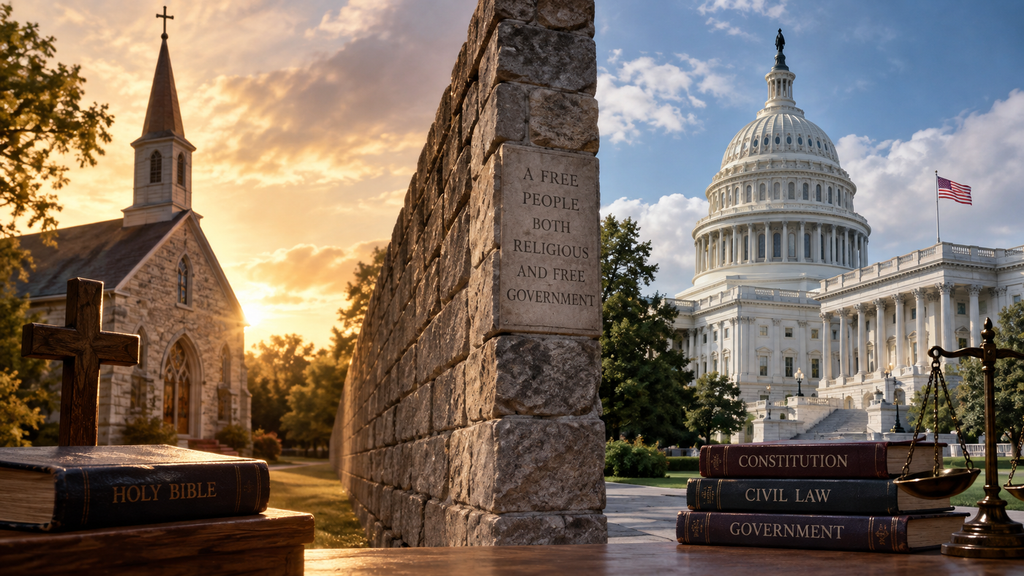
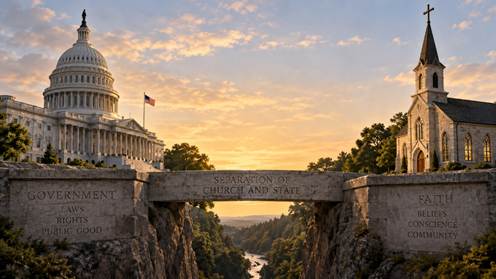
According to reporting from PBS and NBC News, the commission’s draft report argues for replacing the traditional “wall of separation” framing of church and state with the idea of religious liberty as a “bridge” connecting the two. It leans on the premise that the country was founded on Judeo-Christian or Christian principles.
Historical record is messier than either side of the modern controversy acknowledges. Religious ideas unquestionably influenced many of the founders. At the same time the constitution they produced did not establish Christianity as the basis of federal authority. Americans have been arguing about the significance of those two facts ever since.
Indeed, one of the remarkable achievements of the nation’s founding was that people whose religious beliefs differed substantially could agree upon the proposition that human beings possess rights that government did not give them and therefore government cannot legitimately take away.
That was Jefferson’s political point. For the purposes of the declaration, it is the source of those rights that matters. Defining the precise theology of the Creator does not.
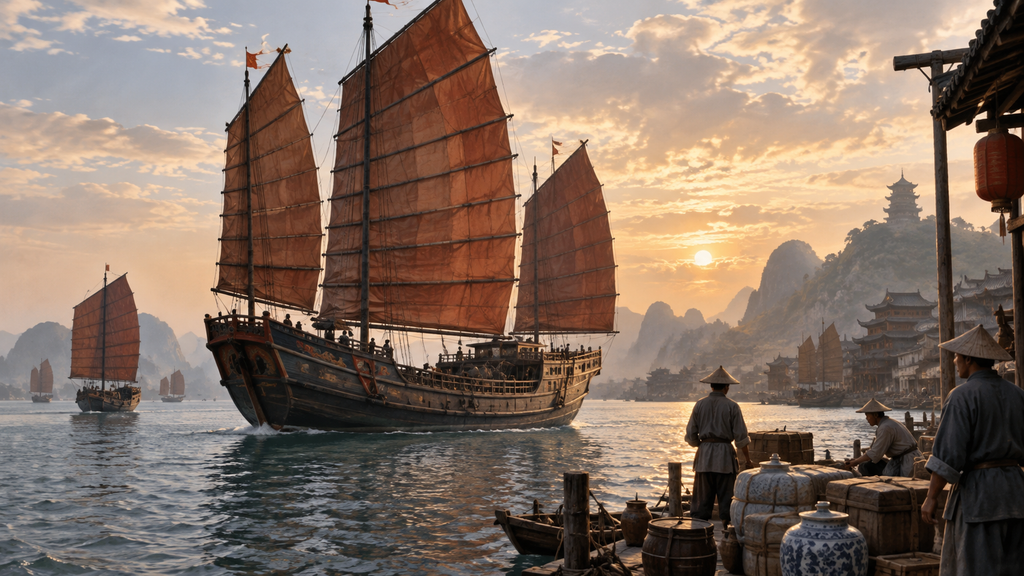
I joined the Navy when I was 19 and I’ve been fascinated with ships ever since, ships of all kinds from square rigged clippers to super tankers. One type of ship that has always held a particular fascination for me is the Chinese junk. Perhaps, it’s because it seems so exotic and it gives hints of adventure. I can remember the first time I saw a junk under full sail. It was 1970 when I visited Hong Kong. I had just got off the Star Ferry, and I caught sight of it sailing across the harbor. I just stood there, watching it until it disappeared from sight and wishing I hadn’t left my camera in the hotel.
The Chinese junk isn’t a single ship design. It’s a family of crafts design to sail in China’s rivers and estuaries, along the coast, and on the open sea. It’s an example of practical shipbuilding, designed to be adaptable to multiple environments.
The word junk isn’t even a Chinese one. It was most likely coined by English traders. The Chinese referred junks by the general name chuan, which means simply “ship” or ‘boat’. Junk may have been derived from the Javanese word jong or the Malay word ajong, both of which refer to a large ship.
We don’t know exactly when the junk was first developed but it may extend all the way back to the Han dynasty, roughly 220 BCE. The earliest versions were likely made of wood, bamboo or reeds and those materials rarely survive for later examination. Early versions of the junk have been documented as operating in the Yangtze River and coastal waters and estuaries and even venturing into maritime trade throughout East Asia.
The most distinctive feature of the junk is its flat or shallow bottom hull, rather than the deep keel vessels associated with European design. The design makes it susceptible to being pushed sideways by the wind while under sail. But the Chinese shipbuilders outfitted it with leeboards, center boards and large adjustable rudders which could extend it into the water to prevent sideways drift and to help maintain course, much like a keel on European ships. Unlike European ships, these elements could be retracted to allow it to enter shallow water and even to be beached to load or unload supplies or make repairs.
The broad beam of the ship and its flat bottom also gave it the ability to handle a large volume of cargo. This was an advantage for traders carrying bulky commodities such as rice, ceramics, textiles or salt. The design also provided a military advantage because it could carry larger numbers of troops and horses than could be carried on a European style ship.
The most significant innovation in the Chinese junk may have been the development of watertight bulkheads. The bulkhead is a wall that separates portions of the ship to prevent flooding should any portion of the hull develop a leak. That way the integrity of the entire ship would not be compromised by a hole in a single area. The bulkheads also strengthened the hull of the ship allowing it to endure greater stress from violent waves and wind. It also increased the capability to carry larger cargo. This is probably the major contribution that the Chinese made to the greater science of shipbuilding and naval technology. Western shipbuilders later adapted this same principle for their ship construction.
The junk sails are both innovative and distinctive. The sails are often fan shaped and are divided into sections separated by horizontal battens usually made of bamboo or wood. These distribute the stress across the fabric and help the sail retain its shape. The early sails were mostly made from woven matts or grasses while later examples were made from more durable cloth. The battens make it easier to raise and lower the sails without requiring sailors to climb up into the riggings to furl or unfurl canvas. Sails can be more quickly and easily adjusted to the weather conditions, allowing the ships to operate with smaller crews. The sails also feature another innovation that was not common among European ships. They can be easily rotated, giving the junk additional maneuverability in harbors and narrow rivers.
Depending on the size of the ship, they may have anywhere from one reportedly up to as many as nine masts on the largest of the naval vessels. The greater number of masts spread the sail area across the ship to adapt to varying wind conditions, allowing the ship to continue under sail in heavy weather, even if a mast or a sail was damaged or completely lost.
Junks have an extremely high stern area. This is useful both as a living and a working space. It can accommodate crew’s quarters, storage, cargo, and historically provided a defensive position in case of attack. Most junks are steered by a tiller operated rudder, and the high stern provides additional leverage to operate the rudder.
The junks aren’t simply limited to the local Chinese area. During the Ming dynasty between 1405 and 1433 CE Chinese fleets operated throughout Southeast Asia, across the Indian Ocean, into the Persian Gulf, and the ports of Arabia and East Africa. They carried political envoys, trade goods, supplies, and tribute. They conducted trade with Buddhist, Muslim, Hindu, and Christian communities and facilitated some of the earliest interactions between these groups.
Junks are best known to western historians from a voyage that occurred in the early 15th century. Admiral Zheng He commanded what became known as “treasure voyages” for the Ming dynasty. His fleets reportedly included massive junks up to 400 feet in length with as many 9 masts, although many historians doubt they were this large. Regardless of the actual size, they were far superior to any European ships of the same era both in size and technology.
Today, we think of the junk most often as a quaint and picturesque tourist symbol usually associated with Hong Kong. But the junk isn’t merely an attractive photo op. It is a sophisticated design that met the demands of a seafaring community. It has an innovative hull with an adjustable steering system, compartmental construction, and battened sails that set the standard for centuries before the advent of steam propulsion. It carried more than cargo. It carried knowledge, technology, and civilization across the waters of Asia and eventually across the waters of the world.
If you’re a history buff like me, you’ve probably run across fascinating but obscure characters who played a large role in a small region in distant history. I recently came across one of those people who was only referenced on a single page of a book I was reading. But the description of her was enough to get me interested in finding out more.
History has a habit of forgetting women who shaped it, especially women from Africa. But Amanirenas, the warrior queen of the ancient empire of Meroë, pulled off something that almost no one else in the ancient world ever managed. She fought Rome to a standstill and walked away with her kingdom’s independence intact. That alone makes her story remarkable.
A Kingdom You Have Never Heard Of
To understand Amanirenas, you first need to understand Meroë, and most western history classes have completely skipped it. Meroë was the capital of the Kingdom of Kush in what is now northern Sudan. It was a sophisticated, wealthy empire and was a major power in northeastern Africa for over 1000 years. The Egyptians called it Nubia “Ta-Seti”, the Land of Bows, as a tribute to the extraordinary skill of Kushite archers.
Meroë was one of the most important trading hubs of the ancient world. It sat at a natural crossroads between the Mediterranean world and sub-Saharan Africa. Ivory, gold, iron, grains, and livestock all flowed through the city. The Egyptians depended heavily on this trade, giving Meroë’s rulers extraordinary power.
Unlike much of the ancient world, Kush had a long tradition of powerful female leaders known as the kandakes. They commanded armies, negotiated treaties, and governed with the same authority as a male king.
Amanirenas was one of these kandakes. Her full title in the Meroitic language was “Amanirenas qore li kdwe li” meaning she held both the “qore” (king) and “kandake” (queen) titles simultaneously. It was a clear signal that she was the sole independent ruler of Kush.
Rome Moves In
Kush had profited handsomely from trade with Ptolemaic Egypt for generations. Around 30 BCE, Augustus Caesar defeated Cleopatra and Mark Antony and folded Egypt into the Roman Empire. Rome was a different kind of neighbor; it was hungrier, more aggressive, and believed in its divine right to expand. Roman tax collectors and administrators moved into lower Nubia, imposing heavy levies on the people of Meroë. Rome wasn’t interested in just trading; it was extracting tribute.
Amanirenas ruled alongside her husband, King Teriteqas, until he died in battle around 27 BCE, leaving her in sole command of the Kingdom and its army. She was a widow, a queen, and increasingly, a general, and she faced the most powerful military machine in the world.
The One-Eyed Queen Strikes First
Amanirenas grew tired of being exploited by Rome. When Roman forces were pulled back for a campaign in Arabia, she acted quickly. Around 24 BCE, she led her army of some 30,000 soldiers into Roman occupied territory. Her forces captured three major Roman held cities, Syene (modern Aswan), Philae, and Elephantine. They enslaved Roman citizens and plundered the cities. In a particularly pointed act of defiance, her warriors tore down statues of Caesar Augustus throughout the captured territory.
The severed bronze head of Augustus was carried back to Meroë as a trophy. Amanirenas had it buried under the steps of a temple dedicated the victory, so that her people could walk over the face of the Roman emperor every day. This artifact, now known as the Meroë head, was rediscovered by archaeologists in the early 20th century and is on display at the British Museum.
The Greek historian Strabo, writing around 21 BCE, described Amanirenas as “a masculine sort of woman, and blind in one eye.” Strabo clearly did not mean this as a compliment and today it stands as grudging acknowledgment that this was not a queen to be taken lightly.
Rome Pushes Back and Meets Its Match
Rome predictably was not going to accept this without responding. Augustus dispatched his prefect Petronius with a veteran Roman army. The ensuing campaign pushed Kushite forces back, recapturing the occupied cities and pressing deep into Kush. Petronius sacked Napta, a city sacred to the Kushites.
But Rome found it couldn’t hold the territory it was taking. Logistics were brutal. The harsh desert environment, the long supply lines from Egypt, and Amanirenas’ aggressive guerrilla tactics all wore down Rome’s ability to sustain its army.
Amanirenas counter attacked repeatedly, keeping Roman forces off balance. Historical accounts mention her using war elephants, a weapon that would have been unnerving to even experienced Roman soldiers. The war ground on for years. Eventually, Petronius recognized he could not achieve a decisive victory and urged negotiations.
When Amanirenas’ envoys finally met with Augustus at Samos, they acted formally, not as a defeated foe. According to historian Dr. Robert Stephen Bianchi, this is believed to be the first recorded instance of Black African diplomats traveling to Europe to negotiate a peace treaty on behalf of an independent African ruler. Amanirenas sent representatives rather than going herself as a deliberate signal that she considered herself Rome’s equal, not a supplicant.
A Peace Deal That Rewrote The Map
The resulting Treaty of Samos, signed around 20 or 21 BCE, was an extraordinary diplomatic victory for Kush. Rome agreed to exempt Kush from all tribute payments, withdrawal from disputed territories and recognized Kushite sovereignty in lower Nubia. Rome’s southern border in Africa was essentially fixed, and Meroë remained fully independent. The treaty held for nearly 300 years.
Amanirenas then turned her attention to rebuilding her kingdom. The last decade of her reign, from around 21 to 10 BCE, is described as one of the most prosperous periods in Kushite history. It was the golden age of monument building, culture, and trade. The peace with Rome opened new commercial opportunities and increased the wealth of Kush.
Amanirenas never remarried. She died around 10 BCE and was buried at Jabel Barkal in Sudan. A wall painting in a pyramid chapel at Meroë commemorates her legacy, depicting her holding a bow, arrows and a spear, with seven Roman captives tethered at her feet.
Why Her Story Matters
Amanirenas checks almost every box that typically earns someone a place in the mainstream history books: military genius, savvy diplomat, resilient under fire, and a Kingdom that flourished under her leadership. Yet most people have never heard her name. Part of that is a legacy of colonial era scholarship which systematically undervalued African history. Part of it is the Meroitic language problem. Because the language still is largely undeciphered the story is told mostly through Roman and Greek eyes, with all the bias that implies.
What is clear, even from those biased sources, is that she did something extraordinary. She took on Rome, the same Rome that crushed Carthage, absorbed Egypt, and eventually swallowed up most of the known world, and she proved herself their equal. She proved that the Roman Empire had limits and she did it as a one-eyed widow, commanding an army in the field, in a desert, against the most formidable military force of the ancient world.
History, as it turns out, has a lot of catching up to do.
Image generated by the author using ChatGPT.
References
1. Wikipedia — Amanirenas: https://en.wikipedia.org/wiki/Amanirenas
2. HISTORY.com — The Nubian Queen Who Fought Back Caesar’s Army: https://www.history.com/articles/nubian-queen-amanirenas-roman-army
3. Narratively — The One-Eyed African Queen Who Defeated the Roman Empire: https://www.narratively.com/p/the-one-eyed-african-queen-who-defeated-the-roman-empire
4. Ancient Origins — The One-Eyed African Queen Who Defeated the Roman Empire: Amanirenas: https://www.ancient-origins.net/history-famous-people/queen-amanirenas-0018872
5. African History Extra — The Meroitic Empire, Queen Amanirenas and the Candaces of Kush: https://www.africanhistoryextra.com/p/the-meroitic-empire-queen-amanirenas
6. History Is Now Magazine — The Kingdom of Kush & the 27-22 BC War with Rome: http://www.historyisnowmagazine.com/blog/2023/9/18/the-kingdom-of-kush-amp-the-27-22-bc-war-with-rome
7. All That’s Interesting — The Shocking Story of Queen Amanirenas: https://allthatsinteresting.com/amanirenas
8. History Heroines — Amanirenas: One-Eyed Warrior Queen: http://historyheroines.com/2020/02/28/amanirenas/
9. Rejected Princesses — Amanirenas: The One-Eyed Queen Who Fought Rome Tooth and Nail: https://www.rejectedprincesses.com/princesses/amanirenas
10. Google Arts & Culture — Queen Amanirenas: The Story of the White Nile Nubi Archeress: https://artsandculture.google.com/story/queen-amanirenas-the-story-of-the-white-nile-nubi-archeress/bALSN3WTK_YEJA
Cholesterol has an odd reputation. It’s usually treated as a villain, but your body can’t function without it. Every cell membrane relies on it, and it’s the raw material for hormones like estrogen and testosterone, as well as for vitamin D. The trouble starts when you have too much of the wrong kind circulating in your blood for too long a time. Excess cholesterol can quietly build up inside your artery walls for many years before you’re aware of it. The consequences of ignoring it can range from an abnormal stress test to a heart attack. Let’s walk through how your doctor diagnoses a cholesterol problem, how you can treat it, and what happens if it goes unaddressed.
How Cholesterol Is Diagnosed
The starting point is a lipid panel. That is a blood test that’s usually done after you’ve been fasting. Although newer research has shown non-fasting panels work nearly as well for most purposes. The panel reports several numbers, and each identifies a different type of cholesterol.
LDL cholesterol, low-density lipoprotein, is the one most people mean when they say “bad cholesterol.” It’s the particle that tends to stick to artery walls and starts the buildup of plaque, the main component of blockages.
HDL, high-density lipoprotein, works in the opposite direction. It helps carry cholesterol back to the liver for disposal, which is why it’s nicknamed “good cholesterol.”
Triglycerides, a different type of fat entirely, round out the standard panel and, when elevated, add their own risk on top of LDL.
There isn’t one universal LDL number that applies to everyone. Instead, doctors weigh your LDL alongside your overall cardiovascular risk that also considers age, blood pressure, diabetes status, smoking history, and family history. If you’ve already had a heart attack, stroke, or other diagnosed artery disease you have increased risk.
The 2026 guideline from the American College of Cardiology and American Heart Association, sets LDL goals that correspond with risk: under 100 mg/dL for people at borderline or intermediate risk, under 70 mg/dL for those at high risk, and under 55 mg/dL for people who already have known artery disease and are considered very high risk. Additionally, initial lipid panels are now recommended starting at age 19, rather than waiting until later adulthood.
Two additional tests are being used more often now. Apolipoprotein B, or apoB, counts the actual number of cholesterol-carrying particles in your blood rather than just the cholesterol mass inside them. The newest guideline lists it as a more accurate risk predictor, even though it sometimes disagrees with the standard LDL number.
Lipoprotein(a), or Lp(a), is a genetically determined particle that raises artery-disease risk independent of LDL. An elevated Lp(a), even in the absence of an elevated LDL, is considered an increased risk. The update also recommends adults be screened for it once, since it isn’t affected by diet or exercise. When it’s high, your doctor may be more aggressive in treating your other numbers.
There are two tests that are not strictly cholesterol but are related to the risk associated with elevated cholesterol. They may be ordered for patients considered to be at risk or to evaluate their risk if it is unknown or uncertain.
Coronary artery calcium (CAC) scoring is a noninvasive, low-radiation CT scan that measures calcified atherosclerotic plaque in the coronary arteries and reports a calcium score. A score of zero indicates no detectable coronary calcium, while progressively higher scores indicate a greater level of coronary atherosclerosis and generally greater future cardiovascular risk. CAC is particularly useful when a person’s need for preventive treatment, such as a statin, is uncertain.
The new American Heart Association PREVENT (Predicting Risk of Cardiovascular Disease EVENTs) calculator, is recommended in the 2026 dyslipidemia guideline in place of older methods. It estimates the 10- and 30-year risk of atherosclerotic cardiovascular disease, heart failure, and total cardiovascular disease in adults ages 30–79 who do not have established cardiovascular disease. It incorporates age, sex, blood pressure, cholesterol, smoking, diabetes, body mass index, kidney function and medication use. PREVENT and CAC complement one another. PREVENT provides an initial estimate based primarily on clinical risk factors, while CAC can selectively provide direct evidence of coronary atherosclerosis.
Lifestyle Modifications
For most people with mild to moderately elevated cholesterol, lifestyle change is the first line of treatment. It isn’t just a box to check before starting medication. It can meaningfully move the numbers on its own.
Diet has the most consistent evidence behind it. Cutting back on saturated fat (found in fatty cuts of meat, butter, and full-fat dairy) and replacing it with unsaturated fats from sources like olive oil, nuts, and fatty fish can lower LDL. Soluble fiber, the kind found in oats, beans, and fruits like apples and pears, binds cholesterol in the digestive tract and carries it out of the body before it can be absorbed.
Exercise helps too, primarily by raising HDL and improving how your body handles triglycerides. Most clinical guidelines recommend at least 150 minutes a week of moderate activity, like brisk walking. More vigorous exercise appears to help more. Even a modest weight loss tends to improve the whole lipid panel.
Quitting smoking doesn’t lower LDL by much, but it dramatically improves HDL function. It also reduces the inflammation that turns cholesterol deposits into unstable, rupture-prone plaque.
Alcohol is not as clear cut. Heavy drinking clearly raises triglycerides and worsens overall risk but claims that moderate drinking meaningfully protects the heart have not held up well. It’s clearly not a reason to start drinking for health purposes.
Treatments
Doctors generally fall into one of two categories when dealing with our own health issues. Some tend to obsess about their health and check their labs and other tests repeatedly and sometimes undertake unnecessary or only marginally beneficial treatments. Others ignore their own health in ways they would never accept from their patients. I tend to fall into the latter category, and I ignored my marginally elevated cholesterol for several years until my cardiologist, who is also a friend, told me to quit being “stupid” and start treating it.
When lifestyle change isn’t enough on its own (mine wasn’t), or when your risk is high enough or your doctor doesn’t want to wait and see, medication is an option. Statins remain the default first step for most patients. They work by blocking an enzyme your liver uses to make cholesterol, which prompts the liver to pull more LDL out of the bloodstream. Decades of large trials tie this to real reductions in heart attacks and strokes.
If you don’t reach their goal on a statin alone, or you can’t tolerate one, several add-on options exist. Ezetimibe, a daily pill, blocks cholesterol absorption in the gut and is usually the first addition tried because it’s inexpensive and well tolerated. PCSK9 inhibitors, injectable medications like evolocumab and alirocumab, block a liver protein that normally limits how much LDL the liver can clear. They can lower LDL by roughly 50 to 65 percent on top of a statin. Inclisiran works on the same PCSK9 pathway but through a different mechanism, silencing the gene that produces LDL. It only needs to be injected twice a year rather than biweekly. Its long-term effect on heart attacks and strokes is still being evaluated in ongoing trials. Bempedoic acid, a newer oral option, works further upstream in the same cholesterol-production pathway as statins and has shown to reduce cardiovascular events in people who can’t take statins. It’s a more modest LDL reducer than the injectable options and carries a higher risk of gout and gallstones.
Specialists disagree about how aggressively to treat cholesterol, and what the target should be. Guidance has shifted more than once in the last decade. The 2026 multi-society guideline leans toward “lower for longer” as the general philosophy. Some professional groups have pushed back, arguing the most aggressive targets are better supported only for people who have already had a cardiac event. For what it’s worth, my own philosophy is “lower is better.” It’s worth discussing with your own physician.
What Happens If It Goes Untreated
This is the part that makes cholesterol worth taking seriously even though it produces no symptoms of its own for years or decades. Excess LDL particles work their way into the walls of arteries, where they trigger an inflammatory response. Immune cells arrive to clean up the cholesterol, become engorged with it, and form the fatty streaks that eventually mature into plaque. This process, called atherosclerosis, narrows and stiffens arteries throughout the body. It’s essentially silent until it isn’t.
Plaque in the arteries feeding the heart, can cause angina, chest discomfort during exertion when narrowed vessels can’t deliver enough blood. Later it can cause a heart attack if a plaque ruptures and a clot suddenly completely blocks the vessel.
The same rupture-and-clot process occurs in the arteries feeding the brain when a piece of plaque breaks loose and travels downstream causing an ischemic stroke. In the legs, arms, or abdomen, narrowed arteries produce peripheral artery disease, which shows up as cramping or pain with walking and, in advanced untreated cases, can progress to gangrene and amputation.
Chronic kidney disease and, less commonly, vascular dementia are also linked to long-term uncontrolled atherosclerosis, since the same narrowing process affects the small vessels feeding the kidneys and brain. This link is not as well documented as the coronary and peripheral vascular effects.
People with familial hypercholesterolemia, a genetic condition that causes very high LDL from birth, have an accelerated risk. Without treatment, clinically apparent artery disease can show up as early as someone’s thirties or forties instead of the more typical sixth or seventh decade of life.
It’s a useful reminder that the danger of high cholesterol isn’t only about the number itself. It’s also about the cumulative years of exposure. Starting treatment earlier, even modestly, tends to pay off more than starting aggressively later on.
Medical Disclaimer
The information provided in this article is intended for general educational and informational purposes only and does not constitute medical advice. It should not be used as a substitute for professional medical advice, diagnosis, or treatment.
Always seek the guidance of a qualified healthcare provider with any questions you may have regarding a medical condition or treatment. Never disregard professional medical advice or delay seeking it because of something you have read here.
If you are experiencing a medical emergency, call 911 or your local emergency number immediately.
The author of this article is a licensed physician, but the views expressed here are solely those of the author and do not represent the official position of any hospital, health system, or medical organization with which the author may be affiliated.
Illustration generated by the author using ChatGPT.