
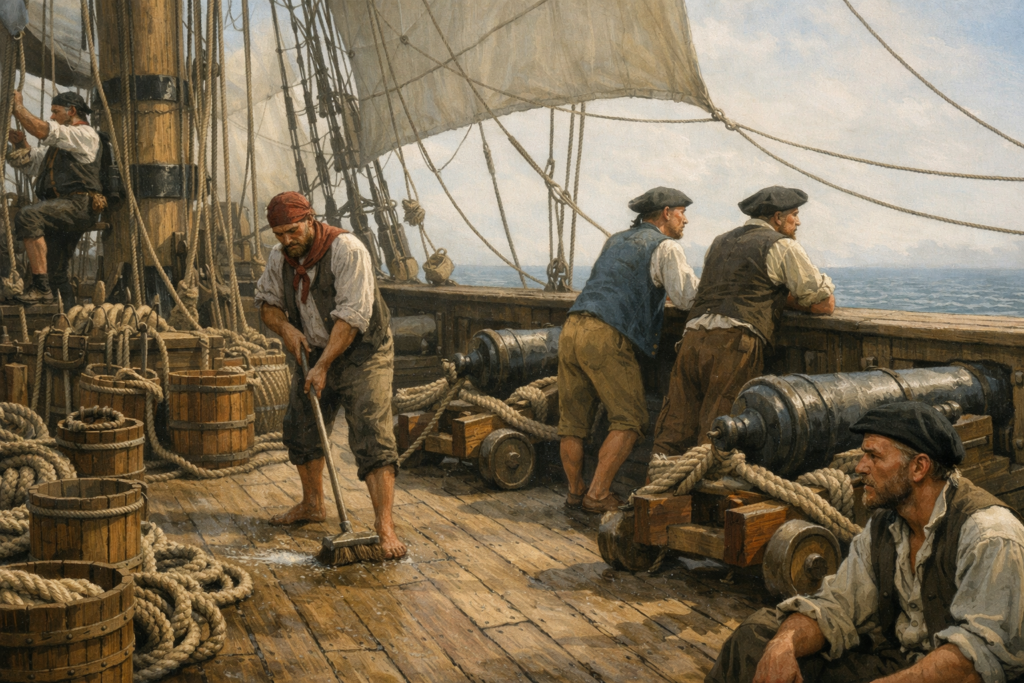
When the Continental Congress established America’s first navy in October 1775, they faced a daunting challenge: how do you build a fleet from scratch when you’re fighting the world’s most powerful naval force? The Continental Navy peaked at around 3,000 men serving on approximately 30 ships, a tiny force compared to Britain’s massive Royal Navy. But who were these sailors who were willing to risk their lives for a fledgling republic?
Where They Came From
The colonial maritime community had extensive seafaring experience, as much of British trade was carried in American vessels, and North Americans made up a significant portion of the Royal Navy’s seamen. Continental Navy sailors came primarily from port cities along the Atlantic coast, particularly New England communities where maritime trades were a way of life. Many had worked as merchant sailors, fishermen, or privateers before joining.
The naval service was notably diverse for its time, including native-born Americans, British deserters, free and enslaved Black sailors, and European immigrants. Unlike the Continental Army, which had periods of banning Black soldiers or sometimes placing them in segregated regiments, the Continental Navy was mostly integrated. At sea, there was less distinction between free and enslaved sailors, and those held in bondage had opportunities to work toward freedom. This maritime tradition of relative equality distinguished naval service from other Revolutionary War experiences.
Getting Into the Service
Recruiting sailors proved to be one of the Continental Navy’s biggest headaches. Navy boards supervised appointing petty officers and enlisting seamen, though these duties were chiefly performed by ship commanders or recruiting agents. The first Marine recruiting station was located at Tun’s Tavern, a bar in Philadelphia.
Enlistment was generally voluntary, though the line between volunteering and impressment—forced service—was sometimes blurred. Recruiting parties would scour port towns seeking able-bodied men, advertising not only pay but also the possibility of capturing British prizes for sale, with proceeds shared among the crew—a powerful incentive.
The problem was competition. Privateering—private ships licensed by congress to seize enemy vessels—was far more attractive to sailors because cruises were shorter and pay could be better. With over 2,000 privateers operating during the war, the Continental Navy struggled constantly to maintain adequate crew sizes. Continental captains often found themselves unable to man their ships due to privateers’ superior inducements.
Landsmen, Seamen, and Petty Officers
At the bottom rung of a Navy crew stood the landsman—a recruit with little or no sea experience. Many were farm boys or tradesmen who had never set foot on a ship. Their days were filled with the hardest labor: hauling ropes, scrubbing decks, and learning basic seamanship.
Above them were ordinary seamen, who had some experience afloat, and the more skilled able seamen who knew their way around sails, rigging, and naval gunnery. These sailors formed the backbone of the Continental Navy. Sailors skilled in managing the ship’s rigging were said to “know the ropes.” Without their knowledge of wind, tide, and timber, ships would have been little more than floating platforms.
The most experienced enlisted men were promoted to petty officers. These weren’t commissioned officers but rather specialists and leaders—boatswain’s mates directing rigging crews, gunner’s mates overseeing cannon fire, and carpenters’ mates keeping the wooden hulls afloat. They were the Navy’s “non-commissioned officers,” long before the U.S. Navy had a formal NCO corps.
Most Continental Navy ships also carried detachments of Continental Marines. These enlisted men were soldiers at sea, tasked with keeping order on deck, manning small arms in combat, and leading boarding parties.
What They Wore
Unlike officers who had prescribed uniforms, enlisted sailors received no standard clothing from the Continental Navy. Due to meager funds and lack of manufacturing capacity, sailors generally provided their own clothing, usually consisting of pantaloons often tied at the knee or knee breeches, a jumper or shirt, neckerchief, short waisted jacket, and low crowned hats. Most sailors went barefoot, and a kerchief was worn either as a sweat band or as a simple collar closure. The short trousers served a practical purpose—they didn’t interfere with climbing the ship’s rigging. This lack of uniforms reflected the Continental Navy’s financial struggles, where everything from ships to ammunition took priority over standardized clothing.
Daily Life at Sea
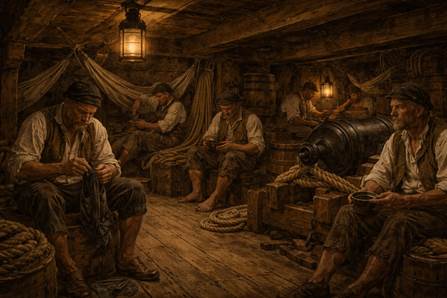
Shipboard duties for enlisted sailors were grueling and dangerous. Landsmen cleaned the deck, helped raise or lower the anchor, worked in the galley, and assisted other crew members. More experienced sailors handled the complex work of managing sails, operating guns during combat, standing watch, and maintaining the vessel. Specialized roles were filled by experienced hands, and most sailors worked long shifts in harsh conditions, often enduring crowded, wet, and unsanitary quarters below deck.
Living conditions were cramped. Sailors lived in close quarters with limited privacy, shared hammocks on the lower decks, and endured monotonous food rations. Meals were simple, based on salted meat, ship’s biscuit, and whatever could be supplemented from local ports or captured prizes. Leisure was rare, and recreation was often limited to singing, storytelling, or gambling. The work was physically demanding and accidents were common—falling from rigging, being crushed by shifting cargo, or drowning were constant risks.
Discipline and Relations with Officers
Discipline in the Continental Navy was deeply influenced by the British Royal Navy and the “ancient common law of the sea.” The Continental Congress issued articles governing naval discipline, empowering officers to maintain strict order and punish infractions including drunkenness, blasphemy, theft, or disobedience. Punishments included wearing a wooden collar, spending time in irons, receiving pay deductions, confinement on bread and water, or, for serious offenses, flogging.
Flogging was often done with a multi-thonged whip known as the cat o’ nine tails. The most common flogging consisted of between 12 and 24 lashes, though mutineers might receive sentences in the hundreds of lashes—often becoming a death sentence.
Even though officers held absolute authority aboard their vessels, the Continental Navy sometimes suffered from severe discipline problems. Some commanders found it impossible to maintain control over squadrons made up of crews recruited from one area and commanded by officers from another. The relationship between officers and enlisted men reflected the social hierarchies of the time, with a clear divide between the educated officer class and working-class sailors. However, the shared dangers of combat and the sea could create bonds that transcended these divisions.
A Brief but Important Legacy
Enlisted sailors of the Continental Navy came from diverse and often hardscrabble backgrounds, shaped by the hard labor and hazards of maritime life. These men, whose names are mostly lost to history, formed the foundation of America’s first navy and contributed profoundly—through sacrifice and service—to the establishment of American independence.
Of approximately 65 vessels that served in the Continental Navy, only 11 survived the war, and by 1785 Congress had disbanded the Navy and sold the remaining ships. Despite its short existence and limited impact on the war’s outcome, the sailors of the Continental Navy created a foundation for American naval tradition and provided trained seamen who would serve in future conflicts.
Sources:
- https://www.history.navy.mil/browse-by-topic/wars-conflicts-and-operations/american-revolution.html
- https://en.wikipedia.org/wiki/Continental_Navy
- https://www.history.navy.mil/research/library/online-reading-room/title-list-alphabetically/e/enlisted-uniforms.html
- https://tallshipprovidence.org/18th-century-waterfront/
- https://www.usni.org/magazines/proceedings/1905/july/administration-continental-navy-american-revolution
- https://navyandmarine.org/ondeck/1800navaldiscipline.htm
Personal note: The Grumpy Doc proudly served as an enlisted sailor in the U.S. Navy from 1967 to 1974.
Leave a Reply