Were it left to me to decide whether we should have a government without newspapers, or newspapers without a government, I should not hesitate a moment to prefer the latter. But I should mean that every man should receive those papers and be capable of reading them. —Thomas Jefferson
I originally posted this article about a year and a half ago. I was concerned about the future of newspapers then and I’m even more concerned now. I’ve updated my original post to reflect recent losses of newspapers.
When I was growing up in Charleston WV in the 1950s and early 1960s, we had two daily newspapers. The Gazette was delivered in the morning and the Daily Mail was delivered in the afternoon. One of my first jobs as a boy was delivering The Gazette. It worked out to be about 50 cents an hour, but I was glad to have the job. (It was good money at the time.)
Ostensibly, the Gazette was a Democratic newspaper, and the Daily Mail was a Republican one. However, given the politics of the day there was not a significant difference between the two, and most people subscribed to both.
There weren’t a lot of options for news at the time. Of course, there were no 24-hour news channels. National news on the three networks was about 30 minutes an evening with local news at about 15 minutes. By the late 1960s national news had increased to 60 minutes and most local news to about 30 minutes. Although, given the limitations of time on the local stations, most of the broadcast was taken up with weather, sports, and human interest stories with little time left to expand on hard news stories.
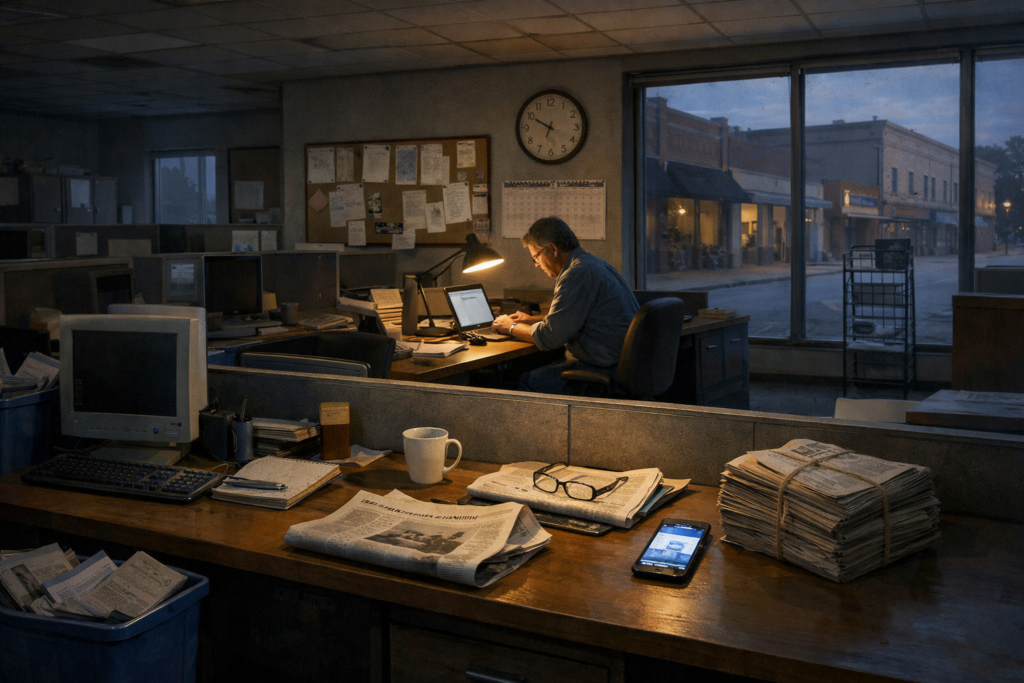
We depended on our newspapers for news of our cities, counties, and states. And the newspapers delivered the news we needed. Almost everyone subscribed to and read the local papers. They kept us informed about our local politicians and government and provided local insight on national events. They were also our source for information about births, deaths, marriages, high school graduations and everything we wanted to know about our community.
In the 21st century there are many more supposed news options. There are 24-hour news networks as I’ve talked about in a previous post. And of course, there are Instagram, Facebook, X and the other online entities that claim to provide news.
There has been one positive development in television news. Local news, at least in Charleston, has expanded to two hours most evenings. There is some repetition between the first and second hour and it is still heavily weighted to sports, weather, and human interest, but there is some increased coverage of local hard news. However, this is somewhat akin to reading the headlines and the first paragraph in a newspaper story. It doesn’t provide in-depth coverage, but it is improved over what otherwise is available to those who don’t watch a dedicated news show. Hopefully, it motivates people to find out more about events that concern them.
The situation has become dire in recent months. The crisis that was building when I first wrote about newspapers has now reached catastrophic proportions. On December 31, 2025, the Atlanta Journal-Constitution published its last print edition after 157 years, making Atlanta the largest U.S. metro area without a printed daily newspaper. Think about that—a major American city, home to over six million people in its metro area, now has no physical newspaper you can hold in your hands.
Just weeks ago in February 2025, the Newark Star-Ledger, New Jersey’s largest newspaper, stopped printing after nearly 200 years. The Jersey Journal, which had served Hudson County for 157 years, closed entirely. These weren’t small-town weeklies—these were major metropolitan dailies that once served millions of readers. The Pittsburgh Post Gazette, founded in 1786, has announced that it will cease publication effective May 3, 2026.
Even more alarming is what just happened at the Washington Post. Just days ago, in early February 2026, owner Jeff Bezos ordered the elimination of roughly one-third of the newspaper’s workforce—approximately 300 journalists. The Post closed its entire sports section, shuttered its books department, gutted its foreign bureaus and metro desk, and canceled its flagship daily podcast. This is the same newspaper that brought down a presidency with its Watergate coverage and has won dozens of Pulitzer Prizes. The Post’s metro desk, which once had 40 reporters covering the nation’s capital, now has just a dozen. All the paper’s photojournalists were laid off. The entire Middle East team was eliminated.
Former Washington Post executive editor Martin Baron, who led the paper from 2013 to 2021, called the cuts devastating and blamed poor management decisions, including Bezos’s decision to spike the newspaper’s presidential endorsement in 2024, which led to the cancellation of hundreds of thousands of subscriptions. The Post lost an estimated $100 million in 2024.
The numbers tell a grim story. Since 2005, more than 3,200 newspapers have closed in the United States—that’s over one-third of all the newspapers that existed just twenty years ago. Newspapers continue to disappear at a rate of more than two per week. In the past year alone, 136 newspapers shut their doors.
Fewer than 5,600 newspapers now remain in America, and less than 1,000 of those are dailies. Even among those “dailies,” more than 80 percent print fewer than seven days a week. We now have 213 counties that are complete “news deserts”—places with no local news source at all. Another 1,524 counties have only one remaining news source, usually a struggling weekly newspaper. Taken together, about 50 million Americans now have limited or no access to local news.
Will TV news be able to provide the details about our community? The format of the newspaper allows for more detailed presentations and for a larger variety of stories. The reader can pick which stories to read, when to read them and how much of each to read. The very nature of broadcast news doesn’t allow these options.
I beg everyone to please subscribe to your local newspapers if you still have one. Though I still prefer the hands-on, physical newspaper, I understand many people want to keep up with the digital age. If you do, please subscribe to the digital editions of your local newspaper and don’t pretend that the other online sources, such as social media, will provide you with local news. More likely, you’ll just get gossip, or worse.
If we lose our local news, we are in danger of losing our freedom of information and if we lose that, we’re in danger of losing our country. For those of you who think I’m fear mongering, countries that have succumbed to dictatorship have first lost their free press.
I believe that broadcast news will never be the free press that print journalism is. The broadcast is an ethereal thing. You hear it and it’s gone. Of course, it is always possible to record it and play it back, but most people don’t. If you have a newspaper, you can read it, think about it, and read it again. There are times when on my second or third reading of an editorial or an op-ed article, I’ve changed my opinion about either the subject or the writer of the piece. I don’t think a news broadcast lends itself to this type of reflection. In fact, when listening to the broadcast news I often find my mind wandering as something that the broadcaster said sends me in a different direction.
In my opinion, broadcast news is controlled by advertising dollars and viewer ratings. News seems to be treated like any entertainment program, catering to what generates ratings rather than facts. I recognize that this can be the case with newspapers as well, but it seems to me that it’s much easier to detect bias in the written word than in the spoken word. Too often we can get caught up in the emotions of the presenter or in the graphics that accompany the story.
With that in mind, I recommend that if you want unbiased journalism, please support your local newspapers before we lose them. Once they are gone, we will never get them back and we will all be much the poorer as a result.
I will leave you with one last quote.
A free press is the unsleeping guardian of every other right that free men prize; it is the most dangerous foe of tyranny. —Winston Churchill
The only way to preserve freedom is to preserve the free press. Do your part! Subscribe!
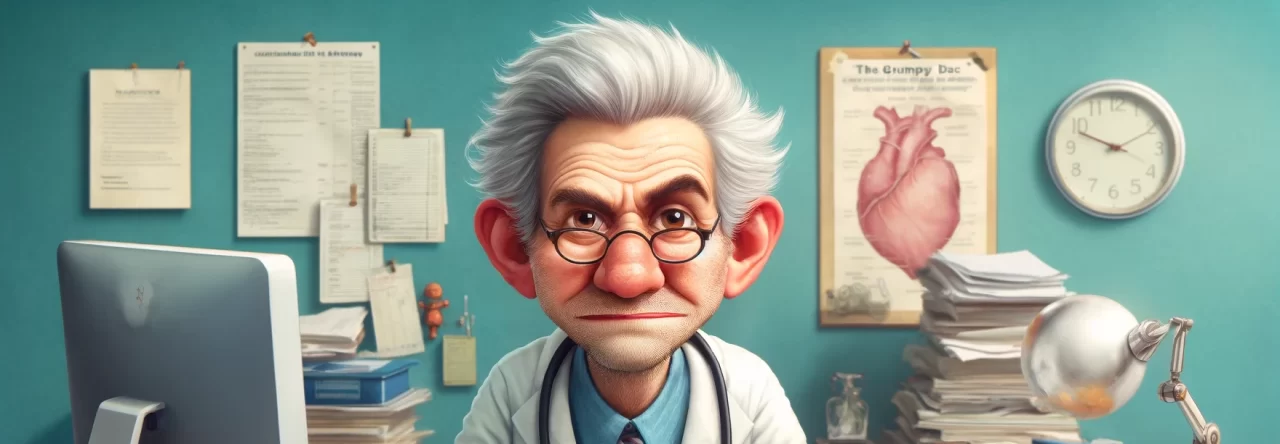
And you can quote The Grumpy Doc on that!!!!
Sources
Fortune (August 29, 2025): “Atlanta becomes largest U.S. metro without a printed daily newspaper as Journal-Constitution goes digital”
https://fortune.com/2025/08/29/atlanta-largest-metro-without-printed-newpsaper-digital-journal-constitution/
Northwestern University Medill School (2025): “News deserts hit new high and 50 million have limited access to local news, study finds”
https://www.medill.northwestern.edu/news/2025/news-deserts-hit-new-high-and-50-million-have-limited-access-to-local-news-study-finds.html
NBC News (February 2026): “Washington Post lays off one-third of its newsroom”
https://www.nbcnews.com/business/media/washington-post-layoffs-sports-rcna257354
CNN Business (February 4, 2026): “Jeff Bezos-owned Washington Post conducts widespread layoffs, gutting a third of its staff”
https://www.cnn.com/2026/02/04/media/washington-post-layoffs
Northwestern University Medill Local News Initiative (2024): “The State of Local News Report 2024”
https://localnewsinitiative.northwestern.edu/projects/state-of-local-news/2024/report/
Northwestern University Medill School (2025): “News deserts hit new high and 50 million have limited access to local news, study finds”
https://www.medill.northwestern.edu/news/2025/news-deserts-hit-new-high-and-50-million-have-limited-access-to-local-news-study-finds.htm
Leave a Reply