Fifty some years ago when I was in the Marines, we used the term “86” to refer to something that should be ignored or discarded—in the colorful vernacular of the Corps, “shit canned”. That’s trashed to you civilians. The Marines have never been known as a peaceable lot and we had many colorful euphemisms for doing grievous bodily harm, but “86” was never among them.
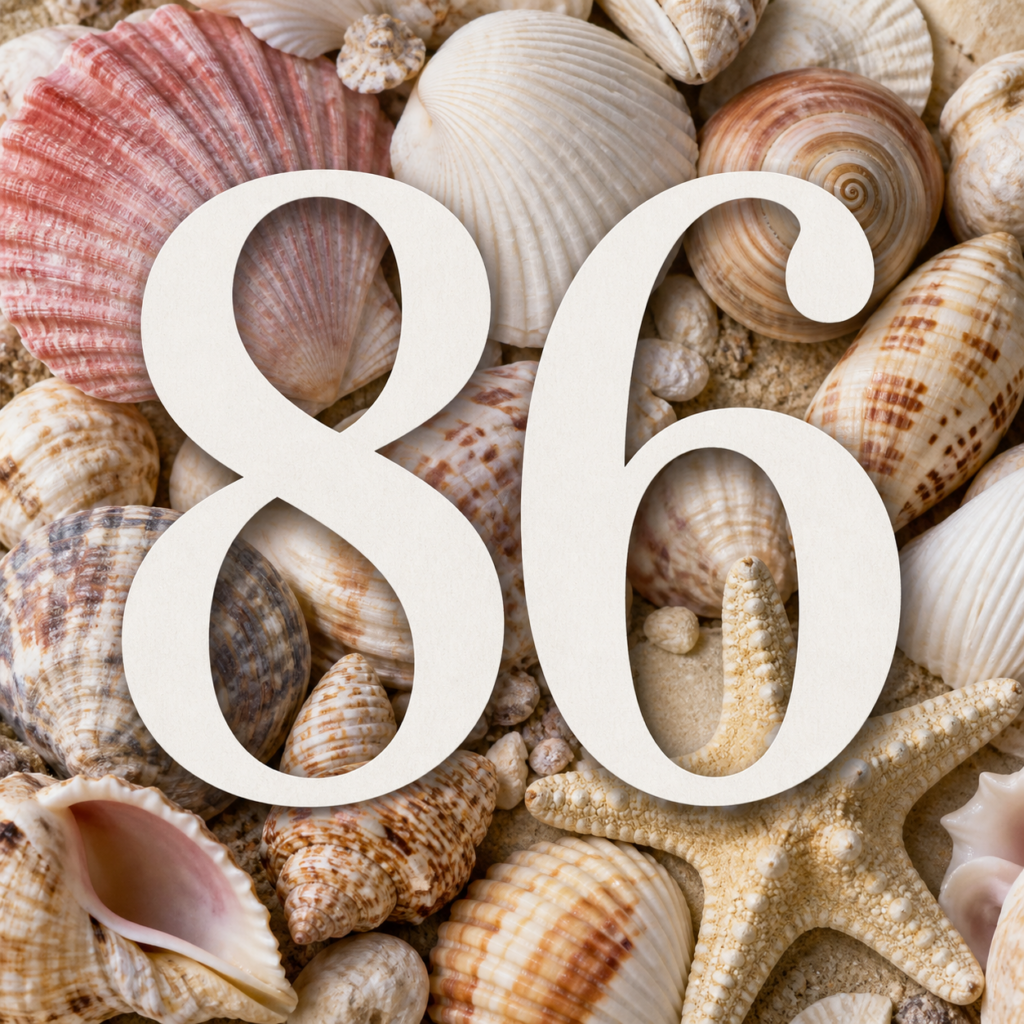
So why is “86” suddenly everywhere in the news? Blame James Comey. The former FBI Director posted a beach photo on Instagram showing seashells arranged to spell out “86 47” — and the internet promptly exploded. Republicans argued it was a death threat against the 47th president. Comey said it simply meant he wanted Trump removed from office. That dispute has brought a piece of century-old American slang back into the spotlight, so it’s worth taking a look at what the term means and where it came from.
The Short Answer
Eighty-six is slang meaning “to throw out,” “to get rid of,” or “to refuse service to.” It most likely comes from 1930s soda-counter slang meaning that an item was sold out. This was part of a broader diner code that included: 13 “the boss is around,” 81 “glass of water,” and 95 “customer left without paying”. Over the decades it evolved from a kitchen noun into a verb with broader reach, and today it shows up everywhere from restaurant kitchens to Twitter and now worldwide headlines.
The Longer Answer
Here’s the honest answer: nobody knows for certain. Its etymology is unknown, but it seems to have been coined in the 1920s or 1930s. There are many theories about its origin — one article enumerates 18 possibilities, and another suggests there are “about 86 theories about 86.”
While the leading contender is the mundane diner option, there are several other more or less plausible and frequently more colorful options.
The most linguistically grounded explanation is that “86” is simply rhyming slang. The most common theory is that it is rhyming slang for “nix.” That’s the same “nix” meaning to reject or say no.
One of the more colorful stories involves a Prohibition-era speakeasy. Chumley’s, a bar with multiple entrances including one at 86 Bedford Street in New York. The story goes that the bar was supposedly warned by police before raids. Customers were told to “86 it” — meaning leave through the Bedford Street exit while cops came through the other door. It’s a great story, and if it’s not true it should be.
How It Evolved
First appearing in the early 1930s as a noun, it did not take long for the word to broaden its use beyond the realm of the soda counter. In the 1950s the word underwent some functional shift and began to be used as a verb — initially meaning “to refuse to serve a customer,” and later taking on the slightly extended meaning of “to get rid of; to throw out.”
It was quickly adopted and members of the military services who love slang, shortcuts, and inside terminology. It may just be a coincidence that Article 86 of the U.S. Uniform Code of Military Justice concerns Absence Without Leave, or AWOL.
By the 1970s it had moved well beyond the restaurant world. In the 1972 film The Candidate, a media adviser says to Robert Redford’s character, “OK, now, for starters, we got to cut your hair and eighty-six the sideburns.”
Where It Stands Today
These days, people use “86” when they cancel plans, dump something, or boot someone from a chat. Social media picked it up — Twitter and TikTok users will “86 a trend” or “86 a person” in a heartbeat.
In professional kitchens and bars, it remains “everyday lingo” — one hospitality industry veteran called it “probably the most overused word in hospitality.”
The Comey controversy also resurrected an older, arcane, and darker shade of the term. According to Cassell’s Dictionary of Slang, “to 86” can alternatively mean “to kill, to murder; to execute judicially.” That said, Merriam-Webster notes this use is infrequent, and they do not include this sense due to its relative recency and sparseness of use.
The bottom line is that “86” is one of those wonderfully slippery pieces of American slang that started in a noisy kitchen, picked up mythology along the way, and is now flexible enough to mean anything from “we’re out of the salmon” to a loaded political statement — depending entirely on who’s using it and who’s listening.
Or, perhaps this entire tempest is just the response of one thin skinned man to his pathologic fear of seashells.
Leave a Reply