
“They’re not after me, they’re after you. I’m just in the way.” —Donald J. Trump
Introduction
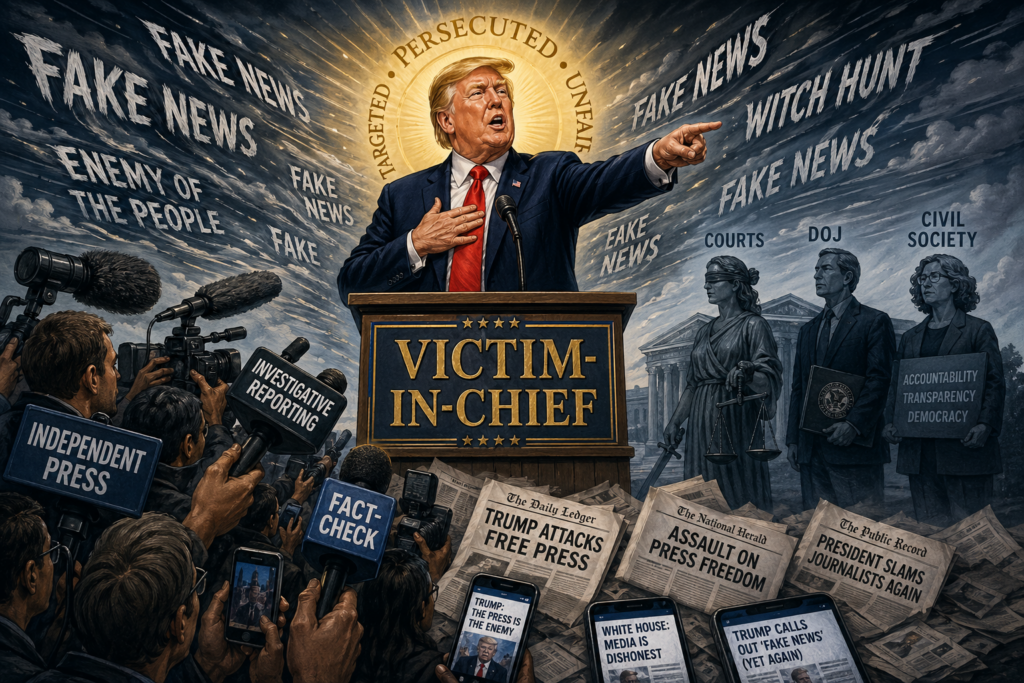
Donald Trump has turned political victimhood into something remarkably durable: a brand. Since his first term, Trump has consistently advanced a narrative that he is the unfair target of a corrupt establishment — not because of anything he has done, but because of who he is and the threat he poses to entrenched power. That narrative, far from fading, has deepened and accelerated in his second term, propelled by a relentless series of legal maneuvers, institutional confrontations, and rhetorical provocations that seem engineered to keep the grievance machine running. Whether the cause is a leaked tax return, a photograph of seashells on a beach, or a comedian’s joke at a press dinner, Trump and his allies have shown a remarkable ability to recast every controversy as evidence of persecution. The result is a political identity built less on policy than on shared victimhood — one that has proven more resilient to contradiction than almost anything else in modern American politics. I first wrote about this several months ago, but recent events have motivated me to update the topic.
The Anatomy of a Persecution Story
At the heart of Trump’s messaging is the claim that nearly every major American institution is rigged against him: the judiciary, the press, federal agencies, social media companies, and even fellow Republicans who fail to show sufficient loyalty. He doesn’t stop at personal grievance. His signature rhetorical move is to project that persecution outward — to his supporters — insisting that the forces targeting him are really targeting them, and that he alone stands in the way. Strongmen throughout history have used this populist inversion to build fierce loyalty, but Trump has refined it for the digital age, where every legal setback can be instantly monetized through fundraising appeals and turned into rally fodder before the ink is dry on a court filing.
Suing His Own Government: The IRS Lawsuit
Few episodes illustrate the paradox of Trump’s persecution narrative more sharply than his $10 billion lawsuit against the IRS and Treasury Department, agencies he controls as president. Filed in January 2026, the suit alleges that a government contractor wrongfully leaked his tax records to the press during his first term — a legitimate grievance in isolation, since the contractor did plead guilty and was sentenced to five years in prison. But the spectacle of a sitting president suing his own executive branch for a payout that would come from taxpayers has raised serious legal and ethical flags. Florida District Judge Kathleen M. Williams questioned whether Trump and the agencies are “sufficiently adverse to each other” for the case to proceed at all, noting that Trump’s own executive orders require the Justice Department to follow his legal interpretations. In plain terms: the president would be suing the government he runs, defended by lawyers who must take his side, with any settlement check written to him by American taxpayers. Trump’s lawyers and the IRS have meanwhile entered settlement talks, requesting a 90-day pause in proceedings. Democratic lawmakers introduced a bill to prohibit the president, vice president, and their families from collecting any such settlement. The episode is vintage Trump — a genuine underlying grievance amplified into a high-profile conflict that simultaneously reinforces his victimhood and generates favorable headlines.
The Pursuit of James Comey: Retribution as Policy
The Trump Justice Department’s second criminal indictment of former FBI Director James Comey, announced April 28, 2026, reads like a case study in how prosecution can become an instrument of political narrative. The charges stem from an Instagram post Comey made in May 2025 showing seashells on a beach arranged to spell “86 47” — a formation Comey said he simply found and photographed. Prosecutors interpreted it as a threat against the 47th president, an argument that First Amendment scholars have called legally dubious. Stanford First Amendment expert Eugene Volokh told CNN: “This is not going anywhere. This is clearly not a punishable threat.” The indictment is the second attempt to prosecute Comey; the first, built on allegations that he lied to Congress, collapsed when a judge ruled that the prosecutor handling the case had been unlawfully appointed. Trump had publicly urged then-Attorney General Pam Bondi to move against Comey, and Bondi was fired in April 2026 after reports that the president was frustrated that she wasn’t pursuing his critics aggressively enough. Her successor, Todd Blanche — Trump’s own former personal defense attorney — moved quickly. The pattern is hard to miss: an allegation, a prosecution, a dismissal, another allegation, a second prosecution. Whether or not the charges succeed, the process itself delivers the message Trump wants delivered.
Perhaps his fear of seashells has caused him to forget that he posted a picture of then President Biden bound and gagged on the back of a pickup truck. Certainly, that was more of a threat than someone’s beachside graffiti, yet Trump was not prosecuted. I wonder why.
The Ballroom and the Bullet: Security as Metaphor
On the evening of April 25, 2026, shots were fired near the security screening area outside the White House Correspondents’ Dinner at the Washington Hilton, where Trump was attending his first such dinner as a sitting president. The suspect, identified as Cole Tomas Allen, was arrested; no attendees inside the ballroom were struck. It was, by any measure, a frightening episode, and the third reported attempt on Trump’s life. What followed, however, quickly illustrated Trump’s talent for turning crisis into confirmation of his narrative. Within two minutes of beginning his press briefing that night, Trump pivoted to arguing that the incident proved the wisdom of his plan to build a new ballroom on White House grounds — a project historic preservationists have challenged in court as unlawful. His administration immediately pressured the National Trust for Historic Preservation to drop its lawsuit, with the acting attorney general writing that the preservation group’s case “cannot possibly justify delaying the construction of a secure facility for the President.” Critics pointed out that Trump’s own administration had given the Correspondents’ Dinner a lower security classification than other events he attends — a detail that complicated his argument. But in Trump’s telling, the shooting was simply the latest proof that enemies lurk everywhere and that his foresight is perpetually vindicated.
The Widow Joke: Melania, Kimmel, and the Media Enemy
Two days before the Correspondents’ Dinner shooting, comedian Jimmy Kimmel delivered a mock roast on his late-night program that included the line: “Look at Melania, so beautiful. Mrs. Trump, you have a glow like an expectant widow.” Kimmel later said it was an obvious joke about the couple’s age difference. The timing — the joke aired before the attempted shooting — became fuel for a firestorm after the incident. First Lady Melania Trump, called on ABC to “take a stand” against Kimmel and President Trump wrote on social media that Kimmel should be “immediately fired by Disney and ABC,” calling his comments “beyond the pale.” FCC Chair Brendan Carr had previously threatened ABC affiliates over Kimmel’s coverage of an earlier controversy. Kimmel pushed back on his Monday night broadcast, calling the joke a “light roast” and denying any connection to the shooting, but the episode had already served its purpose in the persecution playbook: a comedian’s punchline reframed as an incitement; the president and first lady as targets of a corrupt, hostile media; and a federal regulator positioned to remind a broadcast network of who holds the license.
The Nobel Grievance: Peace Prize as Persecution
Trump’s relationship with the Nobel Peace Prize offers perhaps the purest distillation of his persecution aesthetic: a prestigious honor he was not given becomes evidence of institutional bias against him. In January 2026, Trump sent a text message to Norwegian Prime Minister Jonas Gahr Støre that, as reported by PBS and confirmed by Norwegian officials, declared: “Considering your Country decided not to give me the Nobel Peace Prize for having stopped 8 Wars PLUS, I no longer feel an obligation to think purely of Peace.” The message was sent in the context of Trump’s threats to acquire Greenland by force and his tariff pressure on Norway. The factual problems were substantial. PolitiFact reported that the prize is awarded by an independent Norwegian committee, not the Norwegian government — a distinction Støre himself spelled out in a public statement — and Trump’s claim to have “stopped 8 wars” was not supported by evidence. The Nobel Committee separately clarified that a medal gifted to Trump by Venezuelan opposition leader María Corina Machado did not legally transfer the prize to him. None of these corrections appeared to land with Trump’s base, for whom the image of a deserving president snubbed by a foreign establishment is emotionally resonant regardless of the technical details or even the truth.
THE BOARD OF PEACE: TRUMP’S PERSONAL PEACE PRIZE
The Board of Peace offers perhaps the most grandiose expression of Trump’s persecution narrative — not a complaint about being snubbed, but an institutional response to it. When Trump texted Norway’s prime minister in January 2026 linking his Greenland threats to the Nobel Committee’s failure to award him the prize, he was voicing a grievance he had already begun to act on. The Board of Peace, formally established at the World Economic Forum in Davos that same month, designated Trump as chairman for life — an arrangement that inverts the Nobel dynamic entirely: rather than waiting for an independent body to recognize his peacemaking, Trump created his own institution where recognition is structural and permanent. On the anniversary of his inauguration, Trump cited the United Nations never having helped him as a justification for the Board’s existence, suggesting it might eventually replace the UN altogether. The persecution logic runs cleanly through both episodes: the institutions that should have honored him failed him, so he built alternatives he controls. That no other G7 nation joined the Board, including Norway — the very country Trump blamed for the Nobel snub — will almost certainly be absorbed into the same narrative as further proof of establishment resistance to a leader they refuse to recognize.
Why the Narrative Works
Trump’s persecution story endures because it performs several functions simultaneously. It flips accountability into loyalty — every legal charge or critical headline becomes not evidence of wrongdoing but proof of how threatening Trump is to the establishment. It mirrors the genuine anxieties of his base, many of whom feel overlooked by media and government institutions. And it delegitimizes opposition before opposition can speak — if the system is rigged, then any ruling, verdict, or investigation against Trump is by definition corrupt. The narrative also has deep theological resonance for evangelical supporters who see Trump’s legal and political battles as a form of spiritual warfare, reinforcing the language of martyrdom that has surrounded his campaigns since 2016. For many supporters, belief in Trump’s victimhood has become identity, not analysis — and identity is far more resistant to factual challenge than any ordinary political position.
The Profitable Persecution
Trump’s persecution narrative is not merely persuasive — it is a business model. Every new indictment, investigation, or hostile media segment has historically triggered an immediate fundraising surge. His platform, Truth Social, serves simultaneously as megaphone and monetization engine. He has sold branded merchandise and Bibles invoking themes of embattlement and martyrdom. And now, with his IRS lawsuit, the grievance machinery has potentially come full circle: a complaint about institutional victimization that — if settled favorably — would result in a taxpayer-funded payout to the president himself. The architecture is durable precisely because it converts every attack into a resource, every setback into a rally cry, and every enemy into a fundraising opportunity.
After the Correspondents’ Dinner shooting, Republican senators moved to authorize $400 million in federal funding, with Senator Graham suggesting private donations could remain in play for furnishings or other expenses. What will happen to the hundreds of millions already raised and sitting in a private nonprofit shielded from standard conflict-of-interest review? That has not been addressed by the legislation or the White House and given the lack transparency in the ballroom fund it is reasonable to speculate on the probability of diversion to other uses.
Trump transferred $1.2 billion of US funds to the Board of Peace. He has pledged to transfer a total of $10 billion. These are taxpayer funds that will be totally under his personal control and can be used at his discretion. There is no public accountability for these funds.
For those who wonder about Donald Trump’s motivation for his persecution narrative, his personal wealth has almost doubled in little more than a year since his inauguration.
The Authoritarian Parallels
Scholars of democratic backsliding have noted that Trump’s strategy tracks closely with patterns seen in other countries where elected leaders have gradually dismantled independent institutions. The elements are recognizable: vilify the press as the enemy of the people; claim that legal proceedings against you are politically motivated; replace career officials with personal loyalists; and promise retribution against those who prosecuted or opposed you. In Trump’s second term, those patterns have sharpened. The firing of an attorney general perceived as insufficiently aggressive toward critics, the second indictment of a former FBI director on a legally thin — some say imaginary — theory, the use of regulatory threats against a broadcast network that aired an unflattering joke, are not isolated incidents. They form a coherent approach in which the persecution narrative both justifies and accelerates the consolidation of power.
Critiques and Contradictions
The persecution narrative has real vulnerabilities. Legal scholars have consistently argued that Trump mischaracterizes how due process works and overstates the degree to which prosecutions against him were politically directed. Fact-checkers have documented numerous false claims woven through his victimhood rhetoric — including the Nobel Peace Prize claim, the “8 wars” assertion, and the repeated charge of a “weaponized” Justice Department that, critics note, he now controls and is actively using against his own perceived enemies. The second Comey indictment, built on a social media photo that First Amendment experts regard as clearly protected speech, has drawn criticism even from some conservative legal commentators. The IRS lawsuit’s fundamental conflict of interest — a president suing the agencies he runs for money from taxpayers — has no obvious precedent in American legal history. Whether these contradictions ultimately matter to Trump’s political standing is another question entirely.
Conclusion
Donald Trump’s persecution narrative has outlasted every legal challenge, every fact-check, and every prediction of its imminent collapse. In the spring of 2026, it is more operationally central to his presidency than ever. The narrative is the brand. It galvanizes supporters, raises money, provides cover for the use of government power against political adversaries, and makes every institutional constraint on presidential authority look like persecution rather than law. For many Americans who support Trump, his legal fate matters far less than the story his victimhood tells — and in that story lies a political power that has proven remarkably difficult to dislodge.
Illustration generated by author using ChatGPT
Leave a Reply