
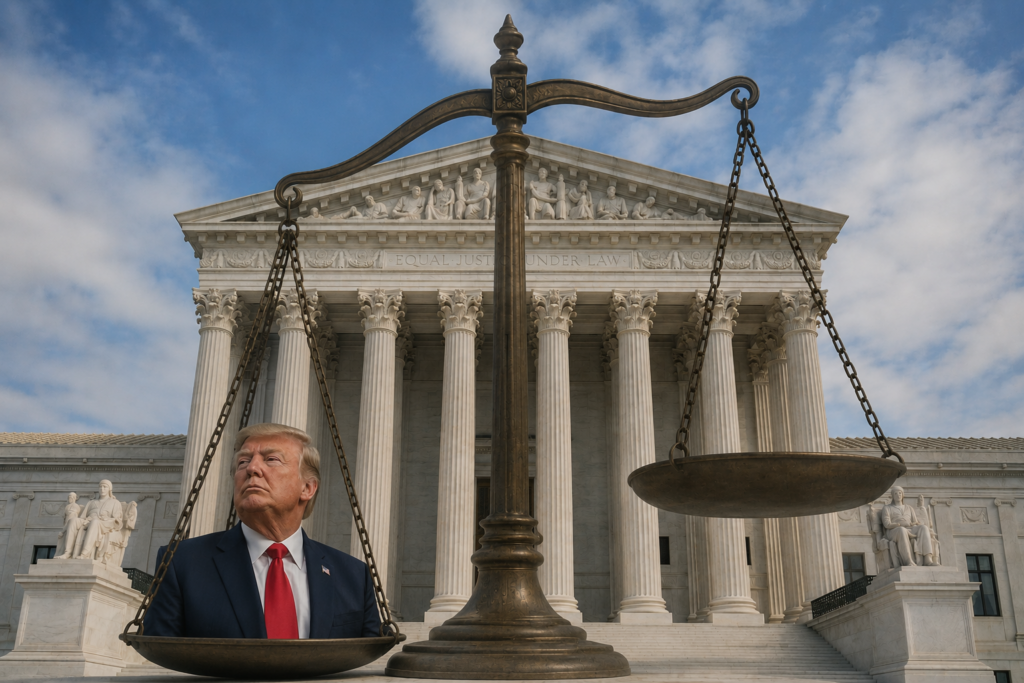
Chief Justice John Roberts keeps telling Americans the Supreme Court is not political. He recently complained that people “view us as purely political actors,” and insisted that’s just not how the Court works. That might have been plausible twenty years ago. After the decisions of the past decade, it sounds less like reassurance and more like spin.
The Roberts Court started out conventionally conservative. Then came the turning points: Anthony Kennedy’s retirement in 2018 and Ruth Bader Ginsburg’s death in 2020. Donald Trump replaced them with Brett Kavanaugh and Amy Coney Barrett, locking in a 6–3 conservative supermajority. Since then, on the biggest fights of our time—voting, money in politics, reproductive freedom, presidential power—the Court’s answers have marched almost uniformly to the right.
One analysis of the Court’s work through 2018 found more than seventy cases where the conservative bloc formed a majority in areas like voting rights, campaign finance, corporate accountability, and civil rights where the conservative justices either bent precedent or quietly shelved their own stated doctrines to get where they wanted to go. That is not happenstance. That is a method.
Look at the decisions that define this era.
In Citizens United, the Court announced that corporations have a First Amendment right to spend unlimited money in elections, destroying what remained of campaign finance law and supercharging the power of wealthy donors and corporate interests. In Shelby County, it gutted a core provision of the Voting Rights Act, inviting a wave of state-level restrictions that predictably hit minority voters hardest. In Rucho, Roberts openly acknowledged that partisan gerrymandering is “incompatible with democratic principles”—and then declared the federal courts powerless to stop it. The Court saw a threat to democracy and chose to shrug.
Dobbs went further. For nearly fifty years, Roe v. Wade recognized a constitutional right to abortion. In 2022, that right vanished in a single 6–3 decision that tracked partisan lines. The majority did not just reject Roe; it rewrote the understanding of liberty in a way that puts other long‑standing rights on shakier ground.
Then there is Trump v. United States, which discovered sweeping criminal immunity for presidents found nowhere in the Constitution’s text or structure. Contrast that with New York State Rifle & Pistol Association v. Bruen, where the same Court insisted modern gun laws must mirror 18th‑ and 19th‑century regulations. History is mandatory when it narrows gun regulation. History is optional when it might constrain a president. The “neutral” principles somehow keep landing on the same ideological side.
The real indictment of the Roberts Court is not that the justices are conservative; conservative legal thought has serious intellectual roots. It is that the Court’s philosophy behaves like a trapdoor: originalism when it helps, textualism when that works better, “judicial restraint” when restraint freezes progressive policies, and muscular judicial power when restraint would get in the way. The tools keep changing. The destination does not.
The shadow docket has only deepened the concern. Using unsigned, unexplained emergency orders, the Court has green‑lit sweeping policy changes—on immigration, civil rights, and executive power—while lower courts were still sorting out legality. Normally, dramatic changes to national policy come with full briefing, oral argument, and written opinions. Under Roberts, some of the most consequential decisions arrive in the dead of night, with no reasoning the public can read and no guidance lower courts can follow.
To be honest, the story is not all one-way traffic. Justice Neil Gorsuch wrote the majority opinion which held that federal employment law protects LGBTQ workers. Roberts has occasionally voted to preserve precedent he personally disliked. There are a handful of high‑profile cases where the conservative justices have broken ranks or rejected expansive claims of presidential power, but those cases are rare.
In the high‑stakes political questions of the last decade the line is brutally clear: when democracy is at stake, money wins; when voting rights are at stake, restrictions win; when women’s bodily autonomy is at stake, state power wins; when presidential accountability is at stake, the president wins. That is not a random walk through neutral legal doctrine. It is a pattern.
Roberts is right about one thing: it is simplistic to call justices “politicians in robes.” Asking whether the Roberts Court is “biased” is not the point. Regardless of label, we have a Supreme Court whose decisions on the most contested issues overwhelmingly favor one political side. The law requires consistency and when the Court keeps changing its rules but not its results, the public is not fooled.
The Chief Justice can insist that is just how the law shakes out. The rest of us are entitled to look at the record and draw our own conclusions.
Leave a Reply