
Notice: After this article, I will no longer be using Constant Contact to announce new postings. If you wish to continue receiving notice of new posts, let me know at GrumpyDocWV@gmail.com
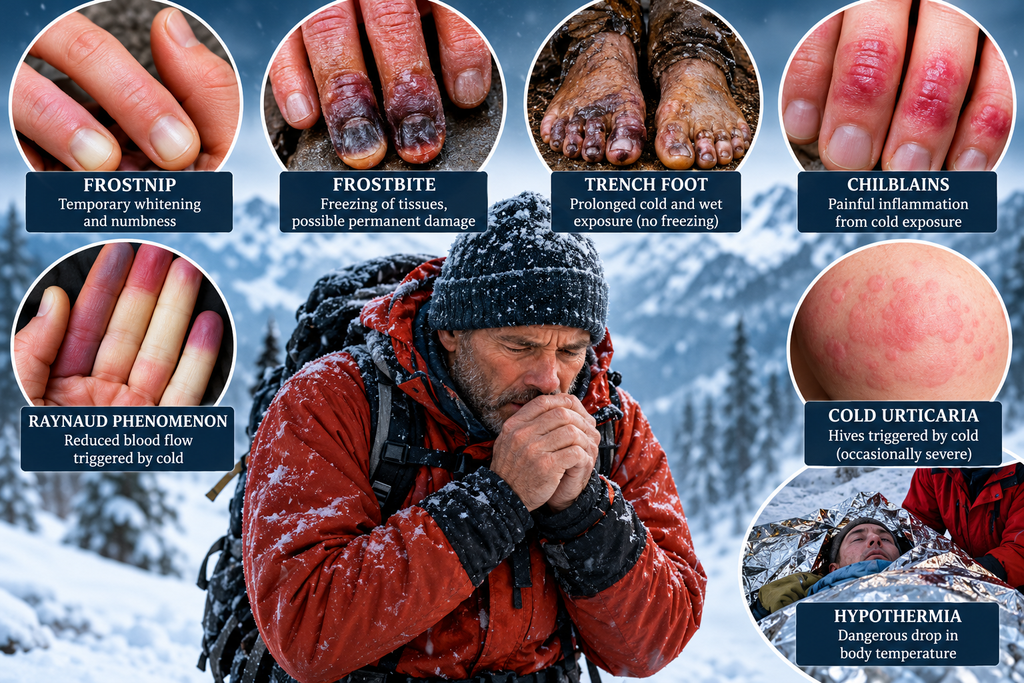
When most of us think of cold injuries, the first thing that comes to mind is frostbite. But frostbite is just one of a spectrum of cold related problems that range from inconvenient to lethal. They fall into three broad categories: the systemic heat loss associated with hypothermia, freezing injuries such as frostbite, and non-freezing injuries such as trench foot. Cold injury depends on more than just temperature. Wind, moisture, and duration of exposure all play an important role. Your overall general physical condition, level of exhaustion, nutritional fitness, and circulatory health all influence your vulnerability to cold injury.
Before looking at specific cold injuries, I’m going to describe how cold affects the body.
Cold and the human body
The human body works most effectively when its core body temperature is maintained between 97°F and 99°F. The body attempts to maintain heat by narrowing blood vessels in the skin and the extremities and directing warm blood towards vital organs.
When these responses are no longer adequate to maintain body temperature and when tissue temperature falls far enough, ice can form in and around cells, leading to tissue damage and ultimately to tissue destruction. When core body temperature falls far enough systemic damage can occur that interferes with brain function, heart rhythm and eventually with the function of every organ system. My recent post, When the Body’s Thermostat Fails: The Dangers of Extreme Heat and Cold, gives a more detailed description of the body’s response to extreme cold temperatures.
Hypothermia: a systemic threat to life
Hypothermia occurs when the body’s core temperature falls below 95°F. While it most commonly occurs in the winter it can develop in above freezing environmental temperatures when a person is wet, exposed to wind, or submerged in cold water.
Mild hypothermia occurs when the body temperature is between 90 and 95°F. It commonly presents with shivering, fatigue, clumsiness, and impaired judgment.
Moderate hypothermia occurs with the body temperature between 82 and 90°F. It can cause confusion, altered consciousness, and dangerous heart rhythms. Shivering may be diminished or may cease altogether with moderate hypothermia.
Severe hypothermia occurs when the core body temperature falls below 82°F. The victim is most commonly unconscious, has extremely slow breathing and pulse, and may go into cardiac arrest.
Outside of a medical facility, it’s almost impossible to determine core body temperature so treatment of suspected hypothermia must be based on a clinical assessment. Even mild hypothermia is a medical emergency, and treatment should not be delayed while waiting for a body temperature to be taken.
Immediate treatment consists of stopping further heat loss and safely restoring warmth. The victim should be immediately moved into a sheltered place, and all wet clothing should be removed once the patient is protected from the environment. The victim’s body must be immediately insulated to prevent any further heat loss. Unnecessary exertion should be minimized. Any type of safe warming device or warming blankets available should be applied to the trunk while avoiding any burns. Warm drinks may be used but only when the person is fully alert and can swallow safely. Alcohol should never be given.
Severe hypothermia requires immediate treatment in a hospital emergency department. External warming devices will be applied, and catheters and nasogastric tubes may be used for warm internal irrigation. Warm Intravenous fluids may also be used.
When there is evidence of cardiac arrest in the field and the core body temperature remains low, the patient should still be immediately transferred to an emergency department capable of cardiac resuscitation. Hypothermia can slow normal body metabolism to the point that it cannot be detected by means available in the field. When I was working in the emergency department there was an old saying “no one is dead until they’re warm and dead”. I personally have treated patients who presented to the emergency department in cardiac arrest with hypothermia that have subsequently been resuscitated and able to return home.
The Freezing Injuries
Frost Nip Is the mildest form a freezing injury. It is usually caused by localized freezing related cold exposure primarily affecting the nose, cheeks, ears, fingers, and toes. It generally causes temporary changes in the skin without the permanent tissue damage caused by frostbite. Some older descriptions of frostnip referred to it as “superficial freezing” but modern clinical classifications describe it as not being a true tissue-freezing injury.
Skin may become pale or red with a tingling sensation or a numbness. Deep tissues remain viable and symptoms usually resolve after warming. Treatment involves moving to a warm environment and removing wet clothing. The affected area should be gently rearmed but the skin should never be vigorously rubbed or exposed to intense direct heat.
Frostnip generally resolves completely without permanent damage. Extra sensitivity to cold may persist for months afterwards. It is a warning sign that continued exposure may lead to frostbite.
Frostbite is when the skin actually freezes, causing direct tissue and cellular damage. Frostbite can cause numbness, redness and swelling. In some cases, the skin will appear pale or waxy. There may also be blisters filled with clear or milky appearing fluid. The skin may feel firm or even hard to the touch. Doctors have traditionally graded frostbite into four tiers, but for common use all suspected frostbite should be treated the same until a medical evaluation is done.
Initial treatment can sometimes seem counter intuitive. You should never make an effort to thaw frozen tissue if there’s a real chance that it will freeze again. Refreezing can cause tissue damage more extensive than the original freezing. The victim should also immediately be assessed and treated for any signs of hypothermia. Unless it is necessary for evacuation, the victim should never attempt to walk on frostbitten feet.
Once you have determined that the victim is safe from refreezing, wet clothing should be immediately removed and the affected skin covered to protect it from additional injury. Any tight or restrictive jewelry should be removed. The skin should not be rubbed and should never be massaged with snow. Blisters should not be punctured. Direct heat should never be applied to the skin.
If the skin is intact and the patient is protected and safe from refreezing, you can begin field treatment using immersion in warm water that is between 99 and 102°F. You should not attempt this if you are unable to accurately measure the temperature of the water. If unable to rewarm, cover the injury with a dry dressing, keep the victim warm and prepare for evacuation. Rewarming can be accompanied by severe pain, and analgesia should be administered if available.
Superficial frostbite can heal with few or no long-term effects. Severe frostbite may lead to loss of digits or larger portions of extremities. Even if there’s no significant tissue loss, long term numbness, pain, and altered sensation may occur. Some patients will have a persistent cold sensitivity.
The Nonfreezing Injuries
Chilblains, also known as pernio, are inflammatory skin lesions caused by exposure to cold damp conditions. They appear as red, swollen, painful, or itchy patches. The principal cause is an abnormal response of small blood vessels to cold temperatures. Prolonged narrowing of the vessels can lead to changes in circulation during warming causing the local inflammation. Young women and people with a very low body weight seem to be especially sensitive to chilblains.
Chilblains can occur in both exposed and unexposed skin almost always at temperatures above freezing. The lesions most commonly occur on the fingers and toes, although they can show up on the ears, nose, or other parts of the face.
Chilblains are frequently unrecognized as a cold injury because they often occur several hours after cold exposure has ended and the victims often suspect they’re having some type of allergic reaction. The most severe cases can lead to blisters or even ulceration, although deep tissue destruction generally doesn’t occur. Chilblains can be painful as the skin starts to warm.
The principal treatment is to avoid any further cold exposure and keep the affected skin comfortably warm and dry but not overheated. Topical corticosteroids may reduce some of the discomfort associated with chilblains. Most uncomplicated chilblains will resolve within one to three weeks.
Cold urticaria can best be thought of as an allergic reaction to the cold. There is no tissue freezing and circulation remains unimpaired. Cold exposure triggers the release of histamines and other inflammatory substances from mast cells, just as in other allergic reactions. Symptoms can develop after exposure to cold air or cold water and even refrigerated beverages or handling cold food containers can trigger a reaction. Swimming in cold water can be a significant trigger because of the large skin area that is simultaneously exposed.
Patients usually develop the typical raised and itchy welts that resemble ordinary hives. They can occur within minutes of exposure or may not occur until the skin begins to rewarm. It most often results in a localized skin reaction, but occasionally a general allergic reaction can occur. In the most severe cases it can lead to anaphylaxis causing airway swelling, breathing difficulty, and a fall in blood pressure.
Treatment includes moving to a warm environment and removing any sources of cold in contact with the body. Second generation antihistamines can be used to treat symptoms. As with any allergic reaction, you should be alert for systemic responses.
Trench foot, more properly known as immersion foot, occurs when feet remain in contact with cold wet socks or boots for days. It almost always occurs at temperatures above freezing but below about 59°F. The foot becomes pale, clammy, swollen, and numb. As the foot warms up it can become red and very painful. Blisters can form and become infected, and the skin may be extremely sensitive to light touch.
This injury first came to the public attention because of the widespread suffering of British troops in the trenches during World War I. It is also a concern among construction workers and fishermen who have significant exposure to cold and wet conditions. More recently, trench foot has become a concern among unsheltered people who lack access to clean socks, dry shoes, or heated shelter.
The main element of treatment is gentle warming, drying, and cleaning of the foot. It should be kept elevated, dry, and warm. Patients should avoid smoking and other forms of nicotine which can impair circulation in the foot. Because most cases of trench foot are found in military units, prognosis is hard to quantify. While mild cases may resolve in a few days to weeks, complete recovery of serious cases is thought to be fairly long, requiring often six months or more. Chronic pain and extensive cold sensitivity can remain long after it appears that the wounds have healed.
Raynaud Phenomenon isn’t technically a cold injury but is included in this list because cold exposure is its principal trigger. Most commonly occurs in the fingers or toes when the small arteries that supply them undergo an exaggerated constriction in response to a cold or emotional stress. Affected fingers may turn white as the blood flow decreases and then blue as oxygen levels fall. Patients may also experience numbness, tingling, pain or throbbing. The skin then turns red as circulation returns.
My wife, who suffers from this, calls it “death hands”. What is interesting about this is that it does not have to occur in cold weather. It can happen when the sufferer makes a transition from a warm to cold environment. My wife has had it occur in the summer when we go to the grocery store and she’s getting frozen or refrigerated food and the difference between her warm skin from outside and the cool environment in the grocery store will trigger an attack.
Primary Raynaud phenomenon occurs without any underlying disease and is usually relatively benign. Circulation returns quickly once warming occurs. It rarely causes any permanent tissue injury.
Secondary Raynaud phenomenon is related principally to autoimmune diseases or vascular disorders. It can occasionally produce digital ulcers, ischemia, or even gangrene. It is sometimes treated with calcium channel blockers to decreased symptoms.
Wrapping up
Cold injuries are more than just frostbite. It’s important to recognize how many types of cold injuries there are. The bottom line is that prevention is far more effective than treatment. Wearing the proper clothing including dry footwear, maintaining adequate shelter from severe weather, and early recognition of symptoms help to prevent most cold injuries.
Image generated by author using ChatGPT.
Medical Disclaimer
The information provided in this article is intended for general educational and informational purposes only and does not constitute medical advice. It should not be used as a substitute for professional medical advice, diagnosis, or treatment.
Always seek the guidance of a qualified healthcare provider with any questions you may have regarding a medical condition or treatment. Never disregard professional medical advice or delay seeking it because of something you have read here.
If you are experiencing a medical emergency, call 911 or your local emergency number immediately.
The author of this article is a licensed physician, but the views expressed here are solely those of the author and do not represent the official position of any hospital, health system, or medical organization with which the author may be affiliated.
Sources
1. Wilderness Medical Society Clinical Practice Guidelines for the Prevention and Treatment of Frostbite: 2024 Update (abstract), Wilderness & Environmental Medicine. https://pubmed.ncbi.nlm.nih.gov/38577729/
2. White L. Understanding and Managing Frostbite, American Family Physician community blog, January 2026. https://www.aafp.org/pubs/afp/afp-community-blog/entry/understanding-and-managing-frostbite.html
3. Frostbite: Recommendations for Prevention and Treatment from the Wilderness Medical Society, American Family Physician, 2020. https://www.aafp.org/pubs/afp/issues/2020/0401/p440.html
4. Wilderness Medical Society Clinical Practice Guidelines for the Prevention and Treatment of Frostbite: 2024 Update (full text), SAGE. https://journals.sagepub.com/doi/10.1177/10806032231222359
5. Frostbite, 5-Minute Clinical Consult (Wolters Kluwer). https://www.unboundmedicine.com/5minute/view/5-Minute-Clinical-Consult/816713/1.3.0/Frostbite
6. Therapeutic recommendations for frostbite: a narrative overview (Health Problems of Civilization). https://www.journals.anstar.edu.pl/index.php/hppa/article/view/691
7. WMS Frostbite Guidelines (summary), NAR Rescue Blog. https://www.narescue.com/nar-blog/wms-frostbite-guidelines.html
8. Frostbite management and imaging overview, emDocs/eMottawa Blog. https://emottawablog.com/?p=11840
9. The value of technetium 99 scintigraphy in the prognosis of amputation in severe frostbite injuries, Journal of Hand Surgery, 2000. https://www.qxmd.com/r/11040315
10. FDA Approves First Medication to Treat Severe Frostbite, U.S. Food and Drug Administration. https://www.fda.gov/news-events/press-announcements/fda-approves-first-medication-treat-severe-frostbite
11. FDA Approves Aurlumyn for Severe Frostbite, HealthDay, February 2024. https://www.healthday.com/healthpro-news/skin-health/fda-approves-aurlumyn-for-severe-frostbite
12. Nonfreezing Tissue Injuries, MSD Manual (consumer version). https://msdmanuals.com/home/injuries-and-poisoning/cold-injuries/nonfreezing-tissue-injuries
13. Nonfreezing Tissue Injuries, MSD Manual (professional version). https://msdmanuals.com/uk/professional/injuries-poisoning/cold-injury/nonfreezing-tissue-injuries
14. Chilblains (Pernio), Patient Care Online. https://www.patientcareonline.com/view/chilblains-pernio
15. Chronic non-freezing cold injury results in neuropathic pain due to a sensory neuropathy, Brain, 2017. https://www.ncbi.nlm.nih.gov/pmc/articles/PMC5841153/
16. Case series of non-freezing cold injury: the modern clinical syndrome, BMJ Military Health. https://militaryhealth.bmj.com/content/166/5/324
17. Trench Foot or Non-Freezing Cold Injury As a Painful Vaso-Neuropathy, Frontiers in Neurology, 2017. https://frontiersin.org/journals/neurology/articles/10.3389/fneur.2017.00514/full
18. Independent Medical Expert Group, Report 1, Topic 3: Non Freezing Cold Injury (UK Ministry of Defence), 2011. https://assets.publishing.service.gov.uk/government/uploads/system/uploads/attachment_data/file/798488/IMEG_Report_1_and_Recommendations_on_Medical_Aspects_-_TOPIC_3_-_Non_Freezing_Cold_Injury__002_.pdf
19. Accidental Hypothermia: Guidelines from the Wilderness Medical Society, American Family Physician, 2020. https://www.aafp.org/pubs/afp/issues/2020/1101/p571.html
20. Classification and Staging of Accidental Hypothermia, MSD Manual (professional version). https://www.msdmanuals.com/professional/multimedia/table/classification-and-staging-of-accidental-hypothermia
21. Use of the HOPE score to assess survival outcome of hypothermic cardiac arrest selected by ECLS rewarming. https://www.ncbi.nlm.nih.gov/pmc/articles/PMC12305985/
22. Hypothermia outcome prediction after extracorporeal life support for hypothermic cardiac arrest patients: an external validation of the HOPE score, Resuscitation. https://boris.unibe.ch/130078
23. Rewarming From Hypothermic Cardiac Arrest Applying Extracorporeal Life Support: A Systematic Review and Meta-Analysis. https://pmc.ncbi.nlm.nih.gov/articles/PMC8155640
24. Hypothermia and Cold Weather Injuries, American Family Physician, 2019. https://www.aafp.org/afp/2019/1201/p680.pdf
25. Protect yourself from cold weather: risks, symptoms, and prevention tips, Hennepin Healthcare. https://hennepinhealthcare.org/blog/protect-yourself-cold-weather-risks-symptoms-and-prevention-tips
26. Frostbite prevention: risk factors, AARP. https://www.aarp.org/health/conditions-treatments/frostbite-prevention/
Leave a Reply