
A plain-language look at gummy vitamins and medications — the good, the bad, and the sticky
Not Your Grandma’s Vitamin
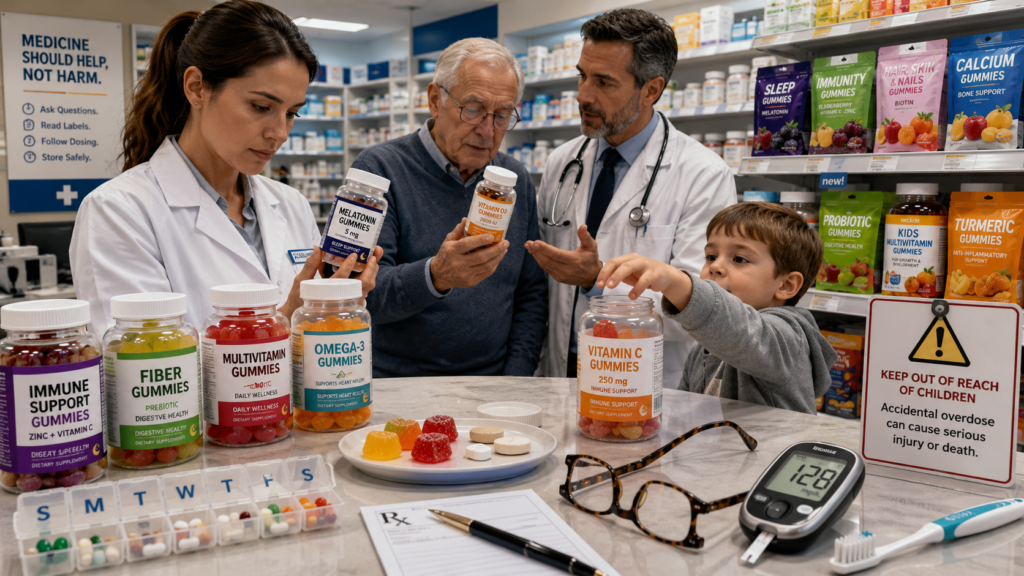
Walk down the supplement aisle of any pharmacy or big-box store and you’ll find row after row of brightly colored bottles filled with gummy bears, worms, and rings that smell vaguely of fruit punch. Decades ago, vitamins came in white tablets that tasted like chalk and left you feeling vaguely like you’d swallowed a piece of sidewalk. Today, a not-insignificant share of the American supplement market looks and tastes a whole lot like candy. That shift didn’t happen by accident, and understanding what’s driving it — and what it costs — is worth your time.
Gummy formulations now cover everything from vitamin C and melatonin to prenatal multivitamins and, increasingly, actual prescription-adjacent medications. The format has clear appeal, especially for children who resist pills and adults who find swallowing large tablets unpleasant or outright difficult. But behind that chewy exterior lies a more complicated picture involving sugar, unreliable dosing, dental damage, and real safety risks that most consumers never think about.
The Appeal Is Real
Let’s give credit where it’s due: the biggest genuine advantage of gummy vitamins isn’t nutritional — it’s behavioral. According to University Hospitals, the primary benefit of gummies over traditional supplements is people will take them more consistently. A vitamin sitting in your cabinet because you hate the taste is worthless. A gummy you look forward to, however modest its nutritional profile, at least does something. That’s not a trivial point.
For parents of young children, this is often a decisive factor. Getting a five-year-old to swallow a pill can feel like an Olympic sport. Gummies sidestep the fight entirely. And for elderly patients managing complex medication regimens, or anyone with a swallowing disorder (called dysphagia), gummies and chewables offer a useful alternative to pills and capsules.
There’s also a psychological dimension. Taking a gummy feels like a small reward rather than a medical obligation, and that association can make adherence to a supplement routine more sustainable. That may sound trivial, but in the real world of patient behavior, it matters.
Gummies may be gentler on the stomach than some traditional tablets because they lack certain binding agents and can sometimes be taken without food or large volumes of water, reducing nausea for sensitive users.
The popularity of gummy medications reflects a broader shift in medicine toward consumer-friendly products. Yet the fact that a medication tastes like candy does not make it harmless.
What’s in the Gummy?
Here’s where things start to get complicated. A standard gummy vitamin isn’t just vitamins. Its base is a blend of gelatin or pectin, corn starch, water, and — almost always — sugar or some form of sweetener. UCLA Health reports that most gummy vitamins contain between 2 and 8 grams of sugar per serving. The American Heart Association recommends no more than 25 grams of added sugar per day for women and 36 grams for men. That is a meaningful slice of a daily sugar budget, especially for someone taking multiple gummies.
The presence of all those filler ingredients — coloring, flavoring, gelling agents — creates a real-world engineering problem for manufacturers: there’s only so much space in a gummy bear. That means there is less room for actual vitamins and minerals.
Many gummy multivitamins leave out key minerals such as iron or zinc, or include them only in small amounts, because certain minerals affect taste or texture or are harder to formulate in a palatable gummy. As a result, relying solely on gummies may leave gaps compared with a well‑formulated tablet or capsule. As Cleveland Clinic notes, gummy vitamins typically contain fewer vitamins and minerals than regular vitamins, and it can be difficult to determine exactly how much nutrition you’re getting.
Sugar-free versions aren’t automatically off the hook either. Many use sugar alcohols like sorbitol or maltitol, which can cause bloating, gas, and diarrhea when consumed in any significant quantity. Others rely on high-sugar fruit juice concentrates that, while technically “no added sugar,” still deliver a meaningful glycemic hit.
The Sugar Problem — Beyond Calories
Your Teeth Are Paying the Price
The sugar content of gummy vitamins isn’t just a caloric issue — it’s a dental one, and it may be more damaging than eating equivalent sugar in another form. The reason comes down to the gelatin matrix. Dental researchers at Tufts University School of Dental Medicine explain that gummies carry roughly the same cavity risk as candy because sticky substances with sugar create oral health problems by lingering against tooth enamel far longer than liquids or even hard candies do.
When you eat ordinary sugary food, your saliva, tongue, and cheeks gradually help clear it away. Gelatin disrupts that process. It’s adhesive by design, that’s what makes gummies chewy rather than crumbly and it holds sugar against tooth surfaces far longer than normal. Bacteria in the mouth metabolize sugar and produce acids, which attack enamel in a process called demineralization. The result: an elevated risk of cavities that many never see coming because they’re thinking of these as health products, not candy.
Most gummy vitamins also contain citric acid, added for flavor. Citric acid softens enamel directly, creating a one-two punch: first the acid weakens the enamel, then the bacteria exploit the weakened surface. Brushing too soon after eating gummies can make things worse, since brushing acid-softened enamel can mechanically remove tooth structure. Dentists recommend rinsing with water immediately after chewing a gummy and waiting at least 30 minutes before brushing.
This is not a hypothetical concern. Pediatric dentists report seeing increased cavity rates in children whose parents switched to gummy vitamins as a supposedly healthier treat alternative. The irony — giving a child a health supplement that damages their teeth — is both real and under appreciated.
Diabetics, Diabetic-Adjacent, and Anyone Watching Sugar
For patients managing type 2 diabetes, pre-diabetes, metabolic syndrome, or insulin resistance, the sugar content of gummy vitamins isn’t just a dental annoyance — it’s a medication management issue. Taking multiple gummies daily, across different supplement categories (vitamin D, omega-3, calcium, melatonin, a multivitamin), can add up to a meaningful daily sugar load that was never accounted for in a dietary plan. Most people don’t track gummy sugar content the way they track the sugar in a soda, but they should.
The Dosing Problem Is Bigger Than You Think
What the Label Says vs What’s in the Bottle
Here’s a fact that should give anyone pause: gummy vitamins have a shorter shelf life than traditional pills and tablets, and the vitamins inside them degrade over time. To compensate, manufacturers sometimes overfill gummies at the time of production, meaning a freshly manufactured product may contain significantly more of a given vitamin than the label states, while an older product approaching its expiration date may contain considerably less.
The label on a gummy vitamin is, at best, a rough approximation. You might be getting 150% of what’s stated, or 60% of what’s stated, depending on when the product was manufactured and how long it sat on the shelf or in your cabinet. For most vitamins, this imprecision is inconvenient but not dangerous. For fat-soluble vitamins — specifically A, D, E, and K — it can become a genuine safety concern.
Unlike water-soluble vitamins such as C or the B vitamins, fat-soluble vitamins accumulate in the body’s fat tissue and liver rather than being excreted in urine. Consuming significantly more than your body needs over time can lead to toxicity. Vitamin A toxicity (hypervitaminosis A) can cause liver damage, bone loss, and a range of neurological symptoms. Vitamin D toxicity, while less common, can cause dangerously elevated calcium levels. The gummy format’s inherent dosing imprecision is most concerning precisely for the vitamins where precision matters most.
The Candy Problem and Accidental Overdose
Gummy vitamins taste like candy. They look like candy. Children cannot reliably distinguish them from candy, and the packaging is often designed with cartoon characters and bright colors that actively appeal to children. The predictable result: accidental ingestion. Poison control centers in the U.S. receive reports of over 60,000 vitamin toxicity events every year, and children under six account for the majority of those.
The FDA has taken notice. In late 2023, the agency convened a meeting of experts specifically to discuss the risks of candy-like nonprescription drug products, including gummy vitamins and OTC sleep aids. Among the concerns raised: packaging that uses cartoon characters and gummy worm shapes that blur the line between supplement and treat. Historically, a documented 500% spike in pediatric overdoses occurred in the late 1940s and early 1950s when drug companies began marketing kid-friendly aspirin and that was a less appealing format than gummies. History, it seems, may be repeating.
For households with young children, the safety implication is straightforward: gummy vitamins — regardless of how benign they may seem — should be stored exactly as any medication would be, in child-resistant containers and out of reach. The pleasant taste is precisely what makes them dangerous when a toddler finds them.
Regulatory Gaps and Quality Control
Supplements Aren’t Drugs
Let’s be clear about the regulatory landscape, because it matters more than most people realize. The FDA classifies dietary supplements — including gummy vitamins — as food items, not drugs. That means manufacturers don’t have to demonstrate safety and efficacy before bringing a product to market the way pharmaceutical companies do. The burden of proof is essentially reversed: the FDA must demonstrate that a product is unsafe before it can be pulled from shelves.
The practical consequences are significant. A gummy vitamin that claims to support immune health doesn’t have to prove that it does. A study analyzing supplements marketed for brain health and cognitive performance found that 83% contained compounds not listed on the label. Some contained prescription drug compounds. Heavy metals including lead, arsenic, cadmium, and mercury have been detected in dietary supplement products. Third-party testing exists (look for seals from NSF International, USP, or ConsumerLab), but it’s voluntary, and most products on the market haven’t been independently verified.
This isn’t an argument against supplements across the board — it’s an argument for educated consumption. If you or your physician have identified a specific nutritional deficiency, a targeted, independently verified supplement in a traditional tablet or capsule form will almost always deliver more reliable dosing than its gummy equivalent.
What about Prescription Gummies?
A growing number of prescription medications are being formulated as gummies or gummy-like chewables. The pharmaceutical industry sees significant potential in these products for pediatric and geriatric populations. However, prescription medications introduce additional challenges because many drugs require extremely precise dosing and predictable absorption characteristics. Compounded prescription gummies prepared by specialty pharmacies are already being marketed for conditions such as erectile dysfunction, sleep disorders, hormonal therapy, and hair loss. These require very specific prescriptions and many of these are not FDA-approved as finished pharmaceutical products, even though the active ingredients themselves may be FDA-approved.
Consumers should be cautious about products marketed online as “prescription gummies,” especially for weight loss, sexual enhancement, bodybuilding, or “natural” performance enhancement. The FDA has found hidden prescription drugs inside some supposedly “herbal” gummies. Several products sold as sexual-enhancement gummies were found to contain non- documented tadalafil, the active ingredient in Cialis. This can be dangerous, especially in patients taking nitrates or cardiac medications.
A Balanced Bottom Line
Gummy vitamins occupy a genuine and useful niche. For children who won’t take pills, for adults with swallowing difficulties, for patients who simply need a behavioral nudge to take something they’d otherwise skip — the gummy format serves a real purpose. Compliance is a legitimate medical outcome, and if the gummy gets someone to take their vitamin D consistently when they otherwise wouldn’t, that has value.
But gummies should be approached with clear eyes. They contain sugar — often more than people realize — and that sugar can damage teeth, complicate blood sugar management, and add up when multiple supplements are taken daily. Their dosing is inherently less precise than traditional formulations, a problem that grows more serious with fat-soluble vitamins that can accumulate to toxic levels. They pose a real accidental overdose risk in homes with children. And they exist in a regulatory environment that places the burden of quality assurance squarely on the consumer.
If you’re going to use gummies, the practical advice is consistent across medical sources: choose brands that have been independently third-party tested, keep them locked away from children, rinse your mouth with water after taking them, don’t substitute them for a meaningful medical intervention without your doctor’s input, and be especially cautious with fat-soluble vitamin gummies where dosing precision matters most. And if you’re taking them alongside prescription medications, tell your doctor — interactions and supplement contamination are real, if underappreciated, risks.
The gummy revolution isn’t going anywhere. The market is too large and the convenience too appealing. But the best version of that revolution is one where consumers understand what they’re actually putting in their mouths.
Image generated by author using ChatGPT.
Sources
1. WebMD — Gummy Vitamins: What to Know. https://www.webmd.com/vitamins-and-supplements/what-to-know-about-gummy-vitamins
2. UCLA Health — Should You Take Gummy Vitamins? https://www.uclahealth.org/news/article/should-you-take-gummy-vitamins
3. University Hospitals — Are Gummy Vitamins as Good as the Real Thing? https://www.uhhospitals.org/blog/articles/2026/01/are-gummy-vitamins-as-good-as-the-real-thing
4. Cleveland Clinic — Do Gummy Vitamins Work as Well as Traditional Vitamins? https://health.clevelandclinic.org/do-gummy-vitamins-work-as-well-as-traditional-vitamins
5. Ochsner Health — Are Gummy Vitamins Effective or Just a Sweet Treat? https://blog.ochsner.org/articles/are-gummy-vitamins-healthy/
6. Scripps Health — Do Gummy Vitamins Really Work? https://www.scripps.org/news_items/7270-do-gummy-vitamins-really-work
7. Healthline — Are Gummy Vitamins Good or Bad? https://www.healthline.com/nutrition/gummy-vitamins
8. MedShadow Foundation — Dangers of Gummy, Patch, and Powder Vitamin Supplements. https://medshadow.org/integrative-health/non-drug-supplements/dangers-of-gummy-patch-and-powder-vitamin-supplements/
9. STAT News — The FDA Weighs the Risks of Candy-Like Nonprescription Drugs. https://www.statnews.com/2023/10/30/candy-like-drugs-gummies-fda-halloween-eve/
10. FDA — Dietary Supplements: Questions and Answers. https://www.fda.gov/consumers/consumer-updates/fda-101-dietary-supplements
11. Tufts University School of Dental Medicine — Something to Chew On Before You Sink Your Teeth into Those Gummy Vitamins. https://now.tufts.edu/2024/07/25/something-chew-you-sink-your-teeth-those-gummy-vitamins
12. SingleCare — What Happens If You Eat Too Many Gummy Vitamins? https://www.singlecare.com/blog/too-many-gummy-vitamins/
13. GoodRx — Can You Overdose on Vitamins? https://www.goodrx.com/well-being/supplements-herbs/overdose-on-vitamins
Medical Disclaimer
The information provided in this article is intended for general educational and informational purposes only and does not constitute medical advice. It should not be used as a substitute for professional medical advice, diagnosis, or treatment.
Always seek the guidance of a qualified healthcare provider with any questions you may have regarding a medical condition or treatment. Never disregard professional medical advice or delay seeking it because of something you have read here.
If you are experiencing a medical emergency, call 911 or your local emergency number immediately.
The author of this article is a licensed physician, but the views expressed here are solely those of the author and do not represent the official position of any hospital, health system, or medical organization with which the author may be affiliated.







You Are Pre-Approved!
By John Turley
On May 27, 2026
In Commentary
The Shameless, Relentless, Occasionally Confounding World of Credit Card Solicitations
There is a tree somewhere in North America that gave its life so that you could receive a glossy envelope informing you that you have been “pre-approved” for a credit card you never asked for, do not need, and will almost certainly use to buy something you will regret. And then, before the last fibers of that tree have even fully composted in a landfill, another envelope arrives. And another. And another. The credit card industry, it turns out, does not take rejection personally.
If there is one thing that unites every American regardless of age, income, or credit score, it is the daily ritual of sorting through a mailbox that appears to be funded entirely by credit card marketing departments. You may be rich, poor, employed, retired, or technically living in a van — the credit card offers will find you. In effect, your mailbox has become a credit card distribution center.
The Numbers: A Blizzard of Pre-Approval
Let’s start with some data, because the numbers are genuinely staggering. At an early peak of credit card direct mail campaigns in 2005 and 2006, the industry was mailing roughly 7.5 billion pieces per year — which works out to approximately 30 offers for every adult in the country. That’s a piece of mail roughly every twelve days, from an industry that had apparently decided that subtlety was for amateurs. The market is so saturated that the response rate is typically less than 1%; that’s an absurd amount of mail just to catch few fish.
The Great Recession briefly interrupted this party. By July 2009, the volume had cratered to a trickle of just over 1.2 billion pieces per year. But credit card issuers, being resilient optimists in the face of human financial suffering, bounced back. By 2020, estimates placed the total at around 11 billion credit card solicitations sent to consumers in a single year. (I think most of them wound up in my mailbox.)
For context, the average American household currently receives roughly 848 pieces of junk mail per year, and credit card solicitations make up a meaningful share of that. One statistical source estimates Americans spend, in aggregate, eight months of their lifetime opening junk mail. One can only imagine how much of that is spent frowning at an offer for a card with a 29.99% APR and a free tote bag.
Despite digital marketing’s rise, the physical mailbox remains a preferred channel for credit card pitches. Why? Because the industry discovered long ago that a glossy envelope with your name printed in a font that implies importance is harder to ignore than an email you delete before you even finish reading the subject line.
The Average American: Already Carrying Quite Enough, Thank You
So, what do all these offers produce? Americans currently hold an average of 7.1 open credit card accounts, though only about 3.7 of those are actively used. The rest appear to be dormant accounts accumulated over the years, like ex-partners you never quite got around to officially ending things with.
Baby Boomers lead the generational pack with an average of 4.61 active cards, followed by Gen X at 4.23. In total, there are now 636 million open credit card accounts in the United States as of mid-2025 — nearly two per American, counting children and people who have sworn off plastic entirely.
The average credit card balance in the U.S. as of late 2024 was $6,730, with the average APR sitting at a punishing 21 to 22 percent. This means that for many people, the credit card they received in a “pre-approved!” envelope is now costing them more in interest than they spend on groceries. The tote bag, presumably, was not worth it.
Senior Citizens: A Special Kind of Target
Now let’s talk about senior citizens, because the credit card industry has a special enthusiasm for this demographic. Seniors, after all, tend to have long credit histories, established accounts, and in many cases, the kind of pristine credit scores that issuers find irresistible. The fact that many are living on fixed incomes does not appear to dim the industry’s ardor.
According to recent data, Americans 65 and older hold on average, up to 4.8 cards per person. This tracks: decades of responsible use and a long credit history make seniors attractive applicants. And credit card issuers can absolutely count Social Security, pension income, IRA distributions, and investment income as qualifying income on applications. Federal law requires it.
What this means, in practice, is that a 78-year-old widower living on $1,400 a month from Social Security can receive and potentially qualify for a credit card — possibly with a $5,000 credit limit and a 28% APR. Whether this is a genuine service or a predatory opportunity dressed in rewards points is a matter of perspective, and apparently a matter of vigorous congressional debate. A House committee hearing on the subject noted with concern that older Americans are the fastest-growing age group to file for bankruptcy, a trend linked in part to credit card debt.
Scenario One: The Comfortable Retiree
Consider “Martha,” a 71-year-old retired schoolteacher in Ohio. She has a pension of $2,200 per month, Social Security of $1,800 per month, and a modest IRA she draws $500 from monthly. Her total annual income is around $54,000. She has an excellent credit score of 760, accumulated over 45 years of never once paying a bill late.
Martha’s mailbox is a cornucopia of opportunity. She receives offers for travel cards, cashback cards, AARP-branded cards, hotel rewards cards, and at least one card that seems to believe she has always wanted to earn airline miles in exchange for buying cat food. She probably qualifies for most of them. Her challenge is not getting a credit card — it is having the discipline not to get all of them.
Scenario Two: The Social Security-Only Retiree
“Robert,” 74, is a retired factory worker in West Virginia. His only income is $1,350 per month in Social Security. He rents a small apartment and drives a 2009 pickup. He would not describe himself as a big spender. Yet the offers come anyway. Some cards he would qualify for; some he would not. But the envelopes do not discriminate.
For Robert, a credit card on a Social Security-only income is a double-edged instrument. Used wisely — a small recurring charge paid off every month — it helps maintain his credit score. Used unwisely, with a 24% APR and a $3,000 limit he does not need, it can quietly become a slow-motion financial disaster. As one congressional witness summarized: more than a third of seniors depend on Social Security for over 90% of their income, and a high-interest credit card can be devastating for someone living on a fixed income.
Scenario Three: The Affluent Senior
“Eleanor” is 68, a retired surgeon living in Scottsdale. She has a pension, maximum Social Security, significant investment income, and a paid-off home. Her total income is probably north of $200,000 a year. Her credit score is 820. Eleanor receives credit card offers the way the rest of us receive pizza coupons — constantly, enthusiastically, and with the implicit suggestion that her life would be measurably improved if she just signed up.
Eleanor gets the platinum cards, the black cards, the invitation-only cards that arrive in weighted envelopes and refer to her, inexplicably, as a “member.” For Eleanor, the game is actually worth playing: if you have the discipline to pay the balance every month, a 2% cashback card on $150,000 in annual spending produces $3,000 in free money. The credit card companies are betting she won’t. She usually does. Eleanor is winning — one of the few.
The Ultimate Power Move: Apply for All of Them
Now we arrive at the scenario that the credit card industry’s actuarial tables do not like to contemplate: what happens if someone actually applies for every card they are offered, gets approved for most of them, charges them all to the maximum, and then declares bankruptcy?
Theoretically, this sounds like a heist. In practice, it is a lot messier, and the law has anticipated your enthusiasm.
First, the logistics. Applying for multiple credit cards simultaneously triggers multiple hard inquiries on your credit report, which almost immediately begins dragging your credit score down. Issuers can see those inquiries in real time. After the third or fourth application, the phone calls from the fraud department start. After the eighth, many issuers simply decline. The window for pulling this off is narrow and rapidly self-closing, like a submarine hatch operated by someone who has had one too many.
That said, people do accumulate considerable credit card debt before reaching bankruptcy. American credit card debt hit $1.18 trillion in 2025, and a meaningful portion of it is genuinely uncollectable. Chapter 7 bankruptcy, the kind that discharges most unsecured debts within a few months, absolutely does handle credit card balances. In most cases, credit card debt is treated as non-priority unsecured debt, meaning it is the first thing eliminated and the last creditor to get paid if there are assets. Usually there are no assets.
But — and here is where the bankruptcy judge stops smiling — there are several traps for the scheming would-be debt escapee.
The first is the luxury goods rule. If you charged more than $725 worth of luxury goods or services within 90 days of filing bankruptcy, that debt is presumptively non-dischargeable. The law has a very dim view of someone who maxed out a credit card at Nordstrom on a Thursday and filed Chapter 7 on a Sunday. Similarly, cash advances over $1,000 taken within 70 days of filing are presumptively non-dischargeable.
The second is fraud. If the bankruptcy trustee or a credit card company can demonstrate that you took on debt with no intention of repaying it — which, if you applied for 14 cards in a month and maxed them all out, is not a difficult case to make — those debts can be challenged as non-dischargeable. The burden of proof matters, and credit card companies have 60 days from your first creditor meeting to file complaints.
The third is the means test. Chapter 7 bankruptcy requires you to pass an income means test. If your income is above the state median, you may be pushed toward Chapter 13, which involves a three-to-five-year repayment plan. Not quite the clean escape the heist film suggested.
For seniors specifically, there is a wrinkle that is either reassuring or terrifying depending on your perspective: Social Security income cannot be garnished by private creditors — even if a court enters a judgment against you. A credit card company can sue you, win, and receive a judgment, and still be unable to touch your monthly Social Security check. This makes seniors who live exclusively on Social Security somewhat “collection-proof,” though that is a legal term, not an invitation, and the stress of debt and lawsuits is not trivial.
In other words, someone could theoretically max out ten credit cards, declare bankruptcy, watch most of the debt get discharged, and continue living on Social Security without the credit card companies collecting a dime. In theory. In practice, this would also mean having a bankruptcy on your credit report for 7 to 10 years, being unable to get any new credit, and explaining to your grandchildren why you have 14 maxed-out cards and a lawyer’s business card on the refrigerator.
Some people believe they may have found a way around this. They plan that if they are ever diagnosed with a fatal illness, they will simply max out every credit card they can get and leave the companies on the hook for their final days of high living.
There’ s just one problem. When you die, your credit card debt doesn’t just evaporate. Everything you own — and everything you owe — becomes part of your “estate.” Your estate is responsible for your debts, meaning outstanding credit card balances are paid from assets like your home, bank accounts, investments, and personal property. The legal sorting-out process is called probate.
So, if you pass away with $5,000 in credit card debt and a $50,000 estate, the debt gets paid first and your heirs get the rest. If you have $5,000 in debt and only $3,000 in assets, the creditor typically eats the difference — your kids don’t write a check. However, if your surviving spouse is a joint account holder or you live in a community property state, they may be responsible for your total credit card debt.
The Bottom Line: A Comedy in Several Acts
The credit card solicitation industry is, at its core, an enormous optimism machine. It believes, against all available evidence, that the person who received 847 pieces of junk mail last year is ready to finally respond to number 848. It believes that a 79-year-old man on Social Security is one glossy envelope away from becoming a loyal travel rewards customer. It believes that if it just makes the sign-up bonus big enough, you will forget about the 26% APR.
Most of us play along, at least a little. We hold three or four cards. We pay them off sometimes and carry a balance sometimes. We accept the cashback and occasionally read the fine print, mostly when something goes wrong.
And somewhere in a mail-sorting facility right now, another batch of envelopes is being addressed. They are glossy. They are personalized. They say, in bold letters, that you have been pre-approved.
You are always pre-approved. That’s the joke. And also, somehow, the business model.
Illustration Generated by author using ChatGPT.
Disclaimer
This article is written for general informational and entertainment purposes. It does not constitute financial, legal, or medical advice. Readers facing significant credit card debt or considering bankruptcy should consult a qualified financial advisor or licensed bankruptcy attorney. The author’s opinions are independent and do not represent any institutional affiliation.
Selected Sources
Acxiom — Direct Mail Credit Card Volume History
Bankrate — Credit Card Ownership and Usage Statistics
Payanywhere — Statistics on American Consumer Credit Card Usage
Clearly Payments — How Many Credit Cards Are in the USA in 2025
CardRates — How Many Credit Cards Does the Average American Have?
WalletHub — Opting Out of Pre-Approved Credit Offers
U.S. House of Representatives — Credit Cards and Older Americans (Hearing)
Firstcard — Best Credit Cards for Low-Income Seniors
Debt.org — Can Social Security Be Garnished for Credit Card Debt?
Justia — Credit Card Debt Under Bankruptcy Law
CBS News — Can Credit Card Debt Be Discharged in Bankruptcy on Disability?