
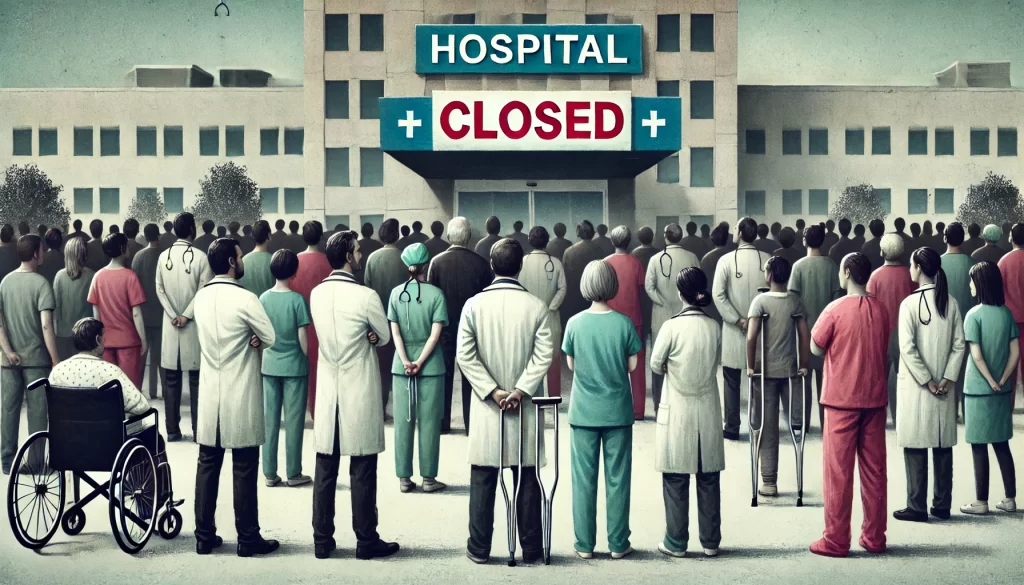
For more than 30 years I have watched our health care system become increasingly more politicized. As a physician I have become concerned with the direction it has recently taken.
Until the early 20th century healthcare was mostly private, and medical expenses were out of pocket. Early calls for national health insurance began with labor organizations and were quickly joined by progressive politicians. President Franklin Roosevelt wanted to include health insurance in the Social Security Act of 1935 but was unable to get it passed. President Harry Truman also proposed a National Health Insurance program in 1945, but it was denounced as socialized medicine. All these efforts were opposed by business interests, conservative politicians — particularly southern— and surprisingly, the American Medical Association.
Finally in the 1960s as part of his “Great Society” programs President Lyndon Johnson pushed for the passage of both Medicare and Medicaid. Rising costs of health care under President Richard Nixon led to the introduction of Health Maintenance Organizations (HMOs) as an attempt to encourage cost efficiency. President Ronald Reagan reduced federal health care spending and pushed for more privatization. In the 1990s President Bill Clinton attempted to introduce universal health coverage but it was met by fierce opposition from the insurance industry, business, and the Republican Party who labeled it as government “overreach”. Finally in 2010 President Obama’s Affordable Care Act (ACA) also called “Obamacare” became the most significant health care reform since Medicare and Medicaid. It also faced legal challenges and political resistance with the Republicans consistently attempting to repeal it. During his first term, President Donald Trump reduced ACA funding and repealed the individual mandate penalty that had required people who did not maintain health insurance to pay a fee. The elimination of the penalty weakened the law and reduced the number of people who sought coverage. We can expect further efforts to weaken the provisions of the ACA but given that it is well entrenched in the US healthcare system now is unlikely that it will be completely repealed.
While early health care programs faced significant controversy and strong debate, progress in providing expanded coverage and improved care was continuous. I’m concerned that we’re about to enter an era where many of our gains in public health are going to be reversed. The United States remains unique among wealthy nations as the only one without universal health care and I fear that we will begin to lose what gains we have made over the past several decades.
I’ve written previously about my concerns with vaccine resistance and the elimination of vaccination requirements for school children. I believe that this is an impending public health disaster and I’m afraid there are even greater disasters on the horizon.
Robert F. Kennedy Jr has been nominated by President Trump to be the secretary of Health and Human Services and by the time you read this he may well have been confirmed. During his confirmation hearings Kennedy has made a few positive statements. He’s expressed an intent to increase focus on chronic diseases such as diabetes and obesity. He has indicated support for rural hospitals. He would like to increase training for physicians in addiction care and increase access to treatment programs. He is also indicated plans to improve American diet by targeting ultra processed foods, contaminants in food, and placing restrictions on food additives. He also has proposed reforms to include stricter FDA oversight of the food supply.
However, there are several very troubling aspects to his nomination. He has a history as a vaccine denier although he is currently denying that denial. He said he is not anti vaccine but is pro safety. He has stated he will support polio and measles vaccines and that all his children have been vaccinated. (In 2020, while speaking on the podcast of his nonprofit organization Children’s Health Defense, Kennedy said that he would do anything, pay anything to be able to go back in time to avoid giving his children the vaccines that he gave them.) Given his history of anti vaccine statements and the fact that he profits from anti vaccine litigation it’s likely he will return to previous anti vaccine positions once confirmed.
He has proposed significant changes to both the CDC and the NIH including significant staff changes. He has proposed redirecting funding to preventative/alternative medicine.
Most troubling is his poor understanding of Medicare and Medicaid programs. During questioning he showed a lack of understanding of the funding sources and statutory requirements of the two programs.
The Centers for Disease Control (CDC) faces considerable threat. House Republicans have proposed a $1.8 billion cut (22%) to CDC’s budget. These budget cuts target programs that address opioid overdoses, firearm injuries and food safety monitoring. This budget conflicts with Kennedy’s statements about his priorities and it remains to be seen how this will be resolved. The Heritage Foundation’s Project 2025 has advocated splitting the CDC into two separate entities: one for data collection and another for limited public health guidance. The intent is to reduce its influence on social policies. The administration has already imposed communications restrictions, requiring that CDC announcements, social media posts and scientific reports undergo political review. There is currently a proposal to reduce the in-house reviews of medical research; there is even a proposal to “deputize the public” to challenge scientific findings used in regulations. This would leave medical research open to review by the least qualified. Unfortunately, he current nominee for CDC director, David Weldon, a physician and former republican congressman, has signaled his intent to narrow the agency’s scope and his support for administration policies.
Highly contentious issues such as gender affirming care and reproductive health have already been severely restricted. It is likely that these areas will come under continued attack by the current administration.
This administration also poses a threat to global health. By executive order the US was withdrawn from the World Health Organization. Additionally, the US Agency for International Development (USAID) has been significantly reduced with all major programs placed on hold. Not only does USAID support foreign aid programs, but it is also a major player in global health.
USAID sponsored programs identify and monitor disease outbreaks, provide treatment and preventive measures for local populations and provide global disease alerts that help protect United States citizens. We are already seeing the beginnings of a worldwide humanitarian healthcare emergency. Not only will this affect healthcare systems but eventually the economic systems in countries who have lost their access to modern medical assistance. We will lose the advanced notice about disease outbreak and spread. Without this remote surveillance, it is possible that we may be caught unaware by the next pandemic until it is ravaging our population.
This administration claims to support “the average American” yet it seems to be intent on destroying all our health.


Waiting For The Reichstag Fire
By John Turley
On February 16, 2025
In Commentary, History, Politics
On the evening of February 27th, 1933 the German Reichstag burst into flames. This attack on the German national parliament building was viewed by many as an attack on Germany itself.
A Dutchman named Marinus van der Lubbe was found and arrested at the scene almost immediately after the fire erupted. The Nazis quickly claimed that the fire was part of a broader communist uprising and used this claim to push for emergency powers.
Van der Lubbe confessed to setting the fire alone, but the Nazi Party quickly claimed that it was part of a widespread communist conspiracy. Many people believe that the Nazis may have set the fire themselves and used it as a pretext to declare emergency rule.
Adolf Hitler persuaded German President Paul von Hindenburg to issue the “Decree for the Protection of the People and the State” which suspended civil liberties, including freedom of speech, press and assembly. It allowed for the arrest and detention of political opponents without due process. Thousands of communists and socialists were arrested.
Within a month new elections were held. While the Nazis did not win an outright majority, they used the fire to create fear that led to passage of the “Enabling Act” on March 23, 1933. The act gave Hitler dictatorial powers, effectively ending democracy in Germany.
The Reichstag Fire was a crucial point in world history. Whether it was a Nazi engineered false flag operation or the act of a alone arsonist, it provided Hitler with the excuse he needed to dismantle democracy and establish a totalitarian dictatorship. This is a chilling example of how fear and propaganda can be weaponized to erase freedom; a lesson that remains relevant today.