The mythology of the founding fathers often portrays them as a harmonious band of brothers united in noble purpose. The reality was far messier—these brilliant, ambitious men engaged in bitter personal feuds that sometimes threatened the very republic they were creating. In some ways, the American revolution was as much of a battle of egos as it was a war between King and colonists.
The Revolutionary War Years: Hancock, Adams, and Washington’s Critics
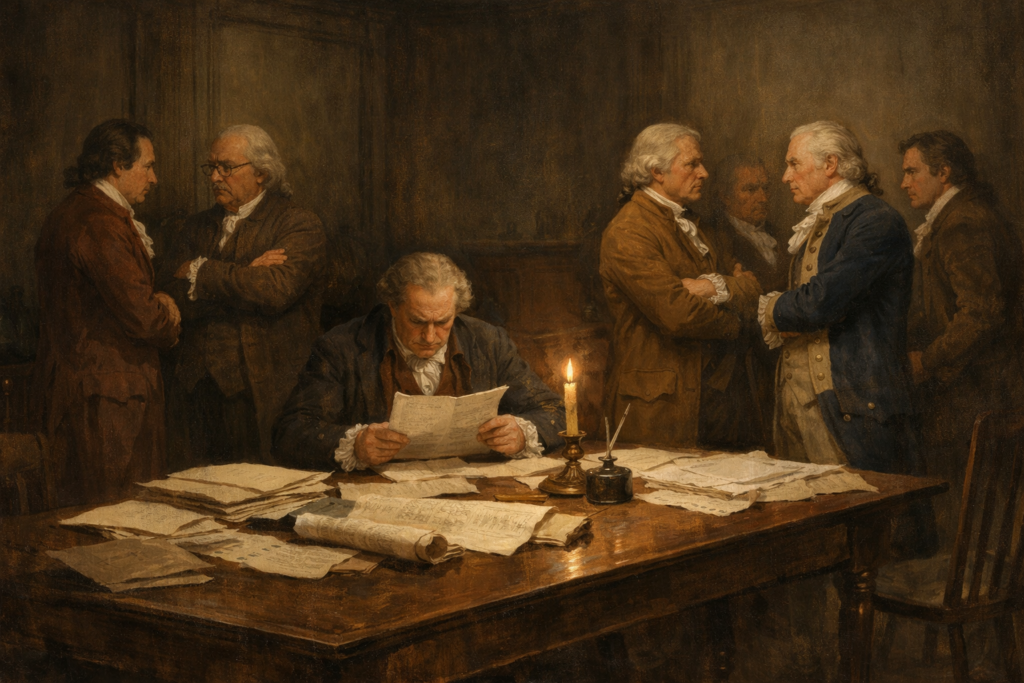
The tensions began even before independence was declared. John Hancock and Samuel Adams, both Massachusetts firebrands, developed a rivalry that simmered throughout the Revolution. Adams, the older political strategist, had been the dominant figure in Boston’s resistance movement. When Hancock—wealthy, vain, and eager for glory—was elected president of the Continental Congress in 1775, the austere Adams felt his protégé had grown too big for his britches. Hancock’s request for a leave of absence from the presidency of Congress in 1777 coupled with his desire for an honorific military escort home, struck Adams as a relapse into vanity. Adams even opposed a resolution of thanks for Hancock’s service, signaling open estrangement. Their relationship continued to deteriorate to the point where they barely spoke, with Adams privately mocking Hancock’s pretensions and Hancock using his position to undercut Adams politically.
The choice of Washington as commander sparked its own controversies. John Adams had nominated Washington, partly to unite the colonies by giving Virginia the top military role. Washington’s command was anything but universally admired and as the war dragged on with mixed results many critics emerged.
After the victory at Saratoga in 1777, General Horatio Gates became the focal point of what’s known as the Conway Cabal—a loose conspiracy aimed at having Gates replace Washington as commander-in-chief. General Thomas Conway wrote disparaging letters about Washington’s military abilities. Some members of Congress, including Samuel Adams, Thomas Mifflin, and Richard Henry Lee, questioned whether Washington’s defensive strategy was too cautious and if his battlefield performance was lacking. Gates himself played a duplicitous game, publicly supporting Washington while privately positioning himself as an alternative.
When Washington discovered the intrigue, his response was characteristically measured but firm. Rather than lobbying Congress or forming a counter-faction, Washington leaned heavily on reputation and restraint. He continued to communicate respectfully with Congress, emphasizing the army’s needs rather than defending his own position. Washington did not respond with denunciations or public accusations. Instead, he handled the situation largely behind the scenes. When he learned that Conway had written a critical letter praising Gates, Washington calmly informed him that he was aware of the letter—quoting it verbatim.
The conspiracy collapsed, in part because Washington’s personal reputation with the rank and file and with key political figures proved more resilient than his critics had anticipated. But the episode exposed deep fractures over strategy, leadership, and regional loyalties within the revolutionary coalition.
The Ideological Split: Hamilton vs. Jefferson and Madison
Perhaps the most consequential feud emerged in the 1790s between Alexander Hamilton and Thomas Jefferson, with James Madison eventually siding with Jefferson. This wasn’t just personal animosity—it represented a fundamental disagreement about America’s future.
Hamilton, Washington’s Treasury Secretary, envisioned an industrialized commercial nation with a strong central government, a national bank, and close ties to Britain. Jefferson, the Secretary of State, championed an agrarian republic of small farmers with minimal federal power and friendship with Revolutionary France. Their cabinet meetings became so contentious that Washington had to mediate. Hamilton accused Jefferson of being a dangerous radical who would destroy public credit. Jefferson called Hamilton a monarchist who wanted to recreate British aristocracy in America.
The conflict got personal. Hamilton leaked damaging information about Jefferson to friendly newspapers. Jefferson secretly funded a journalist, James Callender, to attack Hamilton in print. When Hamilton’s extramarital affair with Maria Reynolds became public in 1797, Jefferson’s allies savored every detail. The feud split the nation into the first political parties: Hamilton’s Federalists and Jefferson’s Democratic-Republicans. Madison, once Hamilton’s ally in promoting the Constitution, switched sides completely, becoming Jefferson’s closest political partner and Hamilton’s implacable foe.
The Adams-Jefferson Friendship, Rivalry, and Reconciliation
John Adams and Thomas Jefferson experienced one of history’s most remarkable personal relationships. They were close friends during the Revolution, working together in Congress and on the committee to draft the Declaration of Independence (though Jefferson did the actual writing). Both served diplomatic posts in Europe and developed deep mutual respect.
But the election of 1796 turned them into rivals. Adams won the presidency with Jefferson finishing second, making Jefferson vice president under the original constitutional system—imagine your closest competitor becoming your deputy. By the 1800 election, they were bitter enemies. The campaign was vicious, with Jefferson’s supporters calling Adams a “hideous hermaphroditical character” and Adams’s allies claiming Jefferson was an atheist who would destroy Christianity.
Jefferson won in 1800, and the two men didn’t speak for over a decade. Their relationship was so bitter that Adams left Washington early in the morning, before Jefferson’s inauguration. What makes their story extraordinary is the reconciliation. In 1812, mutual friends convinced them to resume correspondence. Their letters over the next fourteen years—158 of them—became one of the great intellectual exchanges in American history, discussing philosophy, politics, and their memories of the Revolution. Both men died on July 4, 1826, the fiftieth anniversary of the Declaration of Independence, with Adams’s last words reportedly being “Thomas Jefferson survives” (though Jefferson had actually died hours earlier).
Franklin vs. Adams: A Clash of Styles
In Paris, the relationship between Benjamin Franklin and John Adams was a tense blend of grudging professional reliance and deep personal irritation, rooted in radically different diplomatic styles and temperaments. Franklin, already a celebrated figure at Versailles, cultivated French support through charm, sociability, and patient maneuvering in salons and at court, a method that infuriated Adams. He equated such “nuances” with evasiveness and preferred direct argument, formal memorandums, and hard‑edged ultimatums. Sharing lodgings outside Paris only intensified Adams’s resentment as he watched Franklin rise late, receive endless visitors, and seemingly mix pleasure with business, leading Adams to complain that nothing would ever get done unless he did it himself, while Franklin privately judged Adams “always an honest man, often a wise one, but sometimes and in some things, absolutely out of his senses.” Their French ally, Foreign Minister Vergennes, reinforced the imbalance by insisting on dealing primarily with Franklin and effectively sidelining Adams in formal diplomacy. This deepened Adams’s sense that Franklin was both overindulged by the French and insufficiently assertive on America’s behalf. Yet despite their mutual loss of respect, the two ultimately cooperated—often uneasily—in the peace negotiations with Britain, and both signatures appear on the 1783 Treaty of Paris, a testament to the way personal feud and shared national purpose coexisted within the American diplomatic mission.
Hamilton and Burr: From Political Rivalry to Fatal Duel
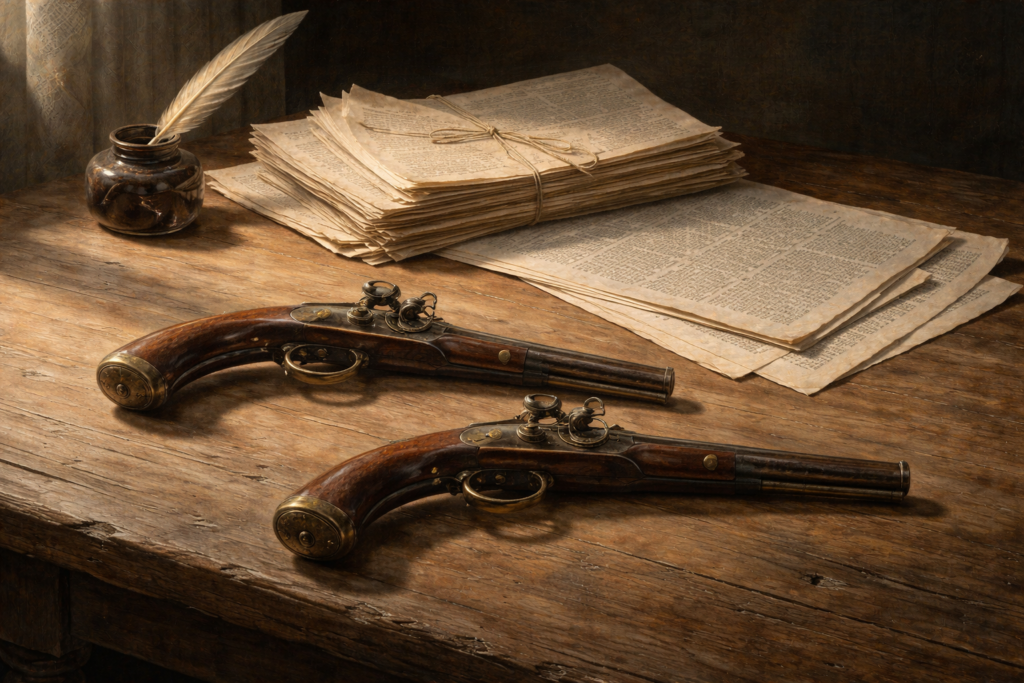
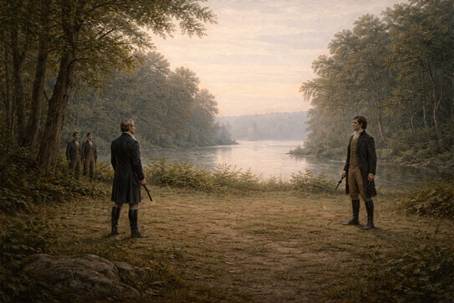
The Hamilton-Burr feud ended in the most dramatic way possible: a duel at Weehawken, New Jersey, on July 11, 1804, where Hamilton was mortally wounded and Burr destroyed his own political career.
Their rivalry had been building for years. Both were New York lawyers and politicians, but Hamilton consistently blocked Burr’s ambitions. When Burr ran for governor of New York in 1804, Hamilton campaigned against him with particular venom, calling Burr dangerous and untrustworthy at a dinner party. When Burr read accounts of Hamilton’s remarks in a newspaper, he demanded an apology. Hamilton refused to apologize or deny the comments, leading to the duel challenge.
What made this especially tragic was that Hamilton’s oldest son, Philip, had been killed in a duel three years earlier defending his father’s honor. Hamilton reportedly planned to withhold his fire, but he either intentionally shot into the air or missed. Burr’s shot struck Hamilton in the abdomen, and he died the next day. Burr was charged with murder in both New York and New Jersey and fled to the South. Though he later returned to complete his term as vice president, his political career was finished.
Adams vs. Hamilton: The Federalist Crack-Up
One of the most destructive feuds happened within the same party. John Adams and Alexander Hamilton were both Federalists, but their relationship became poisonous during Adams’s presidency (1797-1801).
Hamilton, though not in government, tried to control Adams’s cabinet from behind the scenes. When Adams pursued peace negotiations with France (the “Quasi-War” with France was raging), Hamilton wanted war. Adams discovered that several of his cabinet members were more loyal to Hamilton than to him and fired them. In the 1800 election, Hamilton wrote a fifty-four-page pamphlet attacking Adams’s character and fitness for office—extraordinary since they were in the same party. The pamphlet was meant for limited circulation among Federalist leaders, but Jefferson’s allies got hold of it and published it widely, devastating both Adams’s re-election chances and Hamilton’s reputation. The feud helped Jefferson win and essentially destroyed the Federalist Party.
Washington and Jefferson: The Unacknowledged Tension
While Washington and Jefferson never had an open feud, their relationship cooled significantly during Washington’s presidency. Jefferson, as Secretary of State, increasingly opposed the administration’s policies, particularly Hamilton’s financial program. When Washington supported the Jay Treaty with Britain in 1795—which Jefferson saw as a betrayal of France and Republican principles—Jefferson became convinced Washington had fallen under Hamilton’s spell.
Jefferson resigned from the cabinet in 1793, partly from policy disagreements but also from discomfort with what he saw as Washington’s monarchical tendencies (the formal receptions and the ceremonial aspects of the presidency). Washington, in turn, came to view Jefferson as disloyal, especially when he learned Jefferson had been secretly funding attacks on the administration in opposition newspapers and had even put a leading critic on the federal payroll. By the time Washington delivered his Farewell Address in 1796, warning against political parties and foreign entanglements, many saw it as a rebuke of Jefferson’s philosophy. They maintained outward courtesy, but their warm relationship never recovered.
Why These Feuds Mattered
These weren’t just personal squabbles—they shaped American democracy in profound ways. The Hamilton-Jefferson rivalry created our two-party system (despite Washington’s warnings). The Adams-Hamilton split showed that parties could fracture from within. The Adams-Jefferson reconciliation demonstrated that political enemies could find common ground after leaving power.
The founding fathers were human, with all the ambition, pride, jealousy, and pettiness that entails. They fought over power, principles, and personal slights. What’s remarkable isn’t that they agreed on everything—they clearly didn’t—but that despite their bitter divisions, they created a system robust enough to survive their feuds. The Constitution itself, with its checks and balances, almost seems designed to accommodate such disagreements, ensuring that no single person or faction could dominate.
SOURCES
- National Archives – Founders Online
https://founders.archives.gov
2. Massachusetts Historical Society – Adams-Jefferson Letters
https://www.masshist.org/publications/adams-jefferson
3. Founders Online – Hamilton’s Letter Concerning John Adams
https://founders.archives.gov/documents/Hamilton/01-25-02-0110
4. Gilder Lehrman Institute – Hamilton and Jefferson
https://www.gilderlehrman.org/history-resources/spotlight-primary-source/alexander-hamilton-and-thomas-jefferson
5. National Park Service – The Conway Cabal
https://www.nps.gov/articles/000/the-conway-cabal.htm
6. American Battlefield Trust – Hamilton-Burr Duel
https://www.battlefields.org/learn/articles/hamilton-burr-duel
7. Mount Vernon – Thomas Jefferson
https://www.mountvernon.org/library/digitalhistory/digital-encyclopedia/article/thomas-jefferson
8. Monticello – Thomas Jefferson Encyclopedia
https://www.monticello.org/research-education/thomas-jefferson-encyclopedia
9. Library of Congress – John Adams Papers
https://www.loc.gov/collections/john-adams-papers
10. Joseph Ellis – “Founding Brothers: The Revolutionary Generation”
https://www.pulitzer.org/winners/joseph-j-ellis
Illustration generated by author using ChatGPT.




The Marble Statue Problem: Why Half the Story Is No Story at All
By John Turley
On March 12, 2026
In Commentary, History, Politics
A Commentary on Selective American History
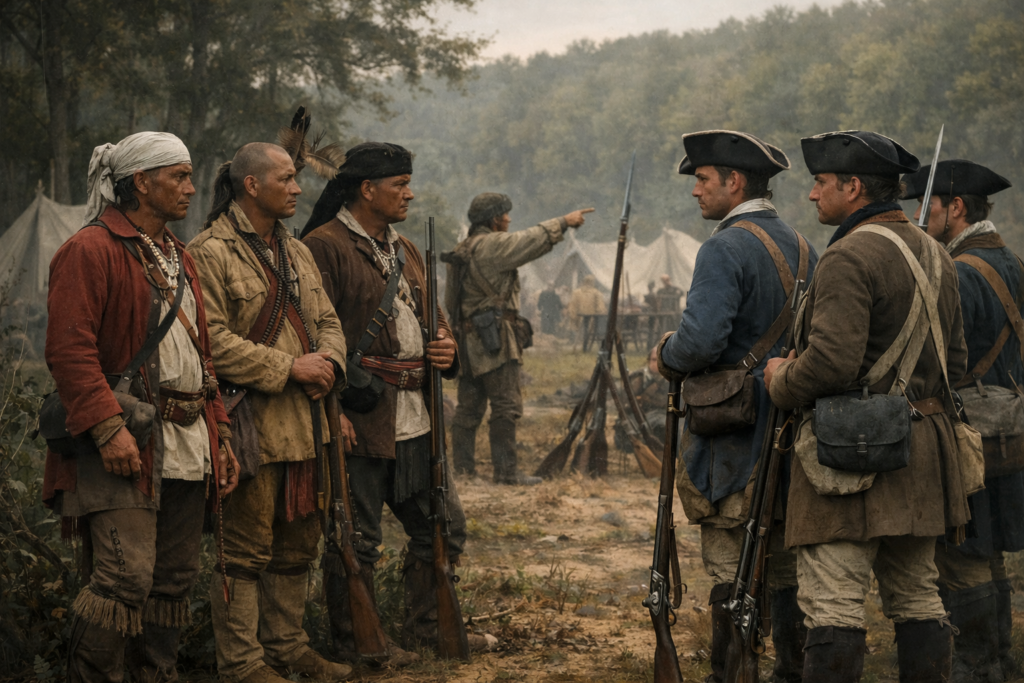
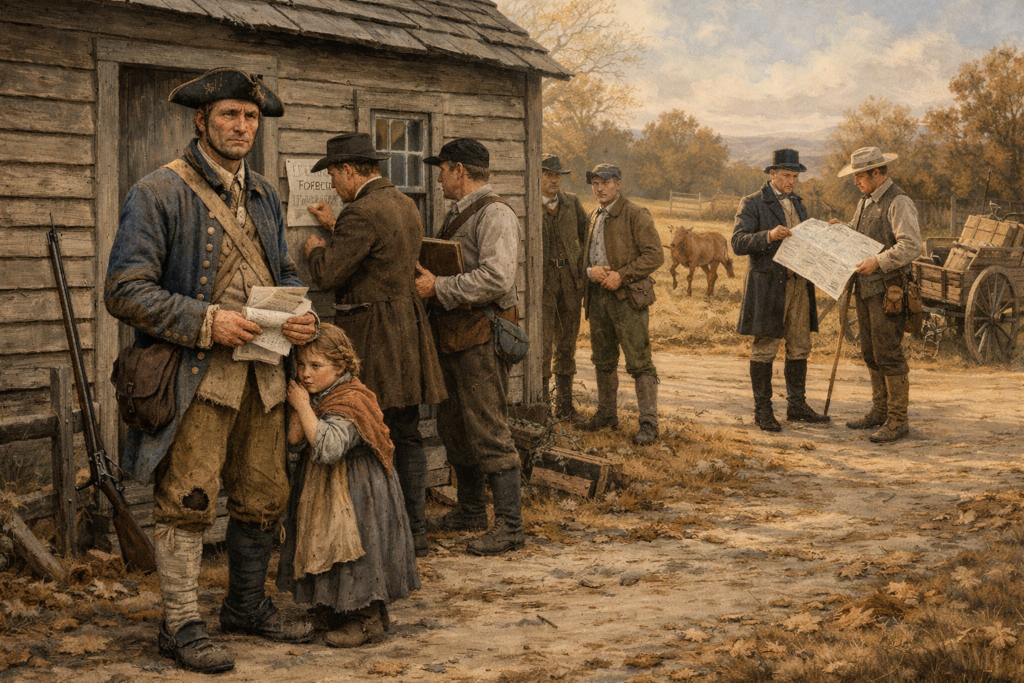
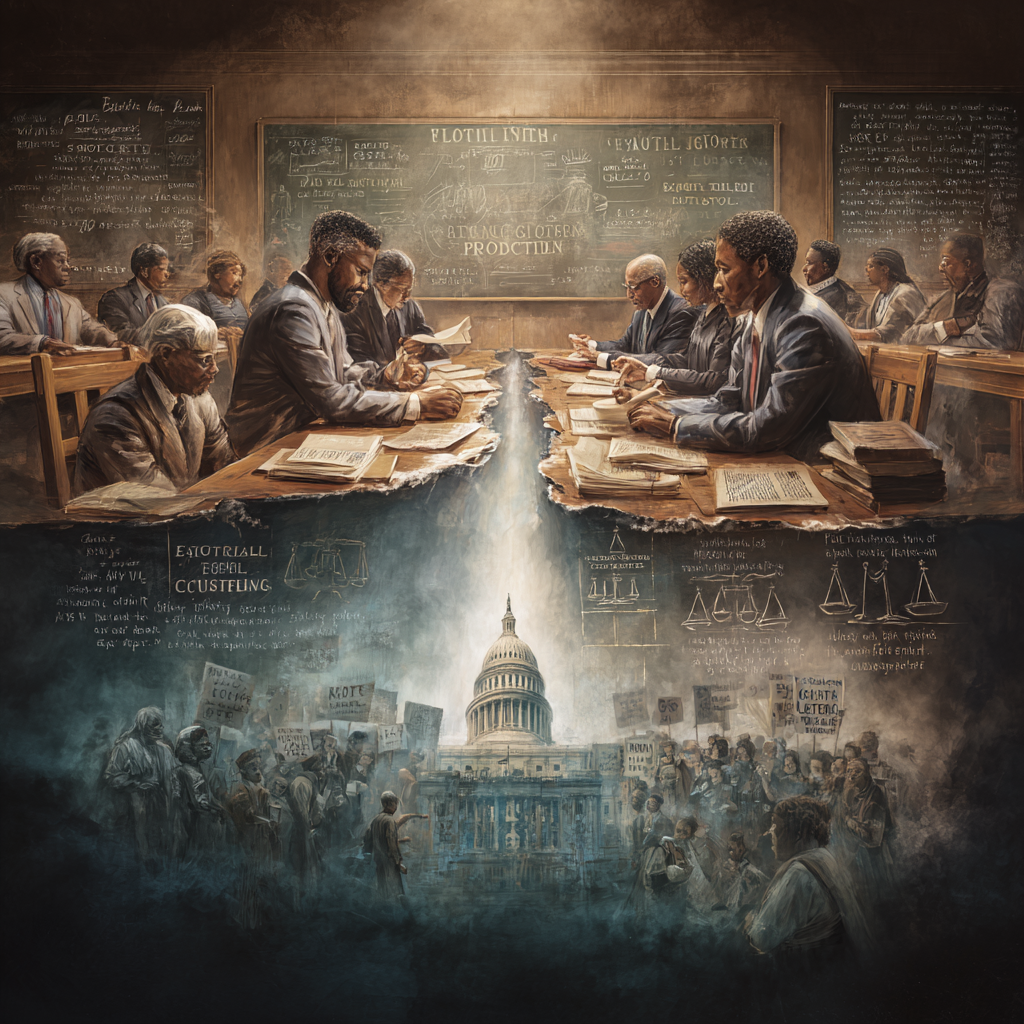
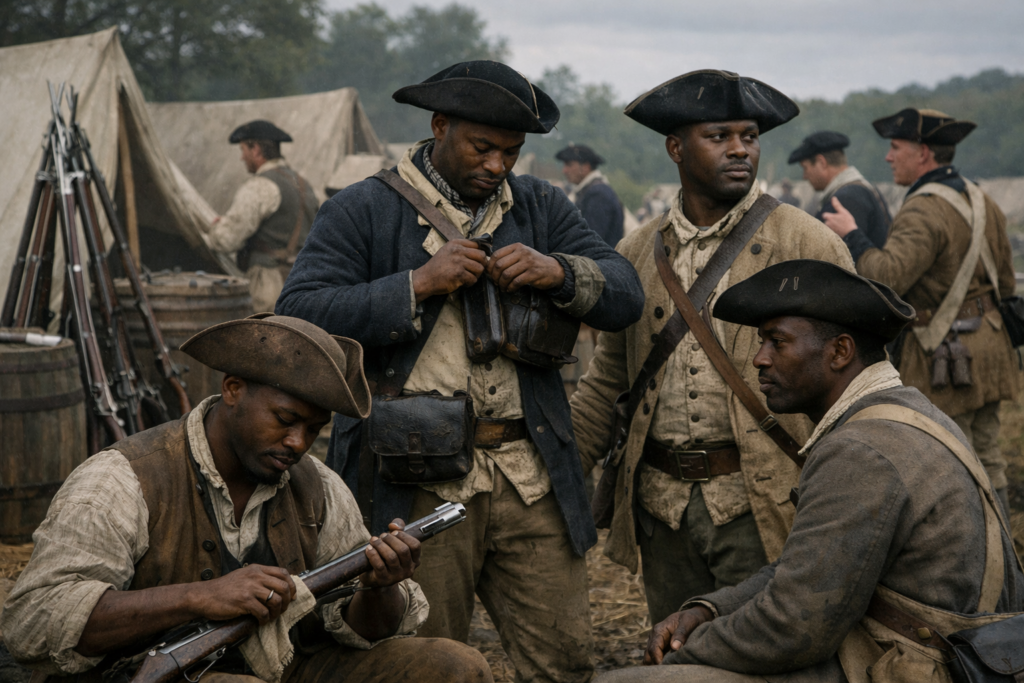
There is a version of American history that looks spectacular. Founding Fathers on horseback, industrialists building steel empires from nothing, pioneers pushing west into open lands. It is the kind of history that gets carved into marble, hoisted onto pedestals, and taught as national mythology. Clean. Inspiring. Incomplete. And right now, there is a visible push by some politicians, curriculum reformers, and commentators to make that marble-statue version the only version — to scrub away what one American Historical Association report called the “inconvenient” truths that complicate the picture. What we lose in that scrubbing is not just accuracy. We lose the full human story of this country, and with it, the lessons that might be useful today.
The selective telling is not new, but its current form has new energy. In recent years, legislation has been introduced across multiple states to restrict how teachers discuss slavery, Indigenous displacement, immigration history, and the treatment of women and the poor. The argument is usually dressed up as national unity and pride. But the practical effect is something else: a history curriculum where triumph and innovation are permissible but suffering and exploitation are edited out.
Historians surveying American teachers in 2024 found this impulse reflected in the classroom as well — students arriving with what teachers described as a “marble statues” version of history absorbed from earlier grades, one that freezes the Founders and other heroes in idealized civic memory, stripped of contradiction. The pitch is usually framed as morale: kids need pride and self esteem, not “division.” But the practical effect is a kind of historical editing that turns real people—enslaved Americans, Native communities, women, immigrants, and the poor—into background scenery rather than participants with agency, suffering, and claims on the national memory.
You can see the argument playing out in education policy and curriculum fights. The “patriotic education” push associated with the federal 1776 Commission is a clear example: it cast some approaches to teaching slavery and racism as inherently “anti-American,” and it encouraged a narrative that stresses national ideals while softening the lived realities that contradicted those ideals.
Historians’ organizations have answered back that this kind of narrowing doesn’t create unity so much as it creates amnesia. At the state level, controversies over how to describe or contextualize slavery—down to euphemisms and selective framing—keep resurfacing, because controlling the vocabulary controls the moral takeaway. Florida’s education standards went so far as to compare slavery with job training.
The tension between celebratory and critical history also appears in how we interpret national symbols. The Statue of Liberty, now widely read as a welcoming beacon for immigrants, was originally conceived in significant part as a commemoration of the end of slavery in the United States and of the nation’s centennial. Over time, its antislavery meaning was overshadowed by a more comfortable story about voluntary immigration and opportunity as official imagery and public campaigns recast the statue to fit new national needs. This shift did not merely “add” an interpretation; it obscured the connection between American liberty and Black emancipation, pushing aside the reality that millions arrived in chains rather than by choice.
The deeper problem isn’t that Americans disagree about the past—healthy societies argue about meaning all the time. The problem is when disagreement becomes a one-way ratchet: complexity gets labeled “bias,” and only a feel-good storyline qualifies as “neutral.” That’s not neutral. That’s a choice to privilege certain experiences as representative and treat others as “inconvenient.”
Nowhere does this distortion show up more clearly than in how Americans tend to celebrate the industrialists of the late 19th and early 20th centuries — the Gilded Age titans who built railroads, steel mills, and oil empires. Andrew Carnegie, John D. Rockefeller, J.P. Morgan, Cornelius Vanderbilt: these men are frequently held up as models of American ambition and ingenuity, visionaries who transformed a post-Civil War nation into the world’s dominant industrial power. And they did do that. But the marble-statue version stops there, and stopping there is where the dishonesty begins.
Look at what powered that industrial machine: coal. And look at who powered coal. The men — and children — who went underground every day to dig it out of the earth under conditions that were, by any modern standard, a form of institutionalized violence. Between 1880 and 1923, more than 70,000 coal miners died on the job in the United States. That is not a rounding error; it is a small city’s worth of human lives, consumed by an industry that knew the dangers and chose profits over protection. Cave-ins, gas explosions, machinery accidents, and the slow suffocation of black lung took miners in ones and twos on ordinary days, and in mass casualties during what miners grimly called “explosion season” — when dry winter air made methane and coal dust especially volatile. Three major mine disasters in the first decade of the 1900s killed 201, 362, and 239 miners respectively, the latter two occurring within two weeks of each other.
And those were the adults. In the anthracite coal fields of Pennsylvania alone, an estimated 20,000 boys were working as “breaker boys” in 1880 — children as young as eight years old, perched above chutes and conveyor belts for ten hours a day, six days a week, picking slate and impurities out of rushing coal with bare hands. The coal dust was so thick at times it obscured their view. Photographer Lewis Hine documented these children in the early 1900s specifically because he understood that seeing them — their coal-blackened faces, their missing fingers, their flat eyes — was the only way to make comfortable Americans confront the total cost of the industrial miracle. Pennsylvania passed a law in 1885 banning children under twelve from working in coal breakers. The law was routinely ignored; employers forged age documents and desperate families went along with it because the wages, however meager, kept families from starving.
Coal mining is a representative case study because the work was both essential and punishing, and because the labor conflicts were not metaphorical—they were sometimes literally armed. In the coalfields, many miners lived in company towns where the company controlled the housing and the local economy. Some workers were paid in “scrip” redeemable only at the company store, a system that locked families into dependency and debt. When union organizing surged, the backlash could be violent. West Virginia’s Mine Wars culminated in the Battle of Blair Mountain in 1921—widely described as the largest labor uprising in U.S. history—where thousands of miners confronted company-aligned forces and state power. The mine owners deployed heavy machine guns and hired private pilots to drop arial bombs on the miners.
If you zoom out, this pattern wasn’t limited to coal. The Triangle Shirtwaist Factory fire in 1911 became infamous partly because locked doors and poor safety practices trapped workers—mostly young immigrant women—leading to 146 deaths in minutes.
When workers tried to organize for better pay and safer conditions, the response from the industrialists and their allies was not negotiation. It was force. Henry Clay Frick, chairman at Carnegie Steel, cut worker wages in half while increasing shifts to twelve hours, then hired the Pinkerton Detective Agency — effectively a private army — to break the strike that followed at Homestead, PA in 1892. During the Great Railroad Strike of 1877, when workers walked off the job across the country, state militias were called in. In Maryland, militia fired into a crowd of strikers, killing eleven. In Pittsburgh, twenty more were killed with bayonets and rifle fire. A railroad executive of the era, asked about hungry striking workers, reportedly suggested they be given “a rifle diet for a few days” to see how they liked it. Throughout this period the federal government largely sided with capital against labor.
This is the part of the story that the marble-statue version leaves out — and not because it is marginal. The labor movement that emerged from these battles shaped virtually every protection American workers have today: the eight-hour workday, child labor laws, workplace safety regulations, the right to organize. These were not gifts handed down by generous industrialists. They were won through strikes, suffering, and in some cases, death. Ignoring that history does not honor the industrialists. It dishonors the workers.
The same pattern runs through every thread of American history that is currently under pressure. The story of westward expansion is incomplete without the story of Native displacement and the deliberate destruction of Indigenous cultures. The story of American agriculture is incomplete without the story of enslaved labor and the systems of racial control that followed emancipation. The story of American prosperity is incomplete without the story of immigrant communities channeled into the most dangerous, lowest-paid work and then told to be grateful for the opportunity. Women’s history, for most of American history, was not considered history at all. In each case, leaving out the difficult chapter does not produce a cleaner story. It produces a false one.
The argument for the marble-statue version is usually that complexity is demoralizing — that children need heroes, that citizens need pride, that a nation cannot function if it is constantly relitigating its worst moments. There is something in that concern worth taking seriously. History taught purely as a catalog of grievances is not good history either. But the answer to that problem is not to swap one distortion for another. Good history holds both: the genuine achievement and the genuine cost. Mark Twain understood this when he coined “The Gilded Age” — a title that means literally covered in a thin layer of gold over something much cheaper underneath. That phrase has been in the American vocabulary for 150 years because it captures something true about how surfaces can deceive.
A country that cannot look honestly at its own history is a country that will keep repeating the parts it refuses to examine. The enslaved deserve to be in the story. Indigenous people deserve to be in the story. Women deserve to be in the story. The breaker boys deserve to be in the story. The miners killed by the thousands deserve to be in the story. The workers shot by militias while asking for a living wage deserve to be in the story. Not because the story should only be about suffering, but because they were there — and because understanding what they faced, and what they fought for, and what they eventually changed, is how the story makes sense.
Illustration generated by author using ChatGPT.
Sources
American Historical Association. “American Lesson Plan: Curricular Content.” 2024.
https://www.historians.org/teaching-learning/k-12-education/american-lesson-plan/curricular-content/
Brewminate. “Replaceable Lives and Labor Abuse in the Gilded Age: Labor Exploitation and the Human Cost in America’s Gilded Age.” 2026.
https://brewminate.com/replaceable-lives-and-labor-abuse-in-the-gilded-age/
Bureau of Labor Statistics. “History of Child Labor in the United States, Part 1.” 2017.
https://www.bls.gov/opub/mlr/2017/article/history-of-child-labor-in-the-united-states-part-1.htm
Energy History Project, Yale University. “Coal Mining and Labor Conflict.”
https://energyhistory.yale.edu/coal-mining-and-labor-conflict/
Hannah-Jones, Nikole, et al. “A Brief History of Slavery That You Didn’t Learn in School.” New York Times Magazine. 2019.
https://www.nytimes.com/interactive/2019/08/14/magazine/slavery-capitalism.html
Investopedia. “The Gilded Age Explained: An Era of Wealth and Inequality.” 2025.
https://www.investopedia.com/terms/g/gilded-age.asp
MLPP Pressbooks. “Gilded Age Labor Conflict.”
https://mlpp.pressbooks.pub/ushistory2/chapter/chapter-1/
Princeton School of Public and International Affairs. “Princeton SPIA Faculty Reflect on America’s Past as 250th Anniversary Approaches.” 2026.
https://spia.princeton.edu/
USA Today. “Millions of Native People Were Enslaved in the Americas. Their Story Is Rarely Told.” 2025.
https://www.usatoday.com/
Wikipedia. “Breaker Boy.”
https://en.wikipedia.org/wiki/Breaker_boy
Wikipedia. “Robber Baron (Industrialist).”
https://en.wikipedia.org/wiki/Robber_baron_(industrialist)
America250 (U.S. Semiquincentennial Commission). “America250: The United States Semiquincentennial.”
https://www.america250.org/
Bunk History (citing Washington Post reporting). “The Statue of Liberty Was Created to Celebrate Freed Slaves, Not Immigrants.”
https://www.bunkhistory.org/
Upworthy. “The Statue of Liberty Is a Symbol of Welcoming Immigrants. That’s Not What She Was Originally Meant to Be.” 2026.
https://www.upworthy.com/