
Grumpy opinions about everything.

Category: History Page 5 of 9

Grumpy opinions about American history

The Communist Dream vs. Stalinist Reality: A Tale of Two Visions

Recently, I’ve been looking at various political philosophies. I’ve written about fascism, totalitarianism, authoritarianism, autocracy and kleptocracy. In this post I’m going to look at theoretical communism versus the reality of Stalinist communism, and I would be remiss if I didn’t at least briefly mention oligarchy as currently practiced in Russia.

The gap between Karl Marx’s theoretical vision of communism and its implementation under Joseph Stalin’s leadership in the Soviet Union represents one of history’s most significant divergences between ideological theory and political practice. While both claimed the same ultimate goal—a classless, stateless society—their approaches and outcomes differed in fundamental ways that continue to shape our world today, one a workers’ utopia and the other a brutal dictatorship.

The Marxist Vision

Marx envisioned communism as the natural culmination of historical progress, emerging from the inherent conflicts within capitalism. In his theoretical framework, the working class (proletariat) would eventually overthrow the capitalist system through revolution, leading to a transitional socialist phase before achieving true communism. This final stage would be characterized by the absence of social classes, private property, private ownership of the means of production, and ultimately, the state itself.

Central to Marx’s concept was the idea that communism would emerge from highly developed capitalist societies where industrial production had reached its peak. He believed that the abundance created by advanced capitalism would make scarcity obsolete, allowing society to operate according to the principle “from each according to his ability, to each according to his needs.” The state, having served its purpose as an instrument of class rule, would simply “wither away” as class distinctions disappeared.

Marx also emphasized that the transition to communism would be an international phenomenon. He argued that capitalism was inherently global, and therefore its replacement would necessarily be worldwide. The famous rallying cry “Workers of the world, unite!” reflected this internationalist perspective, suggesting that communist revolution would spread across national boundaries as workers recognized their common interests.

The Stalinist Implementation

Vladimir Lenin took firm control of Russia following the revolution in 1917 and oversaw creation of a state that was characterized by centralization, suppression of opposition parties, and the establishment of the Cheka (secret police) to enforce party rule. Economically, Lenin’s government shifted from War Communism (state control of production during the civil war) to the New Economic Policy (NEP) in 1921, which allowed limited private trade and small-scale capitalism to stabilize the economy. It formally became the Union of Soviet Socialist Republics in 1922. This period provided the groundwork for the highly centralized, totalitarian state under Stalin that followed Lenin’s death in 1924.

Stalin’s approach to building communism in the Soviet Union diverged sharply from Marx’s theoretical blueprint. Rather than emerging from advanced capitalism, Stalin attempted to construct socialism in a largely agricultural society that had barely begun industrialization. This fundamental difference in starting conditions shaped every aspect of the Soviet experiment.

Instead of the gradual withering away of the state, Stalin presided over an unprecedented expansion of state power. The Soviet government under his leadership controlled virtually every aspect of economic and social life, from industrial production to agricultural collectivization to cultural expression. The state became not a temporary tool for managing the transition to communism, but a permanent and increasingly powerful institution that dominated all aspects of society.  By the early 1930s, Joseph Stalin had centralized all power in his own hands, sidelining collective decision-making bodies like the Politburo or Soviets.

Marx emphasized rule by the proletariat giving power to all people equally.  Stalin fostered a cult of personality through relentless propaganda.  His image appeared on posters, statues, and in schools.  History books were rewritten to credit him for Soviet successes—often erasing Lenin, Trotsky, or others.  He was referred to as the “Father of Nations,” “Brilliant Genius,” and “Great Leader.”  Loyalty to Stalin became more important than loyalty to the Communist Party or its ideals.  The government and the economy operated at his personal direction, enforced by the secret police, censorship, executions, and mass purges of dissidents.

Stalin implemented a command economy, in which the government or central authority makes all major decisions about production, investment, pricing, and the allocation of resources, rather than leaving those choices to market forces. In this system, planners typically set production targets, control industries, and determine what goods and services will be available, often with the goal of achieving social or political objectives such as central control and rapid industrialization. This is the direct opposite of the voluntary cooperation Marx had envisioned. The forced collectivization of peasants onto government farms, rapid industrialization through five-year plans, and the use of prison labor in gulags represented a top-down model of development that contradicted Marx’s emphasis on worker empowerment and democratic participation.

Where Marx emphasized emancipation and freedom for workers, Stalinist policies involved widespread repression, political purges, forced labor camps, and censorship. Most notable is the period that came to be known as the “Great Purge,” also called the “Great Terror,” a campaign of political repression between 1936 and 1938. It involved widespread arrests, forced confessions, show trials, executions, and imprisonment in labor camps (the Gulag system). Stalin accused perceived political rivals, military leaders, intellectuals, and ordinary citizens of being disloyal or conducting “counter-revolutionary” activities. It is estimated that about 700,000 people were executed by firing squad after being branded “enemies of the people” in show trials or secret proceedings.  Another 1.5 to 2 million people were arrested and sent to Gulag labor camps, prisons, or exile. Many died from overwork, malnutrition, disease, or harsh conditions.

Perhaps most significantly, Stalin abandoned Marx’s internationalist vision in favor of “socialism in one country.” This doctrine, developed in the 1920s, argued that the Soviet Union could build socialism independently of worldwide revolution. This shift not only contradicted Marx’s theoretical framework but also led to policies that prioritized Soviet national interests over international worker solidarity.

Key Contradictions

The differences between Marxist theory and Stalinist practice created several fundamental contradictions. Where Marx predicted the elimination of social classes, Stalin’s Soviet Union developed a rigid hierarchy with the Communist Party elite at the top, followed by technical specialists, workers, and peasants. This new class structure, while different from capitalist society, still involved significant inequalities in power, privilege, and access to resources.

Marx’s vision of worker control over production stood in stark contrast to Stalin’s centralized command economy. Rather than workers democratically managing their workplaces, Soviet workers found themselves subject to increasingly detailed state control over their labor. The factory became less a site of worker empowerment than a component in a vast state machine directed from Moscow.

The treatment of dissent also revealed fundamental differences. Marx believed that communism would eliminate the need for political repression as class conflicts disappeared. Stalin’s regime, however, relied extensively on surveillance, censorship, and violent suppression of opposition. The extensive use of terror against both perceived enemies and ordinary citizens contradicted Marx’s vision of a society based on cooperation and mutual benefit.

Modern Russia

At this point, I want to mention something about modern Russia and its current governmental and economic situation since the breakup of the Soviet Union

An oligarchy is a form of government where power rests in the hands of a small number of people. These individuals typically come from similar backgrounds – they might be distinguished by wealth, family ties, education, corporate control, military influence, or religious authority. The word comes from the Greek “oligarkhia,” meaning “rule by few.” In an oligarchy, this small group makes the major political and economic decisions that affect the entire population, often prioritizing their own interests over those of the broader society.

Modern Russia’s economy is often described as having oligarchic features because a relatively small group of wealthy business leaders—many of whom made their fortunes during the chaotic privatization of the 1990s—maintain outsized influence over key industries like energy, banking, and natural resources. While Russia is technically a mixed economy with both private and state involvement, political connections determine who gains access to wealth and power. This creates a system where economic opportunity is concentrated among elites closely tied to the Kremlin, most closely resembling an oligarchy.

Historical Context and Consequences

Understanding the differences between Marxist theory and Stalinist implementation requires considering the historical context in which Stalin operated. The Soviet Union faced external threats, internal resistance, and the enormous challenge of rapid modernization. Stalin’s supporters argued that harsh measures were necessary to defend the revolution and build industrial capacity quickly enough to survive in a hostile international environment.

Critics, however, contend that Stalin’s methods created a system that was fundamentally incompatible with Marx’s vision of human liberation. The concentration of power in a single party—much less a single person— combined with the suppression of democratic institutions, and the extensive use of violence and coercion demonstrate that Stalinist practice moved away from, rather than toward, Marx’s goals.

The legacy of this divergence continues to influence contemporary political debates. Supporters of Marxist theory often argue that Stalin’s failures demonstrate the dangers of abandoning egalitarian principles and internationalist perspectives. Meanwhile, critics of communism point to the Soviet experience as evidence that Marxist ideals are inherently unrealistic or even dangerous.

This comparison reveals the complex relationship between political theory and practice, highlighting how historical circumstances, leadership decisions, and practical constraints can shape the implementation of ideological visions in ways that may fundamentally alter their character and outcomes.

The First Amphibious Landing

 The Continental Marines at Nassau

When the Second Continental Congress authorized the creation of the Continental Marines on November 10, 1775, few could foresee their pivotal role in orchestrating North America’s first amphibious assault less than four months later.  The operation against Nassau, on New Providence Island in the Bahamas, was born of necessity, marked by improvisation, and ultimately set the tone for Marine Corps operations—an audacious legacy that endures to this day.

Origins: Gunpowder Desperation and Strategic Vision

The American Revolution’s early years were marked by chronic shortages, especially of gunpowder. After the British seized stores destined for the Patriot cause, intelligence uncovered that significant quantities were stockpiled at Nassau. The Continental Congress approached this challenge with typical Revolutionary War creativity—they would use their brand-new Navy and even newer Marines to solve an Army problem. The Congress’ official instructions to Commodore Esek Hopkins focused on patrolling the Virginia and Carolina coasts, but “secret orders” directed attention to the Bahamas, setting in motion a bold plan to directly address the fledgling army’s supply crisis.

Organization: The Making of an Amphibious Battalion

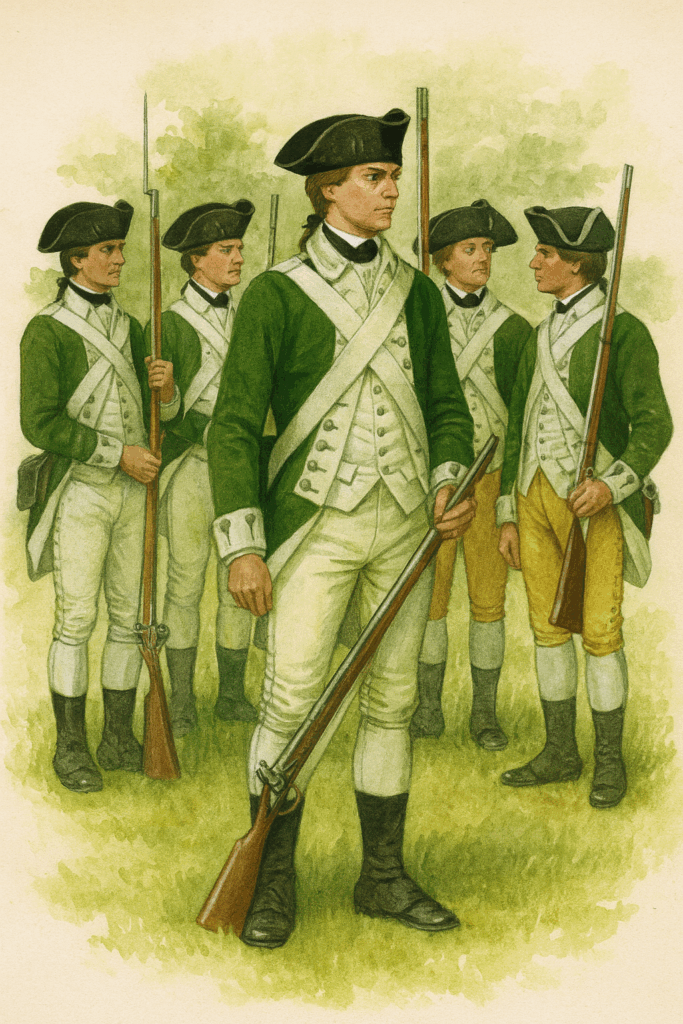
With barely three months’ existence, the Continental Marines had hastily raised five companies of around 300 men. Captain Samuel Nicholas, tasked as the first Marine officer, oversaw their training and organization in Philadelphia. Their equipment was uneven—many wore civilian garb rather than uniforms and carried whatever muskets and bayonets were available. The uniform regulations specifying the now famous green coats with white facings were not promulgated until several months after the raid was over.

The Voyage South: Challenges and Preparation

Hopkins’ fleet consisted of the ships Alfred, Hornet, Wasp, Fly, Andrew Doria, Cabot, Providence, and Columbus. In addition to ships’ crews, the fleet carried more than 200 Continental Marines under the command of Captain Nicholas. The expedition began inauspiciously on January 4, 1776, when the fleet attempted to leave Philadelphia but became trapped by ice in the Delaware River for six weeks.

When they finally reached the Atlantic on February 17, 1776, the small fleet faced additional challenges. Disease found its way onboard most of the ships. Smallpox was a huge concern and was reported on at least four ships.

The fleet’s journey to the Caribbean took nearly two weeks of sailing through challenging winter conditions. Despite the hardships, Hopkins maintained the element of surprise—British intelligence had detected American naval preparations but assumed the fleet was bound for New York or Boston, not the distant Bahamas.

Implementation: Amphibious Innovation at Nassau

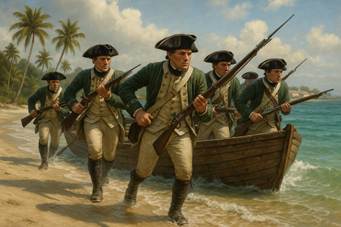
The element of surprise was initially lost when the fleet’s approach triggered alarm at Nassau. Plans to storm the stronger Fort Nassau dissolved, and Hopkins convened a council to identify a new landing point. A revised strategy saw about 230 Marines and 50 sailors, led by Captain Nicholas, land from longboats two miles east of the weaker Fort Montagu on March 3, 1776. They wore a patchwork of civilian clothes and white breeches—some men had managed to find green shirts as a form of identification. They set out marching toward the fort armed with muskets and bayonets, looking perhaps more like pirates than soldiers. 

Their advance was met with only token resistance. Outnumbered and ill-prepared, local militia withdrew as Nicholas’s men captured Fort Montagu in what historian Edwin Simmons called a “battle as bemused as it was bloodless.”

Nicholas decided to wait until morning to advance on the town.  His decision was tactically sound given the circumstances—he’d lost surprise, did not know the enemy’s strength, was operating in unknown terrain, night was falling, and he lacked naval support. However, this prudent military decision allowed Governor Browne to escape with over 80% of Nassau’s gunpowder stores, turning what could have been a complete strategic victory into a partial success. This incident highlights the tension between tactical prudence and strategic urgency that was destined to become a recurring theme in amphibious warfare.

The next day the Americans took Fort Nassau and arrested the Governor, Montfort Browne. Browne had already sent most of the coveted gunpowder on to St. Augustine, Florida, the night before. Despite this, American forces seized cannons, shells, and other military stores before occupying Nassau for nearly two weeks.

Marine discipline and flexibility were evident, as they pivoted from their surprise landing, conducted operations deep inland, and created their evolving amphibious reputation. The fleet departed on March 17, not before stripping Nassau and its forts of anything militarily useful.

Aftermath: Growing Pains and Enduring Lessons

Though the mission failed in its primary objective of securing a cache of gunpowder, its operational successes far outweighed the losses. The Marines returned with large quantities of artillery, munitions, and several recaptured vessels. On the return leg, they faced and fought (though did not defeat) HMS Glasgow; the squadron returned to New England by April 8, with several casualties including the first Marine officer killed in action, Lt. John Fitzpatrick.

Controversy followed—Hopkins was censured for failing to engage British forces as directed in his official orders.  Nicholas was promoted to major and tasked with raising additional Marine companies for new frigates then under construction. These developments reflected both the lessons learned and the growing recognition of the value of the Marine force in expeditionary operations ashore.

A second raid on Nassau by Continental Marines occurred from January 27–30, 1778, under Captain John Peck Rathbun. Marines and seamen landed covertly at midnight, quickly seizing Fort Nassau and liberating American prisoners held by the British. The raiders proceeded to capture five anchored vessels, dismantled Fort Montagu, spiked the guns, and loaded 1,600 lbs of captured gunpowder before departing. This bold operation marked the first time the Stars and Stripes flew over a foreign fort and showcased the resourcefulness of American forces, who managed to strike a valuable blow against British power in the Caribbean without suffering casualties.

Long-Term Implications for the United States Marine Corps

The Nassau operation set powerful precedents:

  • Amphibious Warfare Doctrine: This was the Marines’ first organized amphibious landing, shaping the Corps’ future focus on rapid deployment from sea to shore, a hallmark that continues in modern doctrine.  This was likely referred to at the time as a Naval landing, as the word amphibious did not come into use in this context until the 1930s.
  • Adaptability Under Fire: The improvisational tactics used at Nassau foreshadowed the Corps’ reputation for flexibility and mission focus.
  • Naval Integration: Joint operations with the Navy not only succeeded tactically, but helped institutionalize the Marine-Navy partnership, with Marines serving as shipboard security, landing parties, and naval infantry.
  • Legacy of Boldness: This first operation established a “first-in” ethos and a culture embracing challenge and audacity, foundational principles in Marine culture.

After the war, the Continental Marines disbanded, only to be re-established in 1798. Yet the legacy of Nassau endured. “Semper Fidelis”—always faithful—has its roots in that March 1776 assault, when the odds seemed long and the stakes critical.

Today’s United States Marine Corps draws a direct lineage from that small, ragtag battalion of Marines scrambling ashore at Nassau, forever entwining its identity with the promise, risk, and legacy of that first storied mission. Every modern Marine, stepping from ship to shore, walks in the footprints of Captain Samuel Nicholas and his men—soldiers of the sea whose boldness, improvisation, and teamwork have echoed across the centuries.

The Electoral College: Should America Go Popular?

Few topics in American politics generate as much perennial debate as the Electoral College. Every four years, calls to abolish it resurface—often with renewed vigor when the electoral vote winner loses the popular vote, as happened in 1824, 1876, 1888, 2000, and 2016. The proposal is to elect the president by a nationwide popular vote, just as we do governors and senators.

Why We Have an Electoral College

The Electoral College was a late-stage compromise at the Constitutional Convention of 1787. The framers were balancing multiple tensions:

  • Large vs. small states
  • Slave vs. free states
  • Congress choosing the president vs. direct election

Delegates feared that direct election by popular vote would favor populous states, allow urban centers to dominate rural areas, and encourage demagogues to campaign purely on popular passions. At the same time, they worried about giving Congress too much control over the executive branch.

The system for selecting the president—via the Electoral College—was partly designed to prevent direct popular influence. Its original intent, according to historians, was to empower electors (seen as more knowledgeable) and to ensure thoughtful deliberation in choosing the president, guarding against the masses being swayed by charm rather than substance.

Some delegates—like James Madison, James Wilson, and Gouverneur Morris—supported direct popular election of the president, while others, like Elbridge Gerry and Roger Sherman, explicitly voiced distrust in direct election of the president and believed ordinary voters lacked impartiality or sufficient knowledge. 

Institutional and political bargaining ultimately shaped the final structure. Their solution: each state gets electors equal to its total number of representatives and senators. The addition of two electors for the senators ensures that the small states remain, on a population basis, overrepresented in the Electoral College.

State legislatures determine how electors are chosen (eventually, every state moved to popular election). Most states now award all their electoral votes to the statewide popular vote winner—“winner-take-all.”

The Electoral College thus emerged not as anyone’s ideal system, but as a possible,  workable compromise that balanced competing regional interests, philosophical concerns about democracy, and the practical realities of governing a large, diverse republic in the 18th century.

Pros of Eliminating the Electoral College

Equal Weight for Every Vote

The most compelling argument for eliminating the Electoral College centers on democratic equality. Under the current electoral system, a vote in Wyoming carries roughly three times the weight of a vote in California when measured by electoral votes per capita. To put this in real numbers Wyoming has about 193,000 people per electoral vote while California has about 718,000.  This mathematical reality means that some Americans’ voices count more than others in selecting their president, a principle that seems to contradict the foundational democratic ideal of “one person, one vote.”

A national popular vote would ensure that every American’s vote carries identical weight, regardless of geography. This approach would eliminate scenarios where candidates win the presidency while losing the popular vote. Such outcomes can undermine public confidence in democratic institutions and raise questions about the legitimacy of electoral results.

Reflects the Will of the Majority

In two of the last six elections (2000 and 2016), the candidate with fewer total popular votes became president. While the framers accepted the possibility of divergence between the popular and electoral results, many modern Americans view such outcomes as undermining democratic legitimacy.

Encourages Nationwide Campaigning

Because many states are firmly “red” or “blue,” campaigns focus their energy on a handful of battleground states that could go either way—like Pennsylvania, Wisconsin, and Arizona. Under a popular vote, candidates would have an incentive to compete everywhere, because every additional vote counts the same regardless of location.

Simplifies the Process

The Electoral College system confuses many Americans and can seem archaic in the 21st century. A direct popular vote is straightforward and immediately understandable: the candidate who receives the most votes wins. This simplicity could increase public trust and participation in the democratic process.

Eliminates “Faithless Electors”

Although rare, faithless electors—those who cast electoral votes against their state’s popular choice—are possible under the current system. A direct election would remove this constitutional quirk.

Cons of Eliminating the Electoral College

Federalism Concerns

The United States is a union of states as well as a single nation. The Electoral College reinforces the role of states in presidential elections, reflecting their status as sovereign entities in certain respects. Abolishing it could be seen as eroding federalism by further centralizing power.

Risk of Regional Dominance

Opponents argue that without the Electoral College, candidates could focus disproportionately on high-population regions—California, Texas, Florida, New York—while ignoring rural states and smaller communities. Whether this would happen in practice is debated, but the perception of neglect could deepen regional divides.

Potential for Narrow-Margin Crises

In a popular vote system, a razor-thin margin would require a nationwide recount. Under the Electoral College, disputes are typically contained within a state (e.g., Florida in 2000). A national recount would be a logistical and political nightmare.

Constitutional Hurdles

Abolishing the Electoral College requires a constitutional amendment—an extraordinarily high bar. That means approval by two-thirds of both houses of Congress and ratification by three-quarters of the states. Smaller states, which benefit from the Electoral College’s vote weighting, have little incentive to approve such a change.

Intermediate Options

Since abolishing the Electoral College outright is politically unlikely in the near term, reform advocates have proposed middle-ground solutions.

The National Popular Vote Interstate Compact (NPVIC)

The NPVIC is an agreement among states to award all their electoral votes to the national popular vote winner, but it only takes effect once states totaling at least 270 electoral votes join. As of 2025, 17 states plus D.C. (totaling 209 electoral votes) have joined. This approach sidesteps a constitutional amendment but relies on states’ willingness to cede control over their electoral votes.  The compact could be implemented without amending the constitution and achieves the functional equivalent of a popular vote. However, it has not been legally tested and would likely face court challenges. To me, the greatest drawback is that states could withdraw at any time. I would envision that in a closely contested and contentious election states unhappy with the national outcome would likely withdraw from the compact.

Proportional Allocation of Electoral Votes

Instead of winner-take-all, states could allocate electoral votes proportionally to the share of the statewide vote. Maine and Nebraska already use a variation of this system, awarding some votes by congressional district.  Theoretically, this would reduce the impact of battleground states and increase the representation for minority views within states. But it could also increase the likelihood of no candidate reaching 270 electoral votes thereby sending the election into the House of Representatives. It still preserves the over representation of smaller states because it retains the two electors for senators. 

If electors are awarded proportionally based on statewide voting, the popular vote may not be distributed in a manner to allow awarding of whole delegates. There’s no constitutional provision for awarding partial electors. This would be especially significant in states with only one or two representatives in the house.

If electors were awarded to the winners of each Congressional District this would encourage even more gerrymandering than we are currently seeing. Extreme gerrymandering could undermine any progress towards reflecting the popular vote, simply continuing the current mismatch of popular and electoral votes.

Gerrymandering is a political practice that involves manipulating the boundaries of electoral districts to benefit a particular party or group. It is nothing new in American politics, originating in the early 19th century.  The term “gerrymandering” was coined after an 1812 incident in Massachusetts, where Governor Elbridge Gerry signed a bill redrawing district lines to favor his party. One of the districts resembled a mythical salamander in shape, inspiring the portmanteau “Gerry-mander” in a satirical cartoon by Elkanah Tisdale that helped popularize the term. It’s interesting, that since gerrymandering favored the Democratic-Republican Party and the newspaper that published the cartoon supported the Federalist Party, it was made to look not like a cute salamander but more like an ominous dragon. 

Bonus Electoral Votes for National Popular Vote Winner

A hybrid idea would keep the Electoral College but award a fixed number of bonus electors (say, 100) to the national popular vote winner. This would almost guarantee alignment between the popular and electoral results without abandoning the current structure.  This option maintains a state-based system and reduces the chance of a split result. But it would also require a constitutional amendment and add complexity that many voters may find confusing.

Feasibility of Change

Reforming or abolishing the Electoral College faces three main obstacles:

  • Constitutional Entrenchment – Article II and the 12th Amendment are clear about elector allocation. Full abolition would require one of the most difficult political feats in American governance—a constitutional amendment.
  • State Incentives – Smaller states and swing states have outsized influence under the current system. They are unlikely to support reforms that dilute their power.
  • Partisan Dynamics – Since recent Electoral College/popular vote splits have benefited Republicans, Democrats tend to favor reform, while Republicans tend to defend the status quo. That dynamic could shift if the pattern changes.

 Conclusion

The Electoral College is both a relic of 18th-century compromises and a living feature of America’s federal structure. Its defenders argue that it protects smaller states, contains electoral disputes, and reinforces the states’ role in national governance. Its critics counter that it violates the principle of “one person, one vote” and distorts campaign priorities.

Abolishing it in favor of a direct popular vote would likely make presidential elections more democratic in the literal sense, but it would also raise questions about federalism, campaign strategy, and the handling of close results. The Electoral College preserves federalism and geographic balance but can produce outcomes that seem to contradict majority will.

Intermediate options like the NPVIC or proportional allocation may offer ways to mitigate the College’s most controversial effects without uprooting the constitutional framework but also face significant hurdles for implementation.

Whether reform happens will depend not just on the merits of the arguments, but on the political incentives of the states and the parties. Until those incentives shift, the Electoral College is likely to remain—imperfect, contentious, and uniquely  American.

The Constitutional Foundations

Who Controls Elections?

Donald Trump has repeatedly claimed that the president should have broad authority to change how elections are conducted—particularly when it comes to abolishing mail-in voting and voting machines. As recently as August 2025, Trump pledged to issue an executive order banning mail-in ballots and voting machines ahead of the 2026 midterm elections, insisting that states must comply with his directive because, in his words, “States act merely as ‘agents’ for the Federal Government when it comes to counting and tabulating votes.… They are required to follow what the Federal Government, represented by the President of the United States, instructs them to do, FOR THE GOOD OF OUR COUNTRY”.

But this isn’t the first time he has suggested that he could control the election process.  In March 2025, Trump issued a major executive order titled “Preserving and Protecting the Integrity of American Elections” that aims to expand presidential control over the election process.  The order attempts to direct the Election Assistance Commission (EAC) — an independent, bipartisan agency — to mandate that voters show a passport or other similar document proving citizenship when registering to vote using the federal voter registration form.  The executive order has been the subject of extensive litigation, and several federal judges have issued injunctions against various portions of it.

Amid the COVID-19 pandemic during his first term, President Trump publicly suggested delaying the election. Constitutional scholars and members of Congress quickly pointed out he lacked such authority—the date of federal elections is set by statute, and only Congress could change it.

The U.S. Constitution provides a clear framework for who holds the authority to control elections, and it is not the president.

Article I, Section 4: Congressional and State Authority

The main constitutional authority over U.S. elections is found in Article I, Section 4, commonly called the “Elections Clause.” It states:

“The Times, Places and Manner of holding Elections for Senators and Representatives, shall be prescribed in each State by the Legislature thereof; but the Congress may at any time by Law make or alter such Regulations…”

This language charges state legislatures with defining the details of congressional elections, including logistics and procedures. Importantly, Congress retains the power to override state laws and impose federal rules—such as standardized Election Days or regulations for voter registration and districting.

What does this mean for the president? The Constitution is clear: the president has no direct authority to determine the conduct of congressional elections or to unilaterally change the way federal elections are held. Presidential influence over elections is limited to signing or vetoing congressional legislation, not acting alone.

Article II and the 12th Amendment: Presidential Elections

Presidential elections are regulated by Article II, which created the Electoral College, and by the 12th Amendment .

Article II, Section 1 provides:

“Each State shall appoint, in such Manner as the Legislature thereof may direct, a Number of Electors…”

States arrange how their presidential electors are selected, subject to changes imposed by congressional law. The federal government, through Congress (not the president!), determines the timing of choosing electors and casting electoral votes. The 12th Amendment sets procedures for how electors meet and vote for both president and vice president.

Again, neither Article II nor the 12th Amendment gives the president authority to independently set election rules. At most, the president can recommend reforms, sign laws crafted by Congress, and advocate for certain policies.

Historical Examples of Limits on Presidential Power Over Elections

Even during national crises, presidents have not been able to unilaterally change election rules:

  • 1864 Election (Lincoln): Despite the Civil War, Abraham Lincoln did not postpone or suspend the presidential election. Elections were carried out in the states, including special arrangements for soldiers to vote.
  • 1944 Election (Roosevelt): In the midst of World War II, Franklin Roosevelt stood for re-election. Again, no effort was made by the president to change election laws.

Presidential Powers: What Can the Executive Branch Do?

The president’s responsibilities in elections are more limited than you might expect and are essentially ministerial and ceremonial, not regulatory.

The executive power in Article II invests the president with broad national leadership, command of the military, and responsibility to “take Care that the Laws be faithfully executed”. This can include enforcing voting rights laws and overseeing federal agencies that support election integrity. However, the Constitution and decades of legal precedent restrict the president from directly controlling election rules.

  • The president cannot by executive order change state rules for voting methods (e.g., mail-in voting, voting machines).
  • The president cannot unilaterally suspend or postpone federal elections.
  • The president cannot direct states to alter their voter registration, polling locations, or other administrative details.
  • The president has no role in certifying state results. That function belongs to state officials, with Congress responsible for counting electoral votes.
  • The president can direct federal agencies like the Department of Justice to enforce federal election laws, protect voting rights, and intervene in cases of fraud or intimidation.  The president does not have the authority to direct federal agencies to act in a manner contrary to the law.

When presidents have sought to influence election administration more directly, courts and Congress have reaffirmed the constitutional boundaries. For example, efforts to change the date of an election or prohibit certain voting methods without congressional action have consistently failed in the courts.

Congressional Power: The Real Check on Election Rules

While state legislatures remain the primary manager of elections, Congress retains the final word. The Supreme Court has confirmed that congressional law “preempts” conflicting state rules in matters of federal elections. When Congress acts—through laws like the Voting Rights Act, Help America Vote Act, and the National Voter Registration Act—states must comply, and the president’s role is simply to sign or veto those laws.

Congress has used its power over the years to:

  • Set a uniform national Election Day.
  • Establish protections for disabled voters and overseas citizens.
  • Mandate requirements around voter registration and accessibility.
  • Regulate campaign finance and transparency.

Checks, Balances, and Modern Tensions

Recent political debates have seen calls for presidents to take stronger action on election oversight, especially regarding the use of mail-in ballots or voting machines. However, these calls run up against clear constitutional limits: the president cannot rewrite the rules of elections without Congress or state legislatures.

Any presidential attempt to do so by executive order would face swift legal challenges and almost certainly be invalidated. The intent of the Framers was to divide election power between the states and Congress, with the president largely excluded from direct rule-making authority. This balance—central to federalism—protects elections from potential abuses of executive power and ensures that reforms require broad democratic consensus. While presidents can champion reforms and enforce federal laws supporting fair elections, they are constitutionally forbidden from unilaterally changing election rules.

Conclusion

The framework isn’t perfect—it can create confusion when state and federal authorities clash. But the basic principle remains: states run elections. Congress can regulate them within constitutional bounds, and presidents enforce the resulting laws.

For citizens, lawmakers, and presidents alike, respect for these boundaries secures the foundation of American democracy. The right to vote—and the integrity of how that vote is counted—is protected not by any single leader, but by enduring constitutional principles and the shared power of states and Congress.

Deborah Sampson: A Revolutionary Soldier

In the story of the American Revolution, the names most often remembered are those of the Founding Fathers and battlefield generals. Yet woven through the familiar narrative are lesser known but extraordinary individuals whose actions defied the norms of their time. One of the most remarkable among them was Deborah Sampson, a Massachusetts woman who disguised herself as a man and served for nearly two years in the Continental Army. Her life reflects not only courage and patriotism, but also the complexity of gender roles in Revolutionary America

A Difficult Early Life

Deborah Sampson was born in Plympton, Massachusetts, in 1760 as the eldest of seven children in a family with deep Pilgrim roots, tracing lineage to Myles Standish and Governor William Bradford. Despite this heritage, her family struggled financially, and she grew up with poverty and abandonment. Her father deserted the family when she was young, leaving her mother with limited resources to care for their children. It was initially thought that he had died at sea, but they later discovered he had actually moved to Maine where he married and raised a second family.

Deborah was still young when her mother died and she was sent to live with a widow, Mary Price Thatcher, then in her 80s. Deborah likely learned to read while living with her.  After Widow Thatcher died, Deborah was bound out as an indentured servant to the Thomas family in Middleborough, Massachusetts, where she worked until she turned 18. This experience exposed her to hard physical labor and taught her skills typically associated with men’s work, including farming and carpentry. During this time, she educated herself and developed a keen intellect that would prove invaluable throughout her life. 

When her term of indenture ended in 1782, Sampson found herself in a precarious position as a young, unmarried woman with few economic opportunities. She intermittently supported herself as a teacher in the summers and a weaver in the winters.

Enlisting in the Army

The Revolutionary War was still raging, and the Continental Army desperately needed recruits. Motivated by both patriotic fervor and economic necessity, Sampson made the audacious decision to enlist in the army disguised as a man. She initially enlisted in 1782 under the name Timothy Taylor and collected a cash enlistment bounty but she failed to report for duty with her company.   She was later recognized as being Taylor and was required to repay what she had not already spent from her enlistment bounty.  No further punishment was made by the civil authorities; however, the Baptist Church withdrew its fellowship until she apologized and asked for forgiveness.

She later made a second enlistment, adopting the name Robert Shurtleff (sometimes spelled Shurtlieff or Shirtliff). This time she followed through and reported for duty.

She bound her chest, cut her hair, and donned men’s clothing to complete her transformation.  Sampson’s physical appearance aided her deception. She was tall for a woman of her era, standing nearly six feet, with a lean build and strong constitution developed through years of manual labor. Her lack of facial hair was not unusual among young male recruits, and she successfully passed the initial examination to join the 4th Massachusetts Regiment in May 1782.

The challenge of maintaining her disguise while living in close quarters with other soldiers required constant vigilance. Sampson developed strategies to protect her secret, including volunteering for guard duty to avoid sleeping arrangements that might expose her, and finding private moments to tend to personal needs. She also had to manage the physical demands of military life while dealing with the unique challenges of being a woman in a male-dominated environment.

Sampson’s military career nearly ended when she was wounded during a skirmish. She received a sword cut to her head and was shot in the thigh. Fearing that medical treatment would reveal her true identity, she initially treated her wounds herself, even digging a musket ball out of her own leg with a knife. Some of the shot remained too deep to remove, leaving her with a lifelong disability.

During her military service, Sampson demonstrated exceptional courage and skill as a soldier. She participated in several skirmishes and battles, including engagements near New York City and in Westchester County. Her fellow soldiers respected her for her dedication, marksmanship, and willingness to volunteer for dangerous scouting missions. She proved herself particularly adept at reconnaissance work, using her intelligence and observational skills to gather valuable information about enemy positions and movements.

Discovery and Discharge

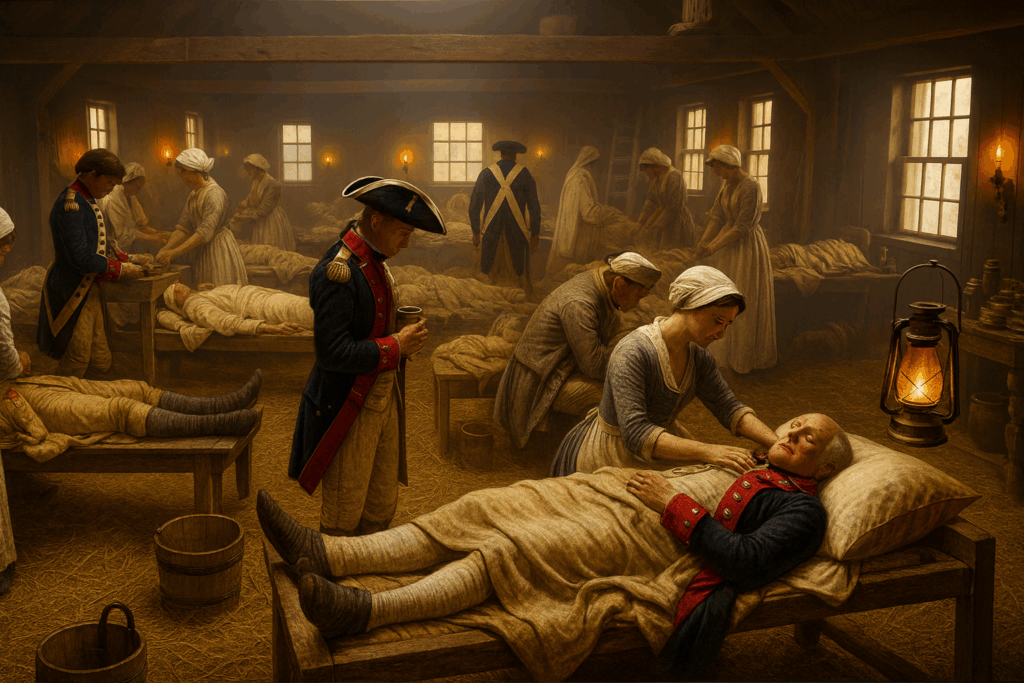
During an epidemic in Philadelphia, she fell seriously ill with a fever and was taken to a hospital, where a physician discovered her secret while treating her. Fortunately, the doctor, Barnabas Binney, chose to protect Sampson rather than expose her. He treated her quietly and helped facilitate her honorable discharge from the army in October 1783. Her commanding officer, General John Paterson, reportedly handled the situation with discretion and respect, recognizing her valuable service to the cause of independence.  Eventually she was discharged by General Henry Knox on October 25, 1783, and was given funds to return home and a Note of Advice, similar to modern discharge papers.

Life After the War

After the war, Sampson returned to Massachusetts, where she married Benjamin Gannet in 1785 and had three children. But like many veterans, she struggled financially and had difficulty obtaining the military pay and benefits she had earned. In 1792, with the help of prominent supporters—including Paul Revere—she successfully petitioned the Massachusetts legislature for back pay and a modest state pension and she later received a pension from the federal government.

Her story didn’t end with domestic life. She became one of the first women in America to go on a speaking tour, traveling throughout New England and New York to share her experiences. Wearing her military uniform, she delivered a combination of storytelling, dramatic performance of military drills, and patriotic appeal.  These lectures, which began in 1802, were groundbreaking for their time, as respectable women rarely spoke publicly before mixed audiences.

A Lasting Legacy

Deborah Sampson’s legacy extends far beyond her military service. She challenged rigid gender roles and demonstrated that women could serve their country with the same valor and effectiveness as men. Her story inspired future generations of women who sought to break barriers and serve in traditionally male-dominated fields.

After she died in 1827, her story continued to gain recognition. In 1838, her husband was awarded a widow’s pension, possibly the first instance in U.S. history that the benefit was granted to a man based on his wife’s military service.

She left behind a legacy of courage, determination, and pioneering spirit that continues to resonate today. In 1983, she was declared the Official Heroine of the Commonwealth of Massachusetts, and in 2020, the U.S. House of Representatives passed the Deborah Sampson Act, expanding healthcare and benefits for female veterans. Statues and memorials, including her gravesite in Sharon, Massachusetts, commemorate her contributions.  Her wartime exploits have been the subject of books, plays, and scholarly research and her story continues to inspire generations as a symbol of courage and the ongoing struggle for gender equality in military service. 

While she was not the only woman to disguise herself and enlist—others like Margaret Corbin and Anna Maria Lane also took up arms—Sampson is among the best documented and celebrated.

Her life represents a crucial chapter in both military history and women’s history, illustrating the complex ways in which the American Revolution created opportunities for individuals to transcend social conventions in service of the greater cause of independence.  Deborah’s journey from indentured servant to Continental Army soldier and national lecturer is a testament to her extraordinary courage and determination. By stepping into a role forbidden to women and excelling under the harshest conditions, she challenged the boundaries of her time and set a precedent for future generations.

Though it is possible that her wartime activities may have been exaggerated—a common practice in biographies of the time—her life remains a powerful reminder of the contributions women have made, often unrecognized, in the shaping of American history.

The illustration at the beginning of this post is from The Female Review: Life of Deborah Sampson, the Female Soldier in the War of Revolution (1916), a reprint of the 1797 biography by Herman Mann.  

The Quasi-War

America’s Undeclared Naval Conflict with France

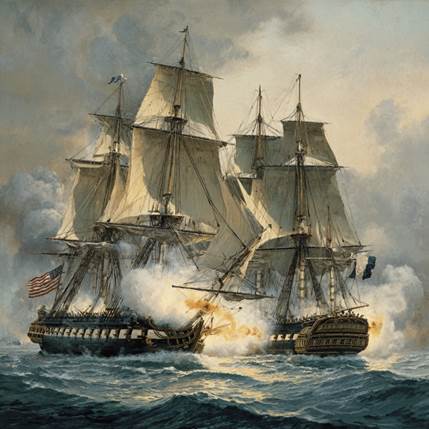
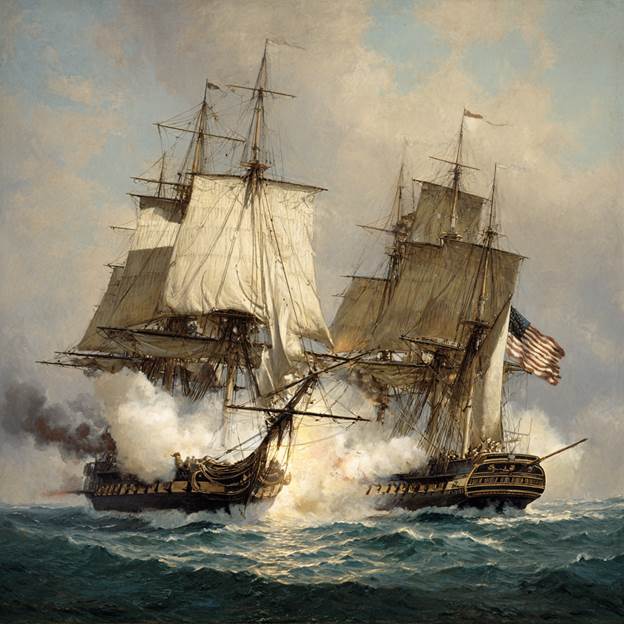
Following the American Revolution, the newly independent United States found itself caught between the competing imperial ambitions of Britain and France. What began as tensions over trade and neutrality escalated into an undeclared naval war and became the country’s first international crisis. The Quasi-War, as historians have named this conflict, was a pivotal moment in early American history when the republic’s survival hung in the balance. 

The Quasi-War was a limited, undeclared naval conflict fought primarily in the Caribbean and along the American coast. The conflict was “quasi” because it lacked a formal declaration of war and was limited in scope, focusing mainly on naval encounters rather than land-based military campaigns.

Origins of the Conflict

The roots of the Quasi-War began with the disagreements, conflicts, and confusion of international relations that followed the French Revolution. The French declaration of war on Britain in 1793 put the United States in a difficult position. The 1778 Treaty of Alliance with France technically obligated the United States to support France militarily, but President George Washington, recognizing that America was too weak to engage in another major conflict, issued a Proclamation of Neutrality.

This decision to remain neutral infuriated the French government, which viewed it as a betrayal of their wartime alliance.  

Tensions increased when the United States suspended loan repayments to France in 1793 primarily due to the dramatic political upheaval of the French Revolution and uncertainty about the legitimacy of the French government.

When the French Revolution began, the U.S. had outstanding debts to France from loans provided during the American Revolution. By 1793, the situation in France had become extremely volatile — King Louis XVI was executed in January, and various revolutionary factions were competing for power.

The Washington administration faced a dilemma: should they continue making payments to the new revolutionary government, or would doing so constitute recognition of a regime that might not be stable or even legitimate? There were also concerns about whether honoring debts to the revolutionary government might drag the U.S. into France’s expanding wars with European monarchies.

The situation deteriorated even further when the United States signed Jay’s Treaty with Britain in 1794. This commercial agreement resolved several outstanding issues between America and Britain, including the evacuation of British forts in the Northwest Territory and the establishment of limited trade relationships. To the French, Jay’s Treaty represented a clear alignment with their enemy.

The French responded in 1795, by authorizing privateers and naval vessels to attack and capture American merchant ships, particularly those trading with British ports or carrying British goods. By 1797, the French had captured over 300 American vessels, causing significant economic damage to American merchants and threatening the nation’s maritime commerce.

The diplomatic crisis deepened with the infamous XYZ Affair of 1797.  When President John Adams sent envoys to Paris to negotiate a resolution to the mounting tensions, French Foreign Minister Talleyrand’s agents demanded substantial bribes, described as loans, before any negotiations could begin. The American diplomats refused these demands and returned home empty-handed. When news of the attempted extortion became public, it sparked outrage across America and the rallying cry “Millions for defense, but not one cent for tribute!”  In his report to Congress, President Adams referred to the three French officials as X, Y, and Z to protect their actual identity, thus giving the XYZ Affair its name.

The Undeclared War Begins

The failure of diplomatic negotiations and continued French attacks on American shipping pushed the Adams administration toward military action. Adams chose not to declare war, which would have required congressional approval and would have risked drawing in other European powers. Instead, he chose a more limited response, authorizing the United States Navy to capture French vessels found in American waters and to protect American merchant ships on the high seas.

The Adams administration took several significant steps to prepare for this maritime conflict. Congress authorized the creation of a separate Navy Department, expanded the existing naval forces, and approved the construction of new warships. The Marine Corps, which was disbanded in 1783, was also formally reestablished during this period. Additionally, Congress suspended all commercial activities with France and authorized American naval vessels to capture French ships engaged in hostile acts against American commerce.

Naval Encounters and Key Battles

The Quasi-War witnessed numerous naval engagements, ranging from single-ship duels to larger squadron actions. American naval commanders like Thomas Truxtun emerged as heroes during this conflict. Truxtun’s frigate USS Constellation achieved two notable victories, first capturing the French frigate L’Insurgente in February 1799, and later defeating La Vengeance in a fierce night battle in February 1800.

The conflict extended throughout the Caribbean, where American naval squadrons protected merchant convoys and hunted French privateers. The USS Enterprise, USS Experiment, and other smaller American vessels proved particularly effective in these operations, capturing numerous French privateers and recapturing American merchant vessels. The U. S. Navy captured or destroyed over 80 French vessels while having only a single ship captured in combat and that ship was later recaptured.

One of the most significant aspects of the naval war was its impact on American naval development. The conflict provided valuable combat experience for American officers and sailors, many of whom would later serve with distinction in the War of 1812. The success of American naval forces during the Quasi-War also demonstrated the importance of maintaining a strong navy for protecting American commercial interests.

While the war was almost exclusively naval, there were minor land actions such as that which occurred during September 1800, when U.S. Marines landed at Curaçao to drive French forces from two forts.

Fears of a possible French invasion led Congress to authorize a provisional army of 10,000 men. President John Adams appointed George Washington as Commander-in-Chief, with Alexander Hamilton as his second-in-command, though no land battles occurred.

Domestic Political Consequences

The Quasi-War worsened the growing divide between Federalists and Democratic-Republicans. President Adams and the Federalist Party generally supported a strong response to French aggression, viewing it as necessary to protect American honor and commercial interests. The conflict provided Federalists with an opportunity to strengthen the federal government and build up American military forces.

The Alien and Sedition Acts, passed in 1798 during the height of anti-French sentiment, granted the government broad powers to deport foreign nationals and prosecute critics of the administration. These measures were widely seen as attacks on civil liberties and became a major political liability for the Federalists.

Thomas Jefferson and the Democratic-Republicans opposed both the war and the domestic security measures, arguing that Adams was leading the country toward unnecessary conflict and tyranny. They maintained that the French grievances were legitimate and that diplomatic solutions should be pursued more vigorously.

Resolution and the Convention of 1800

By 1799, both sides had grown weary of the costly and disruptive conflict. Napoleon Bonaparte, who had come to power in France, was more interested in European affairs than in continuing a naval war with America. Similarly, President Adams recognized that prolonged conflict would be economically devastating and politically dangerous.

In February 1799, Adams surprised both his own party and the nation by announcing his intention to send new diplomatic envoys to France. This decision split the Federalist Party, with many hawks opposing any negotiations with France. Nevertheless, Adams persisted, believing that peace was in America’s best interest.

The resulting negotiations led to the Convention of 1800, also known as the Treaty of Mortefontaine, signed in September 1800. This agreement effectively ended the Quasi-War by establishing terms for peaceful coexistence based on the principle of “free trade, free goods” between the two nations. The treaty also provided for the mutual restoration of captured vessels, established compensation procedures for maritime losses, and most importantly, formally ended the 1778 Treaty of Alliance between France and the United States.

Long-term Impact and Legacy

The Quasi-War’s conclusion marked a significant turning point in American foreign policy. The conflict demonstrated that the United States could successfully defend its interests against a major European power without formal allies. It also established important precedents for presidential war powers and the use of limited military force without formal declarations of war.  The experience gained during the Quasi-War would prove invaluable in subsequent conflicts, particularly the War of 1812.

The Quasi-War Was the beginning of a long-standing policy of neutrality in European conflicts, that persisted for much of the 19th century and was even echoed in the first half of the 20th century.   It demonstrated to the world that the United States was a viable country that stood ready to defend its sovereignty.

The Quasi-War was America’s first undeclared war.  Although Congress eventually granted limited military authority it was begun at the direction of President Adams. This has influenced American foreign policy and the use of military forces ever since. The Quasi-War was referenced in debates about American involvement in Vietnam and in the Gulf War. The War Powers Act of 1973 was passed an effort to limit the ability of the President to send American troops to combat in foreign countries, but its effectiveness and enforcement have been debated ever since it was passed.

Button Gwinnett

An Almost Forgotten Signer of the Declaration of Independence

History is full of people both little known and unknown who were present at important events. They may have participated, or they may simply have been observers. Understanding them, their lives and their involvement can help us to understand the human aspect of historical events. This is what I love most about history, the stories of average people.

Not long ago, I was looking at a copy of a broadside of the Declaration of Independence when I noticed an intriguing signature — Button Gwinnett. He is one of the lesser-known signers of the Declaration of Independence, yet he played a significant role in the early political landscape of Georgia. His life was a blend of ambition and political maneuvering. His dramatic rise and fall remain intriguing to historians. Even though Gwinnett is little remembered today, his story offers a glimpse into the turbulent period of America’s founding.

Early Life and Migration to America

Button Gwinnett was born in 1735 in Down Hatherley, Gloucestershire, England. He was the son of an Anglican vicar and was named after his mother’s cousin Barbara Button who was also his godmother.

While details about his early education are scarce, it is believed that he received a basic education typical of the English gentry. Gwinnett’s early adulthood was marked by modest success as a merchant. In the 1760s, facing limited opportunities in England and the promise of economic prosperity in the American colonies, Gwinnett and his wife, Ann, emigrated to the New World.

Initially, Gwinnett settled in Charleston, South Carolina, where he engaged in trade. However, he struggled financially, and by 1765, he had relocated to Savannah, Georgia. This move marked not only the beginning of his political career, but also a period of fluctuating fortune. Gwinnett purchased St. Catherine’s Island off the coast of Georgia, hoping to become a successful plantation owner. Unfortunately, he overextended himself financially, and his attempts to establish a profitable business met with failure. Despite his financial setbacks, Gwinnett’s status as a landowner and merchant allowed him to enter the local political scene.

Rise in Politics and Revolutionary Activity

Gwinnett’s involvement in politics grew as tensions between the American colonies and Britain escalated. By the early 1770s, he had become aligned with the growing revolutionary sentiment. In 1775, he was elected to Georgia’s Provincial Congress, where he quickly rose to prominence due to his vocal support for independence from British rule. Although Georgia had initially shown less enthusiasm for independence than colonies like Massachusetts or Virginia, a growing faction of Georgia patriots, including Gwinnett, began advocating for stronger opposition to British rule. By 1776, Gwinnett had become a delegate to the Second Continental Congress.

Continental Congress and the Declaration

On January 20, 1776, Gwinnett left Georgia for Philadelphia to represent the colony in Congress. This appointment marked the pinnacle of his political career and placed him at the center of the deliberations for American independence. His journey to Philadelphia came at a crucial moment when the Continental Congress was moving toward a formal declaration of independence.

Gwinnett voted for independence on July 2, voted to approve the declaration on July 4, and signed his name to the parchment of the Declaration of Independence on August 2. Out of the 56 delegates who signed the Declaration, Button was one of only 8 who were born in Britain. His British birth added a unique perspective to his role as a Founding Father, representing the immigrant experience that was central to colonial American society.

His signing of the Declaration of Independence would later make his signature one of the most valuable autographs in American history. Gwinnett is known chiefly because his autographs are extremely rare and collectors have paid dearly to obtain one. (In 2001 one of his 36 known autographs sold at public auction for $110,000. Since then, several others have been documented.)

Conflict and Power Struggles in Georgia

Back in Georgia, Gwinnett became embroiled in a power struggle with General Lachlan McIntosh, a prominent figure in the colony’s revolutionary army. The conflict between Gwinnett and McIntosh was fueled by political rivalry and personal animosity. Gwinnett aspired to leadership positions within Georgia’s government and military, and in March 1777, he became acting president of Georgia’s Revolutionary Council after the sudden death of Governor Archibald Bulloch.

During his brief tenure as acting council president, Gwinnett’s leadership was controversial. He proposed a bold military expedition against British-controlled East Florida, intending to bolster his political standing and secure Georgia’s borders. However, the campaign was poorly executed, and it ended in failure. This debacle intensified the feud between Gwinnett and McIntosh, with each blaming the other for the military defeat.

Gwinnett’s promising political career was cut short by an ongoing personal conflict that became intertwined with the honor culture of the American South. The rivalry between Gwinnett and McIntosh reached its climax in May 1777. After a series of public insults—McIntosh called Gwinnett a “scoundrel and lying rascal,” Gwinnett responded by challenging him to a duel. Dueling, though technically illegal, was still a common way to resolve disputes among gentlemen of the period. On May 16, 1777, the two men faced each other with pistols in a pasture near Savannah. Both were wounded, but only Gwinnett’s injuries proved fatal. He died three days later, at age 42, and was buried in Savannah’s Colonial Park Cemetery, though the exact location of his grave is still unknown.

Legacy and Historical Significance

Gwinnett’s legacy is visible in his namesake Gwinnett County, one of Georgia’s most populous counties, a tribute to his contributions to the state’s early political history.

In recent decades, historians have taken a renewed interest in Button Gwinnett, examining his role beyond the narrow context of his duel and signature. While he lacked the fame of other founding fathers, Gwinnett’s political maneuvering and his role during the revolutionary period highlight the complexities of early American politics. His rivalry with McIntosh reflects the deep divisions and regional conflicts that existed even among those who supported independence.

Gwinnett’s life also underscores the risks faced by those who ventured into the revolutionary cause. Unlike many of his contemporaries who enjoyed long, celebrated careers, Gwinnett’s story is one of a meteoric rise and abrupt fall. His legacy, while overshadowed by more prominent figures, is a reminder of the many lesser-known men and women who played vital roles in America’s fight for independence.

Button Gwinnett’s life was marked by ambition, conflict, and an untimely death that left him as one of the more obscure figures of the American Revolution. His contributions to the independence movement in Georgia were significant, even if his political career was cut short. Today, Gwinnett’s name lives on in Georgia’s geography, and his autograph serves as a rare artifact of a fleeting yet impactful moment in history.

Sources:

·      National Archives: Declaration of Independence Signers – https://www.archives.gov/founding-docs/signers

·      The Georgia Historical Society: Biography of Button Gwinnett – https://georgiahistory.com

·      Smithsonian Magazine: The Rare Autograph of Button Gwinnett – https://www.smithsonianmag.com

·      Library of Congress: Early American Biographies – https://www.loc.gov

“From The Halls of Montezuma”

The Evolution of the Marine Corps Hymn

The opening line of the Marine Corps Hymn, “From the halls of Montezuma to the shores of Tripoli,” stands as one of the most recognizable phrases in American military tradition. But what are The Halls of Montezuma?  Where are the Shores of Tripoli?  Why are they important to Marines?

Few realize that this iconic song has undergone subtle but significant changes throughout its history, reflecting the Marine Corps’ evolution from a small naval force into a modern, multi-domain fighting organization. 

The Original Battles

The hymn’s opening line commemorates two pivotal early battles that established the Marine Corps’ reputation for courage and effectiveness. “The Halls of Montezuma” refers to the Battle of Chapultepec during the Mexican American War in September 1847. Chapultepec Castle, perched on a hill overlooking Mexico City, was built on the site where Aztec Emperor Montezuma II once maintained his palaces and gardens. The fortress housed the Mexican military academy and served as a key defensive position protecting the capital. The term “Montezuma” evokes the grandeur of ancient Mexico, even though Montezuma himself had no connection to the castle. It was a bit of poetic license—common in martial songs—to evoke the exotic location and historic weight of the conquest.

During the assault on Chapultepec, Marines fought alongside Army units in a fierce battle against heavily fortified positions. The Marines’ performance in this engagement helped secure American victory and opened the path to Mexico City, effectively ending the war. This battle demonstrated that Marines could excel not just in naval operations but also in major land campaigns.

The “blood stripe”—the red stripe on Marine dress blue trousers—is traditionally said to honor the Marines who fell at Chapultepec, although this is more legend than documented fact.

The second half of the line, “to the shores of Tripoli,” reaches back even further to the First Barbary War (1801-1805). In this conflict, a small force of Marines participated in the capture of Derna, a fortified city on the Libyan coast. Led by Lieutenant Presley O’Bannon, the Marines marched across the desert with a motley force of mercenaries and Arab allies to attack the Barbary pirates’ stronghold. The success at Derna marked the first time the American flag was raised over a fortress in the Old World and established the Marines’ reputation for discipline, effectiveness, and fighting in exotic, far-flung locations.

Marine Corps officers still carry a Mameluke Sword based on the sword presented to Lt. O’Bannon by Ottoman Viceroy Prince Hamet in recognition of his valor.

The Hymn’s Origins

The Marine Corps Hymn emerged sometime in the 1840s or 1850s, shortly after the Mexican-American War. It was not officially adopted until 1929 when Commandant of the Marine Corps, Major General John A. Lejeune issued an order making it the official song of the Corps.  Several variations of the lyrics were in use prior to that, and the words were standardized in the adoption order.

Unlike many military songs that were composed by established musicians, the hymn’s authorship remains uncertain. The melody was borrowed from a comic opera by Jacques Offenbach, but the words appear to have been written by Marines themselves, possibly at the Marine Barracks in Washington, D.C.

The original version celebrated these early victories with straightforward language: “From the halls of Montezuma to the shores of Tripoli, we fight our country’s battles on the land as on the sea.” This phrasing reflected the Marine Corps’ dual nature as both a naval force and an expeditionary force capable of fighting anywhere American interests were threatened.

The Aviation Revolution

For nearly a century, the hymn remained largely unchanged. However, as the Marine Corps expanded its capabilities during the early 20th century, the traditional wording began to seem incomplete. The establishment of a Marine Aviation Company in 1915 and its expansion during World War I marked a significant evolution of the Corps’ mission and capabilities.

By World War II, Marine aviation had become a crucial component of the Corps’ fighting power. Marine pilots flew close air support missions, fought in aerial combat, and provided reconnaissance for ground forces. The Pacific theater, where Marines conducted their most famous campaigns, showcased the integration of air, land, and sea operations in ways that the original hymn could not capture.

The Historic Change

Recognition of this evolution came on November 21, 1942, when Commandant of the Marine Corps authorized an official change to the hymn’s first verse. The modification was originally proposed by Gunnery Sergeant H.L. Tallman, who recognized that the traditional phrasing no longer adequately described the Marines’ expanding role.

The fourth line of the first verse was changed from “on the land as on the sea” to “in the air, on land and sea.” This seemingly small addition carried profound significance. It acknowledged that Marines now operated in three environments rather than two, reflecting the Corps’ transformation into a modern, combined-arms force.

The timing of this change was crucial. Coming just as the United States was fully engaged in World War II, the revision recognized the vital role Marine aviation was playing in Pacific operations. From the skies over Guadalcanal to the beaches of Iwo Jima, Marine pilots were proving that air power was no longer a supporting element but an integral part of Marine Corps operations.

Legacy and Meaning

The evolution of the Marine Corps Hymn’s opening stanza reflects a broader story about military adaptation and institutional identity. The original battles at Montezuma and Tripoli established the Marines’ reputation for fighting in distant, challenging environments. The addition of “air” recognized that this tradition continued but now extended into new realms of warfare.

Today, when Marines sing “From the halls of Montezuma to the shores of Tripoli,” they honor not just those early victories but the entire span of Corps history. The hymn connects modern Marines with their predecessors while acknowledging how the institution has grown and changed. The simple addition of one word in 1942 ensured that the Marine Corps Hymn would remain relevant for generations of Marines who would fight not just on land and sea, but in the air as well: preserving the past while embracing the future.

Peleliu: The Unnecessary Battle

Anyone with even a passing familiarity of the history of World War II knows about the major island campaigns in the Pacific: Guadalcanal, Tarawa, Iwo Jima and Okinawa.  But unless you are a student of military history or perhaps a former Marine, you’ve probably never heard of the Battle of Peleliu

The Battle of Peleliu, fought from September 15 to November 27, 1944, stands as one of the most controversial and costly operations in the Pacific Theater. This assault on the small coral island in the Palau chain reveals much about the complexities of strategic decision-making during wartime.

Objectives and Strategic Rationale

The primary objective was to capture Peleliu’s airfield to prevent Japanese aircraft from interfering with General MacArthur’s upcoming invasion of the Philippines. American planners believed that Japanese forces based on Peleliu could attack the right flank of the Philippine invasion force. Additionally, the island was seen as a potential base for supporting further operations against Japan in the western Pacific.

Military planners, especially Admiral Chester Nimitz and his staff, believed neutralizing Japanese air power on Peleliu was critical to protecting the Philippineinvasion. The airfield on the island, if left in Japanese hands, could theoretically pose a threat to operations in the southern Philippines or even to the fleet.

However, this concern was based on a misreading of Japan’s actual capacity to project power from the island. By late 1944, Japan’s air forces were significantly degraded, and their capacity to use the Peleliu airfield was minimal, if it existed at all.

The operation was planned as part of a broader strategy to neutralize Japanese strongholds and establish forward bases for the final push toward Japan. Admiral Nimitz initially supported the invasion, viewing it as necessary to protect MacArthur’s Philippine campaign and to continue the island-hopping strategy that had proven successful elsewhere in the Pacific.

Admiral William Halsey argued the operation was unnecessary, as American bombardment had already isolated Japanese forces and rendered the airfield unusable. However, Admiral Nimitz approved the invasion, believing cancellation logistically impractical because preparations were too far advanced. Marine commanders initially predicted a swift victory, with Major General William Rupertus claiming the island would fall in four days.

The Strategic Reality

In retrospect, Peleliu’s strategic value was far more limited than initially assessed. The island’s airfield, while operationally useful, was not critical to the success of the Philippine invasion. The Japanese garrison of approximately 11,000 troops under Colonel Kunio Nakagawa had transformed the island into a fortress, utilizing the coral caves and ridges to create an intricate defensive system that would exact a terrible price from the attackers.

The 1st Marine Division, supported by the 81st Infantry Division, ultimately secured the island, but at enormous cost. American casualties totaled over 9,000, with nearly 1,800 killed in action. Japanese losses were almost total, with fewer than 200 prisoners taken from the original garrison.

Post-Battle Assessment

After the battle’s conclusion, many military leaders questioned whether the operation had been worth its tremendous cost in human lives. The strategic benefits gained were minimal compared to the losses sustained. The airfield was not essential to subsequent operations, and the island’s location proved less critical than originally believed.

Military historians increasingly view Peleliu as an example of how the initial strategic and tactical assessments proved flawed when planners failed to recognize the evolution of Japanese defensive tactics, which emphasized fighting from prepared positions rather than the banzai charges that had characterized earlier encounters.

Historical Significance

Peleliu is overshadowed in World War II histories by larger, more decisive battles like Iwo Jima and Okinawa. However, it served as a crucial learning experience for American forces, providing insights into Japanese defensive innovations that would prove valuable in later operations. The battle highlighted the importance of accurate intelligence and realistic strategic assessment.

The intense fighting on Peleliu also demonstrated the resilience and adaptability of American forces under extremely challenging conditions. The prolonged nature of the battle, lasting over two months instead of the predicted few days, tested logistics, medical support, and command structures in ways that informed future operations.

The Aftermath

While the immediate strategic gains from Peleliu were limited, the battle did provide several important advantages. It eliminated a potential threat to Allied shipping lanes in the region and provided valuable experience in assaulting heavily fortified positions. The lessons learned about Japanese defensive tactics, the importance of coordinated air and ground support, and the challenges of fighting in coral terrain all contributed to improved performance in subsequent operations.

Perhaps most significantly, Peleliu demonstrated the need for more careful strategic evaluation of objectives relative to costs. This lesson influenced planning for later operations and contributed to discussions about alternative strategies for ending the war in the Pacific.  In specific, the battle demonstrated Japan’s willingness to fight to the death and perhaps may have indirectly influenced the decision to use atomic bombs to avoid similar carnage in a main island invasion.

The Battle of Peleliu remains a sobering reminder of the complexities of wartime strategy and the human cost of military operations. While its immediate strategic value was questionable, its role in the broader context of Pacific War operations and its lessons for military planning ensured its place in the historical record of World War II.

The U.S. Public Health Service: Guardians of America’s Health

The United States Public Health Service (USPHS) has quietly served as the backbone of the nation’s public health infrastructure for over two centuries. From its beginnings as a maritime medical service to its current role as a comprehensive public health organization, the USPHS has evolved to meet the changing medical challenges facing Americans and to protect and promote the health of the nation.

Origins and Early History

The U.S. Public Health Service traces back to 1798, when President John Adams signed “An Act for the Relief of Sick and Disabled Seamen.” This legislation established the Marine Hospital Service and created a network of hospitals to care for the merchant sailors who served America’s growing maritime commerce. The act represented one of the first examples of federally mandated health insurance, as ship owners were required to pay 20 cents per month per sailor to fund medical care.

The Marine Hospital Service initially operated a series of hospitals in major port cities including Boston, New York, Philadelphia, and Charleston. These facilities served not only sick and injured sailors but also played a crucial role in preventing the spread of infectious diseases that could arrive on ships from foreign ports. This dual function of treatment and prevention would become a defining characteristic of the USPHS mission.

The transformation from the Marine Hospital Service to the modern Public Health Service began in the late 19th century. In 1889, the organization was restructured and placed under the supervision of Dr. John Maynard Woodworth as Supervising Surgeon—later Surgeon General—marking the beginning of its evolution into a more comprehensive public health agency. The name was officially changed to the Public Health and Marine Hospital Service in 1902, and finally to the U.S. Public Health Service in 1912, reflecting its expanded mandate beyond maritime health.

Evolution and Expansion

The early 20th century brought significant expansion to the USPHS mission. The 1906 Pure Food and Drug Act gave the service regulatory responsibilities, leading to the creation of what would eventually become the Food and Drug Administration. During World War I, the USPHS took on additional responsibilities for military health and epidemic control, establishing its role as a rapid response organization for national health emergencies.

The Great Depression and World War II further expanded the service’s scope. The Social Security Act of 1935 created new public health programs administered by the USPHS, while wartime demands led to increased focus on occupational health, environmental health hazards, and the health needs of defense workers. The post-war period saw the establishment of the National Institutes of Health—originally called the Laboratory of Hygiene—as part of the USPHS, cementing its role in medical research.

Major Functions and Modern Roles

Today’s U.S. Public Health Service operates as part of the Department of Health and Human Services and supports major agencies and functions. The service’s mission centers on protecting, promoting, and advancing the health and safety of the American people through several key areas.

Disease Prevention and Health Promotion are the core of USPHS activities. It works with the Centers for Disease Control and Prevention (CDC), to lead national efforts in the prevention and control of infectious and chronic diseases. From tracking disease outbreaks to promoting vaccination programs, the USPHS a part of America’s first line of defense against health threats.

Regulatory and Safety Functions represent other crucial areas. The USPHS coordinates with the Food and Drug Administration (FDA) to ensure the safety and efficacy of medications, medical devices, and food products. It works with the Agency for Toxic Substances and Disease Registry monitoring environmental health hazards. Other USPHS components are involved in regulating everything from clinical laboratories to health insurance portability.

Emergency Response and Preparedness has become increasingly important in recent decades. The USPHS maintains rapid response capabilities for natural disasters, disease outbreaks, and public health emergencies. This includes the deployment of Commissioned Corps officers to disaster zones and the maintenance of strategic national stockpiles of medical supplies.

Health Services for Underserved Populations continues the service’s historic mission of providing care where it’s most needed. The Health Resources and Services Administration oversees community health centers, rural health programs, and initiatives to address health disparities among vulnerable populations.  The Indian Health Service is an important part of the USPHS, providing healthcare to often isolated communities.

The Commissioned Corps

One of the most distinctive features of the USPHS is its Commissioned Corps, a uniformed service of over 6,000 public health professionals. Established in 1889, the Corps operates as one of the eight uniformed services of the United States, alongside the armed forces, NOAA Corps, and Coast Guard. Officers hold military-style ranks and wear uniforms, but their mission focuses entirely on public health rather than defense.

The Commissioned Corps provides a ready reserve of highly trained health professionals who can be rapidly deployed to address public health emergencies. From hurricane and disaster relief to pandemic assessment and treatment, Corps officers have served on the front lines of America’s health challenges, providing everything from direct patient care to epidemiological investigation and public health program management.

Contemporary Challenges and Future Directions

The U.S. Public Health Service continues to evolve in response to emerging health challenges. Climate change, antimicrobial resistance, mental health crises, and health equity concerns represent current priorities. The COVID-19 pandemic demonstrated both the critical importance of robust public health infrastructure and the challenges of maintaining public trust in health authorities.

As America faces an increasingly complex health landscape, the USPHS mission of protecting and promoting the nation’s health remains as relevant as ever. From its origins serving sailors in port cities to its current role addressing global health threats, the U.S. Public Health Service continues its quiet but essential work of safeguarding American health, adapting its methods while maintaining its core commitment to serving the public good.

The service’s history shows that effective public health requires not just scientific expertise, but also the institutional ability to respond rapidly to emerging threats, the authority to implement necessary interventions, and the public trust to lead national health initiatives. As new challenges appear, the USPHS continues to build on its more than two-century legacy of service to the American people.

Page 5 of 9

Powered by WordPress & Theme by Anders Norén