
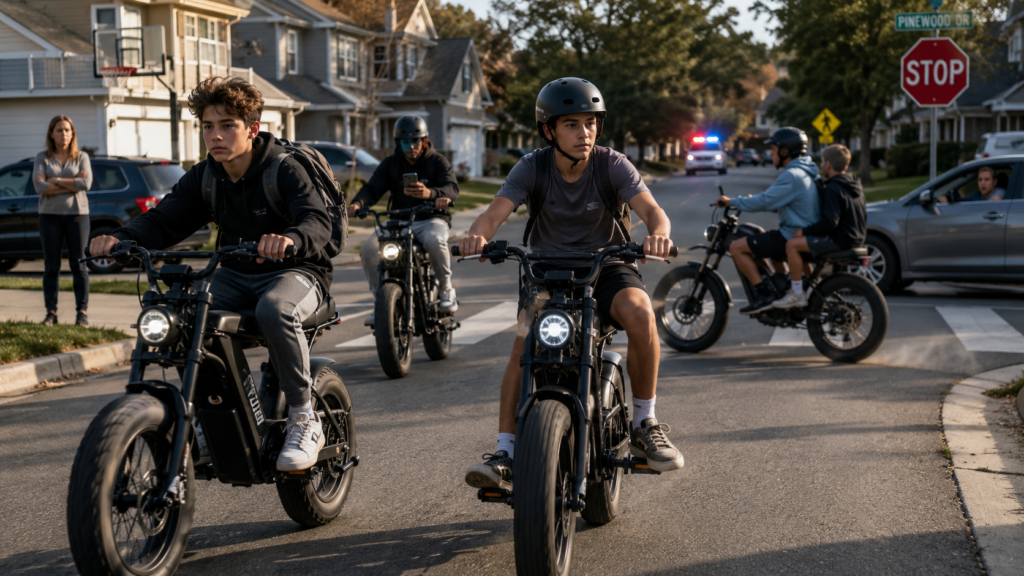
How Young Riders Are Turning E-Bikes Into Motorcycles — And Paying the Price
Walk around any suburban neighborhood, school parking lot, or boardwalk on a warm afternoon, and you’ll spot them — teenagers zipping past on e-bikes that look suspiciously like small motorcycles. They’re leaning into the throttle, barely touching the pedals, weaving through traffic with the confidence of experienced riders and the inexperience of kids who’ve never had a driver’s license. It’s a scene playing out all across America, and it’s landing more and more young people in emergency rooms.
E-bikes — short for electric bicycles — have exploded in popularity. According to the American College of Surgeons, more than 1.1 million e-bikes were sold in the United States in 2022, with projected annual growth of around 10 percent. They’re cheaper than cars, faster than regular bicycles, and — crucially — they don’t require a driver’s license or registration in most states. For teenagers who can’t yet get behind the wheel of a car, an e-bike can feel like the next best thing. Sometimes it’s marketed that way, too.
But the gap between what parents think they’re buying and what these machines can do is widening dangerously and regulators, pediatricians, and trauma surgeons are all sounding the alarm.
A Classification System Built for Adults, Ignored by Kids
Under federal guidelines, e-bikes fall into three classes. Class 1 bikes use pedal assist — the motor only kicks in when the rider is actually pedaling, and it cuts out at 20 mph. Class 2 bikes come with a throttle, meaning the motor engages without any pedaling at all, topping out at 20 mph. Class 3 bikes are pedal-assist only but allow speeds up to 28 mph. The American College of Surgeons and most safety advocates have noted that Class 2 bikes — the ones with throttles — most closely resemble mopeds in how they really function.
The throttle is the key word here. On a Class 2 e-bike, a rider can twist the grip, lean back, and let the motor do everything. There’s no need to pedal. No need to exert any physical effort. The bike simply goes. A teenager who’s never ridden anything faster than a 10-speed now has access to a motor vehicle — because legally, in most states, that’s not what it’s called.
Some e-bikes complicate things further by allowing riders to toggle between classes, sometimes without the rider or parent even knowing it. A California lawsuit alleged that one manufacturer falsely marketed a bike as Class 2 when it could easily be switched to Class 3 operation. Colorado state lawmaker Lesley Smith, who co-sponsored legislation addressing this, put it plainly: “The biggest issue is e-bikes that switch from a power-assisted bike to essentially a motorized scooter.”
And then there are outright counterfeits and gray-market products — machines marketed as e-bikes that are functionally electric motorcycles. Researchers at the American College of Surgeons noted that some controllers can be deactivated by a magnet or a few keystrokes, unlocking speeds above 37 mph. Conversion kits available online can boost motors to more than 1,000 watts — well above federal limits. These aren’t bicycles by any meaningful definition, but they’re being sold and ridden as if they were.
Nobody’s Pedaling — And That’s the Point
Ask any parent who’s watched their kid ride an e-bike for more than five minutes and they’ll tell you: the pedals are mostly decorative. Young riders, especially those on throttle-equipped Class 2 models, are operating these bikes like mini motorcycles — right hand on the throttle, both feet tucked back, no pedaling whatsoever. It’s intuitive, it’s fun, and it’s exactly what the design invites them to do.
Manufacturers market throttle operation openly. One company describes it this way: “Throttle mode lets you control speed with a handlebar twist or button, requiring no pedaling — similar to a motorcycle.” Another notes the throttle “works like a regular throttle on a motorcycle.” The pitch is freedom and convenience. What isn’t mentioned in the branding is the risk profile that comes along with operating a motor vehicle without any training, licensing requirement, or mandatory safety course.
The legal fiction that these are bicycles and therefore unregulated as motor vehicles is doing a lot of heavy lifting for the industry. E-bikes are not subject to the same federal oversight as motorcycles or mopeds. No driver’s license is required. No registration. No insurance. In most states, no helmet is mandated for adult riders. A 12-year-old can, in many jurisdictions, legally operate a machine that travels at 20-28 mph through traffic, with zero formal training.
KFF Health News, reporting in late 2025, found that federal oversight of e-bike safety has largely stalled, leaving a patchwork of state and county rules that vary wildly. More than half the states now restrict who can ride Class 3 bikes, but Class 2, the throttle-equipped, motorcycle-operation models that require zero pedaling, often has far lighter age restrictions, if any.
The Injury Numbers Are Alarming — and Getting Worse
Trauma surgeons across the country are watching the data accumulate with growing alarm. At Penn State Health Children’s Hospital, doctors treated more children for e-bike and e-scooter injuries in 2025 than in the prior three years combined. At Connecticut Children’s Medical Center, pediatric e-bike injuries nearly tripled in just one year, from 32 cases in the first half of 2024 to 92 during the same period in 2025. In May and June of 2025 alone, the Connecticut hospital saw 25 injuries, compared to just 3 the year before.
The injuries themselves tell the story. Dr. James Dodington of Yale Medicine described an “explosion” in serious pediatric trauma, saying that patients are arriving with injuries more consistent with motorcycle accidents than bicycle falls: severe head trauma, facial fractures, internal bleeding. This is confirmed an American College of Surgeons report that e-bike injuries are more severe than standard bicycle injuries, and that the rate of such injuries is increasing every year.
Perhaps the most striking data point comes from Marin County, California, where health officials found that children between ages 10 and 15 who crash their e-bikes require an ambulance at five times the rate of other age groups involved in e-bike crashes. These aren’t minor spills. These are serious, life-altering events.
Why Young Riders Are Especially at Risk
It’s not just that kids are riding fast machines — it’s that adolescent brains are not yet wired for the kind of risk assessment that operating a motor vehicle demands. The prefrontal cortex, which governs impulse control and judgment, is still developing well into a person’s mid-twenties. The American Academy of Pediatrics advises that children under 16 should not operate motorized e-bikes at all.
Research consistently shows that young riders under 25 take the most risks on e-bikes and e-scooters and are also four times more likely to engage in risky behavior. Add to that the social dynamics of adolescence — showing off for friends, going faster than is wise, taking shortcuts through traffic — and the risk profile compounds quickly.
Helmet use is another major gap. Research published in JAMA Surgery found that e-bike riders without helmets were nearly twice as likely to sustain head injuries as those who wore them. And yet helmet use among young e-bike riders remains inconsistent, often because helmets aren’t legally required for them and because the cultural norm for e-biking hasn’t caught up with the reality of what these machines can do. For Class 3 speeds of 28 mph, many safety experts now recommend motorcycle-rated helmets rather than standard bike helmets — a recommendation that most young riders have not heard of and probably wouldn’t follow anyway.
Distraction compounds the danger further. Dr. Bryanna Emr, director of pediatric trauma surgery at Penn State, noted that many riders have headphones on or are looking at their phones while riding — a behavior that is dangerous on a regular bicycle and potentially fatal on a machine traveling at near highway speeds without the safety cage of a car.
The Regulatory Gap: No One Is Clearly in Charge
Part of what makes this problem so difficult to solve is that e-bikes fall between regulatory agencies in a frustrating way. The Consumer Product Safety Commission oversees products sold to consumers, while the National Highway Traffic Safety Administration governs motor vehicles. E-bikes, classified legally as bicycles, fall primarily under CPSC — but the existing standards were written for traditional pedal bicycles and have been acknowledged as inadequate for e-bikes. Parents should also be aware that some bikes marketed as Class 2 can be easily toggled into higher-speed Class 3 operation — sometimes without the rider even realizing it.
Meanwhile, the regulatory landscape at the state level is a true patchwork. Some states follow the three-class system in full. Others have partial adoptions. A few set minimum ages for Class 3 bikes. Some localities have taken things into their own hands — Marin County in California, for instance, has banned children under 16 from operating Class 2 e-bikes entirely. Colorado, Minnesota, and Utah passed new laws in 2025 addressing battery fire risks and attempting to distinguish legal e-bikes from the faster “e-motos” that are being sold under the e-bike label.
The American College of Surgeons issued a formal statement in June 2025 calling for clearer federal definitions, age-based restrictions, mandatory helmet requirements, and enforcement against illegally modified bikes. The statement noted that e-bikes should be classified based on their maximum obtainable speed on flat ground — not just their advertised class — and that speed unlocks and modification kits need to be regulated or banned.
For the moment, the fastest-moving part of this landscape is the injury statistics, which are outpacing the regulatory response at an escalating rate.
What Parents and Policymakers Should Know
If you’re a parent considering an e-bike for a child who’s still years away from a driver’s license, here’s what the evidence says: the machine your child will operate is functionally a motorized vehicle. A throttle-equipped model requires no pedaling, no physical effort, and no prior training. At speeds of 20-28 mph, a crash produces injuries more similar to a motorcycle accident than a bicycle tumble. And the regulatory system, for now, is not keeping pace with the technology.
From a policy standpoint, the calls from the medical and trauma community are consistent: age-based federal minimums, mandatory helmet laws for all e-bike riders, clearer definitions that separate true bicycles from what are functionally motor vehicles, and enforcement mechanisms restricting conversion kits that bypass speed limiters.
Until those protections exist, the gap between a child’s excitement about a new e-bike and the reality of what that machine can do will keep filling emergency rooms.
Illustration generated by author using ChatGPT
Sources
1. American College of Surgeons — Statement on E-Bike Safety (June 2025): https://www.facs.org/about-acs/statements/statement-on-electric-bicycle-safety-and-injury-prevention/
2. ACS Bulletin — Electric Bikes Are Emerging as Public Health Hazard (July/August 2024): https://www.facs.org/for-medical-professionals/news-publications/news-and-articles/bulletin/2024/julyaugust-2024-volume-109-issue-7/electric-bikes-are-emerging-as-public-health-hazard/
3. KFF Health News — Kids and Teens Go Full Throttle for E-Bikes (December 2025): https://kffhealthnews.org/news/article/electric-e-bike-regulation-federal-states-counties-cpsc-nhtsa-colorado-injuries/
4. Penn State Health News — E-Bike and E-Scooter Injuries on the Rise in Kids (October 2025): https://pennstatehealthnews.org/2025/10/the-medical-minute-e-bike-and-e-scooter-injuries-are-on-the-rise-in-kids-what-every-parent-should-know/
5. Connecticut Law Blog — The Alarming Rise of E-Bike Accidents (December 2025): https://www.doddlawfirmct.com/2025/12/17/the-alarming-rise-of-e-bike-accidents-what-recent-injury-data-means-for-riders-and-drivers/
6. Safe Kids CT — E-Bike Injuries Are Rising Fast (August 2025): https://ctsafekids.org/blog/e-bike-injuries-are-rising-fast-heres-what-parents-need-to-know/
7. The Conversation — Young People Are Being Killed or Injured on E-Bikes (April 2026): https://theconversation.com/young-people-are-increasingly-being-killed-or-injured-on-e-bikes-its-time-for-governments-to-act-269095
8. UCSF News — Electric Scooter and Bike Accidents Are Soaring (July 2024): https://www.ucsf.edu/news/2024/07/428096/electric-scooter-and-bike-accidents-are-soaring-across-us
9. Johns Hopkins Bloomberg School — Evidence Synthesis on E-Bike Injuries (October 2024): https://publichealth.jhu.edu/sites/default/files/2025-03/BIGRS_Evidence-Synthesis-E-bikes-2025.pdf
10. ABC News — Kids and Teens Go Full Throttle for E-Bikes (November 2025): https://abcnews.com/Health/kids-teens-full-throttle-bikes-federal-oversight-stalls/story?id=127708920
Leave a Reply