
English is a beautifully messy language—shameless in its borrowing and relentless in its evolution. It resists the tidy logic that might make a grammarian’s life easier, and that resistance is part of what makes its history so compelling. The English we speak today is the product of centuries of invasion, migration, cultural collision, and literary ambition—a language built in layers, like geological strata laid down over time.
To see how English grew from an obscure Germanic dialect into a global lingua franca, it helps to trace three broad phases: Old English, Middle English, and Modern English. Each stage was shaped by different historical forces, from Germanic migration and Viking settlement to the Norman Conquest, the Renaissance, the printing press, and ultimately the worldwide reach of the British Empire and the United States.
Anglo-Saxon Foundations
The story begins on the European mainland. When Roman authority collapsed in Britain in the early fifth century, Germanic-speaking peoples from what is now northern Germany, Denmark, and the Netherlands moved into the island. The Angles, Saxons, and Jutes arrived in waves, bringing closely related West Germanic dialects that gradually developed into Old English, often called Anglo-Saxon.
Old English was thoroughly Germanic in both grammar and vocabulary. It was a highly inflected language: case endings marked whether a noun was subject, object, or possessive, and nouns had grammatical gender. Verbs were conjugated with a complexity that feels foreign to most modern English speakers. Much of the core vocabulary of modern English—words such as water, house, bread, child, earth, life, and death—dates back to this early period and still carries that Germanic stamp.
The language of Beowulf, composed between the eighth and early eleventh centuries, is virtually unreadable today without specialized training. Its famous opening line, “Hwæt! We Gardena in geardagum,” is technically English, but it feels closer to a foreign language. Old English used letters such as þ (thorn) and ð (eth) and relied on grammatical structures that later disappeared.
Nor was Old English a single uniform tongue. It existed as a cluster of regional dialects including Northumbrian, Mercian, Kentish, and West Saxon. Under King Alfred the Great in the late ninth century, Wessex became the leading political power in England and a center of learning. Alfred sponsored translations of important Latin works into Old English, most often in the West Saxon dialect. As a result, most surviving Old English texts come from that dialect, giving us only a partial view of the linguistic diversity of early England.
Latin and Celtic Influences
Even before the Anglo-Saxons arrived in Britain, Latin had begun to influence their speech through contact with the Roman world. Early Latin loanwords include street (from strata), wall (from vallum), and wine (from vinum).
A second wave of Latin influence arrived with the Christianization of England beginning in 597, when Augustine of Canterbury established a mission in Kent. Christianity introduced vocabulary connected with religion, learning, and administration—words such as church, bishop, monk, school, altar, and verse.
By contrast, the Celtic languages spoken by the native Britons left a surprisingly small mark on English vocabulary. Their influence survives most clearly in place names—for example Thames, Avon, and Dover—and in landscape terms such as combe (valley) and tor (rocky hill). Why Celtic languages left relatively few everyday words in English remains one of the lingering puzzles of linguistic history.
Vikings and the Norse Contribution
Beginning in the late eighth century, Scandinavian raiders and settlers—collectively known as Vikings—began attacking and eventually settling parts of England. By the ninth century much of northern and eastern England had become part of the Danelaw, where Old English speakers lived alongside speakers of Old Norse.
Because Old Norse and Old English were closely related Germanic languages, speakers could often roughly understand each other. Over time, however, sustained contact produced deep linguistic blending. English absorbed many Norse-derived words that now feel completely native, including sky, skin, skill, skirt, egg, leg, window, husband, call, take, give, get, want, and die.
Perhaps the most striking Norse contribution lies in the pronouns they, them, and their, which replaced earlier Old English forms. When a language adopts core pronouns from another language, it signals unusually intense and prolonged contact.
Many linguists also believe that contact with Norse speakers helped accelerate the simplification of English grammar. In bilingual communities, speakers often reduce complex inflectional endings that make communication difficult. As a result, English gradually moved away from the elaborate grammatical endings of Old English and toward a system that relied more heavily on word order.
The Norman Transformation
The Norman Conquest of 1066 transformed English more dramatically than any other single event in its history. When William of Normandy defeated King Harold at the Battle of Hastings and became king of England, he brought with him a French-speaking aristocracy.
For several centuries after the conquest, French dominated the language of power—the court, the law, the church hierarchy, and much of government administration. English remained the everyday language of the population but lost prestige in elite circles.
French vocabulary poured into English in areas associated with authority and culture. Law gained terms such as justice, court, judge, jury, prison, crime, and verdict. Government absorbed parliament, sovereign, minister, authority, tax, and treasury. Military language adopted army, navy, soldier, captain, defense, and siege.
Even the language of food reflects this social divide. The animals in the field kept their Old English names—cow, sheep, pig, and deer—while the meat served at noble tables took French names: beef, mutton, pork, and venison.
The Rise of Middle English
Over time, French dominance gradually weakened. The loss of Normandy in 1204 encouraged English nobles to identify more strongly with England itself. Later, the Black Death (1348–1350) reshaped English society by elevating the economic importance of English-speaking laborers and craftsmen.
During the fourteenth century, English returned as the language of all social classes. The language that emerged—Middle English—looked very different from Old English. Most grammatical endings disappeared, grammatical gender vanished, and sentence structure shifted toward the familiar subject-verb-object order.
At the same time, English vocabulary became a rich mixture of Germanic and Romance elements. This layering produced sets of near-synonyms with different levels of formality: ask (Germanic), question (French), and interrogate (Latin).
The most famous literary figure of this period was Geoffrey Chaucer, whose Canterbury Tales demonstrated that English could rival French and Latin as a vehicle for sophisticated literature. Chaucer wrote in the London dialect, which was gaining prominence due to the city’s political and commercial importance. Though not yet standardized, London English gradually became the foundation of later written English.
Printing and the Great Vowel Shift
William Caxton established England’s first printing press in 1476, and this technological revolution had far-reaching consequences for the language. Printing created a need for standardized spelling and grammar, since texts would now be distributed widely rather than copied by hand in local scriptoria. Caxton himself struggled with the problem of dialect variation, complaining about the difficulty of choosing forms that all English readers could understand. Over time, the conventions adopted by London printers became the de facto standard. Additionally, the need to create type for the printing press led to the dropping of the letters þ (thorn) and ð (eth) that were difficult to replicate in lead.
At the same time, English pronunciation underwent a dramatic change known as the Great Vowel Shift, which occurred roughly between 1400 and 1700. Long vowel sounds moved upward in the mouth, transforming the pronunciation of many common words. For example, “name” once sounded closer to nah-muh, while “mouse” sounded more like moose.
The causes of the Great Vowel Shift remain debated—theories range from the social upheaval following the Black Death to the influence of French-accented English—but its effects were enormous. The spellings had been largely fixed by printing before the vowel shift was complete, so that the written words reflected pronunciations that no longer existed such as knife and through.
Renaissance Expansion
The English Renaissance of the sixteenth and seventeenth centuries unleashed another flood of new vocabulary, much of it borrowed from Latin and Greek. Scholars and writers introduced thousands of words connected to science, philosophy, and literature, including democracy, encyclopedia, atmosphere, thermometer, criticism, and educate.
Critics derided the new coinages as “inkhorn terms”—pretentious, unnecessary words invented by scholars dipping their quills in inkhorns. Some of these attacked words, like “perpetrate” and “contemplate,” survived, others, like “ingent” (enormous), did not.
Two towering cultural works further shaped English during this era: Shakespeare’s plays and the King James Bible (1611). Shakespeare popularized countless words and expressions—among them assassination, lonely, eventful, and phrases like “break the ice” and “wild goose chase.” The King James Bible, widely read for centuries, left deep marks on English rhythm and idiom.
Dictionaries and Standardization
By the eighteenth century, many writers wanted to standardize and regulate English. The most influential effort was Samuel Johnson’s Dictionary of the English Language (1755), which became the dominant reference work of its era.
In the United States, Noah Webster’s American Dictionary of the English Language (1828) promoted simplified spellings such as color instead of colour and center instead of centre. Webster viewed spelling reform as part of America’s broader cultural independence from Britain.
English Goes Global
From the seventeenth through the early twentieth centuries, the British Empire spread English across the globe. Along the way, the language absorbed vocabulary from many other languages. Hindi contributed words such as jungle and shampoo, Arabic added algebra and alcohol, and Malay gave English bamboo and ketchup.
As English took root in different regions, new varieties emerged—American, Australian, Canadian, Indian, Nigerian, Singaporean, and many others. Linguists today increasingly recognize these as legitimate forms of English rather than deviations from a single standard.
English in the Digital Age
In the twentieth and twenty-first centuries, mass media and digital communication have accelerated linguistic change. Radio, film, television, and the internet spread slang, accents, and new expressions around the world with unprecedented speed.
English continues to absorb new words from science, technology, business, and online culture. Brand names become verbs; internet slang becomes everyday speech. Today more than a billion people speak English as a first or second language, making it the most widely used language in human history.
A Language Still Evolving
The history of English reminds us that language is not a fixed monument but a living system shaped by human interaction. Its vocabulary is like an archaeological site, where almost every common word carries traces of earlier eras.
English has never been “pure,” and attempts to purify it have always failed. Its strength lies in its openness—its ability to borrow, adapt, and reinvent itself. From the heroic poetry of Beowulf to Shakespeare’s theater, from the King James Bible to the language of the internet, English continues to grow through the voices of those who use it.
And if history is any guide, the English spoken a few centuries from now will sound just as surprising to us as Chaucer’s language once did.
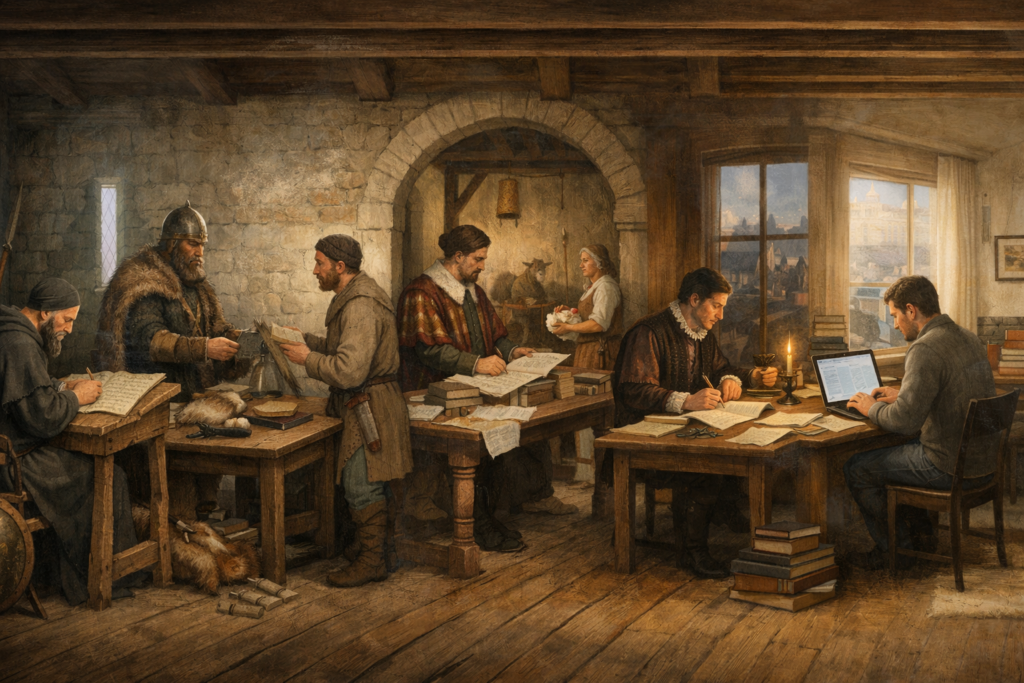
Illustration generated by author using ChatGPT.
Sources
Baugh, Albert C. and Thomas Cable. A History of the English Language (6th edition). Routledge, 2012. This remains the standard academic textbook on the subject and covers every period and influence discussed above.
Crystal, David. The Cambridge Encyclopedia of the English Language (3rd edition). Cambridge University Press, 2019. An accessible and richly illustrated reference covering the structure and history of English.
McCrum, Robert, Robert MacNeil, and William Cran. The Story of English (3rd revised edition). Penguin, 2003. A popular history that accompanied the PBS television series, excellent for general readers.
Mugglestone, Lynda (ed.). The Oxford History of English (2nd edition). Oxford University Press, 2012. A collection of essays by specialists covering English from its earliest origins to the present day.
Bede, The Venerable. Ecclesiastical History of the English People. Penguin Classics, 1990 (translated by Leo Sherley-Price). The primary early source on the Anglo-Saxon migrations.
Townend, Matthew. “Contacts and Conflicts: Latin, Norse, and French.” In The Oxford History of English, edited by Lynda Mugglestone, 2012. A detailed treatment of the major external influences on English.
Online resource: The British Library’s “Evolving English” exhibit materials are available at https://www.bl.uk/learning/langlit/evolvingenglish/
Online resource: Durkin, Philip. “Borrowed Words: A History of Loanwords in English.” Oxford University Press, 2014. Summary and excerpts available at https://global.oup.com/academic/product/borrowed-words-9780199574995
Leave a Reply