
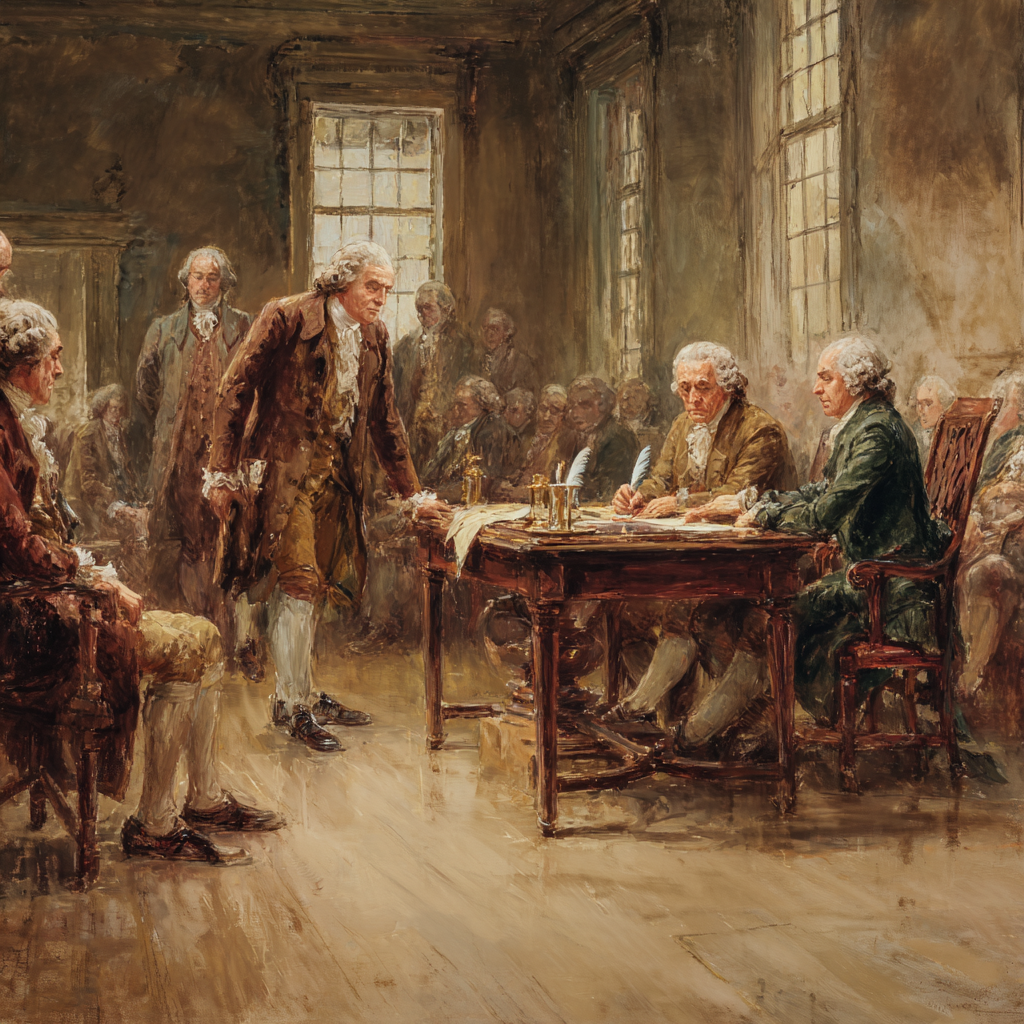
When fifty-five delegates gathered in Philadelphia during the sweltering summer of 1787, they faced a challenge that would haunt American politics for the next eight decades. The question wasn’t whether slavery was morally right—many delegates privately acknowledged its evil—but whether a unified nation could exist with slavery as a part of it. That summer, the institution of slavery nearly killed the Constitution before it was born.
The Battle Lines
The convention revealed a stark divide. On one side stood delegates who spoke forcefully against slavery, though they represented a minority voice. Gouverneur Morris of Pennsylvania delivered some of the most scathing condemnations, calling slavery a “nefarious institution” and “the curse of heaven on the states where it prevailed.” According to James Madison’s notes, Morris argued passionately that counting enslaved people for representation would mean that someone “who goes to the Coast of Africa, and in defiance of the most sacred laws of humanity tears away his fellow creatures from their dearest connections & damns them to the most cruel bondages, shall have more votes in a Government instituted for protection of the rights of mankind.”
Luther Martin of Maryland, himself a slaveholder, joined Morris in opposition. He declared the slave trade “inconsistent with the principles of the revolution and dishonorable to the American character.”. Even George Mason of Virginia, who owned over 200 enslaved people, denounced slavery at the convention, warning that “every master of slaves is born a petty tyrant” and that it would bring “the judgment of heaven on a country.”
The Southern Coalition
Facing these critics stood delegates from the Deep South—primarily South Carolina and Georgia—who made it abundantly clear that protecting slavery was non-negotiable. The South Carolina delegation was particularly unified and aggressive in defending the institution. All four of their delegates—John Rutledge, Charles Pinckney, Charles Cotesworth Pinckney, and Pierce Butler—owned slaves, and they spoke with one voice.
Charles Cotesworth Pinckney stated bluntly: “South Carolina and Georgia cannot do without slaves.” John Rutledge framed it even more starkly: “The true question at present is, whether the Southern States shall or shall not be parties to the Union.” The message was unmistakable—attempt to restrict slavery, and there would be no Constitution and perhaps no United States.
The Southern states didn’t just defend slavery; they threatened to walk out repeatedly. When debates over the slave trade heated up on August 22, delegates from North Carolina, South Carolina, and Georgia stated they would “never be such fools as to give up” their right to import enslaved Africans. These weren’t idle threats—they were credible enough to force compromise.
The Three-Fifths Compromise
The central flashpoint came over representation in Congress. The new Constitution would base representation on population, but should enslaved people count? Southern states wanted every enslaved person counted fully, which would dramatically increase their congressional power. Northern states argued that enslaved people—who had no rights and couldn’t vote—shouldn’t count at all.
The three-fifths ratio had actually been debated before. Back in 1783, Congress had considered using it to calculate state tax obligations under the Articles of Confederation, though that proposal failed. James Wilson of Pennsylvania resurrected the idea at the Constitutional Convention, suggesting that representation be based on the free population plus three-fifths of “all other persons”—the euphemism they used to avoid writing the word “slave” in the Constitution.
The compromise passed eight states to two. New Jersey and Delaware are generally identified as the states voting against the compromise, New Hampshire is not listed as taking part in the vote. Rhode Island did not send a delegation to the convention and by the time of the vote New York no longer had a functioning delegation.
Though the South ultimately accepted the compromise, it wasn’t what they wanted. Southern delegates had pushed to count enslaved people equally with free persons—but otherwise ignored on all issues of human rights. The three-fifths ratio was a reduction from their demands—a limitation on slave state power, though it still gave them substantial advantage. With about 93% of the nation’s enslaved population concentrated in just five southern states, this compromise increased the South’s congressional delegation by 42%.
James Madison later recognized the compromise’s significance. He wrote after the convention: “It seems now to be pretty well understood that the real difference of interests lies not between the large and small but between the northern and southern states. The institution of slavery and its consequences form the line of discrimination.”
Could the Constitution Have Happened Without It?
Here’s where I need to speculate, but I’m fairly confident in this assessment: no, the Constitution would not have been ratified without the three-fifths compromise and related concessions on slavery.
The evidence is overwhelming. South Carolina and Georgia delegates stated explicitly and repeatedly that they would not join any union that restricted slavery. Alexander Hamilton himself later acknowledged that “no union could possibly have been formed” without the three-fifths compromise. Even delegates who despised slavery, like Roger Sherman of Connecticut, argued it was “better to let the Southern States import slaves than to part with them.”
The convention negotiated three major slavery compromises, all linked. Beyond the three-fifths clause, they agreed Congress couldn’t ban the international slave trade until 1808, and they included the Fugitive Slave Clause requiring the return of escaped enslaved people even from free states. These deals were struck together on August 29, 1787, in what Madison’s notes reveal was a package negotiation between northern and southern delegates.
Without these compromises, the convention would likely have collapsed. The alternative wouldn’t have been a better Constitution—it would have been no Constitution at all, potentially leaving the thirteen states as separate nations or weak confederations. Whether that would have been preferable is a profound counterfactual question that historians still debate.
The Impact on Early American Politics
The three-fifths compromise didn’t just affect one document—it shaped American politics for decades. Its effects were immediate and substantial.
The most famous early example came in the presidential election of 1800. Thomas Jefferson defeated John Adams in what’s often called the “Revolution of 1800″—the first peaceful transfer of power between opposing political parties. But Jefferson’s victory owed directly to the three-fifths compromise. Virginia’s enslaved population gave the state extra electoral votes that proved decisive. Historian Garry Wills has speculated that without these additional slave-state votes, Jefferson would have lost. Pennsylvania had a free population 10% larger than Virginia’s, yet received 20% fewer electoral votes because Virginia’s numbers were inflated by the compromise.
The impact extended far beyond that single election. Research shows the three-fifths clause changed the outcome of over 55% of legislative votes in the Sixth Congress (1799-1801). (The additional southern representatives—about 18 more than their free population warranted—gave the South what became known as the “Slave Power” in Congress.
This power influenced major legislation throughout the antebellum period. The Indian Removal Act of 1830, which forcibly relocated Native Americans to open land for plantation agriculture, passed because of margins provided by these extra southern representatives. The Missouri Compromise, the Kansas-Nebraska Act, and numerous other slavery-related measures bore the fingerprints of this constitutional imbalance.
The compromise also affected Supreme Court appointments and federal patronage. Southern-dominated Congresses ensured pro-slavery justices and policies that protected the institution. The sectional tensions it created led directly to later compromises—the Missouri Compromise of 1820, the Compromise of 1850—each one a temporary bandage on a wound that wouldn’t heal.
By the 1850s, the artificial political power granted to slave states had become intolerable to many northerners. When Abraham Lincoln won the presidency in 1860 without carrying a single southern state, southern political leaders recognized they had lost control of the federal government. Senator Louis Wigfall of Texas complained that non-slaveholding states now controlled Congress and the Electoral College. Ten southern states seceded in large part because they believed the three-fifths compromise no longer protected their interests.
The Bitter Legacy
The framers consciously avoided using the words “slave” or “slavery” in the Constitution, recognizing it would “sully the document.” But the euphemisms fooled no one. They had built slavery into the structure of American government, trading moral principles for political union.
The Civil War finally resolved what the Constitutional Convention had delayed. The Thirteenth Amendment abolished slavery in 1865, but not until 1868 did the Fourteenth Amendment finally strike the three-fifths clause from the Constitution, requiring that representation be based on counting the “whole number of persons” in each state.
Was it worth it? That’s ultimately a question of values. The Constitution created a stronger national government that eventually abolished slavery, but it took 78 years and a war that killed over 600,000 Americans. As Thurgood Marshall noted on the Constitution’s bicentennial, the framers “consented to a document which laid a foundation for the tragic events which were to follow.”
The convention delegates knew what they were doing. They chose union over justice, pragmatism over principle. Whether that choice was necessary, wise, or moral remains one of the most contested questions in American history.
____________________________________________________
Sources
- https://www.battlefields.org/learn/articles/slavery-and-constitution
- https://en.wikipedia.org/wiki/Luther_Martin
- https://schistorynewsletter.substack.com/p/7-october-2024
- https://www.americanacorner.com/blog/constitutional-convention-slavery
- https://www.nps.gov/articles/000/constitutionalconvention-august22.htm
- https://en.wikipedia.org/wiki/Three-fifths_Compromise
- https://www.brennancenter.org/our-work/analysis-opinion/electoral-colleges-racist-origins
- https://www.gilderlehrman.org/history-resources/teaching-resource/historical-context-constitution-and-slavery
- https://www.nps.gov/articles/000/constitutionalconvention-august29.htm
- https://www.lwv.org/blog/three-fifths-compromise-and-electoral-college
- https://www.aaihs.org/a-compact-for-the-good-of-america-slavery-and-the-three-fifths-compromise-part-ii/










Study The Past If You Would Define The Future—Confucius
By John Turley
On December 26, 2025
In Commentary, History
I particularly like this quotation. It is similar to the more modern version: Those who don’t learn from the past are doomed to repeat it. However, I much prefer the former because it seems to be more in the form of advice or instruction. The latter seems to be more of a dire warning. Though I suspect, given the current state of the world, a dire warning is in order.
But regardless of whether it comes in the form of advice or warning, people today do not seem to heed the importance of studying the past. The knowledge of history in our country is woeful. The lack of emphasis on the teaching of history in general and specifically American history, is shameful. While it is tempting to blame it on the lack of interest on the part of the younger generation, I find people my own age also have little appreciation of the events that shaped our nation, the world and their lives. Without this understanding, how can we evaluate what is currently happening and understand what we must do to come together as a nation and as a world.
I have always found history to be a fascinating subject. Biographies and nonfiction historical books remain among my favorite reading. In college I always added one or two history courses every semester to raise my grade point average. Even in college I found it strange that many of my friends hated history courses and took only the minimum. At the time, I didn’t realize just how serious this lack of historical perspective was to become.
Several years ago I became aware of just how little historical knowledge most people had. At the time Jay Leno was still doing his late-night show and he had a segment called Jaywalking. During the segment he would ask people in the street questions that were somewhat esoteric and to which he could expect to get unusual and generally humorous answers. On one show, on the 4th of July, he asked people “From what country did the United States declare independence on the 4th of July?” and of course no one knew the answer.
My first thought was that he must have gone through dozens of people to find the four or five people who did not know the answer to his question. The next day at work, the 5th of July, I decided to ask several people, all of whom were college graduates, the same question. I got not one single correct answer. Although, one person at least realized “I think I should know this”. When I told my wife, a retired teacher, she wasn’t surprised. For a long time, she had been concerned about the lack of emphasis on social studies and the arts in school curriculums. I was becoming seriously concerned about the direction of education in our country.
A lot of people are probably thinking “So what, who really cares what a bunch of dead people did 200 years ago?” If we don’t know what they did and why they did it how can we understand its relevance today? We have no way to judge what actions may support the best interests of society and what might ultimately be detrimental.
Failure to learn from and understand the past results in a me-centric view of everything. If you fail to understand how things have developed, then you certainly cannot understand what the best course is to go forward. Attempting to judge all people and events of the past through your own personal prejudices leads only to continued and worsening conflict.
If you study the past you will see that there has never general agreement on anything. There were many disagreements, debates and even a civil war over differences of opinion. It helps us to understand that there are no perfect people who always do everything the right way and at the right time. It helps us to appreciate the good that people do while understanding the human weaknesses that led to the things that we consider faults today. In other words, we cannot expect anyone to be a 100% perfect person. They may have accomplished many good and meaningful things and those good and meaningful things should not be discarded because the person was also a human being with human flaws.
Understanding the past does not mean approving of everything that occurred but it also means not condemning everything that does not fit into twenty-first century mores. Only by recognizing this and seeing what led to the disasters of the past can we hope to avoid repetition of the worst aspects of our history. History teaches lessons in compromise, involvement and understanding. Failure to recognize that leads to strident argument and an unwillingness to cooperate with those who may differ in even the slightest way. Rather than creating the hoped-for perfect society, it simply leads to a new set of problems and a new group of grievances.
In sum, failure to study history is a failure to prepare for the future. We owe it to ourselves and future generations to understand where we came from and how we can best prepare our country and the world for them. They deserve nothing less than a full understanding of the past and a rational way forward.
This was my first post after I started my blog in 2021. I believe it is even more relevant now.