
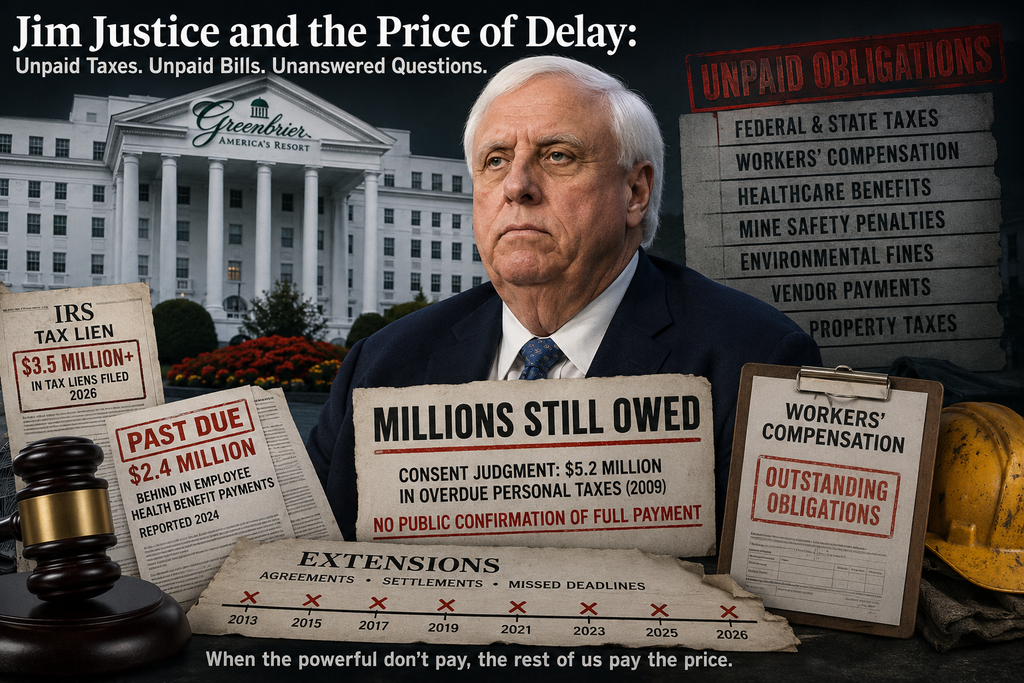
When Powerful Debtors Play by Different Rules
Jim Justice is one of West Virginia’s most recognizable public figures. He built his political identity on the language of business success, hometown loyalty, and plain common sense. As a coal operator, the longtime owner of the historic Greenbrier Resort, a two-term governor, and now a United States senator, he has cultivated a reputation as a successful entrepreneur and a folksy political leader.
For more than a decade, though, his business empire has also generated a striking number of lawsuits, tax liens, collection actions, environmental penalties, and disputes over unpaid bills. In August 2026, that long financial story reached what may be its most consequential chapter yet. Facing the threat of a court-ordered takeover, the Justice family agreed to hand majority ownership of The Greenbrier to an outside investment firm as part of a refinancing deal reported at figures ranging from roughly $380 million to $500 million, depending on which court filing or press account you read.
None of this is really in dispute anymore. The debts, the liens, and the lawsuits are documented in court records and government filings, not rumor. The more interesting question is why Jim Justice and his companies have so often been given additional time to make things right, while many ordinary citizens facing comparable debts experience much faster and harsher consequences.
It is worth saying up front that Justice’s financial troubles are one single debt. He and his family control dozens of separately incorporated businesses, so what looks from a distance like “Jim Justice’s debt” is really a long list of obligations owed by different companies to different creditors. Over the years these have included unpaid federal and state taxes, mine safety penalties, environmental fines, delinquent property taxes, unpaid vendor bills, employee health benefit contributions, workers’ compensation premiums, and very large commercial loans. Justice has typically responded by disputing how serious the debts really are, suggesting political motives behind the collection efforts, or arguing that the trouble was temporary and would eventually work itself out. Court filings and lien records, however, show a consistent pattern: creditors sue or file liens, and the amounts owed grow because of interest, penalties, and delay.
A Personal Tax Bill
One of the more personal episodes involved Justice and his wife directly. In late 2025, the U.S. Department of Justice sued the couple for roughly $5.2 million in unpaid federal income taxes, penalties, and interest tracing back to their 2009 return. The government’s complaint said that despite notice and demand, the Justices had not paid in full. On the very day the suit was filed, their attorney signed a consent judgment agreeing to pay the amount, and Chief U.S. District Judge Frank Volk approved it.
Justice has linked the dispute to an IRS audit that began under the Obama administration, describing it as politically motivated and tying it back to the complicated 2009 sale of Bluestone Coal to the Russian firm Mechel for roughly $436 million. Whatever the origin of the disagreement, it ended not with a courtroom fight over whether the money was owed, but with a signed agreement to pay it.
The Greenbrier’s Reckoning
By 2026, the biggest financial fight by far involved The Greenbrier itself. The Justice family bought the historic resort in 2009 and, for years, told the story of its rescue as one of the family’s signature achievements. That story came under real strain in 2026, when the resort became the focus of a legal and financial battle involving hundreds of millions of dollars.
The trouble came to public attention when White Sulphur Springs Holdings, an affiliate of Omni Hotels & Resorts’ parent company, TRT Holdings, acquired roughly $300 million in Greenbrier-related loan debt previously held by Carter Bank & Trust. That debt was secured by The Greenbrier and related properties. When the Justice family fell behind, the Omni affiliate went to federal court seeking a receiver — essentially, court-appointed control of the resort — arguing that the Justice companies had defaulted and had already failed to meet the terms of earlier forbearance agreements. The Justice family sharply disputed that characterization, accusing the Omni-linked company of trying to seize The Greenbrier outright rather than simply collect what it was owed.
The stakes could hardly have been higher. A receivership could have effectively ended the family’s control of the resort altogether. Once again, though, the Justices were given more time. Judge Volk paused the case for nearly two months in the spring of 2026 while the family worked to arrange new financing, and he later extended that deadline more than once as negotiations dragged on.
The proposed deal was with Kennedy Lewis Investment Management, a New York-based private credit firm founded in 2017 that manages more than $30 billion in assets and specializes in lending to companies working through financial disruption. The transaction, reported to be as high as $500 million, was meant to pay off the Greenbrier’s secured debt, address other liens, and fund capital improvements at the aging resort.
The closing date slipped repeatedly. An initial mid-July deadline came and went, with attorneys for the Omni-affiliated creditor telling the court they remained skeptical a deal would ever close. Judge Volk then granted the family until August 7 to finish the job, warning that the underlying takeover litigation would resume in full if they missed it again. As that deadline approached, the situation looked precarious enough that the family told the court it might have to temporarily shut down the resort’s casino (more on that below).
Then, on August 14, the deal finally closed.
Majority Control Changes Hands
What closed was not a simple refinancing. Under the structure described to West Virginia gaming regulators, Kennedy Lewis formed a new company that holds 51 percent ownership of The Greenbrier and controls three of five board seats. In practical terms, Kennedy Lewis becomes the majority controlling owner of the resort, while the Justice family keeps a meaningful minority stake and a voice on the board, but not the final word.
That distinction matters. The Justice family did not lose The Greenbrier to foreclosure or a court-appointed receiver, but it also did not emerge from the crisis with the same control it had exercised since buying the resort in 2009. Kennedy Lewis named veteran gaming and hospitality executive Lloyd Nathan as chairman of the new board, and the firm has said it plans long-term investment in the property.
Jill Justice, who previously ran day-to-day operations at the resort, publicly framed the arrangement as bringing in financial strength and expertise to protect the property’s future. Governor Patrick Morrisey — a Republican and a political rival of Justice’s — was quick to note on social media that Kennedy Lewis now holds majority ownership and controlling interest.
The closing also ended the receivership lawsuit brought by White Sulphur Springs Holdings, which was dismissed once the transaction went through. The Greenbrier stayed open throughout the transition, and existing reservations, conferences, weddings, and other events continued as scheduled.
More Tax Liens Piled Up Along the Way
The refinancing saga unfolded against a backdrop of still more tax trouble. In June 2026, the West Virginia State Tax Division disclosed roughly $4.4 million in state tax liens against Greenbrier Hotel Corporation, made up of about $3.9 million in consumer sales and use taxes and roughly $455,000 in state payroll-related taxes.
Federal liens followed close behind. In July, the IRS filed liens totaling about $3.5 million against Greenbrier-related properties, roughly $3.3 million tied to the hotel itself and another $290,000 tied to the Greenbrier Clinic. Attorneys for the Justice businesses said at the time that these liabilities would be resolved through the anticipated financing deal.
Then, on August 10, just days before the deal closed, the IRS recorded additional liens of more than $8 million against Greenbrier Hotel Corporation, plus roughly $827,000 against the Greenbrier Clinic. These were payroll tax liens — covering federal income tax withholding along with Social Security and Medicare taxes tied to employee paychecks. They are worth pausing on, because payroll taxes are not an ordinary corporate debt. This is money withheld from workers’ paychecks and owed to the government on their behalf. The hotel-related liens broke down to roughly $4.92 million for the tax period ending December 31, 2025, and another $3.08 million for the period ending March 31, 2026.
The Justice organization said the new Kennedy Lewis financing would provide the money to clear these obligations. As of the most recent public reporting available for this article, however, the closing of the deal should not be read, by itself, as proof that every one of these federal and state liens has actually been released. That will require separate confirmation from the taxing authorities once the paperwork catches up. This is a distinction that matters for anyone trying to track whether the debts are truly resolved or simply announced as satisfied.
The Casino That Almost Closed
The refinancing produced one more, oddly dramatic subplot, a last-minute fight over The Greenbrier’s casino. Because Kennedy Lewis was taking a controlling interest in the resort, West Virginia gaming regulators had to review the change in ownership before it could take effect. As the August 7 deadline bore down, attorneys for the Greenbrier told the court the family was prepared to temporarily close the casino rather than delay the total transaction any further. They cited daily carrying costs they put at roughly $145,000. Court filings indicated that a shutdown could have meant layoffs for around 90 casino employees.
That outcome was ultimately avoided. The West Virginia Lottery Commission determined the casino could keep operating while its review continued, so long as safeguards kept incoming board members walled off from casino operations. The casino stayed open, and the anticipated layoffs did not happen. Still, the episode is a useful reminder of how close The Greenbrier’s financial troubles came to producing real, immediate consequences for ordinary employees who had nothing to do with the underlying debts.
Debts Tied to Workers’ Benefits
Some of the more consequential unpaid bills across the entire Justice business empire have involved insurance meant to protect workers and retirees, rather than conventional taxes and government fines. Back in 2017, an insurer won an $850,000 default judgment in New York against Justice’s Southern Coal Corporation over unpaid workers’ compensation and liability premiums.
When federal marshals later went looking for company assets in West Virginia to satisfy the judgement, they reportedly found bank accounts that were empty or had been closed. A separate ProPublica investigation documented retired coal miners who said health coverage promised by Justice-linked companies lapsed after premiums went unpaid, with some retirees describing delayed medical care as a result.
More recently, an insurer sued in 2021 over roughly $166,000 in unpaid deductibles under a workers’ compensation policy, and in January 2026 a federal judge ordered Justice-controlled coal and coke companies to pay just over $1 million to a Liberty Mutual affiliate for unpaid workers’ compensation and employers’ liability premiums covering 2020 through 2022.
Greenbrier-related employee benefits have had their own troubles, too. In 2024, union officials reported that Greenbrier-related companies were roughly $2.4 million behind on payments to an employee health insurance fund. Because the Justice business empire is spread across so many separate corporations, there is no single public accounting that confirms every one of these employment-related obligations is now fully current.
A Long Mine Safety Record
The mine safety side of the story follows a similar arc. Between 2014 and 2019, federal inspectors issued thousands of citations to Justice-controlled coal operations, and a 2019 Department of Justice lawsuit followed after reporting showed the companies carried some of the largest delinquent mine-safety penalty balances in the country. A federal court approved a roughly $5 million settlement in 2020, to be paid through an initial installment followed by monthly payments. Court records then showed repeated missed deadlines, prompting government notices and further enforcement action. In August 2024, federal attorneys asked a court to hold the Justice coal companies in contempt for continuing to owe money under that settlement, and a 2025 agreement set new payment deadlines with the threat of daily contempt penalties if they were missed again.
This history matters because it shows the Greenbrier dispute is not an isolated event. It fits a pattern already visible across other parts of the Justice business empire.
Payment, Eventually — Usually Under Pressure
To be fair, it would be wrong to say Jim Justice or his companies simply never pay what they owe. They do, mostly. Tax liens have been satisfied. Creditors have been paid. Settlements have been reached. Regulatory penalties have eventually been resolved. It’s important to note that many of these debts have been negotiated to a much lower amount than the Justice companies initially owed.
Perhaps the fairer criticism is not that Justice never pays, but that his business history shows a recurring cycle: large obligations build up, litigation follows, deadlines get extended, new agreements get negotiated, those deadlines sometimes get missed too, and actual payment or restructuring tends to happen only after real legal pressure. The Greenbrier saga fits that pattern about as neatly as one could imagine.
Why Do Courts Keep Granting More Time?
This is the question that has trailed Justice’s financial disputes for years. Why do judges keep giving him and his companies additional chances? The answer has less to do with Justice personally than with how American civil litigation generally works. Judges tend to prefer repayment over economically destructive liquidation. When a debtor owns an operating business that employs hundreds of people, seizing or shutting it down immediately can destroy jobs, reduce the value of the underlying assets, and ultimately leave creditors with less money than they would get through an orderly refinancing or restructuring. Courts routinely give parties time to negotiate, refinance, and restructure when there is a realistic chance of being paid.
That principle played out clearly in the Greenbrier case. Judge Volk allowed the family additional time in part because the proposed Kennedy Lewis transaction looked concrete enough to justify waiting before reaching for the drastic remedy of receivership. The eventual closing arguably validated that call. The main creditor was satisfied without ever forcing The Greenbrier into court-ordered receivership. These legal principles, in theory, apply to everyone regardless of wealth or political standing. Whether access to them works out equally in practice is a separate question.
The Advantage That Wealth and Influence Buy
The sheer frequency with which Justice and his companies have secured additional opportunities has understandably generated public skepticism. Ordinary taxpayers who fall behind can quickly face tax liens, wage garnishment, bank levies, and foreclosure. Small businesses that miss tax or benefit payments often run into aggressive collection efforts. Homeowners who miss mortgage payments do not typically have access to teams of lawyers capable of negotiating a half-billion-dollar restructuring on their behalf.
Large corporations and wealthy individuals simply have options that most debtors do not: specialized attorneys, accountants, investment bankers, tax advisers, and restructuring experts who can challenge assessments, negotiate forbearance agreements, refinance assets, appeal judgments, and line up financing. The Greenbrier transaction clearly illustrates the point.
Facing the possibility of losing the resort to a receiver, the Justice family negotiated a deal approaching half a billion dollars with a major private investment firm — a deal that preserved a piece of the family’s ownership, kept the resort operating, protected hundreds of jobs, and apparently satisfied its principal secured creditor. That is a legitimate business solution. It is also one that would be entirely out of reach for most Americans facing unpaid debts of their own.
Is This Unequal Justice?
It is worth being careful here. There is no public evidence that judges improperly favored Jim Justice because of his wealth or political standing. Each extension can generally be explained under ordinary principles of civil procedure and commercial law, and the Greenbrier refinancing arguably shows why judges grant such extensions in the first place. Had the court moved immediately to receivership, the financing deal that ultimately kept the resort operating as a going concern might never have happened.
Even so, the cumulative pattern remains. When a debtor repeatedly misses deadlines and yet keeps getting fresh chances to refinance, restructure, settle, or renegotiate, it is reasonable for citizens to wonder whether the legal system functions differently for people with enormous financial and political resources than it does for the rest of us. The difference may not lie in the law itself so much as in who has the practical ability to use it. For the average West Virginian watching this play out, that may be the more important distinction. A sitting senator who represents ordinary taxpayers, while his businesses repeatedly face tax liens, unpaid employee-related obligations, regulatory penalties, and collection lawsuits, is bound to raise questions about fairness and accountability. Questions that a single successful refinancing does not resolve.
The August 2026 Greenbrier transaction does not erase that longer history. If anything, it offers an unusually revealing conclusion to one chapter of it. After months of litigation, a threatened receivership, millions of dollars in fresh tax liens, repeated court extensions, missed financing deadlines, and even the brief prospect of a shuttered casino, the Justice family avoided the forced loss of The Greenbrier. But keeping the resort required giving up something significant in return: majority control of perhaps the most prominent business asset carrying the Justice name.
Whether that outcome represents another example of a wealthy debtor enjoying opportunities unavailable to ordinary citizens, or simply the commercial legal system working as it is designed to, is a matter of interpretation, and reasonable people can land in different places. What is not really open to interpretation is the documented sequence of events. Debts accumulated, creditors went to court, deadlines were extended again and again, new liens kept appearing even as the refinancing was being negotiated, and a major restructuring eventually became unavoidable.
For many West Virginians, the lasting question about Jim Justice may be less about whether any particular debt eventually got paid, and more about whether a legal system that supposedly treats everyone alike hands out very different practical options to those with extraordinary wealth, valuable assets, political prominence, and access to sophisticated advisers. The Greenbrier survived its latest financial crisis, and the Justice family kept a stake in it — but for the first time since the family rescued the resort in 2009, someone else is now the one in control.
Illustration generated by author using ChatGPT.
References
Mike Tony, West Virginia GazetteMail. The articles by Mike Tony concerning Jim Justice’s multiple tax and financial difficulties are too numerous to individually list. His work has been both a source and an inspiration for this article.
Associated Press. “U.S. Sen. Jim Justice of West Virginia agrees to pay nearly $5.2 million in overdue personal taxes.” November 25, 2025. (AP News)
Associated Press. “Debt problems that dogged Sen. Jim Justice as West Virginia’s governor continue to nip at his heels.” 2025. (AP News)
West Virginia Public Broadcasting. “U.S. Sen. Jim Justice Agrees To Pay Nearly $5.2M In Overdue Personal Taxes.” November 25, 2025. (West Virginia Public Broadcasting)
West Virginia MetroNews. “IRS files $3.5 million in liens on Greenbrier properties.” July 3, 2026. (WV MetroNews)
West Virginia Press Association. “Greenbrier Hotel and Clinic struggles mount with IRS filing.” July 7, 2026. (West Virginia Press Association)
West Virginia Watch. “Late and unpaid bills are nothing new for Justice and his family businesses.” August 27, 2024. (West Virginia Watch)