
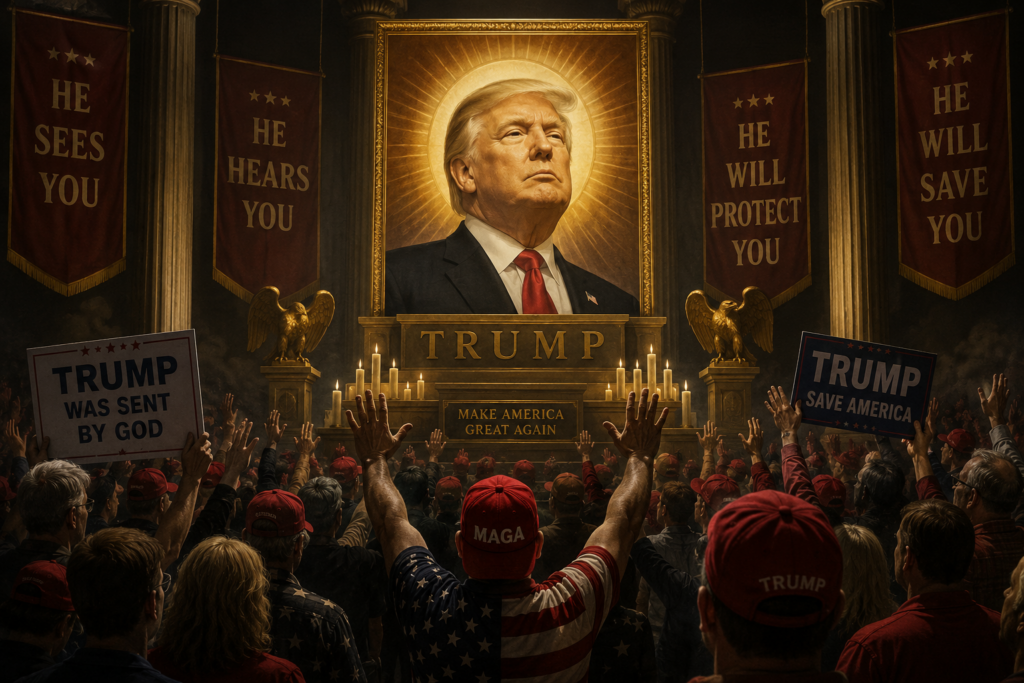
The word “cult” is often tossed around in American politics as little more than an insult. But dismissing it outright may obscure something real. When political scientists and psychologists begin applying the term with specificity—pointing to identifiable patterns of behavior and belief—it deserves more than a reflexive eye roll. The question is not whether “cult” is too strong a word for the MAGA movement. The question is whether the label, used carefully, helps explain what we are actually seeing.
Start with the basics. Psychiatrist Robert Jay Lifton’s early work on cults emphasized three elements: a charismatic leader, mechanisms for sustaining loyalty, and a degree of devotion that overrides independent judgment. More recently, Steven Hassan’s “BITE” model—Behavior, Information, Thought, and Emotional control—has attempted to map how high-control groups shape members’ reality. Critics are right to note that these frameworks can be stretched too far. Not every cohesive political movement is a cult. But when multiple criteria begin to align, the comparison becomes harder to dismiss.
Consider first the role of Donald Trump. Charismatic leadership, as Max Weber described it, is not mere popularity. It is authority rooted in personal magnetism so strong that followers treat the leader as a primary source of truth. Trump’s political durability rests precisely on this dynamic. His supporters routinely absorb claims—about elections, public health, or crime—that have been widely discredited, not by rejecting evidence outright but by reinterpreting his statements as strategic, symbolic, or justified. When factual accuracy becomes secondary to loyalty, something deeper than conventional partisanship is at work.
Equally telling is how dissent is handled. Political movements always enforce boundaries, but MAGA does so with unusual speed and severity. Figures once central to Trump’s orbit can be recast as enemies almost overnight for the crime of deviation. This is not simply hardball politics; it is a system of social discipline that rewards conformity and punishes independence. The effect is to narrow the range of acceptable thought until disagreement itself becomes suspect.
The movement’s identity reinforces this dynamic. Its symbols—hats, flags, slogans—and its tightly aligned media ecosystem create a sense of belonging that goes well beyond policy preferences. Again, that is not unique. But what is unusual is how consistently that identity orbits a single individual rather than a consistent set of ideas. Positions that were once staples of conservative ideology—on trade, foreign policy, even the role of government—have shifted as Trump’s own positions have shifted. That kind of ideological fluidity is less characteristic of a political program than of a personality-centered movement.
None of this settles the question definitively. There are good reasons many scholars resist the “cult” label. MAGA is not a secluded sect cut off from society; it is a mass political force with institutional power and millions of participants who live ordinary lives. Applying the term too loosely risks draining it of meaning. But rejecting it entirely risks ignoring the extent to which loyalty to an individual has, at times, eclipsed loyalty to institutions, principles, or even observable reality.
What is harder to dispute is the movement’s psychological core. MAGA is not primarily a policy agenda; it is an emotional alignment organized around grievance, distrust, and a sense of cultural dispossession that is channeled through a single dominant figure. Whether one calls that a cult or an extreme form of political tribalism may be, in the end, a matter of vocabulary. The underlying structure is what matters.
That brings us to the more consequential question: what happens when the figure at the center is gone. History offers three broad paths for movements built on charismatic authority: succession, fragmentation, or decline. Durable movements typically have two things MAGA lacks—a clear heir and a body of doctrine that can survive the founder. Trump has cultivated neither. His dominance depends on being singular.
There is, however, another possibility. After death, leaders of personality-driven movements often grow more powerful as symbols than they ever were as individuals. Freed from the constraints of real-time controversy, they become vessels for projection. In that sense, Trumpism could outlast Trump even if no successor can replicate his particular hold on the electorate.
The safest conclusion is also the least comforting. MAGA is not an aberration but a familiar pattern in American political life. From McCarthyism to the John Birch Society to the Tea Party, waves of populist, personality-driven politics have risen before, each fueled by similar currents of anxiety and resentment. They recede, but they do not disappear.
So the debate over whether MAGA is a “cult” risks missing the larger point. Labels matter less than patterns. And the pattern here is clear: a movement defined less by ideas than by allegiance, less by persuasion than by identity, and less by institutions than by one man. That combination is unlikely to vanish when Trump does. It will adapt, rebrand, and return. The only real uncertainty is in what form and how prepared we will be to recognize it.
Trump, MAGA, and the Politics of Permission
By John Turley
On July 18, 2026
In Commentary, Politics
Donald Trump did not invent a new American bigotry. He did something more subtle—and perhaps more consequential. He transformed long-standing resentments into a political identity and gave many people permission to express views they had previously kept private.
The central question surrounding the Make America Great Again movement is: has it created a new ethical worldview, or has it simply exposed attitudes that have long existed beneath the surface of American society? The answer is probably: both.
The resentments themselves are not new. Long before Trump entered politics, historians and political scientists documented the enduring influence of racial resentment, nativism, religious nationalism, and cultural anxiety. Many Americans believed their country was changing too quickly and that immigration, globalization, and shifting social norms threatened a way of life they once took for granted.
American history offers countless examples. Anti-immigrant movements flourished in the nineteenth century. Segregation and white supremacy were embedded in law for generations. George Wallace’s “law and order” campaigns, Pat Buchanan’s culture-war speeches, and the Tea Party’s reaction to Barack Obama’s presidency all reflected recurring fears that “real America” was slipping away.
Obama’s election encouraged hopes that the nation had entered a post-racial era, yet research continued to show that racial and cultural anxieties remained powerful undercurrents. Trump did not create those sentiments. He recognized them, embraced them, and gave them a simple narrative.
“Make America Great Again” is more than a campaign slogan. It tells a story of loss, restoration, and retribution. It suggests that something valuable has been taken away and that reclaiming it is both necessary and morally justified. For many supporters, it became less about policy than identity.
Trump’s most significant innovation was not ideological but cultural. Previous politicians often relied on coded language while preserving at least the appearance of restraint. Trump discarded those conventions. He mocked opponents, encouraged inflammatory chants, proposed banning Muslims from entering the country, and described immigrants as “poisoning the blood” of America. Many supporters interpreted this not as recklessness but as authenticity—a rejection of what they viewed as the constraints of political correctness.
That shift changed more than political rhetoric. It altered the boundaries of acceptable public behavior. Conduct once viewed as disqualifying became, for many supporters, evidence of courage and honesty. Loyalty increasingly outweighed character. Offending critics became proof that one was willing to stand up to elite opinion.
Political scientists describe this process as norm erosion. Laws remain the same, but the unwritten rules governing public life gradually weaken. Loyalty becomes more important than truth, institutions are trusted only when they favor one’s own side, and democratic restraints come to be seen as obstacles rather than safeguards.
Trump did not invent this dynamic. Populist movements throughout history have divided society into virtuous insiders and corrupt outsiders. His contribution was to make that style of politics a daily spectacle. Political conflict became a struggle between patriots and traitors, real Americans and dangerous enemies. Once politics is framed in existential terms, compromise becomes betrayal and restraint begins to look like weakness.
It would be inaccurate to say Trump created prejudice from nothing. A more persuasive argument is that he reduced the social cost of expressing it. Social norms matter because they define the boundaries of acceptable conduct. When prominent public figures use inflammatory language or repeat conspiracy theories without losing support from their followers, those boundaries inevitably shift.
Supporters who might once have hesitated can now dismiss criticism as media bias or political correctness. The line between prejudice and plain speaking becomes increasingly blurred.
This may prove to be Trump’s most enduring legacy. Even if his personal political influence fades, the standards governing public discourse may not return to where they once were. Future politicians can imitate the style—its confrontation, norm-breaking, and appeals to grievance—even if they reject parts of Trump’s agenda.
That is why the distinction between creating prejudice and legitimizing it matters. If Trump merely invented these impulses, defeating one political leader might solve the problem. But if he tapped into deeper currents already present in American society, then the challenge extends far beyond one election.
Trump is best understood as both symptom and accelerant. He gave shape to existing resentments, transformed them into a powerful political identity, and lowered the barriers against openly expressing them. The prejudices themselves were not new. The confidence with which they could be publicly displayed—and sometimes celebrated—was.
Whether that change proves temporary or enduring may become one of the defining questions facing American democracy.