
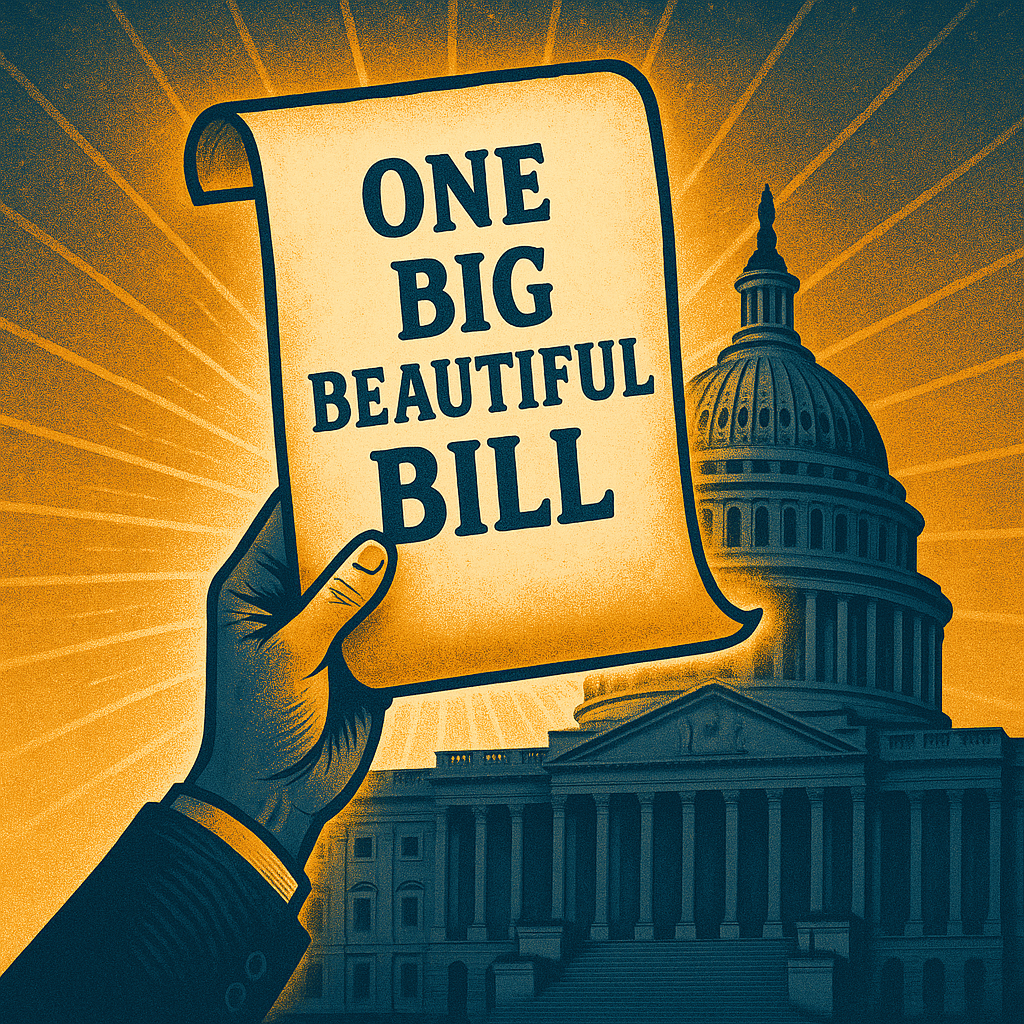
In late May 2025, the U.S. House of Representatives narrowly passed a massive legislative package called the “One Big Beautiful Bill Act.” Touted by President Donald Trump and Republican leaders as a sweeping reform of tax policy, federal spending, and government regulation, the bill is now at the center of heated debate—not just over its fiscal and policy impacts, but also over its implications for the balance of power among the branches of government.
What the Bill Does—and Doesn’t Do
The “Big Beautiful Bill” is a reconciliation bill, meaning it can bypass the Senate’s usual 60-vote threshold and be passed with a simple majority. This process is designed to fast-track budgetary and tax legislation, but it also means the bill can only address certain policy areas directly related to the federal budget. At its core, the bill delivers major tax cuts, extends the Trump-era tax reductions, and makes permanent changes, principally reductions, to mandatory spending programs. It also includes provisions on agriculture, immigration, Medicaid, and technology, among other areas. The bill is viewed by critics as favoring the wealthy to the detriment of the poor.
Despite claims on social media, the bill does not give the president the power to delay or cancel elections. Multiple fact-checkers and legal experts have confirmed that such authority would violate the Constitution, which assigns election timing to Congress and state legislatures. The bill’s focus is on fiscal and regulatory reforms, not election administration.
While the bill ostensibly comes from Congress, it actually weakens Congress’s own institutional role in the separation of powers by removing one of the key mechanisms used by the judicial branch to enforce constitutional limits on executive power. If passed, this will be an unmitigated disaster for the Constitution and the country.
Democratic Representative Jamie Raskin called it an unprecedented power grab: “Instead of providing support for the judicial branch, this Judiciary Committee bill seeks to strip the courts of their power to hold the administration in contempt when the President violates court orders”.
The Hidden Provision: Section 70302
Buried within the bill’s 1,000-plus pages is a provision—Section 70302—that has drawn sharp criticism from legal scholars, civil rights groups, and even some lawmakers. The bill is not available for public examination, but it has been reported by the international news service Reuters that this section states that no federal court may use appropriated funds to enforce a contempt citation for failure to comply with an injunction or temporary restraining order unless the plaintiff posted a security bond when the order was issued.
Surety bonds are intended to protect the defendant in civil suits from incurring financial loss associated with legal expenses occurring from defending against frivolous or wrongful lawsuits. If the ruling is in favor of the defendant, the plaintiff must surrender the bond to cover the expenses of the defendant. For example, if I sue you for slander, I may have to post a cash bond and if the judge rules against me, the bond will be forfeited to cover your legal fees. If I win, the bond will be returned to me.
Historically, courts have often waived the bond requirement, especially when plaintiffs challenge government actions as unconstitutional. The rationale is that requiring a bond would make it prohibitively expensive for individuals or groups to seek judicial relief against unlawful government conduct. Section 70302 would change this, making it much harder for courts to enforce their rulings against the executive branch or other government actors unless the plaintiff can afford to post a bond. If this passes, it is conceivable that the administration may attempt to impose bonds of $1 million or more—effectively eliminating the ability of citizens to challenge government actions.
Why is It Important?
The federal judiciary is one of the three pillars of our constitutional government, and it plays a vital role in the balance of powers. It serves as an independent check on the executive and legislative branches, interpreting laws, resolving disputes, and safeguarding constitutional rights. Since Marbury v. Madison (1803), the judiciary has claimed the authority to strike down laws or executive actions that violate the Constitution. This power of judicial review is foundational to the principle of checks and balances. The proposed legislation seeks to shift that balance. Among its most concerning provisions are efforts to limit judicial oversight of executive actions.
How This Shifts Power to the Executive
The practical effect of Section 70302 is to limit the judiciary’s ability to hold the executive branch accountable for violating court orders. If a judge issues an injunction to stop an unconstitutional or illegal government action, but no bond was posted when the injunction was granted, the court would be barred from using its contempt power to enforce compliance.
This provision applies retroactively, meaning it would render thousands of existing court orders unenforceable overnight. Critics argue that this creates a “catch me if you can” system, where the government can violate constitutional rights faster than courts can stop them. Legal experts warn that this undermines the rule of law and the separation of powers, which depend on the ability of courts to check executive overreach.
While the bill does not explicitly allow the executive branch to completely bypass legal challenges, it makes it much harder for courts to compel the executive to comply with their rulings. This functionally increases the executive’s authority to resist or delay judicial oversight.
Current Status of the Bill
As of early June 2025, the “One Big Beautiful Bill” has passed the House by a razor-thin margin (215-214) and is now before the Senate where Majority Leader John Thune has expressed hope that the bill could reach President Trump’s desk by the July 4 holiday, but the path forward is far from certain.
The Senate is expected to make significant modifications to the House version, and some provisions—including Section 70302—could be stripped out or revised. The reconciliation process limits what can be included in the final bill, and the Senate Parliamentarian may rule that certain provisions are not eligible for inclusion.
Why This Matters
The “One Big Beautiful Bill” is not just about taxes and spending. It represents a bold attempt to reshape the relationship between the executive and judicial branches. By limiting courts’ ability to enforce their rulings, the bill tilts the balance of power toward the executive, making it easier for the president and his administration to ignore or delay compliance with court orders.
Critics argue that this threatens the rule of law and the constitutional system of checks and balances. Supporters, however, see it as a way to prevent frivolous lawsuits and give the executive more flexibility to implement its agenda and to move closer to the unitary executive theory.
Looking Ahead
As the Senate debates the bill, watch for the fate of Section 70302. The outcome will have lasting implications for the balance of power in Washington and for the ability of courts to hold the government accountable.
For now, the “One Big Beautiful Bill” remains a work in progress. Its final form—and its impact on American governance—will depend on the compromises and changes made in the Senate over the coming weeks.
Accountability or Restoration? The Dilemma Facing Democrats
By John Turley
On November 10, 2026
In Commentary, Politics
It is tempting to imagine Donald Trump, his sons, and the rest of his administration standing in the dock answering criminal charges. It would be satisfying, but a waste of time, considering the amount of work needed to repair the damage that he has done to this country. I’m not saying that they shouldn’t be held responsible; I’m saying that repair and restoration should come before revenge.
I know some of you are thinking “It’s not revenge, it’s justice.” I agree that justice needs to be done, but it should be deliberate, fact-based justice, not the weaponized justice of the Trump administration. More importantly, it should not detract from the important work of rebuilding public faith in our government and restoring important programs that have been destroyed.
The Democrats message should be first that they’re going to make the government work for the people again and that they will provide remedies where the law allows. At the same time, they must assure the public that where there is credible evidence of wrongdoing there will be a proper and independent investigation. They must state that no one gets immunity because they are powerful or wealthy and likewise that no one loses their constitutional rights because they are unpopular.
The guiding principle should be that they will not sacrifice justice for the appearance of reconciliation and will not sacrifice the public’s welfare for the satisfaction of punishment. They will repair injuries, establish responsibility in a fair manner, and make it harder for anyone else to abuse government powers.
We must also hold the members of the Trump administration accountable to send a message to future political leaders that such behavior is not tolerable. It is important to recognize the difference between illegal behavior and bad policy. The Congress should concentrate on repairing bad policy but should at the same time put in place the procedures for punishing crimes. Special prosecutors and revived inspectors general would be the most reasonable method of pursuing the legal avenues.
Convening impeachment hearings might be an appealing undertaking. but in the long run it will be unsuccessful in removing Donald Trump from office and will detract from the important work of reversing the damage he has done. Since there’s little likelihood a finding 67 senators who will vote for conviction, it would simply be a “feel good” activity.
It may seem simple to distinguish criminal conduct from bad policy decisions. But it’s not as straightforward as it seems. Illegal and harmful are not simply interchangeable ideas.
Bribery, obstruction of justice, and corruption obviously require criminal investigation. It will not be possible to investigate everything at once. Congress should prioritize criminal investigations based on the seriousness of the harm done to the public not on what would make the biggest splash on the 6:00 news.
Abuses of government authority may violate constitutional or administrative law while not resulting in any individual criminal liability. There are also actions that may be harmful, discriminatory, economically damaging, or contrary to traditional activity but still are not unlawful. Pursuing a criminal indictment against behavior that is not clearly unlawful runs the risk of tainting the entire investigative process, ultimately accomplishing little, and emboldening future bad actors with the idea if they can “get away with it”.
It is important at the beginning to establish that officials who have violated criminal statutes cannot claim immunity from prosecution simply because they were pursuing political objectives or operating under the orders of government officials. We need to strongly invalidate the “I was only following orders” defense.
I won’t attempt to list the number of things that Congress needs to undertake to repair all the damage that’s been done to this country. Many of the political and institutional problems exposed during the Trump administration are not necessarily new. There have been longstanding tensions between presidential authority over federal bureaucracy and immigration policy and the role of congressional oversight. We’ve also seen increasing politicization of judicial review and law enforcement.
But I believe one thing is important: we must not only repair the damage that’s been done but we must perform an analysis of how a single administration was able to undermine years of government procedure and policy so that we can ensure that safeguards are in place to prevent it from ever happening again.
Congress should pursue a two-track program running in unison to examine both personal accountability and systemic reform. Congress needs to be careful not to make promises beyond their ability to deliver. The Democrats do not have a veto proof majority and attempting to reach beyond what they can expect to accomplish may undermine their entire program.
This is not about one president or one administration, and it is not an either-or choice. We need to do both. If done properly, we could emerge with an even stronger constitutional system with stronger checks and balances and a greater ability to serve the public.