
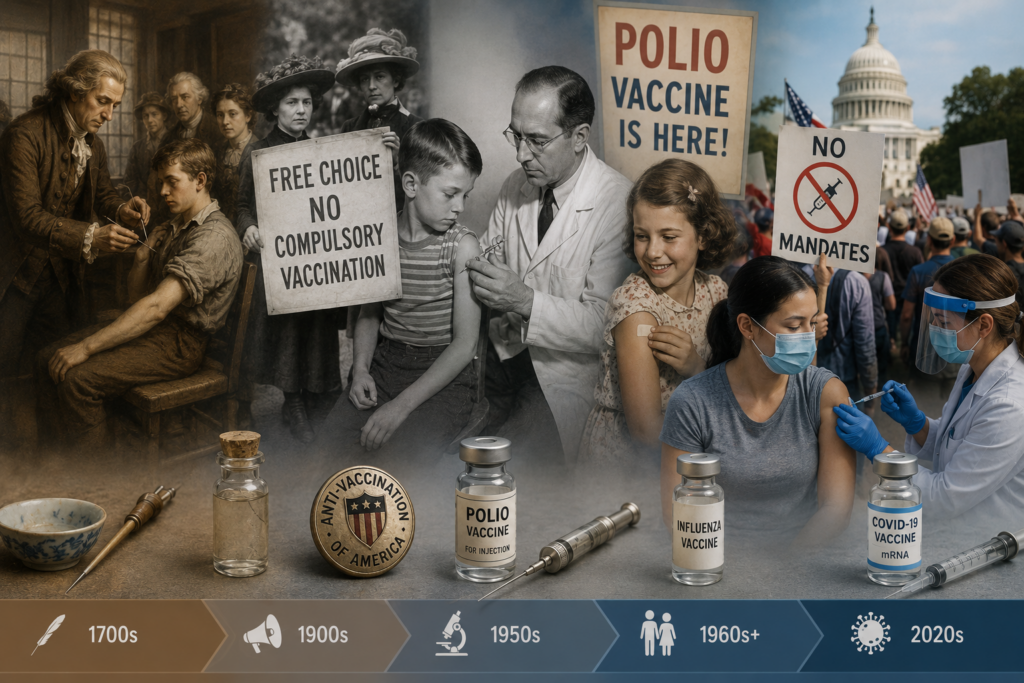
Every vaccine the United States has ever rolled out has arrived with a shadow twin: a countermovement insisting the shot poses more danger than the disease it prevents, or that no government has the right to demand it. That pattern predates the country itself, and it has recurred with almost eerie consistency across three centuries — from the smallpox pustules of colonial Boston to the mRNA vials of 2021.
Colonial Boston and Smallpox
The story usually begins in Boston in 1721, during the sixth smallpox epidemic to strike the city since its founding. A ship called the Seahorse arrived from the Caribbean that April carrying a sailor with active smallpox, and within weeks the disease was moving through a city of roughly 11,000 people. By the time the epidemic burned out the following year, more than 6,000 Bostonians had been infected and about 850 had died.
The remedy that split the town in two was not vaccination in the modern sense but variolation, or inoculation — deliberately introducing live smallpox matter into a small cut in the skin, on the theory that a controlled, minor case would produce immunity without the risk of the full-blown disease. The technique had circulated for generations across West Africa, the Ottoman Empire, and Asia, and it reached Boston through the injustice of slavery. The Puritan minister Cotton Mather learned of it from Onesimus, a man he held in bondage, who described having undergone the procedure himself in Africa. Mather corroborated the account with other enslaved Africans in Boston and read reports out of Constantinople before becoming inoculation’s loudest champion.
Physician Zabdiel Boylston put the idea into practice, inoculating his own son and two enslaved members of his household first, then expanding the program despite fierce opposition. The city’s medical establishment largely revolted. Dr. William Douglass, one of the few Bostonians who actually held a medical degree, led the case against inoculation on grounds that ranged from the religious objection, that deliberately spreading disease usurped divine providence, to a reasonable-for-the-time scientific worry that the practice itself was seeding new outbreaks. The argument did not stay academic. Someone threw a lit grenade through Mather’s window that November, with a note attached reading, in essence, that he could inoculate himself with the bomb. It failed to detonate.
The case against inoculation was never purely religious or clinical; it was tangled up with its origin. Opposition writers repeatedly invoked its African and Ottoman source as grounds for distrust, treating its foreign, non-Christian lineage as evidence of danger apart from any medical argument. One Boston pamphleteer asked why residents should “cherish the cruel Blood of Africa or Asia” in their bodies, and a London critic writing a decade later dismissed inoculation as a “barbarous and dangerous Invention” imported from Turkey that had wrought “Havock and Slaughter” once it took hold. Because the technique reached Boston through Onesimus, the racial dimension of the debate was impossible to separate from the medical one — critics were rejecting a treatment in part because of who had brought it, not because of what it did.
What makes 1721 more than a historical curiosity is that Boylston and his allies did something close to a clinical study. They tallied outcomes among the inoculated against outcomes among those who caught smallpox naturally, and the inoculated group fared markedly better. That comparison helped slowly tip opinion in inoculation’s favor over the following decades. By the time George Washington ordered mandatory inoculation of the Continental Army in 1777, the practice — though still controversial — had become an accepted tool of public health.
The Gilded Age Leagues: Liberty, Quackery, and the Courts
Edward Jenner’s cowpox vaccine, introduced in 1796, eventually replaced variolation as the standard smallpox prevention. As vaccination spread across the Atlantic world through the nineteenth century, so did organized resistance. Britain passed an 1853 law making infant vaccination compulsory, and an 1867 act extended the mandate to age fourteen with real penalties attached for refusal. Britons who objected on religious, medical, or libertarian grounds organized the Anti-Vaccination League and, in 1867, the Anti-Compulsory Vaccination League, and within a few years it claimed over a hundred branches and roughly 10,000 members.
The British campaigner William Tebb carried that movement across the Atlantic. Following Tebb’s visit, Americans opposed to compulsory vaccination founded the Anti-Vaccination Society of America in 1879, and the New England Anti-Compulsory Vaccination League followed in 1882. These organizations drew on a mix of motives that will sound familiar to a modern reader: a libertarian objection to state intrusion into personal and parental decisions, religious conviction that disease and its prevention were matters for providence, and — more cynically — the financial interests of the era’s patent-medicine sellers and homeopaths, whose loosely regulated business model was directly threatened by a state-endorsed, evidence-based alternative.
The movement’s grievances were not entirely invented. In 1901, contaminated diphtheria antitoxin killed thirteen children in St. Louis, and contaminated smallpox vaccine killed several more in Camden, New Jersey, in the same year. Congress responded with the Biologics Control Act of 1902, the first federal law requiring licensure and safety standards for vaccine manufacturers — an early ancestor of the FDA’s modern oversight role. Those tragedies, however, did not settle the legal question of whether a state could force the issue. That came in 1905, when the Supreme Court decided Jacobson v. Massachusetts, upholding a Cambridge ordinance that fined residents who refused smallpox vaccination during an outbreak. The Court held that individual liberty was not absolute and could yield to a state’s power to protect public health — the first Supreme Court ruling on the subject, and one still cited today in disputes over compulsory vaccination and other public health mandates.
The ruling galvanized rather than pacified the opposition. Three years later, in 1908, opponents founded the Anti-Vaccination League of America in Philadelphia, built on the principle — in the League’s own words — that health was nature’s greatest safeguard against disease and that no state had the right to demand its impairment. It had the stated goal of abolishing what it called oppressive medical laws. Charles Higgins, one of the League’s most prolific pamphleteers, published tracts like his 1912 broadside “Open Your Eyes Wide!” arguing that vaccination was both dangerous and a violation of fundamental freedom. When Texas tried to require vaccination for public school attendance, the League’s arguments resurfaced in Zucht v. King, a 1922 case in which the Supreme Court again sided with the state.
Polio and The Vaccine Disasters of the 20th Century
By the mid-twentieth century, American vaccine skepticism had a new source of fuel, manufacturing failures serious enough to validate the movement’s oldest fear, that the shot itself might cause the disease. On April 12, 1955, officials announced that Jonas Salk’s inactivated polio vaccine, tested in a trial of 1.8 million children, was safe and effective, and the federal government licensed five manufacturers within days to begin mass production. One of them, Cutter Laboratories of Berkeley, California, shipped batches in which the virus-inactivation process had failed, leaving live, virulent polio virus in vaccine given to roughly 200,000 children across five states. An estimated 40,000 developed abortive polio, 200 were left with some degree of paralysis, and at least ten died. The program was suspended within weeks, federal oversight of vaccine manufacturing was overhauled, and vaccination resumed that fall under tighter controls.
The Cutter Incident became a formative episode in the history of American vaccine regulation and it had a lasting effect: a generation of parents who had watched the worst-case scenario for the trustworthiness of vaccines play out on the evening news, and that memory did not fade quickly.
Two decades later, a different kind of failure struck the flu vaccine. In early 1976, an Army recruit at Fort Dix, New Jersey, died of an influenza strain resembling the one responsible for the catastrophic 1918 pandemic. Fearing a repeat, the Ford administration pushed Congress to fund a crash national vaccination campaign, and nearly 43 million Americans were vaccinated within about ten weeks — an extraordinary logistical feat. The anticipated pandemic never arrived. Worse, as vaccinations proceeded, epidemiologists began detecting a modest but real increase in Guillain-Barré syndrome, a rare autoimmune paralytic condition, among recipients — roughly one additional case per 100,000 doses by later estimates. The program was suspended in December 1976, the CDC director was fired on live television, and the New York Times dubbed the whole affair a “fiasco,” a label that stuck for decades.
The Flu Shot’s Persistent Image Problem
Unlike smallpox or polio vaccination, the annual flu shot has never fully shaken a reputation for being optional, unpleasant, and only modestly effective in any given year. This is largely because the vaccine’s composition is re-engineered annually against strains predicted months in advance. That combination of a recurring injections, a variable and sometimes underwhelming efficacy rate, and the folk memory of 1976 has kept flu vaccination rates well below public health targets in most seasons, hovering in recent years around half of American adults, with substantial swings by age, region, and political affiliation. There is still the belief among some groups that the vaccine itself can cause flu even though flu vaccines do not contain live virus and cannot cause the disease.
COVID-19: An Old Argument at Unprecedented Speed
The COVID-19 pandemic compressed a century of vaccine controversy into about eighteen months. The mRNA vaccines developed by Pfizer-BioNTech and Moderna, along with a viral-vector vaccine from Johnson & Johnson, received emergency authorization by early 2021 after a development timeline that was, by historical standards, astonishingly fast. It was a point public health officials framed as a triumph of scientific investment and one that vaccine skeptics framed as a reason for caution. By September 2021, about 62 percent of Americans age twelve and older had received at least one dose, but demand had already begun slowing well before the country approached anything like universal coverage.
What followed diverged from earlier vaccine controversies in one important respect, hesitancy did not fade as more safety data accumulated, and in some respects it hardened. One national longitudinal study found that COVID-19 vaccine refusal actually rose from about 41 percent of adults in 2021 to nearly 45 percent in 2022. Even as overall vaccination coverage climbed, belief in the vaccine’s broader social benefit fell sharply, from roughly 48 percent to 25 percent. Parental hesitancy about vaccinating children against COVID-19 rose by nearly 16 percentage points in just nine months of 2021 and 2022, notably concentrated among white and rural parents, a pattern that cut against the demographic profile of vaccine resistance in earlier eras of American history. By the 2025–26 respiratory virus season, CDC surveillance found that only about 16 percent of American adults had received that season’s COVID-19 vaccine, with somewhat higher uptake — about 31 percent — among adults sixty-five and older, who face the greatest risk from the disease.
COVID-19 did not create vaccine skepticism, but it sharply politicized and enlarged the anti-vaccine movement by tying vaccination to partisan identity, distrust of government and public-health institutions, and debates over mandates, individual liberty, and pandemic restrictions. Political leaders, partisan media, and online networks often framed vaccination less as a medical decision grounded in evidence than as a symbol of cultural allegiance or resistance to perceived government overreach. Anti-vaccine activists used that environment to spread misinformation and reach audiences far beyond earlier disputes over childhood immunizations. The result was a more organized “health freedom” politics in which skepticism about COVID-19 vaccines could spill over into opposition to other routine vaccines, making public health a continuing front in America’s broader political polarization.
The pandemic-era pattern echoes several of its historical predecessors at once: distrust of a fast-moving federal program (echoing 1976), suspicion of a technology many found unfamiliar and difficult to evaluate (echoing the original inoculation debates of 1721), and a fusion of libertarian and religious objection to government mandates (echoing the Anti-Vaccination League of America a century earlier).
A Recurring American Argument
Over the last 50 years, advocacy groups have questioned the growing number of childhood vaccines and raised concerns about vaccine ingredients, scheduling, and possible long-term effects. The movement gained momentum after publication in 1998 of a now-retracted paper by Andrew Wakefield that falsely suggested a link between the measles-mumps-rubella (MMR) vaccine and autism. Numerous large studies subsequently found no evidence supporting such a connection, and investigations revealed ethical violations and scientific misconduct in Wakefield’s work, but the damage was done and the foundation was laid for the modern anti vaccination movement.
Read across three centuries, American vaccine resistance is not one continuous movement so much as the same underlying argument recurring in new costumes. It is a tension between collective protection and individual or parental autonomy, sharpened at each turn by episodes — some tragic and real, like Cutter and the 1976 swine flu campaign, some largely fabricated, like William Tebb’s invented nineteenth-century casualty statistics — that gave skeptics evidence, or the appearance of it, to point to. The debate has never been resolved so much as relitigated, generation after generation, against whatever the era’s most feared disease happens to be.
Disclaimer: The author writes independently. The views expressed here are his own and are not made on behalf of, and should not be attributed to, any hospital, university, or other institution with which he is affiliated. This article is a work of historical journalism, not medical advice.
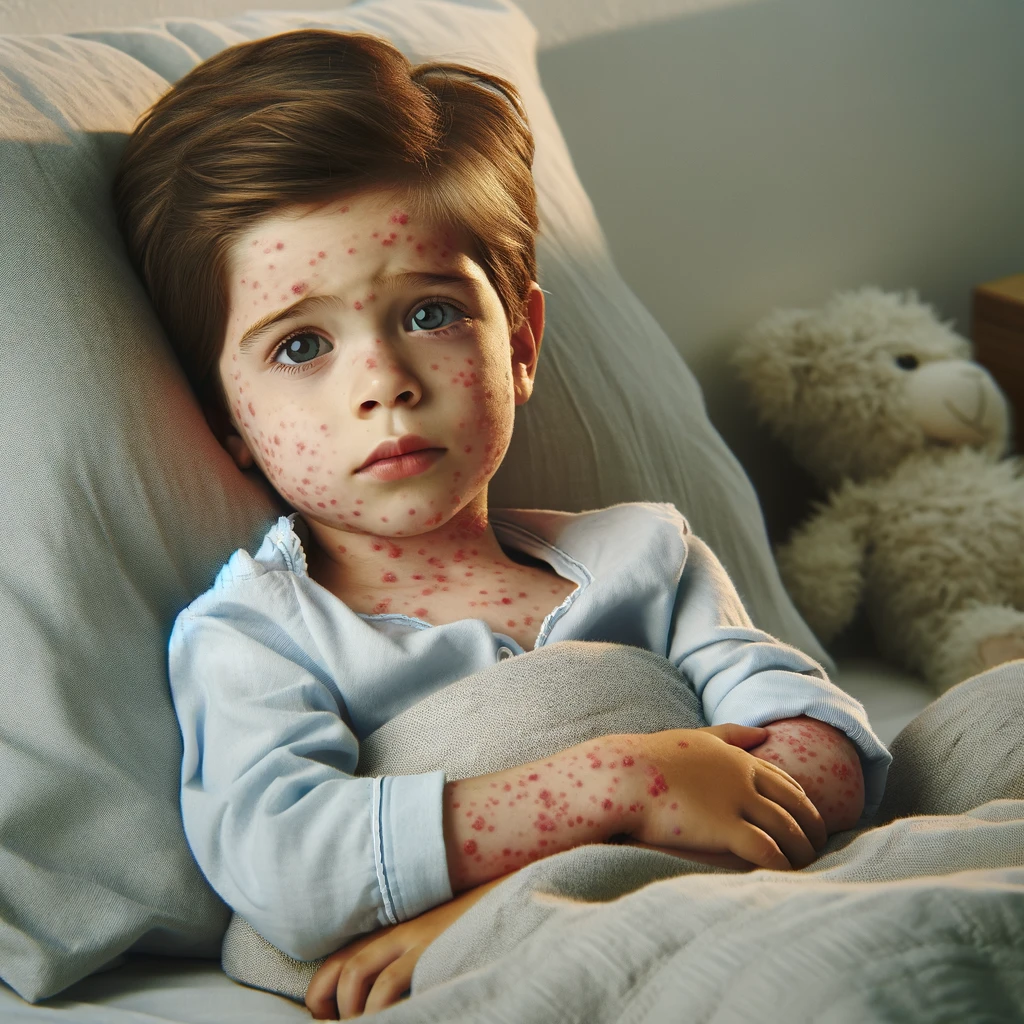
Image generated by the author using ChatGPT.
Sources
1. The Fight Over Inoculation During the 1721 Boston Smallpox Epidemic, Harvard SITN. https://sites.harvard.edu/sitn/2014/12/31/the-fight-over-inoculation-during-the-1721-boston-smallpox-epidemic
2. Benjamin Franklin’s fight against a deadly virus, The Conversation. https://theconversation.com/benjamin-franklins-fight-against-a-deadly-virus-colonial-america-was-divided-over-smallpox-inoculation-but-he-championed-science-to-skeptics-161569
3. A “Doubtful and Dangerous Practice”: The 1721 Boston Inoculation Controversy, Readex Report. https://www.readex.com/readex-report/issues/volume-10-issue-1/doubtful-and-dangerous-practice-1721-boston-inoculation
4. The 200-year history of the anti-vaxxer movement, Newsweek. https://www.newsweek.com/history-anti-vaxxers-vaccination-1358403
5. National Anti-Vaccination League, Wikipedia. https://en.wikipedia.org/wiki/National_Anti-Vaccination_League
6. History of Anti-Vaccination Movements, History of Vaccines (College of Physicians of Philadelphia). https://historyofvaccines.org/vaccines-101/misconceptions-about-vaccines/history-anti-vaccination-movements/
7. Anti-Vaccination Society of America, Wikipedia. https://en.wikipedia.org/wiki/Anti-Vaccination_Society_of_America
8. Anti-vaccination in America, National Museum of American History (Smithsonian). https://americanhistory.si.edu/explore/stories/anti-vaccination-america
9. Anti-vaccination in America, National Museum of American History (Smithsonian). https://americanhistory.si.edu/explore/stories/anti-vaccination-america
10. On this day, the Supreme Court rules on vaccines and public health, National Constitution Center. https://constitutioncenter.org/blog/on-this-day-the-supreme-court-rules-on-vaccines-and-public-health
11. Freedom, Rights, and Vaccine Refusal: The History of an Idea, PubMed / American Journal of Public Health. https://pubmed.ncbi.nlm.nih.gov/35080944/
12. Historical Vaccine Concerns, CDC. https://www.cdc.gov/vaccine-safety/historical-concerns/index.html
13. The Cutter Incident, Polio Network (citing CDC). https://polionetwork.org/archive/adig3shiiagcds4x1igpvp9u3istoo
14. The Cutter Incident, 50 Years Later, New England Journal of Medicine. https://www.nejm.org/doi/abs/10.1056/nejmp048180
15. 1976 Swine Flu Vaccination Program, David J. Sencer CDC Museum. https://www.cdc.gov/museum/online/story-of-cdc/h1n1/index.html
16. Reflections on the 1976 Swine Flu Vaccination Program, Emerging Infectious Diseases (CDC). https://wwwnc.cdc.gov/eid/article/12/1/05-1007_article
17. Biology:1976 swine flu outbreak, HandWiki (summarizing CDC and contemporary reporting). https://handwiki.org/wiki/Biology:1976_swine_flu_outbreak
18. The Long Shadow of the 1976 Swine Flu Vaccine ‘Fiasco,’ Smithsonian Magazine. https://www.smithsonianmag.com/smart-news/long-shadow-1976-swine-flu-vaccine-fiasco-180961994/
19. Swine Flu Immunization Program of 1976, Gerald R. Ford Presidential Library. https://www.fordlibrarymuseum.gov/digital-research-room/topic-guides/swine-flu-immunization-program-1976
20. Determinants and trends of COVID-19 vaccine hesitancy and vaccine uptake in a national cohort of U.S. adults, medRxiv. https://www.medrxiv.org/content/10.1101/2021.05.12.21257116.full.pdf
21. Changes in general and COVID-19 vaccine hesitancy among U.S. adults from 2021 to 2022, PMC. https://www.ncbi.nlm.nih.gov/pmc/articles/PMC11141308/
22. Sociodemographic Trends and Correlation between Parental Hesitancy towards Pediatric COVID-19 Vaccines and Routine Childhood Immunizations, PMC. https://www.ncbi.nlm.nih.gov/pmc/articles/PMC11126092/
23. Vaccination Uptake, Intent, and Confidence, RespVaxView, CDC. https://www.cdc.gov/respvaxview/dashboards/vaccination-behavioral-social-drivers.html


The Correlation Mirage: How Good Intentions Go Wrong in Health Debates
By John Turley
On December 8, 2025
In Commentary, Medicine
Understanding the Basics
Here’s the fundamental problem: just because two things happen together doesn’t mean one caused the other. When we say two variables are “correlated,” we’re simply observing that they move in tandem—when one goes up, the other tends to go up (or down). Causation, on the other hand, means that a change in one variable directly causes a change in the other. Think of correlation as a suspicious coincidence, while causation is a proven relationship with a clear mechanism.
The tricky part is that our brains are pattern-seeking machines. We evolved to spot connections quickly because that helped our ancestors survive. If you ate those red berries and got sick, better to assume the berries caused it rather than to wait around for a controlled study. But this mental shortcut can seriously mislead us in the modern world, especially when it comes to complex health issues.
Classic Examples That Illustrate the Problem
Let me give you some examples that show how ridiculous this confusion can get when we’re not careful. There’s a famous correlation between ice cream sales and drowning—both increase during summer months, but ice cream isn’t causing drowning. The real driver is warmer weather, which leads people to both buy more ice cream and to spend more time at beaches or swimming pools where drowning might happen. This is what researchers call a “confounding variable”—a third factor that influences both things you’re measuring.
Here’s another head-scratcher: there’s a correlation between the number of master’s degrees awarded and box office revenue. Does getting more education somehow boost movie sales? Of course not. This is what we call a spurious correlation—a completely coincidental relationship that exists in the data but has no meaningful connection in reality.
Here’s good news for us coffee drinkers. For years, studies suggested a correlation between heavy coffee drinking and heart disease. Later research found the real issue: heavy coffee drinkers were also more likely to smoke. Once smoking was controlled for, coffee itself did not increase heart risk.
Perhaps the most amusing example is the correlation between stork populations and birth rates in Germany and Denmark spanning decades. As the stork population fluctuated, so did the number of newborns. Now, you could construct a “Theory of the Stork” claiming that storks deliver babies, but the real explanation probably involves other variables like weather patterns, urbanization, or environmental developments that affected both populations.
The medical field offers more serious examples. You observe a strong correlation between exercise and skin cancer cases—people who exercise more seem to get skin cancer at higher rates. Without digging deeper, you might panic and conclude that exercise somehow causes cancer. But the actual explanation is far more mundane: people who exercise more tend to spend more time outdoors in the sun, which increases their UV exposure. The confounding variable here is sun exposure, not the exercise itself.
The Vaccine-Autism Controversy: A Cautionary Tale
Now let’s talk about one of the most damaging correlation-causation confusions in recent medical history: the claim that vaccines cause autism. Many childhood vaccines are administered at the same ages when numerous developmental conditions first become noticeable—including autism, seizure disorders, and certain metabolic or genetic issues. This is a textbook case of how mistaking correlation for causation can have real-world consequences.
The whole mess started in 1998 when Andrew Wakefield, a gastroenterologist at London’s Royal Free Hospital, published a paper in The Lancet describing 12 children, eight of whom were reported as having developed autism after receiving the MMR vaccine. Here’s the thing: this wasn’t even a proper study that could establish causation. It was described as a consecutive case series with no control group or control period—it was simply a description that couldn’t tell you whether one thing causes another.
But why did this idea catch fire so dramatically? The timing created a perfect storm for correlation-causation confusion. Autism becomes apparent early in childhood, around the same time children receive many vaccines and there will be a temporal relationship by chance alone. Parents naturally searched for explanations, noticed the temporal proximity, and drew what seemed like an obvious conclusion.
The scientific community took these concerns seriously and conducted extensive research. Despite overwhelming data demonstrating that there is no link between vaccines and autism, many parents remain hesitant to immunize their children because of the alleged association. Study after study found no connection. A study of over 500,000 children in Denmark, published in The New England Journal of Medicine in 2002 found no relationship between autism and MMR as did a subsequent Danish study published in 2019. In April 2015, JAMA published a large study analyzing health records of over 95,000 children, including about 2,000 who were at risk for autism because they had a sibling already diagnosed. It confirmed that the MMR vaccine did not increase the risk for autism spectrum disorder.
The original Wakefield study eventually collapsed under scrutiny. The Lancet retracted the article, and Wakefield was found guilty of deliberate fraud—he picked and chose data that suited his case and falsified facts. Wakefield lost his license to practice medicine after being sanctioned by scientific bodies. But by then, the damage was done.
Here’s the correlation-causation issue in stark terms: the prevalence of autism has increased over time, which researchers and healthcare professionals explain is likely due to multiple factors, including people becoming more aware of autism, improved screening, and updated and expanded diagnostic criteria to include other conditions on the autism spectrum. Meanwhile, immunizations have increased and have dramatically reduced the incidence of vaccine-preventable diseases. These two trends—increasing autism diagnoses and increasing vaccination rates—happened to occur during the same historical period, creating an illusory correlation.
The real causes of autism are complex. There is no single root cause; a combination of influences is likely involved, including certain genetic syndromes, genetic changes affecting cell function, and environmental influences such as premature birth, older parents, and illness during pregnancy. Vaccines simply aren’t part of that picture.
Other Health-Related Confusion
The vaccine-autism controversy isn’t the only place where correlation-causation confusion causes problems in health contexts. Let me give you a few more examples that show how pervasive this issue is and how difficult it can be to distinguish between correlation and causation.
Consider the relationship between diet and health outcomes. The amount of sodium a person gets in their diet is closely correlated to the total calories they eat—in other words, the more a person eats, the more sodium they’re likely to take in, and eating a lot of calories often leads to obesity. Both obesity and high-sodium diets are believed to contribute to high blood pressure. So, what’s the primary driver? Is it sodium, excess calories, or obesity? These are exactly the kinds of questions researchers must carefully untangle.
Here’s another tricky one: research has shown a correlation between antibiotic use in children and increased risk of obesity, with greater antibiotic use associated with higher obesity risk, particularly for children with four or more exposures. But this correlation alone doesn’t tell us whether antibiotics cause obesity. There could be multiple explanations: perhaps children who need frequent antibiotics have other health issues that predispose them to weight gain, or perhaps the infections themselves (not the antibiotics) are the real issue, or maybe it’s actually a disruption of gut bacteria that matters. Without understanding the exact physiological mechanism, we can’t design effective interventions.
Similarly, increased BMI seems to be associated with an increased risk of several cancers in adults. But it would be erroneous to conclude that simply being overweight directly causes cancer. Socioeconomic factors, environmental toxins, access to healthcare, lifestyle differences, physical activity levels, and diet all intertwine in complex ways. Some people may face multiple risk factors simultaneously, making it difficult to isolate which factors are most significant.
When cell phones first became widely used, there was an increasing concern that radiation from the cell phones was causing brain cancer. Brain cancer rates have remained stable for decades despite exponential increases in cell-phone use—strong evidence against a causal relationship.
Beyond Statistics
The stakes here go way beyond academic accuracy. When people confuse correlation with causation in health contexts, they make decisions that can harm themselves and others. The 2017 measles epidemic in Minnesota’s Somali community was in no small measure fomented by Wakefield—he didn’t fade away quietly. He and other anti-vaxers repeatedly proselytized to the community, leading to an approximately 45% reduction in vaccination. At the same time there was an increase in autism diagnoses. Think about that: vaccination rates dropped, yet autism diagnoses continued to rise—the exact opposite of what you’d expect if vaccines caused autism. A word of caution: this is an observation, not a carefully controlled study.
The problem extends to how we evaluate new treatments and risk factors. In clinical medicine, there are treatment protocols in use that are not supported by randomized controlled trials. There are risk factors that have been associated with various diseases where it’s difficult to know for certain if they are actually contributing causes. This uncertainty creates space for misunderstanding.
How Scientists Establish Causation
So, how do researchers move from observing a correlation to proving causation? They look for several key elements. These include: a stronger association between variables (which is more suggestive of cause and effect than a weaker one), proper temporality (the alleged effect must follow the suspected cause), a dose-response relationship (where increasing exposure leads to proportionally greater effects), and a biologically plausible mechanism of action.
The gold standard is the randomized controlled trial, where researchers can carefully control for confounding variables by randomly assigning people to treatment and control groups. For ethical reasons, there are limits to controlled studies—it wouldn’t be appropriate to use two comparable groups and have one undergo a harmful activity while the other does not. That’s why we often rely on observational studies combined with careful statistical methods to rule out alternative explanations.
The Bottom Line
Understanding the difference between correlation and causation isn’t just an academic exercise—it’s a critical thinking skill that helps you navigate health claims, news stories, and medical decisions. The vaccine-autism controversy shows how dangerous it can be when we mistake coincidental timing for causal relationships, especially when those misunderstandings spread through communities and lead to preventable disease outbreaks.
The key takeaway? When you see two things happening together, your brain will want to assume one caused the other. Resist that urge. Ask yourself: could there be a third factor driving both? Could the timing just be coincidental? Is there a clear, testable mechanism that would explain how one causes the other? These questions can help you separate meaningful connections from statistical coincidences—and potentially save you from making poor health decisions based on faulty reasoning.