
An Idea Born From Defeat
Nobody plans for a myth. The Lost Cause grew out of a very specific and very human problem: how do you explain to a grieving, ruined society that the cause it sacrificed everything for was not just defeated but morally indefensible? Roughly eighteen percent of white Southern men of military age died fighting for the Confederacy, an almost unfathomable toll for any society to absorb. For the widows, mothers, and veterans left behind, the idea that all of that loss had been in service of preserving slavery was, as one historian has put it, simply unthinkable.
Former Confederates faced the psychological and political task of explaining catastrophic loss, human devastation, and the failure of a slaveholding social order they had claimed was divinely sanctioned and constitutionally sound. So, a different story took shape, and it took shape fast. Even before the war had formally ended, Confederate leaders were already laying the rhetorical groundwork. In his farewell address to the Army of Northern Virginia the day after Appomattox, Robert E. Lee thanked his men for four years of “unsurpassed courage and fortitude,” framing the surrender as a matter of being overwhelmed by superior numbers and resources rather than a defeat on the merits of the cause itself.
The term “Lost Cause” itself entered print in 1866, when the Richmond journalist Edward Pollard published a book titled The Lost Cause: A New Southern History of the War of the Confederates. Pollard’s argument was strategic rather than sentimental. Having lost the war on the battlefield, he wrote, the South still had a “war of ideas” left to fight, and that war could still be won.
At its core, The Lost Cause is less a historical interpretation than a civil religion and propaganda project, designed to preserve white Southern honor and racial hierarchy under new conditions. It is hard to overstate how much that single phrase came to shape the next century and a half of American memory.
Pillars of a Comforting Fiction
Historians who study the Lost Cause generally point to a recognizable cluster of claims that, taken together, formed its core. Secession and the war, in this telling, had little or nothing to do with slavery and everything to do with defending states’ rights against federal overreach. The antebellum South was recast as a place of benevolent enslavers and a contented, loyal enslaved population. Confederate soldiers were honorable men fighting a defensive war, not traitors who took up arms against their own government. Military defeat was attributed almost entirely to the Union’s overwhelming advantage in manpower and industrial capacity, never to any failure of Confederate leadership or to the moral weakness of the cause. Robert E. Lee, in particular, was elevated into something close to secular sainthood. African Americans were described as “faithful slaves,” loyal to their masters and the Confederate cause and supposedly unprepared for freedom. Reconstruction was portrayed as a vindictive, corrupt imposition on a prostrate South, justifying the violent reassertion of white political control that followed. Finally, the myth insisted that though the Confederacy had fallen politically, the “spirit” of the South survived and might “rise again” if white Southerners preserved their distinctive culture, honor, and racial order. In this way, the Lost Cause provided continuity between antebellum slavery, wartime rebellion, and postwar white supremacist politics.
Every one of these claims runs directly against the documented record. The secession declarations of South Carolina, Mississippi, Georgia, Texas, and other states say plainly and repeatedly that the preservation of slavery was the cause, not an incidental issue among many. But factual accuracy was never really the point of the Lost Cause. Its purpose was psychological and political: to let the white South live with its defeat, and, just as importantly, to lay the moral groundwork for restoring the racial order that the war had supposedly settled.
Spreading the Story: Memorial Societies, Veterans, and the Pen of Jubal Early
The earliest carriers of the Lost Cause were not generals but grieving women. Ladies’ Memorial Associations formed across the South almost immediately after the war, organizing the reburial of Confederate dead and the upkeep of cemeteries. Their work was tender and local at first, but it built the emotional infrastructure — the rituals, the orations, the sanctified ground — on which a much larger ideological project would later be built.
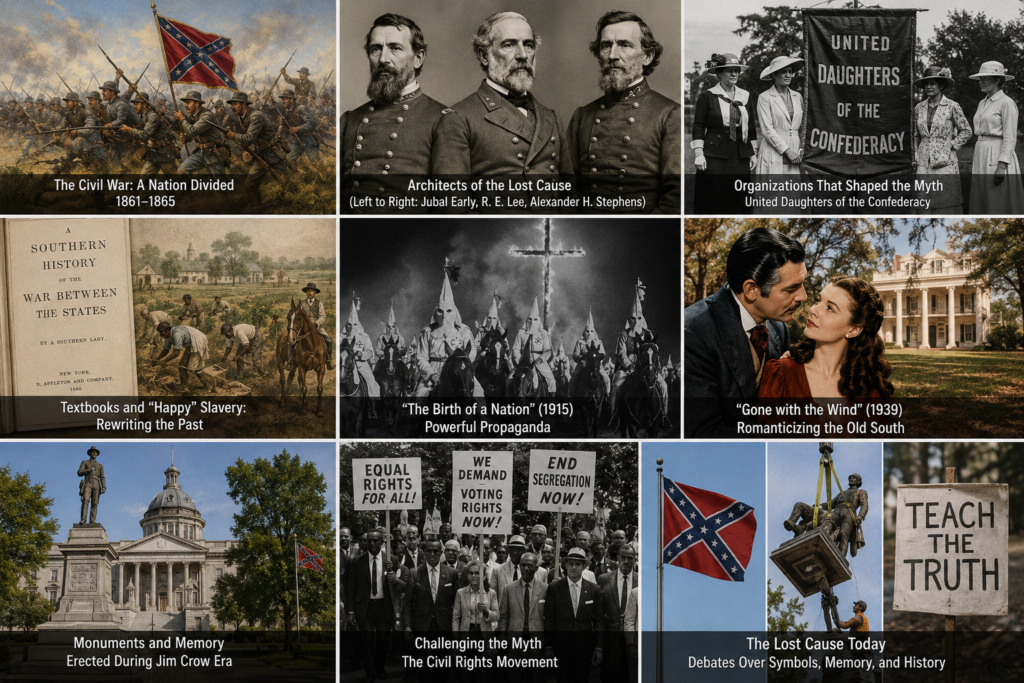
Among former Confederate officers, the most consequential figure in shaping the Lost Cause as formal history was General Jubal Early. Early devoted much of his postwar life to defending Lee’s reputation and to attacking the record of Lee’s subordinate James Longstreet, whom Early and his allies scapegoated for the defeat at Gettysburg, protecting Lee from any share of the blame. Through groups like the Southern Historical Society, Early and like-minded veterans worked to control the historical record of the war, vetting books and articles to make sure they conformed to the approved narrative.
But the organization that did more than any other to plant the Lost Cause permanently in American culture was the United Daughters of the Confederacy, founded in 1894. The UDC’s reach extended into nearly every institution that shapes how a society remembers itself: cemeteries, churches, civic ceremonies, street names, and above all, public school textbooks. Led by figures such as Mildred Lewis Rutherford, the UDC reviewed and effectively censored history textbooks used across the South, blacklisting books that strayed from the Lost Cause storyline and rewarding those that conformed to it.
The UDC’s other great instrument was the monument. Beginning in earnest around the turn of the twentieth century and continuing well into the Jim Crow era, the organization raised money for hundreds of Confederate statues and memorials across the South and beyond. Surprisingly, at least 14 confederate monuments were established in West Virginia, a state that itself seceded from the Confederacy.
The timing of the monument wave is revealing: most went up not in the immediate aftermath of the war but decades later, in the 1890s through the 1920s, precisely as Jim Crow segregation laws were being written into state codes. Confederate iconography was being erected at the same time Black political and civil rights were being systematically stripped away. In 1904 the UDC even campaigned for so-called “faithful slave” monuments, intended to memorialize the fiction of contented, loyal enslaved people.
Churches also played a central role, effectively transforming the Lost Cause into a “culture religion” that blended Christianity with Confederate civil mythology. Clergymen like J. William Jones, sometimes called the “Evangelist of the Lost Cause,” framed Confederate soldiers as Christian martyrs and linked fidelity to Southern memory with fidelity to the faith, sanctifying the cause and its leaders. Rituals such as Confederate Memorial Day, graveside decoration, and monument dedication ceremonies functioned as recurring liturgies that reinforced the myth, with symbols like “Dixie,” the battle flag, and the gray uniform serving as quasi-sacred emblems
These organizations presented themselves as guardians of memory, but in practice they curated a highly selective recollection that emphasized honor, sacrifice, and white unity, while erasing slavery, Black agency, and Confederate internal dissent.
Popular culture did its own work alongside the formal organizations. D.W. Griffith’s 1915 film The Birth of a Nation, a massive commercial and cultural success, was adapted from a novel sympathetic to the Ku Klux Klan. It presented Reconstruction as a period of Black misrule rescued by Klan heroism. Margaret Mitchell’s 1936 novel Gone with the Wind and its 1939 film adaptation did similar work in a softer key, romanticizing the antebellum plantation South for a national, as well as Southern, audience.
A Useful Story for the Whole Country, Not Just the South
It would be a mistake to treat the Lost Cause as a purely Southern phenomenon that was merely tolerated by the rest of the country. Northern white Americans had their own reasons to embrace a version of the war that didn’t dwell too long on slavery or its aftermath. As the decades passed and the Gilded Age’s industrial culture left many white Americans disillusioned, a sentimental story of Northern and Southern soldiers as equally brave men fighting on opposite sides of a tragic but honorable conflict offered a tidy path to national reconciliation. Popular fiction of the era often symbolized this reunion literally, pairing a wealthy Northern man with an impoverished but spiritually superior Southern woman as a stand-in for the reunited nation.
That impulse for reconciliation came at a steep price and the price was paid almost entirely by Black Americans, whose claims to full citizenship and civil rights were quietly set aside so that the white North and the white South could embrace one another over Confederate graves. The historian David Blight argued that this national reunion was built directly on top of the abandonment of Reconstruction’s promises.
From Veterans’ Memory to Civil Rights Backlash
The Lost Cause did not simply persist after its turn-of-the-century peak; it surged again whenever white supremacy felt politically threatened. Its second major resurgence came during the civil rights movement of the 1950s and 1960s, when Confederate flags, monuments, and rhetoric were deployed by segregationists as symbols of resistance to federal civil rights enforcement and to the broader push for racial equality. The display of Confederate iconography on state capitol grounds and on state flags during this period was viewed by many as a calculated act of contemporary political defiance dressed up as heritage and not a simple continuation of nineteenth-century commemoration.
Politically, the Lost Cause served the interests of Southern Democratic elites and white supremacist movements seeking to roll back Reconstruction and to legitimize Jim Crow segregation. By re-framing the war as a righteous defense of self-government and by portraying Reconstruction as illegitimate “Northern rule,” the myth provided a moral vocabulary for resisting Black voting, officeholding, and civil equality. Supporters of the Lost Cause were not simply being nostalgic; they were engaging in active political work, using historical distortion to shape contemporary policy.
By the mid-twentieth century, professional historians had begun dismantling the Lost Cause’s factual claims in earnest. Scholars such as Eric Foner, Barbara Fields, David Blight, and others reoriented Civil War and Reconstruction history around the documentary evidence: the secession declarations, the wartime speeches, the Confederate constitution’s explicit protections for slavery. Among professional historians today, the Lost Cause is treated not as a contested interpretation but as a settled case of historical negation — a comforting story constructed and maintained for reasons that had little to do with what actually happened.
How the Lost Cause Shows Up Today
The most visible modern flashpoint has been the fight over Confederate monuments. The removal of statues in cities such as New Orleans and Charlottesville in the 2010s, and the surge of removals following the 2020 protests over the killing of George Floyd, were not really arguments about bronze and granite. They were arguments about which story of the war and which set of values a public square should honor.
The Lost Cause also survives in quieter, more subtle ways. Many people still describe the Civil War as a conflict over “states’ rights.” They often leave out the specific right Southern states were determined to protect: slavery. Family heritage organizations, such as the Sons of Confederate Veterans, continue much of the commemorative work begun by the United Daughters of the Confederacy. Some textbooks and museum exhibits are still being revised to remove decades of Lost Cause interpretation, though this action is currently coming under attack. Popular culture also continues to romanticize the antebellum South as gracious and orderly, while overlooking that its economy depended on enslaved labor.
For many Americans, this version of history became the story they learned as children. Ideas learned early are often the hardest to change. Understanding the Lost Cause as a myth rather than a mere mistaken interpretation is crucial, because it underscores that this narrative was consciously constructed to serve specific social and political ends. It helped white Southerners cope with defeat, but it also justified the continued subordination of African Americans and shaped national memory in ways that obscured the realities of slavery and racial violence. Its persistence into the present suggests that struggles over the historical narrative are inseparable from struggles over power: how Americans remember the Civil War is bound up with how they understand inequality, citizenship, and the responsibilities of the modern state.
Why the Story Still Matters
The Lost Cause endures, I think, because it solves a problem every defeated society faces: what do you do with the dead, and with the cause they died for, when that cause turns out to have been wrong? The honest answer — that hundreds of thousands of men died defending a system built on human bondage — is almost unbearable to sit with, and the Lost Cause offered, and still offers, an alternative that lets descendants feel pride instead of horror. That emotional utility is precisely what has made it so durable, and precisely why dismantling it has taken historians the better part of a century and is, by most accounts, still unfinished work that may never be complete.
Sources
1. “Lost Cause | Meaning, Myth, Ideology, History, Significance, & Facts,” Encyclopaedia Britannica.
2. Caroline Janney, “The Lost Cause,” Encyclopedia Virginia, Virginia Humanities.
3. “The Lost Cause: Definition and Origins,” American Battlefield Trust.
4. “Lost Cause of the Confederacy,” Wikipedia.
5. “United Daughters of the Confederacy,” Wikipedia.
8. “Lost Cause Myth,” The Inclusive Historian’s Handbook.
9. “Origins of the Confederate Lost Cause,” JSTOR Daily.
11. “The Lost Cause Myth: How the South Flipped the American Civil War Story,” The Valentine Museum.