
For much of the late twentieth century, “socialism” was almost a forbidden word in American politics. Republicans used it as an accusation, Democrats generally avoided it, and politicians who actually described themselves as socialists occupied a small place on the political fringe.
Things have changed dramatically. Today, politicians on both the right and the left talk about socialism—although they usually mean entirely different things.
On the right, “socialism” has become a broad warning label applied to proposals ranging from universal health insurance to government regulation and higher taxes. On the left, a growing number of politicians and activists have reclaimed the word, associating it with economic equality, stronger labor rights, universal public services, and restraints on corporate power.
The interesting question may be less whether America is becoming socialist than why Americans are suddenly arguing about the meaning of socialism.
Socialism Originally Meant Something Specific
Historically, socialism was not simply another word for government spending. It developed during the nineteenth century largely in response to industrial capitalism. Although socialist thinkers disagreed considerably among themselves, they generally believed that the production resources of society—factories, mines, transportation systems, land, and eventually large corporations—should be owned collectively or controlled by workers rather than by private investors.
Karl Marx advocated a transformation by revolution. Other socialists eventually pursued democratic and parliamentary approaches.
That distinction matters because many policies routinely described as “socialist” in American political debate do not meet the traditional definition at all. A government can tax corporations, regulate banks, provide health insurance, and maintain a generous welfare system while leaving most businesses privately owned. Economists would normally describe such a country as a mixed capitalist economy or social democracy, rather than a socialist economy.
What the American Right Means by Socialism
For many conservatives, socialism has acquired a much broader meaning. The term is frequently applied to policies that increase government involvement in the economy such as progressive taxation, environmental regulation, student-debt relief, subsidized health care, expanded welfare benefits, government-supported child care, or other programs that redistribute income or provide services collectively.
In this usage, socialism is less a precise economic system than a direction of travel. Conservatives argue that as government assumes greater responsibility for allocating resources and providing benefits, individual choice and private markets become less important.
There is a legitimate philosophical argument here. There has always been a debate over where the boundary should lie between private markets and collective responsibility.
But calling every government economic intervention “socialism” stretches the word almost beyond recognition. By that definition, nearly every modern industrial democracy—including the United States—has been partly socialist for generations.
The political usefulness of the word helps explain its persistence. For Americans who remember the Cold War, “socialism” may evoke the Soviet Union, communist Eastern Europe, Cuba, or more recently Venezuela. Calling an opponent socialist therefore does more than criticize a particular tax or health-care proposal. It associates that proposal with an entire political system many Americans regard as oppressive and economically unsuccessful.
Polling illustrates how powerful that association remains. Pew Research Center found in 2022 that only 14 percent of Republicans and Republican-leaning independents had a positive impression of socialism. Republicans were also much more likely than Democrats to associate socialism with restrictions on individual freedom.
What the American Left Means by Socialism
The situation on the left is considerably more complicated because there is no single left-wing definition of socialism.
Many Americans who describe themselves favorably toward “socialism” appear to mean something closer to social democracy: a basically capitalist economy combined with universal health care, stronger unions, affordable higher education, progressive taxation, extensive social insurance, and stronger regulation of corporations.
Their preferred models are often Scandinavian countries such as Denmark and Finland. Yet those countries retain private businesses, private property, financial markets, entrepreneurship, and international corporations. They are heavily regulated capitalist welfare states, not classical socialist economies.
Pew’s research demonstrates this ambiguity. When Americans favorable toward socialism were asked what they liked about it, many emphasized fairness, meeting basic needs, and combining elements of capitalism and socialism rather than eliminating capitalism altogether.
Other people on the American left mean something more substantial when they use the term. The Democratic Socialists of America, for example, explicitly says democratic socialism should go beyond merely regulating capitalism. The organization advocates greater democratic control of workplaces and collective ownership of important parts of the economy, including areas such as energy and transportation. That position is much closer to the traditional meaning of socialism.
Consequently, it is misleading to assume that a liberal Democrat supporting Medicare expansion and a democratic socialist advocating worker control of corporations necessarily have the same economic philosophy.
They may support some of the same immediate policies while disagreeing profoundly about the ultimate economic system they want.
Why Has Socialism Suddenly Returned?
First was the financial crisis of 2008. Younger Americans watched banks and financial institutions receive extraordinary government assistance while millions of ordinary Americans lost jobs, savings, and homes. That experience weakened the assumption that an essentially unregulated market produces fair outcomes.
Then came decades of concern about wage stagnation, college debt, housing affordability, medical expenses, and growing concentrations of wealth. For some younger Americans, “capitalism” increasingly came to mean not neighborhood businesses and entrepreneurship but enormous corporations, billionaires and now trillionaires, expensive housing, and economic insecurity.
Bernie Sanders accelerated the transformation during his presidential campaigns in 2016 and 2020. By openly calling himself a democratic socialist while attracting millions of votes, Sanders helped remove some of the Cold War stigma surrounding the word.
Generational change matters as well. Younger Americans did not experience the Cold War in the same way their parents and grandparents did. Pew found striking age differences in its 2022 survey. Americans under 30 were roughly as likely to have an exclusively positive view of socialism as an exclusively positive view of capitalism. Older Americans remained considerably more favorable toward capitalism.
The political right has responded by emphasizing the word even more strongly. That makes strategic sense. If progressive Democrats increasingly accept the socialist label—or propose policies Republicans can associate with it—Republicans have an incentive to connect those policies with a word that remains deeply unpopular among conservative and many older voters.
The result is a feedback loop: the left talks more about socialism because the word has become less frightening to some voters, while the right talks more about socialism precisely because it hopes to make the word frightening again.
Is America Already Partly Socialist?
The answer depends almost entirely upon our definition.
Under the traditional definition—collective ownership of the means of production—the United States is overwhelmingly capitalist. Most farms, factories, banks, hospitals, restaurants, stores, technology companies, media companies, and other productive enterprises are privately owned.
But America has never operated as a completely laissez-faire capitalist economy either.
The federal government operates Social Security, for example, which the Social Security Administration itself describes as a social insurance program. Workers and employers contribute through payroll taxes, and benefits provide partial income replacement after retirement, disability, or death. About 96 percent of American jobs are covered.
Medicare and Medicaid place government deeply into health-care financing while most hospitals, physician practices, pharmaceutical manufacturers, and medical suppliers remain private.
The government also insures private bank deposits through the FDIC. Deposits at insured banks are generally protected up to $250,000 per depositor, per bank, per ownership category, backed by the federal government.
Public schools, public universities, highways, libraries, police departments, fire departments, water systems, parks, and numerous municipal utilities provide goods and services collectively rather than through ordinary private markets.
The United States even owns or operates certain enterprises directly. The Postal Service, for example, is an independent establishment within the executive branch that provides a nationwide public service while simultaneously operating in a competitive marketplace.
These arrangements contain elements of collective provision, social insurance, public ownership, or economic regulation, but calling all of them “socialism” creates more confusion than clarity.
A public fire department is not evidence that America has adopted a socialist economic system any more than a privately owned grocery store proves that government has no role in the economy.
America Has a Mixed Economy—and Always Has
Perhaps the greatest problem with the current socialism debate is the assumption that capitalism and socialism exist as two completely separate boxes and that a country must choose one or the other. Modern economies rarely work that way.
The United States relies primarily on private ownership, competition, investment, and markets to produce goods and services. At the same time, Americans have repeatedly decided that certain risks and services should be handled collectively.
Even organized labor introduces an element of collective economic power into a capitalist system, although union membership has declined substantially. In 2025, 10 percent of American wage and salary workers belonged to unions, compared with 20.1 percent in 1983.
The real political disagreement is rarely capitalism versus socialism in their pure theoretical forms. It is about where to draw the line between the market and the community.
Should health insurance operate primarily as a commercial product or a public service? Should housing be left largely to market forces or should government intervene to make it more affordable? Should corporations answer primarily to shareholders, or should workers have greater influence over corporate decisions? How progressive should taxation be? Which industries, if any, should be publicly owned? How much inequality should society tolerate in exchange for the incentives created by private enterprise?
A surprising twist is that some of the loudest recent “socialism” accusations are coming from conservatives — aimed at their own president. Since returning to office, the Trump administration has taken direct equity stakes in Intel, secured a “golden share” in U.S. Steel, arranged profit-sharing with Nvidia and AMD on chip sales to China, imposed sweeping tariffs, and directed the Pentagon to prioritize coal — an unprecedented degree of direct federal involvement in private enterprise for a Republican administration. Commentators across the spectrum — from the Council on Foreign Relations to the Wall Street Journal — have reached for terms like “state capitalism” or “state capitalism with American characteristics,” an explicit echo of the Chinese Communist Party’s own “socialism with Chinese characteristics”. One economist with more than three decades of market-watching called it plainly “the most economically interventionist government of my lifetime”.
Those are legitimate political questions. Calling one side “capitalist” and the other “socialist” obscures more than it explains.
The Word May Matter Less Than the Argument
There is one particularly revealing finding in the polling. Americans do not necessarily treat capitalism and socialism as opposites. Pew found people who expressed favorable opinions of both, suggesting that many Americans interpret capitalism as representing markets and opportunity while interpreting socialism as representing economic security and fairness.
That may tell us something important about the current debate. It appears that Americans want the vitality of capitalism tempered by the compassion of socialism.
The renewed interest in socialism doesn’t indicate that millions of Americans suddenly want the government to seize factories and abolish private enterprise. Instead, it reflects dissatisfaction with how the existing economic system distributes opportunity, security, wealth, and political power.
Conservative warnings about socialism often reflect a genuine concern that expanding government responsibility can gradually reduce economic freedom, increase taxation, and shift decisions from individuals and markets toward political institutions.
Those are fundamentally different concerns—and both become difficult to discuss when the same word means entirely different things to the people using it.
The question is not whether America should become “socialist,” it is what kind of capitalism we want.
That argument has been with us throughout American history. Only the vocabulary has changed.
For an additional discussion of the elements of socialism, see my post Three Shades of Left, published on November 10th 2025.
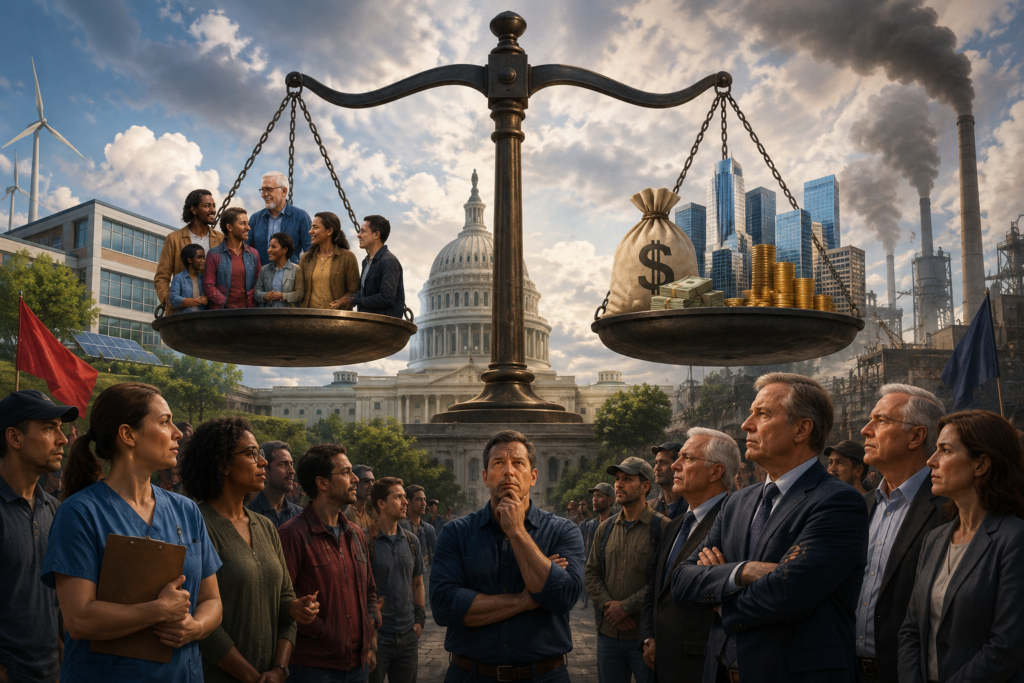
Image generated by author using ChatGPT.
Sources
- NY1 State of Politics, “Understanding democratic socialism amid its rise in 2026 elections,” July 7, 2026. https://nystateofpolitics.com/state-of-politics/new-york/politics/2026/07/07/understanding-democratic-socialism-amid-its-rise-in-2026-elections
- CNN, “Americans — including many Republicans — are losing faith in capitalism, polling shows,” July 23, 2026. https://www.cnn.com/2026/07/23/politics/republicans-capitalism-socialism-poll
- HotAir, “Is Socialism Really Gaining Steam, or Are Socialists Just Gaming the System Better?,” July 28, 2026. https://hotair.com/david-strom/2026/07/28/is-socialism-really-gaining-steam-or-are-socialists-just-gaming-the-system-better-n3817374
- USA Today, “Mamdani wins NYC mayor’s race in generational shift for Democrats,” November 2025. https://www.yahoo.com/news/articles/mamdani-faces-cuomo-become-nyc-132437910.html
- AOL/NBC News republish, “In generational shift, Zohran Mamdani wins NYC mayor’s race,” November 2025. https://www.aol.com/articles/generational-shift-zohran-mamdani-wins-024145015.html
- Charisma Magazine, Dinesh D’Souza, “The Specter of Socialism,” August 6, 2026. https://mycharisma.com/news/the-specter-of-socialism/
- Wikipedia, “Socialism for the rich and capitalism for the poor” (Bernie Sanders quote on the 2008 bailout). https://en.wikipedia.org/wiki/Socialism_for_the_rich_and_capitalism_for_the_poor
- Yahoo/The Hill, “Jeffries accuses Trump of tanking the economy to create opportunities for the rich,” 2026. https://www.yahoo.com/news/jeffries-accuses-trump-tanking-economy-220454230.html
- Goodreads (reprint), Robert Reich, “The populist left and right are on the same side.” https://www.goodreads.com/author_blog_posts/10288117-robert-reich-the-populist-left-and-right-are-on-the-same-side
- A Versus B, “Capitalism vs Socialism 2026: Key Differences Explained.” https://www.aversusb.net/blog/capitalism-vs-socialism-2026-key-differences-explained
Leave a Reply