
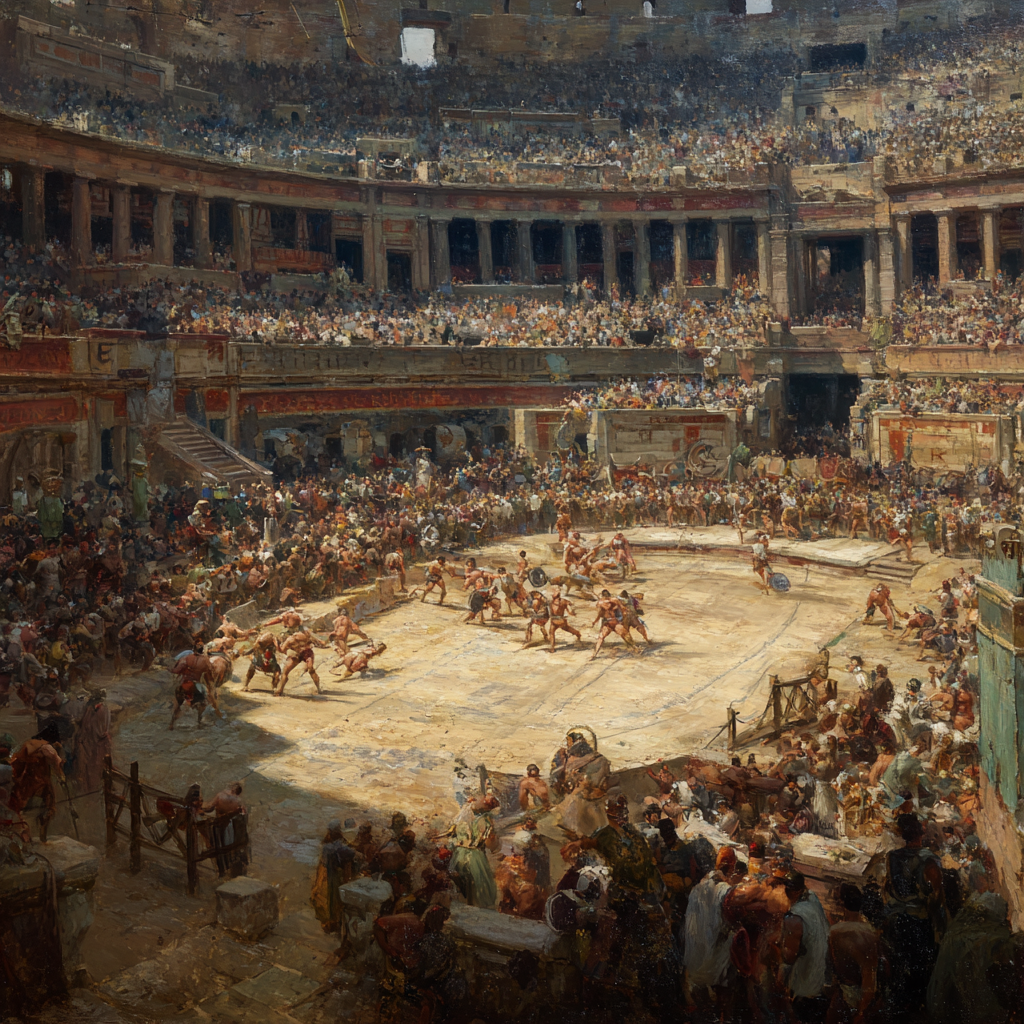
“Already long ago, from when we sold our vote to no man, the People have abdicated our duties; for the People who once upon a time handed out military command, high civil office, legions — everything, now restrains itself and anxiously desires for just two things: bread and circuses.”
Nearly 2,000 years ago, Roman satirist Juvenal penned one of history’s most enduring political observations: “Two things only the people anxiously desire — bread and circuses.” Writing around 100 CE in his Satire X, Juvenal wasn’t celebrating this phenomenon—he was lamenting it. The poet watched as Roman citizens traded their political engagement for free grain and spectacular entertainment, becoming passive spectators rather than active participants in their democracy. The phrase has endured for nearly two millennia as shorthand for a troubling political dynamic: entertainment and consumption replacing civic engagement and accountability.
The Roman Warning
Juvenal’s critique came at a pivotal moment in Roman history. The republic had collapsed, and emperors like Augustus had systematically dismantled democratic institutions. Rather than revolt, Roman citizens seemed content as long as the government provided basic sustenance (the grain dole called annona) and elaborate spectacles at venues like the Colosseum. Political participation withered as people focused on immediate pleasures rather than long-term civic responsibilities.
The strategy worked brilliantly for Roman rulers. Keep the masses fed and entertained, and they won’t question your authority or demand meaningful representation. It was political control through distraction—a form of soft authoritarianism that maintained order without overt oppression. The policy was effective in the short term—peace in the streets and loyalty to the emperors—but disastrous over time. Rome’s population became disengaged from politics, while real power consolidated in the hands of a few.
Modern American Parallels
Fast-forward to contemporary America, and Juvenal’s observation feels uncomfortably relevant. While we don’t have gladiatorial games, we do have our own version of “circuses”—professional sports, reality TV, social media feeds, and celebrity culture that dominate public attention. These aren’t inherently problematic, but they become concerning when they crowd out civic engagement.
Our modern “bread” takes various forms: government assistance programs, subsidies, and economic policies designed to maintain consumer spending. We are saturated with cheap goods, instant delivery services, and mass consumerism. For many, economic struggles are temporarily softened by accessible consumption, from fast food to online shopping. Yet material comfort often masks deeper inequalities and systemic challenges—wage stagnation, healthcare costs, and mounting national debt. These programs often serve legitimate purposes, but they can also function as political tools to maintain public satisfaction and suppress dissent.
Consider how political campaigns increasingly focus on entertainment value rather than substantive policy debates. Politicians hire social media managers and appear on talk shows, understanding that capturing attention often matters more than presenting coherent governance plans. Meanwhile, voter turnout for local elections—where citizens have the most direct impact—remains dismally low.
The Distraction Economy
Perhaps most striking is how our information landscape mirrors Roman spectacles. We’re bombarded with sensational news, viral content, and manufactured controversies that generate strong emotional reactions but little productive action. Complex policy issues get reduced to soundbites and memes, making genuine democratic deliberation increasingly difficult.
Social media algorithms are specifically optimized for engagement, not enlightenment. They feed us content designed to provoke reactions—anger, outrage, schadenfreude—rather than encourage thoughtful consideration of difficult issues. This creates a population that feels politically engaged through constant consumption of political content while remaining largely passive in actual civic participation.
The danger of “bread and circuses” in modern America lies in apathy. When civic participation declines, voter turnout falls, and policy debates get reduced to simplistic slogans, elites face less scrutiny. The result is a weakened democracy, vulnerable to manipulation and short-term thinking.
Breaking the Cycle
Juvenal’s warning doesn’t mean we should abandon entertainment or social programs. Rather, it suggests we need intentional balance. Democratic societies thrive when citizens remain actively engaged in governance beyond just voting every few years.
This means staying informed about local issues, attending town halls, contacting representatives, and participating in community organizations. It means choosing substance over spectacle and long-term thinking over immediate gratification.
The Roman Republic fell partly because its citizens stopped paying attention to governance. Juvenal’s “bread and circuses” reminds us that democracy requires constant vigilance—and that comfortable distraction can be freedom’s most seductive enemy.
Leave a Reply