When political power is on the line, history shows that the military often becomes the make-or-break institution. Authoritarian leaders—from Hitler to Erdogan—have long understood that a professional military answers to the state, not to any one person. That independence can be inconvenient for leaders who want fewer limits to their power. So, the classic move is simple: replace seasoned, independent officers with people whose primary loyalty is personal rather than constitutional.
This isn’t speculation; it’s a familiar historical pattern.
How Authoritarians Reshape Militaries
Professional militaries promote based on experience, training, and merit. They’re built to resist illegal orders and to stay out of domestic politics. For an authoritarian-leaning leader, military professionalism is a potential obstacle. Purges serve a purpose: clear out officers who take institutional norms seriously, and elevate those who won’t push back.
Two cases illustrate how this works.
Hitler and the German Army
After consolidating political power, Hitler moved aggressively to dominate the military. In 1934, the army was pressured to swear a personal oath of loyalty to him—not to the state or constitution.
By 1938 he removed two top commanders, Werner von Blomberg and Werner von Fritsch, through trumped-up scandals after they questioned his rush toward war. Dozens of senior generals were pushed out soon after.
The goal was not efficiency—it was control.
Turkey After the 2016 Coup Attempt
Following the failed coup, President Erdogan launched the largest purge in modern Turkish history. Tens of thousands across the military, police, and judiciary were arrested or fired, including nearly half of Turkey’s generals.
Later reporting showed that many dismissed officers had no link to the coup at all; they were targeted for being politically unreliable or pro-Western.
These cases differ in scale and context, but the pattern is strikingly similar: the professional military is reshaped to serve the leader.
What Healthy Civil–Military Relations Look Like
In stable democracies, civilian leaders set policy, but the military retains professional autonomy. Officers swear loyalty to the constitution. Promotions are merit-based. And there’s a bright line between national service and political allegiance.
One important safeguard: every member of the U.S. military is obligated to refuse unlawful orders and swears an oath to do so. It’s not optional—it’s core to American military ethics.
Research consistently shows that professional, apolitical militaries strengthen democracies, while politically entangled militaries make coups and repression more likely.
The Current U.S. Debate
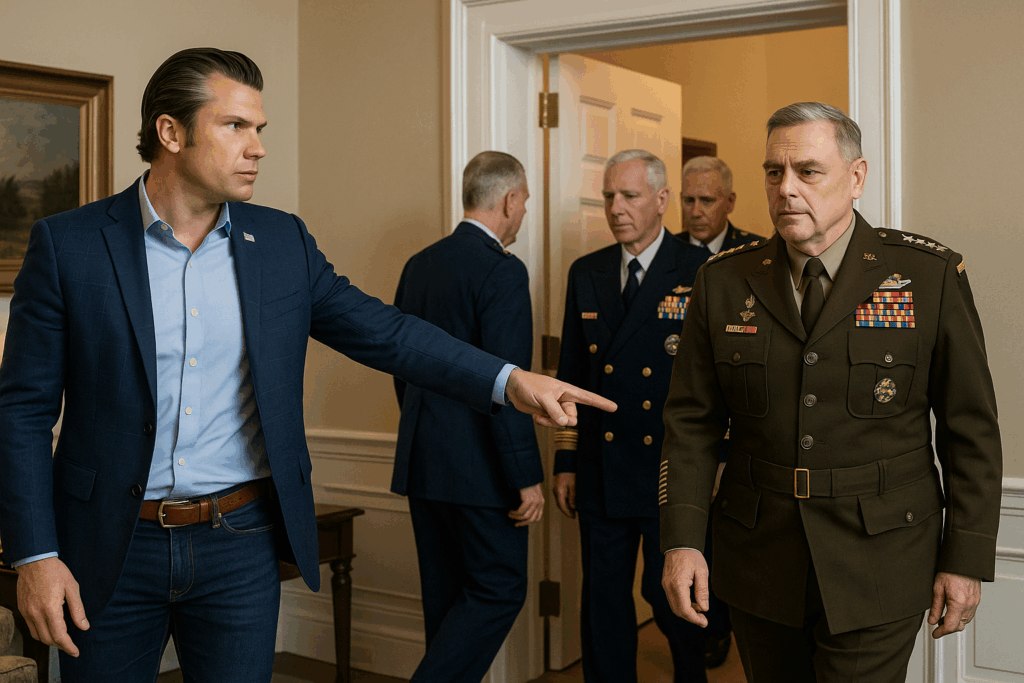
Since early 2025, Defense Secretary Pete Hegseth’s removal or sidelining of more than two dozen generals and admirals has raised alarms within the military and among lawmakers. It includes the unprecedented firing of a sitting Chairman of the Joint Chiefs of Staff and significant cuts to senior officer billets.
Hegseth has framed these moves as reforms—streamlining, eliminating “woke politicization,” and aligning leadership with the administration’s national-security priorities.
Many inside the services describe the environment as unpredictable and politically charged. Officers report confusion about why certain leaders are removed and others promoted, and some say the secretary’s rhetoric has alienated the very institution he’s trying to lead. Public reporting describes an “atmosphere of uncertainty and fear” inside the officer corps.
Similarities and Differences to Classic Purges
Where patterns overlap
- Large-scale personnel changes in a short time
- Emphasis on loyalty to a person rather than institutional norms
- Limited transparency in the selection and removal process
- Signals that dissent or disagreement are disqualifying
Where the U.S. still differs
- Congress can investigate and slow actions
- Courts remain independent (for now)
- Officers swear loyalty to the Constitution, not the president
- No arrests, detentions, or manufactured scandals
- The press is free to report and criticize
Why This Matters
Institutional Readiness
Purges can weaken the military by removing seasoned leaders and creating gaps in institutional memory.
Professionalism
If officers think advancement depends on political alignment instead of performance, the talent pipeline changes. Some of the best people simply leave.
Civil–Military Trust
The relationship between elected leaders and the military rests on mutual respect. Reports of intimidation or political litmus tests damage that trust.
Democratic Stability
Democracies depend on militaries that stay out of politics. History shows that once political loyalty becomes the main metric for advancement, the slope toward politicization—and eventually erosion of democratic norms—gets much steeper.
The Real Question
It’s not whether current events equal Turkey in 2016 or Germany in 1938. They don’t.
The real question is much simpler:
Will we maintain a military that is professional, apolitical, and loyal to the Constitution—or move toward a military where career survival depends on political loyalty?
That direction matters far more than any single personnel decision.
Bottom Line
History shows that authoritarianism doesn’t arrive all at once; it arrives incrementally. One of the clearest patterns is reshaping the military to reward personal loyalty over constitutional loyalty.
The United States still has strong guardrails: congressional oversight, rule of law, open media, and a military culture steeped in constitutional commitment. But those guardrails only work if they’re maintained—by political leaders, by officers, and by citizens paying attention. Many are concerned that the deployment of military forces in American cities and their use to destroy purported drug traffickers is a way to acclimate senior officers to following questionable orders.
Watching these trends isn’t alarmist. It’s simply responsible. It’s our duty as citizens
Leave a Reply