
Part I, Liberty and Slavery
We hold these truths to be self-evident, that all men are created equal, that they are endowed by their Creator with certain unalienable Rights, that among these are Life, Liberty and the pursuit of Happiness.
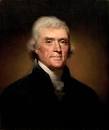
These stirring words that Thomas Jefferson used in the Declaration of Independence put forth a clear statement of his political philosophy. Unfortunately, the man behind the words is not nearly so self-evident. To borrow a phrase from Winston Churchill, he is a riddle wrapped in a mystery, wrapped in an enigma. Biographer Joseph Ellis referred to him as The American Sphinx.
He was a man of the enlightenment, but he was also a man clearly bound to the brutal slave economy. He dreamed of a bucolic America peopled by hardworking yeoman farmers while he lived the life of a wealthy British aristocrat. He abhorred the thought of banks and bankers but spent his entire life mired in debt. He wrote and spoke often of the need to avoid factionalism in politics but was a skillful practitioner of political intrigue. He constantly argued against expansion of governmental power but as President, without having the authority, he undertook to expand the United States to more than double its size.
So, how do we reconcile the words with the man? Perhaps we don’t. Perhaps the best we can do is try to understand the world in which he lived and the circumstances that led him to take such contradictory positions in his political and personal life. Tens of thousands of pages have been written trying to understand and explain Thomas Jefferson. Now, I’m only going to look briefly at his relationship to slavery. In a later post I’ll be looking at Thomas Jefferson as the master of political manipulation.
Of the many contradictions in Thomas Jefferson’s life, his relationship to slavery is the most difficult to reconcile. One of his first cases after becoming a lawyer was to represent a slave seeking his freedom on the grounds that his grandmother was a mulatto which would require him to be in bondage only until age 31. In an argument to the Virginia court Jefferson said, “Everyone comes into this world with the right to his own person, this is what is called personal liberty and is given them by the author of nature, under the law we are all born free.”
Both the judge and the jury were outraged that Jefferson would propose freeing a slave. The judge refused to hear any further such talk and ruled against Jefferson’s client. According to historian Winston Groom the fact that Jefferson had such a position at that time (1770) is considered significant and was a milestone in the evolution of his thought.
About that same time Jefferson was elected to the House of Burgesses and he introduced an act that would allow masters to govern emancipation of their slaves rather than having to seek the permission of the courts and the royal officers. This was met with strong opposition and did not pass. It is significant that Jefferson did not pursue either the court case or the legislation.
As a member of the Continental Congress, Jefferson prepared an amendment to the Ordinance of 1784 (a precursor to the Northwest Ordinance) stipulating the freedom of all children born to slaves after a certain date but requiring that they be deported to either the Caribbean or Africa. This amendment failed by a single vote in Congress. Reflecting on the decision Jefferson wrote: “Thus we see the fate of millions unborn hanging on the tongue of one man and heaven was silent in that awful moment”. But Jefferson was to remain silent as well!
To Jefferson it was unimaginable that free whites and free blacks could live together peaceably. Even years later when writing about it he said that it was “inconceivable [then] that the public mind would bear this proposition, nor will it bear at this day”. He also wrote “Yet the day is not distant when it must bear and adopt it or worse will follow, nothing is more surely written in the book of fate than that these people are to be free.” According to Jefferson’s biographer Jon Meacham, he was never able to move public opinion on slavery and his powers failed him and they failed America.
As president, Jefferson signed a law making it a crime to import slaves. But at the same time, he believed that if slaves were set free, they must be deported to Africa or the Caribbean. Most of his contemporaries agreed; they felt that American slavery was equivalent to “holding the ear of a tiger”, but they saw no way to let go.
So again, we return to the question of how to reconcile Jefferson the philosopher with Jefferson the enslaver. Jefferson was a man who enjoyed luxury and the finer things in life. Today he is viewed as a wealthy planter. However, he was what we would now consider cash poor. All his wealth was tied up in property and his slaves were a large portion of that property. His land was heavily mortgaged, and his slaves were his collateral. Jefferson’s wife was the daughter of a wealthy man and when her father died Jefferson inherited his 135 slaves and his land, which was also heavily mortgaged. He also inherited his father-in-law’s other considerable debts. He worried constantly about his financial status, yet he could not control his lavish spending. Freeing his slaves would have lost him the collateral against which his many loans were guaranteed.
Jefferson recognized the evil of slavery but also benefited greatly from it. He was unable to give up his comfortable life even while bemoaning the institution which made it possible. His relationship with Sally Hemmings has been a subject of much debate and is beyond what I can address here but if you are familiar with her story, you know that this a singular example of Jefferson’s inability to subordinate his desires to his principles.
During his lifetime he freed only two of his slaves and in his will, he freed only an additional three. This compares to some other founders who freed all their slaves in their wills. Perhaps he recognized that freeing his slaves would have resulted in an immediate foreclosure on his beloved Monticello.
It is long been axiomatic among historians that people should be judged by the time in which they lived. Jefferson was a man of his times, an exceptional man without doubt. However, his was a time that was consumed by one of the great evils of history. And that evil will always reflect on his memory. Each of us will have to make our own decision about Thomas Jefferson.
Further reading:
Thomas Jefferson the Art of Power, John Meacham
Jefferson and Hamilton the Rivalry That Forged a Nation, John Ferling
The Patriots, Winston Groom
Thomas Jefferson: An Intimate History, Fawn Brody






By Any Other Name: An Obsession with Titles
By John Turley
On March 31, 2023
In Commentary
Titles are everywhere and they likely have existed since humans began forming groups larger than the individual family. Almost all societies in every part of the world have evolved titles of one form or another. The Europeans, however, have raised titles to a whole new level. Kings, queens, princes, dukes, duchesses, lords, ladies, barons, viscounts, the list is endless. It seems almost everyone in Europe has a title of one type or another.
The European fascination with titles followed the colonists to America. As an American elite arose, they too began to award themselves titles, from the political such as burgess to the religious such as deacon and to the title of master in the slavery system. Some southern planters liked to refer to themselves as “a simple farmer,” though they were far from simple and I doubt that any of them dirtied their hands in the fields. Also, they were also quite fond of the title squire.
Two of my favorite titles are from colonial New England. Elite men were referred to as Worthy, as in Worthy Jones. I wonder if common men were considered unworthy. Married women were referred as Goodwife, often shortened to Goodie.
From the beginning of the United States, we were involved in creating new titles. After the adoption of the constitution, titles, specifically a title for the new chief executive, took up a portion of the first meetings of Congress.
Vice President John Adams suggested the following titles: “His Elective Majesty”, “His Mightiness”, and even “His Highness, the President of the United States of America and the Protector of their Liberties”.
Adams, who might kindly be described as portly, was mockingly referred to as “His Rotundancy”. Fortunately for succeeding generations, Adams’s recommendations were ignored, and Mr. President became the accepted title.
The use of titles, real or imagined, seems to have become particularly widespread in the times of the Internet. We constantly receive emails that include the name of the sender followed by multiple titles, often in the form of abbreviations and strings of letters that we seldom understand. These are meant to add an air of importance to the message. Often, we are impressed without really understanding why.
Some titles are honorary such as those awarded by universities or other such honorary titles as Kentucky Colonel. Others are just for fun such as the title I recently received, Admiral of the Cherry River Navy, the world’s only navy where every member is an admiral.
Please don’t think that I am mocking or dismissing the importance of titles. It’s their misuse and overuse that concerns me. Professional titles have an important place in professional situations. They help establish the expertise and credentials of people who will be working together but may not know each other. In this professional situation they can also help to establish educational accomplishments, political or social authority, or even honorary positions.
I’ve heard the argument’ “I’ve worked hard for that title and I’m going to use it.” I have some sympathy for that position, particularly for someone newly graduated with an advanced degree. But in general, use of professional titles in a nonprofessional setting strikes me as bragging.
Like everyone else, I have a title. However, unless you are seeing me in a professional situation or we are in a situation where all people are expected to use their professional titles, you won’t see an MD after my name. Occasionally when I’m having my name listed in a program or on a group roster, I tell them not to add the title, and I’ll be asked why. My standard response is that it isn’t relevant to the group.
Occasionally I’ll be working on a committee or other group with another professional and invariably they will list all their credentials in all our correspondence. For example, recently I was working with a group completely unrelated to medicine that also included another physician. We are well known to each other and know each other’s credentials. I signed all my emails with a simple John. In his emails, his full name was always followed by MD, MPH, FAAP. I know all about the automatic signature block and use it in professional correspondence, but there is a time and a place for everything. Perhaps he thinks I forgotten who he is since we talked last week.
The Grumpy Doc, HSE, AKMU
For those who don’t recognize my newly self-awarded titles, they are His Serene Excellency, All Knowing Master of the Universe. I will expect appropriate deference from now on.