Grumpy opinions about everything.

Category: Politics Page 2 of 6

Assessing the Trump-Orwell Comparisons: Warning, Not Prophecy

The comparison between the Trump administration and George Orwell’s dystopian works has recently become one of the most prevalent political metaphors. one I’ve used myself. Following Trump’s second inauguration in January 2025, sales of 1984 surged once again on Amazon’s bestseller lists, just as they did during his first term.

These comparisons are rhetorically powerful, but their accuracy depends on how literally Orwell is read and how carefully distinctions are drawn between authoritarian warning signs and fully realized totalitarian systems. But how accurate are the comparisons? Let me walk you through the key parallels, the evidence supporting them, and the critical questions we should be asking.

Understanding Orwell’s Core Themes

Before diving into the comparisons, it’s worth revisiting what Orwell was actually warning us about. In 1984, published in 1949, Orwell depicted a totalitarian state where the Party manipulates reality through “Newspeak” (language control), “doublethink” (holding contradictory beliefs), the “memory hole” (historical revision), and constant surveillance by Big Brother. The novel’s famous slogans—”War is Peace, Freedom is Slavery, Ignorance is Strength”—exemplify how the Party inverts the very meaning of words.

Animal Farm, written as an allegory of the Soviet Union under Stalin, traces how a revolutionary movement devolves into dictatorship. The pigs, led by Napoleon, gradually corrupt the founding principles of equality, with Squealer serving as the regime’s propaganda minister who constantly rewrites history and justifies Napoleon’s increasingly authoritarian actions.

The Major Parallels

The most famous early comparison emerged during Trump’s first term when adviser Kellyanne Conway defended false crowd size claims with the phrase “alternative facts.” This triggered the first major 1984 sales spike in 2017. According to multiple sources, critics immediately drew connections to Orwell’s concept of manipulating language to control thought.

In the current administration, commentators have identified several Orwellian language patterns. The administration has restricted use of certain words on government websites—including “female,” “Black,” “gender,” and “sexuality”—reminiscent of how Newspeak aimed to “narrow the range of thought” by eliminating words. An executive order on January 29, 2025, titled “Ending Radical Indoctrination in K-12 Schooling” has been criticized as doublespeak, using the language of educational freedom while actually restricting what can be taught.  Doublespeak has evolved as a way of combining the ideas of newspeak and doublethink.

Perhaps the most concrete parallel involves the systematic deletion of historical content from government websites. The Organization of American Historians condemned the administration’s efforts to “reflect a glorified narrative while suppressing the voices of historically excluded groups”. Specific documented deletions include information about Harriet Tubman, the Tuskegee Airmen (later restored after public outcry), the Enola Gay airplane (accidentally caught in a purge of anything containing “gay”), and nearly 400 books removed from the U.S. Naval Academy library relating to diversity topics. The Smithsonian’s National Museum of American History also removed references to Trump’s impeachments from its “Limits of Presidential Power” exhibit, which critics including Senator Adam Schiff called “Orwellian”.

Trump’s repeated characterization of political opponents as the “enemy from within” and the media as the “enemy of the people” parallels 1984’s Emmanuel Goldstein figure and the ritualized Two Minutes Hate sessions. One analysis suggests Trump leads Americans through “a succession of Two Minute Hates—of freeloading Europeans, prevaricating Panamanians, vile Venezuelans, Black South Africans, corrupt humanitarians, illegal immigrants, and lazy Federal workers”.

Multiple sources document that new White House staff must undergo “loyalty tests” and some face polygraph examinations. Trump’s statement “I need loyalty. I expect loyalty” echoes 1984’s declaration that “There will be no loyalty, except loyalty to the Party”. Within weeks of his second inauguration, Trump dismissed dozens of inspectors general—the internal government watchdogs. According to reports from Politico and Reuters, several have filed lawsuits claiming their removal violated federal law. An executive order titled “Ensuring Accountability for All Agencies” placed previously independent agencies like the SEC and FTC under direct White House supervision.

The Animal Farm Connections

While 1984 gets more attention, Stanford literature professor Alex Woloch argues that Animal Farm might be more relevant because “it traces that sense of a ‘slippery slope'” from democracy to totalitarianism, whereas in 1984 the totalitarian system is already fully established.

There are echoes of Animal Farm in the way populist rhetoric has framed liberals, progressive institutions, and the press as enemies of “the people,” while power was being consolidated within Trump’s narrow leadership circle. Orwell’s pigs do not abandon revolutionary language; they repurpose it. The “ordinary” supporters are exhorted to endure sacrifices and to direct anger at opposing groups, while political insiders consolidate authority and wealth—echoing the pigs’ gradual move into the farmhouse and adoption of human privileges. Critics argue that Trump’s sustained use of grievance-based populism, even while wielding executive power, fits this pattern symbolically if not structurally.

Other parallels being drawn to Animal Farm include Napoleon’s propaganda minister Squealer and the administration’s communication strategy of inverting reality and the gradual corruption of founding principles while maintaining revolutionary rhetoric like “drain the swamp”. They also are scapegoating political opponents and immigrants much as Napoleon blamed Snowball for all problems. They also are taking credit for others’ achievements just as Napoleon did with the other animals’ work. In the novel, Napoleon demands full investigations of Snowball even after discovering he had nothing to do with alleged misdeeds, much as Trump demanded investigations of Hillary Clinton, James Comey, Letitia James, and Jerome Powell while avoiding scrutiny of his own conduct.

As in Orwell’s farm, where the constant invoking of enemies keeps the animals fearful and loyal, the politics of permanent crisis and blame are being used to normalize increasingly aggressive behavior by those in power.

Critical Perspectives and Limitations

These comparisons raise several important concerns that deserve serious consideration. Orwell was writing about actual totalitarian regimes—Stalinist Russia and Nazi Germany—where millions died in purges, gulags, and genocides. The United States in 2026, despite concerning trends, still maintains functioning courts, elections, a free press, and a civil society. Some observers are warning against trivializing real authoritarian regimes by making overstated comparisons.

The Trump administration’s frequent attacks on the press, civil servants, and election administrators do resemble early warning signs Orwell would have recognized—not as proof of totalitarianism, but as a stress test on democratic norms.

Conservative commentators argue that these comparisons are exaggerated partisan attacks that misrepresent Trump’s actions. They point out that some court challenges to administration actions have succeeded, media criticism continues unabated, and political opposition remains robust—none of which would be possible in Orwell’s Oceania. The question becomes whether we’re witnessing isolated, though concerning actions or rather a systematic pattern—what Professor Woloch calls the “slippery slope” question.

One opinion piece suggested Trump’s actions resemble the chaotic, rule-breaking fraternity culture of “Animal House” more than the calculated totalitarianism of Orwell’s works—emphasizing bombast and spectacle over systematic control. This view argues that the MAGA movement is more “Blutonian than Orwellian,” driven by emotional appeals and personality rather than systematic thought control.

Where the Comparisons Are Strongest and Weakest

Based on my analysis, the comparisons appear most accurate in several specific areas. The pattern of language manipulation and redefinition—calling restrictions “freedom” and censorship “transparency”—closely mirrors doublespeak. The documented systematic removal of historical content from government sources directly parallels the memory hole concept. The dismissing of senior officials such as the head of the Bureau of Labor Statistics after an unfavorable jobs report, the wholesale firing of agency inspectors general and signaling that neutral experts should conform to political expectations mirrors the Orwellian demand for loyalty.  The assumption of control of previously independent agencies, and pressure on courts to allow the administration’s consolidation of power have parallels in the total party control. Unleashing ICE agents on the general public and excusing the murder of protesters are chillingly similar to the thought police and the “vaporizing” of citizens in Oceana. Perhaps most strikingly, Trump’s 2018 statement “What you’re seeing and what you’re reading is not what’s happening” nearly quotes Orwell’s line: “The party told you to reject the evidence of your eyes and ears”.

The comparisons are most strained when they overstate the current reality by suggesting America has already become Oceania, while democratic institutions that were lacking completely in Oceania are still functioning in America. Unlike 1984’s Winston, Americans retain significant ability to resist and organize. There is no single state monopoly over information. State and local governments, and civil society remain vigorous and are often hostile to Trump. Additionally, some comparisons conflate authoritarian-sounding rhetoric with actual totalitarian control, which aren’t equivalent.

Speculation: The Trajectory Question

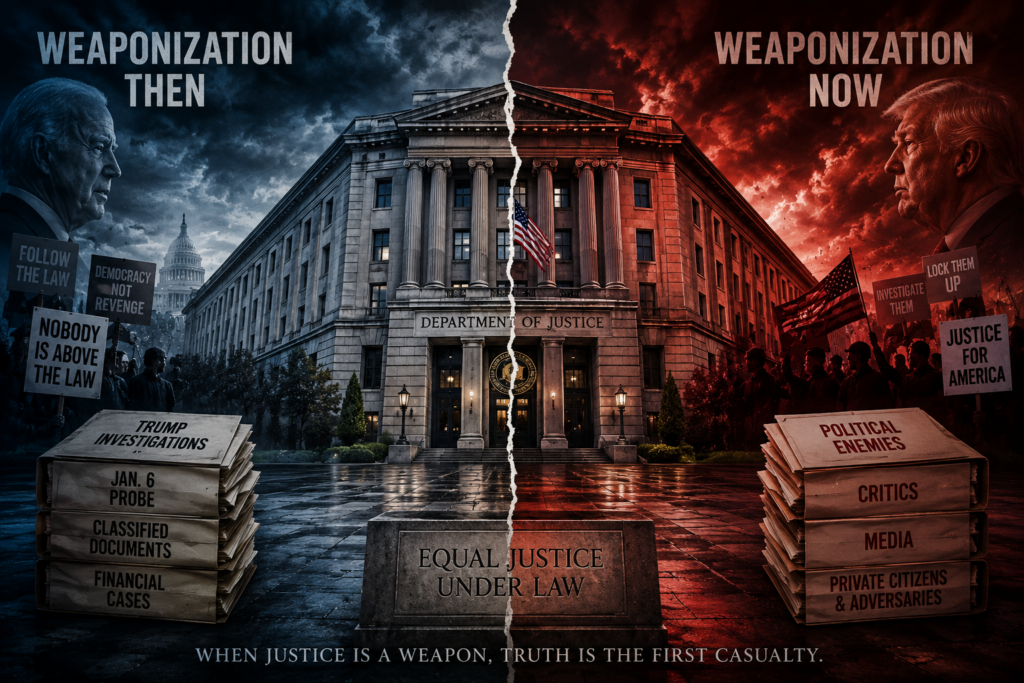
The pattern of actions I’ve documented—systematic information control, loyalty purges, attacks on institutional independence, and explicit statements about seeking a third term—suggests a consistent direction rather than random actions. If these trends continue unchecked, particularly combined with further erosion of electoral integrity, increased prosecution of political opponents through mechanisms like the “Weaponization Working Group,” greater control over media and information, and weakening of judicial independence, then the slide toward authoritarianism could accelerate. As I am writing this article, Trump continues to promote what he calls the “Board of Peace,” a proposed international organization that is an attempt to create a U.S.-led alternative to the United Nations. The scholar Alfred McCoy notes that Trump appears to be pursuing what Orwell described: a world divided into three regional blocs under strongman leaders, with weakened international institutions.

However, several factors may counter this trajectory. Strong civil society and activist movements continue organizing opposition movements. Independent state governments push back against federal overreach and robust legal challenges have blocked numerous executive actions. The free press continues investigative reporting despite attacks. Congressional resistance still exists—even Senator Booker’s 25-hour speech on constitutional abuse entered the Congressional Record as a permanent historical marker.

My speculation is that the most likely outcome is neither complete Orwellian dystopia nor a comfortable return to democratic norms, but rather what political scientists call “competitive authoritarianism” or “illiberal democracy”—where democratic forms persist but are increasingly hollowed out, opposition exists but faces systematic disadvantages, and truth becomes increasingly contested. The key question isn’t whether we’ll replicate 1984 exactly, but whether enough democratic safeguards will hold to prevent sliding further into authoritarianism. One observer standing before a giant banner of Trump’s face in Washington noted that “Orwell’s world isn’t just fiction. It’s a mirror—reflecting what happens when power faces no resistance, when truth bends to loyalty, and when silence becomes the safest response”.

The Bottom Line

The Orwell comparisons aren’t perfect historical analogies, but they’re not baseless partisan rhetoric either. They identify genuine patterns of authoritarian behavior that merit serious attention—the manipulation of language to distort reality, the systematic rewriting of historical narratives, the demand for personal loyalty over institutional integrity, and the rejection of shared factual reality. I am concerned about the increasing use of Nazi inspired phrases and themes by members of the Trump administration. Most recently, Kristy Noam’s use of the phrase “one of us-all of you”. While not a formal written Nazi policy, it reflects their practice when dealing with partisan attacks in occupied countries and can only be viewed as a threat of violence against American citizens.

Whether these patterns represent isolated troubling actions or the beginnings of systematic democratic erosion remains the crucial—and still open—question. As Orwell himself noted, he didn’t write to predict the future but to prevent it. The value of these comparisons may ultimately lie not in their precision as historical parallels, but in their power to alert citizens to concerning trends before they become irreversible.

Key Sources

  • Organization of American Historians statements on historical revisionism
  • Politico and Reuters reporting on inspector general firings
  • The Washington Post and Axios on executive order impacts
  • Stanford Professor Alex Woloch’s analysis in The World (https://theworld.org/stories/2017/01/25/people-are-saying-trumps-government-orwellian-what-does-actually-mean)
  • World Press Institute analysis (https://worldpressinstitute.org/the-orwell-effect-how-2025-america-felt-like-198/)
  • Adam Gopnik, “Orwell’s ‘1984’ and Trump’s America,” The New Yorker, Jan. 26, 2017.
  • “Trump’s America: Rethinking 1984 and Brave New World,” Monthly Review, Sept. 7, 2025.
  • “False or misleading statements by Donald Trump,” Wikipedia (overview of documented falsehoods).
  • “Trump’s Efforts to Control Information Echo, an Authoritarian Playbook,” The New York Times, Aug. 3, 2025.
  • “Trump’s 7 most authoritarian moves so far,” CNN Politics, Aug. 13, 2025.
  • “The Orwellian echoes in Trump’s push for ‘Americanism’ at the Smithsonian,” The Conversation, Aug. 20, 2025.
  • “Everything Is Content for the ‘Clicktatorship’,” WIRED, Jan. 13, 2026.
  • “’Animal Farm’ Perfectly Describes Life in the Era of Donald Trump,” Observer, May 8, 2017.
  • “Ditch the ‘Animal Farm’ Mentality in Resisting Trump Policies,” YES! Magazine, May 8, 2017.

Full disclosure: I recently bought a hat that says “Make Orwell Fiction Again”.

What “Woke” Really Means: A Look at a Loaded Word

Why everyone’s fighting over a word nobody agrees on

Okay, so you’ve probably heard “woke” thrown around about a million times, right? It’s in political debates, online arguments, your uncle’s Facebook rants—basically everywhere. And here’s the weird part: depending on who’s saying it, it either means you’re enlightened or you’re insufferable.

So let’s figure out what’s actually going on with this word.

Where It All Started

Here’s something most people don’t know: “woke” wasn’t invented by social media activists or liberal college students. It goes way back to the 1930s in Black communities, and it meant something straightforward—stay alert to racism and injustice.

The earliest solid example comes from blues musician Lead Belly. In his song “Scottsboro Boys” (about nine Black teenagers falsely accused of rape in Alabama in 1931), he told Black Americans to “stay woke”—basically meaning watch your back, because the system isn’t on your side. This wasn’t abstract philosophy; it was survival advice in the Jim Crow South.

The term hung around in Black culture for decades. It got a boost in 2008 when Erykah Badu used “I stay woke” in her song “Master Teacher,” where it meant something like staying self-aware and questioning the status quo.

But the big explosion happened around 2014 during the Ferguson protests after Michael Brown was killed. Black Lives Matter activists started using “stay woke” to talk about police brutality and systemic racism. It spread through Black Twitter, then got picked up by white progressives showing solidarity with social justice movements. By the late 2010s, it had expanded to cover sexism, LGBTQ+ issues, and pretty much any social inequality you can think of.

And that’s when conservatives started using it as an insult.

The Liberal Take: It’s About Giving a Damn

For progressives, “woke” still carries that original vibe of awareness. According to a 2023 Ipsos poll, 56% of Americans (and 78% of Democrats) said “woke” means “to be informed, educated, and aware of social injustices.”

From this angle, being woke just means you’re paying attention to how race, gender, sexuality, and class affect people’s lives—and you think we should try to make things fairer. It’s not about shaming people; it’s about understanding the experiences of others.

Liberals see it as continuing the work of the civil rights movement—expanding who we empathize with and include. That might mean supporting diversity programs, using inclusive language, or rethinking how we teach history. To them, it’s just what thoughtful people do in a diverse society.

Here’s the Progressive Argument in a Nutshell

The term literally started as self-defense. Progressives argue the problems are real. Being “woke” is about recognizing that bias, inequality, and discrimination still exist. The data back some of this up—there are documented disparities in policing, sentencing, healthcare, and economic opportunity across racial lines. From this view, pointing these things out isn’t being oversensitive; it’s just stating facts.

They also point out that conservatives weaponized the term. They took a word from Black communities about awareness and justice and turned it into an all-purpose insult for anything they don’t like about the left. Some activists call this a “racial dog whistle”—a way to attack justice movements without being explicitly racist.

The concept naturally expanded from racial justice to other inequalities—sexism, LGBTQ+ discrimination, other forms of unfairness. Supporters see this as logical: if you care about one group being treated badly, why wouldn’t you care about others?

And here’s their final point: what’s the alternative? When you dismiss “wokeness,” you’re often dismissing the underlying concerns. Denying that racism still affects American life can become just another way to ignore real problems.

Bottom line from the liberal side: being “woke” means you’ve opened your eyes to how society works differently for different people, and you think we can do better.

The Conservative Take: It’s About Going Too Far

Conservatives see it completely differently. To them, “woke” isn’t about awareness—it’s about excess and control.

They see “wokeness” as an ideology that forces moral conformity and punishes anyone who disagrees. What started as social awareness has turned into censorship and moral bullying. When a professor loses their job over an unpopular opinion or comedy shows get edited for “offensive” jokes, conservatives point and say: “See? This is exactly what we’re talking about.”  To them, “woke” is just the new version of “politically correct”—except worse. It’s intolerance dressed up as virtue.

Here’s the conservative argument in a nutshell:

Wokeness has moved way beyond awareness into something harmful. They argue it creates a “victimhood culture” where status and that benefits come from claiming you’re oppressed rather than from merit or hard work. Instead of fixing injustice, they say it perpetuates it by elevating people based on identity rather than achievement.

They see it as “an intolerant and moralizing ideology” that threatens free speech. In their view, woke culture only allows viewpoints that align with progressive ideology and “cancels” dissenters or labels them “white supremacists.”

Many conservatives deny that structural racism or widespread discrimination still exists in modern America. They attribute unequal outcomes to factors other than bias. They believe America is fundamentally a great country and reject the idea that there is systematic racism or that capitalism can sometimes be unjust.

They also see real harm in certain progressive positions—like the idea that gender is principally a social construct or that children should self-determine their gender. They view these as threats to traditional values and biological reality.

Ultimately, conservatives argue that wokeness is about gaining power through moral intimidation rather than correcting injustice. In their view, the people rejecting wokeness are the real critical thinkers.

The Heart of the Clash

Here’s what makes this so messy: both sides genuinely believe they’re defending what’s right.

Liberals think “woke” means justice and empathy. Conservatives think it means judgment and control. The exact same thing—a company ad featuring diverse families, a school curriculum change, a social movement—can look like progress to one person and propaganda to another.

One person’s enlightenment is literally another person’s indoctrination.

The Word Nobody Wants Anymore

Here’s the ironic part: almost nobody calls themselves “woke” anymore. Like “politically correct” before it, the word has gotten so loaded that it’s frequently used as an insult—even by people who agree with the underlying ideas. The term has been stretched to cover everything from racial awareness to climate activism to gender identity debates, and the more it’s used, the less anyone knows what it truly means.

Recently though, some progressives have started reclaiming the term—you’re beginning to see “WOKE” on protest signs now.

So, Who’s Right?

Maybe both. Maybe neither.

If “woke” means staying aware of injustice and treating people fairly, that’s good. If it means acting morally superior and shutting down disagreement, that’s not. The truth is probably somewhere in the messy middle.

This whole debate tells us more about America than about the word itself. We’ve always struggled with how to balance freedom with fairness, justice with tolerance. “Woke” is just the latest word we’re using to have that same old argument.

The Bottom Line

Whether you love it or hate it, “woke” isn’t going anywhere soon. It captures our national struggle to figure out what awareness and fairness should look like today.

And honestly? Maybe we’d all be better off spending less time arguing about the word and more time talking about the actual values behind it—what’s fair, what’s free speech, what kind of society do we want?

Being “woke” originally meant recognizing systemic prejudices—racial injustice, discrimination, and social inequities many still experience daily. But the term’s become a cultural flashpoint.  Here’s the thing: real progress requires acknowledging both perspectives exist and finding common ground. It’s not about who’s “right”—it’s about building bridges.

 If being truly woke means staying alert to injustice while remaining open to dialogue with those who see things differently, seeking solutions that work for everyone, caring for others, being empathetic and charitable, then call me WOKE.

Supply-Side Economics and Trickle-Down: What Actually Happened?

The Basic Question

You’ve probably heard politicians arguing about tax cuts—some promising they’ll supercharge the economy, others dismissing them as giveaways to the rich. These debates usually involve two terms that get thrown around like political footballs: “supply-side economics” and “trickle-down economics.” But what do these terms actually mean, and more importantly, do they work? After four decades of real-world experiments, we finally have enough data to answer that question.

Understanding Supply-Side Economics

Supply-side economics is a legitimate economic theory that emerged in the 1970s when the U.S. economy was struggling with both high inflation and high unemployment—a combination that traditional economic theories said shouldn’t happen. The core idea is straightforward: economic growth comes from producing more goods and services (the “supply” side), not just from boosting consumer demand.

The theory rests on three main pillars. First, lower taxes—the thinking is that if people and businesses keep more of their money, they’ll work harder, invest more, and create jobs. According to economist Arthur Laffer’s famous curve, there’s supposedly a sweet spot where lower tax rates can actually generate more government revenue because the economy grows so much. Second, less regulation removes government restrictions so businesses can innovate and operate more efficiently. Third, smart monetary policy keeps inflation in check while maintaining enough money in the economy to fuel growth.

All of this sounds reasonable in theory. After all, who wouldn’t work harder if they kept more of their paycheck?

The Political Rebranding: Enter “Trickle-Down”

Here’s where economic theory meets political messaging. “Trickle-down economics” isn’t an academic term—it’s essentially a catchphrase, and not a complimentary one. Critics use it to describe supply-side policies when those policies mainly benefit wealthy people and corporations. The idea behind the name: give tax breaks to rich people and big companies, and the benefits will eventually “trickle down” to everyone else through job creation, higher wages, and economic growth.

Here’s the interesting part: no economist actually calls their theory “trickle-down economics.” Even David Stockman, President Reagan’s own budget director, later admitted that “supply-side” was basically a rebranding of “trickle-down” to make tax cuts for the wealthy easier to sell politically. So while they’re not identical concepts, they’re two sides of the same coin.

The Reagan Revolution: Testing the Theory

Ronald Reagan became president in 1981 and implemented the biggest supply-side experiment in U.S. history. He slashed the top tax rate from 70% down to 50%, and eventually to just 28%, arguing this would unleash economic growth that would lift all boats.

The results were genuinely mixed. On one hand, the economy created about 20 million jobs during Reagan’s presidency, unemployment fell from 7.6% to 5.5%, and the economy grew by 26% over eight years. Those aren’t small achievements.

But the picture gets more complicated when you look deeper. The tax cuts didn’t pay for themselves as promised—they reduced government revenue by about 9% initially. Reagan had to backtrack and raise taxes multiple times in 1982, 1983, 1984, and 1987 to address the mounting deficit problem. Income inequality increased significantly during this period, and surprisingly, the poverty rate at the end of Reagan’s term was essentially the same as when he started. Perhaps most telling, government debt more than doubled as a percentage of the economy.

There’s another wrinkle worth mentioning: much of the economic recovery happened because Federal Reserve Chairman Paul Volcker had already broken the back of inflation through tight monetary policy before Reagan’s tax cuts took effect. Disentangling how much credit Reagan’s policies deserve versus Volcker’s groundwork is genuinely difficult.

The Pattern Repeats

The story didn’t end with Reagan. George W. Bush enacted major tax cuts in 2001 and 2003, especially benefiting wealthy Americans. The result? Economic growth remained sluggish, deficits ballooned, and income inequality continued its upward march.

Then there’s Bill Clinton—the plot twist in this story. In 1993, Clinton actually raised taxes on the wealthy, pushing the top rate from 31% back up to 39.6%. Conservative economists predicted economic disaster. Instead, the economy boomed with what was then the longest sustained growth period in U.S. history, creating 22.7 million jobs. Even more remarkably, the government ran a budget surplus for the first time in decades.

Donald Trump’s 2017 tax cuts, focused heavily on corporations, showed minimal wage growth for workers while generating significant stock buybacks that primarily benefited shareholders—and yes, larger deficits. Trump’s subsequent economic policies in his second term have been characterized by such volatility that reasonable long-term assessments remain difficult.

The Kansas Experiment: A Modern Test Case

At the state level, Kansas Governor Sam Brownback implemented one of the boldest modern experiments in supply-side policy between 2012 and 2017, dramatically slashing income taxes especially for businesses. Proponents called it a “real live experiment” that would demonstrate supply-side principles in action.

Instead of unleashing growth, Kansas faced severe budget shortfalls that forced cuts to education and infrastructure. Economic growth actually lagged behind neighboring states that didn’t implement such aggressive cuts, and the state legislature eventually reversed many of the tax reductions. This case has become a frequently cited cautionary tale for critics of supply-side policies.

What Does Half a Century of Data Show?

After 50 years of real-world experiments, researchers finally have enough data to move beyond political rhetoric. A comprehensive study analyzed tax policy changes across 18 developed countries over five decades, looking at what actually happened after major tax cuts for the wealthy.

The findings are remarkably consistent. Tax cuts for the rich reliably increase income inequality—no surprise there. But they show no significant effect on overall economic growth rates and no significant effect on unemployment. Perhaps most damaging to the theory, they don’t “pay for themselves” through increased growth. At best, about one-third of lost revenue gets recovered through expanded economic activity.

In simpler terms: when you cut taxes for wealthy people, wealthy people get wealthier. The promised broader benefits largely fail to materialize. The 2022 World Inequality Report reinforced these conclusions, finding that the world’s richest 10% continue capturing the vast majority of all economic gains, while the bottom half of the population holds just 2% of all wealth.

Why the Theory Doesn’t Match Reality

When you think about it logically, the disconnect makes sense. If you give a tax cut to someone who’s already wealthy, they’ll probably save or invest most of it—they were already buying what they wanted and needed. Their daily spending habits don’t change much. But if you give money to someone who’s struggling to pay bills or afford necessities, they’ll spend it immediately, directly stimulating economic activity.

Economists call this concept “marginal propensity to consume,” and it explains why giving tax breaks to working and middle-class people actually does more to boost the economy than supply-side cuts focused on the wealthy. A dollar in the hands of someone who needs to spend it has more immediate economic impact than a dollar added to an already-substantial investment portfolio.

The Bottom Line

After 40-plus years of repeated experiments, the pattern is clear. Supply-side policies and trickle-down approaches consistently increase deficits, widen inequality, and fail to significantly boost overall economic growth or create more jobs than alternative policies. Meanwhile, periods with higher taxes on the wealthy, like the Clinton years, saw strong growth, robust job creation, and balanced budgets.

The Nuance Worth Keeping

None of this means all tax cuts are bad or that high taxes are always good—economics is rarely that simple. The critical questions are: who receives the tax cuts, and what outcomes do you realistically expect? Targeted tax cuts for working families, small businesses, or specific industries facing genuine challenges can serve as effective policy tools. Child tax credits, research and development incentives, or relief for struggling sectors might accomplish specific goals.

But the evidence accumulated over four decades is clear: broad tax cuts focused primarily on the wealthy and large corporations don’t deliver the promised economic benefits for everyone else. The benefits don’t trickle down in any meaningful way.

You’ll keep hearing these arguments for years to come. Politicians will continue promising that tax cuts for businesses and the wealthy will boost the entire economy. Now you know what the actual evidence shows, and you can judge those promises accordingly.


Sources:

The Sugar Act of 1764: The Tax Cut That Sparked a Revolution

The Sugar Act of 1764: The Tax Cut That Sparked a Revolution

Imagine a time when people rose up in protest of a tax being lowered.  Welcome to the world of the Sugar Act.

The Sugar Act of 1764 stands as one of the most ironic moments in the history of taxation. Here Britain was actually lowering a tax, and yet colonists reacted with a fury that would help spark a revolution. To understanding this paradox, we must understand that this new act represented something far more threatening than any previous attempt by Britain to regulate its American colonies.

The Old System: Benign Neglect

For decades before 1764, Britain had maintained what historians call “salutary neglect” toward its American colonies. The Molasses Act of 1733 had imposed a steep duty of six pence per gallon on foreign molasses imported into the colonies. On paper, this seemed like a significant burden for the rum-distilling industry, which depended heavily on cheap molasses from French and Spanish Caribbean islands. In practice, though, the tax was rarely collected. Colonial merchants either bribed customs officials or simply smuggled the molasses past them. The British government essentially looked the other way, and everyone profited.

This informal arrangement worked because Britain’s primary interest in the colonies was commercial, not fiscal. The Navigation Acts required colonists to ship certain goods only to Britain and to buy manufactured goods from British merchants, which enriched British traders and manufacturers without requiring aggressive tax collection in America. As long as this system funneled wealth toward London, Parliament didn’t care much about collecting relatively small customs duties across the Atlantic.

Everything Changed in 1763

The Seven Years’ War (which Americans call the French and Indian War) changed this comfortable arrangement entirely. Britain won decisively, driving France out of North America and gaining vast new territories. But victory came with a staggering price tag. Britain’s national debt had nearly doubled to £130 million, and annual interest payments alone consumed half the government’s budget. Meanwhile, Britain now needed to maintain 10,000 troops in North America to defend its expanded empire and manage relations with Native American tribes.

Prime Minister George Grenville faced a political problem. British taxpayers, already heavily burdened, were in no mood for additional taxes. The logic seemed obvious: since the colonies had benefited from the war’s outcome and still required military protection, they should help pay for their own defense. Americans, paid far lower taxes than their counterparts in Britain—by some estimates, British residents paid 26 times more per capita in taxes than colonists did.

What the Act Actually Did

The Sugar Act (officially the American Revenue Act of 1764) approached colonial taxation differently than anything before it. First, it cut the duty on foreign molasses from six pence to three pence per gallon—a 50% reduction. Grenville calculated, reasonably, that merchants might actually pay a three-pence duty rather than risk getting caught smuggling, whereas the six-pence duty had been so high it encouraged universal evasion.

But the Act did far more than adjust molasses duties. It added or increased duties on foreign textiles, coffee, indigo, and wine imported into the colonies. colonialtened regulations around the colonial lumber trade and banned the import of foreign rum entirely. Most significantly, the Act included elaborate provisions designed to strictly enforce these duties for the first time.

The enforcement mechanisms represented the real revolution in British policy. Ship captains now had to post bonds before loading cargo and had to maintain detailed written cargo lists. Naval patrols increased dramatically. Smugglers faced having their ships and cargo seized.

Significantly, the burden of proof was shifted to the accused.  They were required to prove their innocence, a reversal of traditional British justice. Most controversially, accused smugglers would be tried in vice-admiralty courts, which had no juries and whose judges received a cut of any fines levied.

The Paradox of the Lower Tax

So why did colonists react so angrily to a tax cut? The answer reveals the fundamental shift in the British-American relationship that the Sugar Act represented.

First, the issue wasn’t the tax rate. It was the certainty of collection. A six-pence tax that no one paid was infinitely preferable to a three-pence tax rigorously enforced. New England’s rum distilling industry, which employed thousands of distillery workers and sailors, depended on cheap molasses from the French West Indies. Even at three pence per gallon, the tax significantly increased operating costs. Many merchants calculated they couldn’t remain profitable if they had to pay it.

Second, and more importantly, colonists recognized that the Act’s purpose had changed relationships. Previous trade regulations, even if they involved taxes, were ostensibly about regulating commerce within the empire. The Sugar Act openly stated its purpose was raising revenue—the preamble declared it was “just and necessary that a revenue be raised” in America. This might seem like a technical distinction, but to colonists it mattered enormously. British constitutional theory held that subjects could only be taxed by their own elected representatives. Colonists elected representatives to their own assemblies but sent no representatives to Parliament. Trade regulations fell under Parliament’s legitimate authority to govern imperial commerce, but taxation for revenue was something else entirely.

Third, the enforcement mechanisms offended colonial sensibilities about justice and traditional British rights. The vice-admiralty courts denied jury trials, which colonists viewed as a fundamental right of British subjects. Having to prove your innocence rather than being presumed innocent violated another core principle. Customs officials and judges profiting from convictions created obvious incentives for abuse.

Implementation and Colonial Response

The Act took effect in September 1764, and Grenville paired it with an aggressive enforcement campaign. The Royal Navy assigned 27 ships to patrol American waters. Britain appointed new customs officials and gave them instructions to strictly do their jobs rather than accept bribes. Admiralty courts in Halifax, Nova Scotia became particularly notorious.  Colonists had to travel hundreds of miles to defend themselves in a court with no jury and with a judge whose income game from convictions.

Colonists responded immediately. Boston merchants drafted a protest arguing that the act would devastate their trade. They explained that New England’s economy depended on a complex triangular trade: they sold lumber and food to the Caribbean in exchange for molasses, which they distilled into rum, which they sold to Africa for slaves, who were sold to Caribbean plantations for molasses, and the cycle repeated. Taxing molasses would break this chain and impoverish the region.

But the economic arguments quickly evolved into constitutional ones. Lawyer James Otis argued that “taxation without representation is tyranny”—a phrase that would echo through the coming decade. Colonial assemblies began passing resolutions asserting their exclusive right to tax their own constituents. They didn’t deny Parliament’s authority to regulate trade, but they drew a clear line: revenue taxation required representation.

The protests went beyond rhetoric. Colonial merchants organized boycotts of British manufactured goods. Women’s groups pledged to wear homespun cloth rather than buy British textiles. These boycotts caused enough economic pain in Britain that London merchants began lobbying Parliament for relief.

The Road to Revolution

The Sugar Act’s significance extends far beyond its immediate economic impact. It established precedents and patterns that would define the next decade of imperial crisis.

Most fundamentally, it shattered the comfortable arrangement of salutary neglect. Once Britain demonstrated it intended to actively govern and tax the colonies, the relationship could never return to its previous informality. The colonists’ constitutional objections—no taxation without representation, right to jury trials, presumption of innocence—would be repeated with increasing urgency as Parliament passed the Stamp Act (1765), Townshend Acts (1767), and Tea Act (1773).

The Sugar Act also revealed the practical difficulties of governing an empire across 3,000 miles of ocean. The vice-admiralty courts became symbols of distant, unaccountable power. When colonists couldn’t get satisfaction through established legal channels, they increasingly turned to extralegal methods, including committees of correspondence, non-importation agreements, and eventually armed resistance.

Perhaps most importantly, the Sugar Act forced colonists to articulate a political theory that ultimately proved incompatible with continued membership in the British Empire. Once they agreed to the principle that they could only be taxed by their own elected representatives, and that Parliament’s authority over them was limited to trade regulation, the logic led inexorably toward independence. Britain couldn’t accept colonial assemblies as co-equal governing bodies since Parliament claimed supreme authority over all British subjects. The colonists couldn’t accept taxation without representation since they claimed the rights of freeborn Englishmen. These positions couldn’t be reconciled.

The Sugar Act of 1764 represents the point where the British Empire’s century-long success in North America began to unravel. By trying to make the colonies pay a modest share of imperial costs through what seemed like reasonable means, Britain inadvertently set in motion forces that would break the empire apart just twelve years later.

Sources

Mount Vernon Digital Encyclopedia – Sugar Act https://www.mountvernon.org/library/digitalhistory/digital-encyclopedia/article/sugar-act/ Provides overview of the Act’s provisions, economic context, and relationship to British debt from the Seven Years’ War. Includes information on tax burden comparisons between Britain and the colonies.

Britannica – Sugar Act https://www.britannica.com/event/Sugar-Act Covers the specific provisions of the Act, enforcement mechanisms, vice-admiralty courts, and the shift from the Molasses Act of 1733. Useful for technical details of the legislation.

History.com – Sugar Act https://www.history.com/topics/american-revolution/sugar-act Discusses colonial constitutional objections, the “taxation without representation” argument, and the enforcement provisions including burden of proof reversal and jury trial denial.

American Battlefield Trust – Sugar Act https://www.battlefields.org/learn/articles/sugar-act Details colonial response including boycotts, James Otis’s arguments, and the triangular trade system that the Act disrupted.

Additional Recommended Sources

Library of Congress – The Sugar Act https://www.loc.gov/collections/continental-congress-and-constitutional-convention-broadsides/articles-and-essays/continental-congress-broadsides/broadsides-related-to-the-sugar-act/ Primary source collection including contemporary colonial broadsides and protests against the Act.

National Archives – The Sugar Act (Primary Source Text) https://founders.archives.gov/about/Sugar-Act The actual text of the American Revenue Act of 1764, useful for verifying specific provisions and language.

Yale Law School – Avalon Project: Resolutions of the Continental Congress (October 19, 1765) https://avalon.law.yale.edu/18th_century/resolu65.asp Colonial responses to the Sugar and Stamp Acts, showing how the arguments evolved.

Massachusetts Historical Society – James Otis’s Rights of the British Colonies Asserted and Proved (1764) https://www.masshist.org/digitalhistory/revolution/taxation-without-representation Primary source for the “taxation without representation” argument that emerged from Sugar Act opposition.

Colonial Williamsburg Foundation – Sugar Act of 1764 https://www.colonialwilliamsburg.org/learn/deep-dives/sugar-act-1764/ Discusses economic impact on colonial merchants and the rum distilling industry.

Slavery and the Constitutional Convention: The Compromise That Shaped a Nation

When fifty-five delegates gathered in Philadelphia during the sweltering summer of 1787, they faced a challenge that would haunt American politics for the next eight decades. The question wasn’t whether slavery was morally right—many delegates privately acknowledged its evil—but whether a unified nation could exist with slavery as a part of it. That summer, the institution of slavery nearly killed the Constitution before it was born.

The Battle Lines

The convention revealed a stark divide. On one side stood delegates who spoke forcefully against slavery, though they represented a minority voice. Gouverneur Morris of Pennsylvania delivered some of the most scathing condemnations, calling slavery a “nefarious institution” and “the curse of heaven on the states where it prevailed.” According to James Madison’s notes, Morris argued passionately that counting enslaved people for representation would mean that someone “who goes to the Coast of Africa, and in defiance of the most sacred laws of humanity tears away his fellow creatures from their dearest connections & damns them to the most cruel bondages, shall have more votes in a Government instituted for protection of the rights of mankind.”

Luther Martin of Maryland, himself a slaveholder, joined Morris in opposition. He declared the slave trade “inconsistent with the principles of the revolution and dishonorable to the American character.”.  Even George Mason of Virginia, who owned over 200 enslaved people, denounced slavery at the convention, warning that “every master of slaves is born a petty tyrant” and that it would bring “the judgment of heaven on a country.”

The Southern Coalition

Facing these critics stood delegates from the Deep South—primarily South Carolina and Georgia—who made it abundantly clear that protecting slavery was non-negotiable. The South Carolina delegation was particularly unified and aggressive in defending the institution. All four of their delegates—John Rutledge, Charles Pinckney, Charles Cotesworth Pinckney, and Pierce Butler—owned slaves, and they spoke with one voice.

Charles Cotesworth Pinckney stated bluntly: “South Carolina and Georgia cannot do without slaves.” John Rutledge framed it even more starkly: “The true question at present is, whether the Southern States shall or shall not be parties to the Union.” The message was unmistakable—attempt to restrict slavery, and there would be no Constitution and perhaps no United States.

The Southern states didn’t just defend slavery; they threatened to walk out repeatedly. When debates over the slave trade heated up on August 22, delegates from North Carolina, South Carolina, and Georgia stated they would “never be such fools as to give up” their right to import enslaved Africans.  These weren’t idle threats—they were credible enough to force compromise.

The Three-Fifths Compromise

The central flashpoint came over representation in Congress. The new Constitution would base representation on population, but should enslaved people count? Southern states wanted every enslaved person counted fully, which would dramatically increase their congressional power. Northern states argued that enslaved people—who had no rights and couldn’t vote—shouldn’t count at all.

The three-fifths ratio had actually been debated before. Back in 1783, Congress had considered using it to calculate state tax obligations under the Articles of Confederation, though that proposal failed. James Wilson of Pennsylvania resurrected the idea at the Constitutional Convention, suggesting that representation be based on the free population plus three-fifths of “all other persons”—the euphemism they used to avoid writing the word “slave” in the Constitution.

The compromise passed eight states to two. New Jersey and Delaware are generally identified as the states voting against the compromise, New Hampshire is not listed as taking part in the vote. Rhode Island did not send a delegation to the convention and by the time of the vote New York no longer had a functioning delegation.

Though the South ultimately accepted the compromise, it wasn’t what they wanted. Southern delegates had pushed to count enslaved people equally with free persons—but otherwise ignored on all issues of human rights. The three-fifths ratio was a reduction from their demands—a limitation on slave state power, though it still gave them substantial advantage. With about 93% of the nation’s enslaved population concentrated in just five southern states, this compromise increased the South’s congressional delegation by 42%.

James Madison later recognized the compromise’s significance. He wrote after the convention: “It seems now to be pretty well understood that the real difference of interests lies not between the large and small but between the northern and southern states. The institution of slavery and its consequences form the line of discrimination.”

Could the Constitution Have Happened Without It?

Here’s where I need to speculate, but I’m fairly confident in this assessment: no, the Constitution would not have been ratified without the three-fifths compromise and related concessions on slavery.

The evidence is overwhelming. South Carolina and Georgia delegates stated explicitly and repeatedly that they would not join any union that restricted slavery. Alexander Hamilton himself later acknowledged that “no union could possibly have been formed” without the three-fifths compromise. Even delegates who despised slavery, like Roger Sherman of Connecticut, argued it was “better to let the Southern States import slaves than to part with them.”

The convention negotiated three major slavery compromises, all linked. Beyond the three-fifths clause, they agreed Congress couldn’t ban the international slave trade until 1808, and they included the Fugitive Slave Clause requiring the return of escaped enslaved people even from free states. These deals were struck together on August 29, 1787, in what Madison’s notes reveal was a package negotiation between northern and southern delegates.

Without these compromises, the convention would likely have collapsed. The alternative wouldn’t have been a better Constitution—it would have been no Constitution at all, potentially leaving the thirteen states as separate nations or weak confederations. Whether that would have been preferable is a profound counterfactual question that historians still debate.

The Impact on Early American Politics

The three-fifths compromise didn’t just affect one document—it shaped American politics for decades. Its effects were immediate and substantial.

The most famous early example came in the presidential election of 1800. Thomas Jefferson defeated John Adams in what’s often called the “Revolution of 1800″—the first peaceful transfer of power between opposing political parties. But Jefferson’s victory owed directly to the three-fifths compromise. Virginia’s enslaved population gave the state extra electoral votes that proved decisive. Historian Garry Wills has speculated that without these additional slave-state votes, Jefferson would have lost. Pennsylvania had a free population 10% larger than Virginia’s, yet received 20% fewer electoral votes because Virginia’s numbers were inflated by the compromise.

The impact extended far beyond that single election. Research shows the three-fifths clause changed the outcome of over 55% of legislative votes in the Sixth Congress (1799-1801). (The additional southern representatives—about 18 more than their free population warranted—gave the South what became known as the “Slave Power” in Congress.

This power influenced major legislation throughout the antebellum period. The Indian Removal Act of 1830, which forcibly relocated Native Americans to open land for plantation agriculture, passed because of margins provided by these extra southern representatives. The Missouri Compromise, the Kansas-Nebraska Act, and numerous other slavery-related measures bore the fingerprints of this constitutional imbalance.

The compromise also affected Supreme Court appointments and federal patronage. Southern-dominated Congresses ensured pro-slavery justices and policies that protected the institution. The sectional tensions it created led directly to later compromises—the Missouri Compromise of 1820, the Compromise of 1850—each one a temporary bandage on a wound that wouldn’t heal.

By the 1850s, the artificial political power granted to slave states had become intolerable to many northerners. When Abraham Lincoln won the presidency in 1860 without carrying a single southern state, southern political leaders recognized they had lost control of the federal government. Senator Louis Wigfall of Texas complained that non-slaveholding states now controlled Congress and the Electoral College. Ten southern states seceded in large part because they believed the three-fifths compromise no longer protected their interests.

The Bitter Legacy

The framers consciously avoided using the words “slave” or “slavery” in the Constitution, recognizing it would “sully the document.” But the euphemisms fooled no one. They had built slavery into the structure of American government, trading moral principles for political union.

The Civil War finally resolved what the Constitutional Convention had delayed. The Thirteenth Amendment abolished slavery in 1865, but not until 1868 did the Fourteenth Amendment finally strike the three-fifths clause from the Constitution, requiring that representation be based on counting the “whole number of persons” in each state.

Was it worth it? That’s ultimately a question of values. The Constitution created a stronger national government that eventually abolished slavery, but it took 78 years and a war that killed over 600,000 Americans. As Thurgood Marshall noted on the Constitution’s bicentennial, the framers “consented to a document which laid a foundation for the tragic events which were to follow.”

The convention delegates knew what they were doing. They chose union over justice, pragmatism over principle. Whether that choice was necessary, wise, or moral remains one of the most contested questions in American history.

____________________________________________________

Sources

  1. https://www.battlefields.org/learn/articles/slavery-and-constitution
  2. https://en.wikipedia.org/wiki/Luther_Martin
  3. https://schistorynewsletter.substack.com/p/7-october-2024
  4. https://www.americanacorner.com/blog/constitutional-convention-slavery
  5. https://www.nps.gov/articles/000/constitutionalconvention-august22.htm
  6. https://en.wikipedia.org/wiki/Three-fifths_Compromise
  7. https://www.brennancenter.org/our-work/analysis-opinion/electoral-colleges-racist-origins
  8. https://www.gilderlehrman.org/history-resources/teaching-resource/historical-context-constitution-and-slavery
  9. https://www.nps.gov/articles/000/constitutionalconvention-august29.htm
  10. https://www.lwv.org/blog/three-fifths-compromise-and-electoral-college
  11. https://www.aaihs.org/a-compact-for-the-good-of-america-slavery-and-the-three-fifths-compromise-part-ii/

Thomas Jefferson: The Philosopher Who Played Hardball

Here’s the thing about Thomas Jefferson that doesn’t always make it into the history textbooks: the guy who wrote those soaring words about liberty and limited government? He was also one of early America’s most skilled—and sometimes underhanded—political operators.

It’s surprising when you think about it. Jefferson genuinely believed in transparency, virtue in public life, and keeping government small. He wrote beautifully about these ideals. But when it came to actual politics? He played the game as hard as anyone, often using tactics that directly contradicted what he preached.

Jefferson’s public philosophy was straightforward. He thought America should be a nation of independent farmers—regular people who owned their own land and weren’t dependent on anyone else. He worried constantly about concentrated power, whether in government or in the hands of wealthy financiers or merchants. He believed people should be informed and engaged, and that government worked best when it stayed out of people’s lives.

His Declaration of Independence wasn’t just pretty rhetoric—it laid out a genuinely revolutionary idea: governments only have power because people agree to give it to them, and when governments stop serving the people, those people have the right to change things.

The Reality: How Jefferson Actually Operated

Here’s where it gets interesting. While Jefferson was writing about virtue and transparency, he was simultaneously running what today we’d recognize as opposition research, planting stories in the press, and organizing political operations—sometimes against people he was supposed to be working with.

The Freneau Setup: Paying for Attacks

The most blatant example happened in 1791. Jefferson was serving as Secretary of State under George Washington, which meant he was part of the administration. At the same time, he arranged for a guy named Philip Freneau to get a government job—technically as a translator. The real purpose? To give Freneau money to run a newspaper that would relentlessly attack Alexander Hamilton and other Federalists.

Think about that for a second. Jefferson was using his government position to fund media attacks on his own colleagues. When people called him out on it, he basically said, “Who, me? I have nothing to do with what Freneau publishes.” But the evidence shows Jefferson was actively encouraging and directing these attacks.

John Beckley: The Original Campaign Fixer

Jefferson also worked closely with John Beckley, who was essentially America’s first professional political operative. Beckley coordinated messaging, spread information (and sometimes misinformation) about opponents, and helped build the grassroots organization that would eventually become the Democratic-Republican Party.

This wasn’t a gentlemanly debate about ideas. This was organized political warfare—pamphlets, coordinated newspaper campaigns, and opposition research. Jefferson and Jame Madison quietly funded much of this work while maintaining public images as above-the-fray philosophers. We can’t know exactly what Jefferson said in every private conversation with Beckley, but the circumstantial evidence of coordination is convincing.

The Hamilton Rivalry: Ideological War

Jefferson’s conflict with Hamilton was both philosophical and deeply personal. Hamilton wanted a strong federal government, a national bank, and close ties with Britain. Jefferson saw all of this as a betrayal of the Revolution—a step toward creating the same kind of corrupt, elite-dominated system they’d just fought to escape.

But rather than just making his arguments publicly, Jefferson worked behind the scenes to undermine Hamilton’s policies. He encouraged Madison to lead opposition in Congress. He fed stories to friendly newspapers. He coordinated with Republican representatives to block Federalist initiatives.

The philosophical disagreement was real, but Jefferson’s methods were pure political calculation.

Turning on Washington: The Ultimate Betrayal?

Maybe the most damaging thing Jefferson did was secretly working against George Washington while still serving in his cabinet. By Washington’s second term, Jefferson had convinced himself that Washington was being manipulated by Hamilton and moving the country toward monarchy.

 Jefferson stayed in the cabinet, maintaining cordial relations with Washington in person, while privately organizing resistance to administration policies. He encouraged attacks on Washington in the press. He coordinated with opposition leaders. And he did all of this while Washington trusted him as a loyal advisor.

When Washington found out, he was devastated. The betrayal broke their relationship permanently.

The Burr Situation: Using People

Jefferson’s handling of Aaron Burr shows just how pragmatic he could be. Jefferson never really trusted Burr—thought he was too ambitious and unprincipled. But in 1800, when Jefferson needed to win the presidency, Burr was useful for delivering New York’s votes.

After winning, Jefferson kept Burr as vice president but froze him out of any real power. Once Burr’s usefulness ended (especially after he killed Hamilton in that duel), Jefferson completely abandoned him, eventually supporting an unsuccessful prosecution for treason.

Deceiving Congress

Another example of Jefferson’s political manipulation was the Louisiana Purchase. This was a massive land acquisition that doubled the size of the United States. Jefferson knew that under the constitution he had no clear authority to acquire territory for the United States.  He was able to secure the purchase by keeping it secret from both congress and his political opponents until after it was finalized. This allowed him to avoid a debate that could have derailed the deal.  Does this sound familiar?

So, What Do We Make of This?

Here’s the uncomfortable question: Was Jefferson a hypocrite, or was he just being realistic about how politics actually works?  Jefferson’s political manipulation was not always ethical, but it was effective. He was able to use his skills to achieve many of his political goals.

You could argue he was doing what he thought necessary to prevent Hamilton’s vision from taking over—that the ends justified the means. You could also argue that by using underhanded tactics, he corrupted the very democratic processes he claimed to be protecting.

My speculation: I think Jefferson was aware of the contradiction and wrestled with it. His private letters show moments of self-justification and lingering doubt. But ultimately, he kept doing it because he believed his vision for America was too important to lose by playing nice.

The Bottom Line

Thomas Jefferson remains one of our most brilliant political thinkers. But he was also willing to play dirty when he thought the stakes were high enough. That duality—beautiful ideals combined with hardball tactics—might actually make him more relevant today than ever. Because let’s be honest, that tension between principles and pragmatism hasn’t gone away in American politics.

Understanding both sides of Jefferson helps us see that even the founders we most revere weren’t simple heroes. They were complicated people operating in a messy political reality, trying to build something new while fighting over what that something should be.

The evidence for Jefferson’s political maneuvering is extensive and well-established by historians. Some interpretations of his motivations involve educated speculation, but the actions themselves are documented in letters, newspaper archives, and contemporary accounts.​​​​​​​​​​​​​​​​

Reference List

Primary Sources

Founders Online – National Archives https://founders.archives.gov/

  • Digital collection of correspondence and papers from George Washington, Thomas Jefferson, Alexander Hamilton, Benjamin Franklin, John Adams, and James Madison. Essential for Jefferson’s own words and contemporaneous accounts of his political activities.

Library of Congress – Thomas Jefferson Exhibition https://www.loc.gov/exhibits/jefferson/

  • Comprehensive digital exhibition covering Jefferson’s life, philosophy, and political career with original documents and interpretive essays.

Thomas Jefferson Encyclopedia – Monticello https://www.monticello.org/site/research-and-collections/

  • Scholarly resource maintained by the Thomas Jefferson Foundation, covering specific topics including Jefferson’s relationships with Aaron Burr and other political figures.

Secondary Sources – Books

Chernow, Ron. Alexander Hamilton. New York: Penguin Press, 2004.

  • Pulitzer Prize-winning biography that extensively covers the Jefferson-Hamilton rivalry and Jefferson’s behind-the-scenes political maneuvering, including the Freneau affair. Particularly strong on the 1790s conflicts within Washington’s cabinet.

Chernow, Ron. Washington: A Life. New York: Penguin Press, 2010.

  • Provides Washington’s perspective on Jefferson’s activities within his administration and the betrayal Washington felt when learning of Jefferson’s covert opposition.

Ellis, Joseph J. American Sphinx: The Character of Thomas Jefferson. New York: Alfred A. Knopf, 1996.

  • National Book Award winner that explores Jefferson’s contradictions and complexities, particularly the gap between his philosophical writings and political practices.

Ferling, John. Jefferson and Hamilton: The Rivalry That Forged a Nation. New York: Bloomsbury Press, 2013.

  • Detailed examination of the ideological and personal conflict between Jefferson and Hamilton, showing how their struggle shaped early American politics and party formation.

Isenberg, Nancy. Fallen Founder: The Life of Aaron Burr. New York: Penguin Books, 2007.

  • Comprehensive biography of Burr that includes extensive coverage of his complex relationship with Jefferson, from their 1800 alliance through Jefferson’s eventual abandonment of his vice president.

Pasley, Jeffrey L. The Tyranny of Printers: Newspaper Politics in the Early American Republic. Charlottesville: University of Virginia Press, 2001.

  • Scholarly examination of how newspapers and partisan press became political weapons in the 1790s, with detailed coverage of Jefferson’s relationship with Philip Freneau and the National Gazette.

Secondary Sources – Journal Articles and Academic Papers

Sharp, James Roger. “The Journalist as Partisan: The National Gazette and the Origins of the First Party System.” The Virginia Magazine of History and Biography 97, no. 4 (1989): 391-420.

  • Academic analysis of Freneau’s National Gazette and its role in forming political opposition, including Jefferson’s involvement in funding and directing the publication.

Cunningham, Noble E., Jr. “John Beckley: An Early American Party Manager.” The William and Mary Quarterly 13, no. 1 (1956): 40-52.

  • Scholarly examination of Beckley’s role as America’s first professional political operative and his work organizing Jefferson’s political machine.

Historiographical Note

The interpretation of Jefferson’s political behavior has evolved over time. Earlier biographies (pre-1960s) tended to minimize or excuse his behind-the-scenes maneuvering, while more recent scholarship has been willing to examine the contradictions between his philosophy and practice more critically. The works cited above represent current historical consensus based on documentary evidence, though historians continue to debate Jefferson’s motivations and whether his tactics were justified given the political stakes he perceived.

From Reagan Conservative to Social Democrat: A Political Evolution

Political beliefs rarely change overnight. Mine certainly didn’t. My journey from Reagan-era conservatism to social democracy unfolded slowly, shaped less by ideology than by lived experience and an accumulating body of evidence about what actually works.

Morning in America

Like many Americans of my generation, my political awakening came during the Reagan years. The message was optimistic and reassuring: limited government, free markets, individual responsibility, and a strong national defense would restore American greatness. Reagan’s charisma made complex economic ideas feel like common sense. Lower taxes would spur growth. Deregulation would unleash innovation. Markets would reward effort and discipline.

That worldview was personally affirming. Success was earned. Failure reflected poor choices. Government’s role should be narrow—defense, public order, and little else. Social programs, we were told, fostered dependency rather than opportunity. It was a coherent framework, and for a time, it seemed to fit the facts.

Cracks in the Foundation

By the 1990s, inconsistencies began to surface. Economic growth continued, but inequality widened. Entire industrial communities collapsed despite residents working hard and playing by the rules. The benefits of “trickle-down” economics were not trickling very far.

Personal experiences made the abstractions impossible to ignore. Families lost health insurance because of pre-existing conditions. Medical bills pushed insured households into bankruptcy. These outcomes weren’t failures of character; they were failures of systems.

The 2008 financial crisis shattered whatever illusions remained. Financial institutions that preached personal responsibility engaged in reckless speculation, then received massive government bailouts, while homeowners were left to face foreclosure. Like millions of others, I lost nearly half of my retirement savings. The contradiction was glaring: socialism for the wealthy, harsh market discipline for everyone else. Individual responsibility meant little when systemic risk brought down the entire economy.

A Turning Point

Job loss during the Great Recession completed the lesson. Despite qualifications and work history, employment opportunities vanished. Unemployment benefits—once easy to dismiss in theory as handouts—became essential in practice. The bootstrap mythology doesn’t hold up when the floor is pulled away.

This period also exposed the fragility of employer-based healthcare and retirement systems. COBRA coverage was unaffordable. 401(k)s evaporated. The safety net that once seemed excessive suddenly looked inadequate. Meanwhile, countries with stronger social protections weathered the recession better than the United States.

Seeing Other Models

Travel and research broadened my perspective further. Nations like Germany, Denmark, France, and Sweden paired market economies with robust social programs—and consistently outperformed the U.S. on measures of health, social mobility, and life satisfaction.

These were not stagnant, overregulated societies. They were thriving capitalist democracies that simply made different choices about public investment and risk-sharing.

Writers like Joseph Stiglitz and Thomas Piketty documented how concentrated wealth undermines both democracy and long-term growth. Historical evidence showed that America’s most prosperous era—the post-World War II boom—coincided with high marginal tax rates, strong unions, and major public investment.

Healthcare Changed Everything

Healthcare ultimately crystallized my shift. The U.S. spends far more per capita than any other nation yet produces worse outcomes on many basic measures.

As a physician, I watched patients struggle with insurance denials, opaque pricing, and medical debt. Healthcare markets don’t function like normal markets. You can’t comparison shop during a heart attack. When insurers profit by denying care, the system aligns against patients. Medical bankruptcy is virtually unknown in countries with universal coverage—for a reason. We have a system where the major goal of health insurance companies is making a profit for their investors—not providing affordable healthcare to their subscribers. 

Climate and Collective Action

Climate change further exposed the limits of market fundamentalism. Individualism and laissez-faire policies have failed to account for shared environmental costs and long-term consequences. Markets alone cannot price long-term environmental harm or coordinate collective action at the necessary scale. Addressing climate risk requires regulation, public investment, and democratic planning.

What Social Democracy Is—and Isn’t

Social democracy is not the rejection of capitalism. It is regulated capitalism with guardrails—markets where they work well, public systems where markets fail. Healthcare, education, infrastructure, and basic income security perform better with strong public involvement.

This differs from democratic socialism, a distinction I’ve explored elsewhere. Social democracy embraces entrepreneurship and competition while preventing monopoly power, protecting workers, and taxing fairly to fund shared prosperity.

As sociologist Lane Kenworthy notes, the U.S. already has elements of social democracy—Social Security, Medicare, public education—we simply underfund them compared to European nations.

A Pragmatic Conclusion

My evolution wasn’t ideological betrayal; it was pragmatic learning. I adjusted my beliefs based on outcomes, not slogans. Countries with strong social democracies routinely outperform the U.S. on health, mobility, education, and even business competitiveness.

True prosperity requires both entrepreneurial freedom and collective investment. The choice isn’t markets or government—it’s how to balance them intelligently. This lesson took me decades to learn, but the evidence now feels hard to ignore.

References

  1. Federal Reserve History – The Great Recession
    Overview of causes, systemic failures, and economic consequences of the 2007–2009 financial crisis.
    https://www.federalreservehistory.org/essays/great-recession
  2. OECD – Social Protection and Economic Resilience
    Comparative data on how countries with stronger social safety nets performed during economic downturns.
    https://www.oecd.org/economy
  3. World Happiness Report (United Nations / Oxford)
    Cross-national comparisons of well-being, social trust, and economic security.
    https://worldhappiness.report
  4. Joseph Stiglitz – Inequality and Economic Growth (IMF Finance & Development)
    Analysis of how income concentration undermines long-term economic performance and democracy.
    https://www.imf.org/en/Publications/fandd/issues/2019/09/inequality-and-economic-growth-stiglitz
  5. Thomas Piketty – Capital in the Twenty-First Century (Data Companion & Summaries)
    Historical evidence on wealth concentration and taxation in advanced economies.
    https://wid.world
  6. Tax Policy Center – Historical Top Marginal Income Tax Rates
    U.S. tax rate history showing high marginal rates during the post-war economic boom.
    https://www.taxpolicycenter.org/statistics/historical-highest-marginal-income-tax-rates
  7. The Commonwealth Fund – U.S. Health Care from a Global Perspective
    Comparative analysis of health spending, outcomes, and access across developed nations.
    https://www.commonwealthfund.org/publications/issue-briefs/2023/jan/us-health-care-global-perspective-2022
  8. OECD Health Statistics
    International comparisons of healthcare costs, outcomes, and system performance.
    https://www.oecd.org/health/health-data.htm
  9. IPCC Sixth Assessment Report – Synthesis Report
    Scientific consensus on climate change risks and the need for coordinated public action.
    https://www.ipcc.ch/report/ar6/syr
  10. Lane Kenworthy – Social Democratic Capitalism
    Comparative research on social democracy, public investment, and economic performance.
    https://lanekenworthy.net

The Freemasons and the Founding Fathers: Secret Society or Just a Really Good Book Club?

You’ve probably heard the whispers—the Freemasons secretly controlled the American Revolution, George Washington wore a special apron, and there’s a hidden pyramid on the dollar bill. It’s the kind of thing that sounds like it came straight from a Nicolas Cage movie. But like most historical legends, the real story is more interesting (and less conspiratorial) than the mythology.

So, what’s the actual deal with Freemasons and America’s founding? Let’s dig in.

What Even Is Freemasonry?

First things first: Freemasonry started out as actual stonemasons’ guilds back in medieval Europe—think guys who built cathedrals sharing trade secrets. But by the early 1700s, it had transformed into something completely different: a philosophical club where educated men gathered to discuss big ideas about morality, reason, and how to be better humans.

The secrecy? That was part of the appeal. Lodges had rituals and passwords, sure, but the core values weren’t exactly hidden. Freemasons were all about Enlightenment thinking—liberty, equality, the pursuit of knowledge. Basically, the kind of stuff that gets you excited if you’re the type who actually enjoys reading philosophy books.

In colonial America, joining a Masonic lodge was a bit like joining an elite networking group today, except instead of swapping business cards, you discussed natural rights and wore fancy aprons. Lawyers, merchants, printers—the educated professional class—flocked to lodges for both the intellectual stimulation and the social connections.

The Founding Fathers: Who Was Actually In?

Let’s separate fact from fiction when it comes to which founders were card-carrying Masons.

Definitely Masons:

George Washington became a Master Mason at 21 in 1753. He wasn’t the most active member—he didn’t attend meetings constantly—but he took it seriously enough to wear his Masonic apron when he laid the cornerstone of the U.S. Capitol in 1793. That’s a pretty public endorsement.

Benjamin Franklin was perhaps the most dedicated Mason among the founders. Initiated in 1731, he eventually became Grand Master of Pennsylvania’s Grand Lodge and helped establish lodges in France during his diplomatic stint. Franklin was basically the poster child for Enlightenment Masonry.

Paul Revere—yes, that Paul Revere—was Grand Master of Massachusetts. His midnight ride gets all the attention, but his Masonic connections were just as important to his Revolutionary activities.

John Hancock also served as Grand Master of Massachusetts. His oversized signature on the Declaration was matched by his outsized commitment to Masonic ideals.

John Marshall, the Chief Justice who shaped American constitutional law, was a dedicated Mason. So was James Monroe, the fifth president.

Here’s a fun stat: of the 56 signers of the Declaration of Independence, at least nine (about 16%) were Masons. Among the 39 who signed the Constitution, roughly thirteen (33%) belonged to the fraternity.

The Maybes:

Thomas Jefferson? Probably not a Mason, despite endless conspiracy theories. There’s no solid evidence of membership, though his Enlightenment philosophy certainly sounded Masonic. His buddy the Marquis de Lafayette was definitely in, which hasn’t helped dispel the rumors.

Alexander Hamilton? The evidence is murky. Some historians think his writings hint at Masonic sympathies, but there’s no membership record.

Definitely Not:

John Adams wasn’t a Mason and was actually skeptical of secret societies. He still believed in many of the same principles, though—virtue, republican government, that sort of thing.

Did the Masons Really Influence the Revolution?

Here’s where it gets interesting. No, the Freemasons didn’t sit around a lodge plotting revolution like some shadowy cabal. But did their ideas and networks matter? Absolutely.

Think about what Masonic lodges provided: a space where educated colonists could meet, discuss radical ideas about natural rights and self-governance, and build trust across colonial boundaries—all without British officials breathing down their necks. These lodges brought together men from different colonies, different religious backgrounds (Anglicans, Quakers, Deists), and different social classes.

The radical part? Inside a lodge, everyone met “on the level.” It didn’t matter if you were born rich or poor—merit and virtue determined your standing. That’s pretty revolutionary thinking in the 1700s when most of the world still believed some people were just born better than others. Sound familiar? “All men are created equal” has a similar ring to it.

Freemasonry also championed religious tolerance. You had to believe in some kind of Supreme Being, but that was it—no specific creed required. This ecumenical approach directly influenced the founders’ commitment to religious freedom and separation of church and state.

The Masonic motto about moving “from darkness to light” through knowledge wasn’t just ritualistic mumbo-jumbo. It reflected genuine Enlightenment belief in reason and progress—the same intellectual current that powered revolutionary thinking.

What About All That Symbolism?

Okay, let’s address the pyramid and the all-seeing eye on the dollar bill. Are they Masonic? Maybe, maybe not. The Great Seal of the United States definitely uses imagery that Masons also used—but so did lots of 18th-century groups drawing on Enlightenment and classical symbolism. The connection is debated among historians.

What’s undeniable is that Masonic culture emphasized architecture and building as metaphors for constructing a just society. When Washington laid that Capitol cornerstone in his Masonic apron, he was making a statement about building something enduring and meaningful.

The “Conspiracy” Question

Let’s be clear: there was no Masonic conspiracy to create America. The fraternity wasn’t even unified—lodges operated independently, and members included both patriots and loyalists. Officially, Masonic organizations tried to stay neutral during the Revolution, though obviously that didn’t work out perfectly when the war split families and communities.

What is true is that many of the Revolution’s most articulate, influential leaders happened to be Masons. And the fraternity’s values—liberty, equality, reason, fraternity—aligned perfectly with revolutionary ideology. Correlation, not conspiracy.

After the Revolution, Freemasonry exploded in popularity. It became associated with the Enlightenment values that had supposedly won the day. Future presidents including Andrew Jackson, James Polk, and Theodore Roosevelt were all Masons. At its 19th-century peak, an estimated one in five American men belonged to a lodge.

What’s the Bottom Line?

The Freemason influence on America’s founding is real, but it’s cultural rather than conspiratorial. The lodges provided a space where Enlightenment ideas could circulate, where colonial leaders could build networks of trust, and where egalitarian principles could be practiced in miniature.

Washington, Franklin, Hancock, and the others weren’t sitting in smoke-filled rooms with secret handshakes planning to overthrow the British crown. They were part of a broader philosophical movement that valued personal improvement, moral virtue, and human rights. The Masonic lodge was one venue—among many—where those ideas took root.

Freemasonry was one tributary feeding into the river of revolutionary thought, along with classical republicanism, British common law, various religious traditions, and plain old grievances about taxes and representation.

The real story is somehow simpler and more fascinating than the conspiracy theories: a bunch of educated colonists joined a fraternity that encouraged them to think big thoughts about human nature and just governance. Those thoughts, debated in lodges and taverns and town halls, eventually sparked a revolution.

Not because of secret symbols or mysterious rituals, but because ideas about liberty and equality—once you start taking them seriously—are genuinely revolutionary.

True confession—The Grumpy Doc is not now, nor has he ever been, a Mason.

Military Purges and Democratic Stability: Why History Still Matters

When political power is on the line, history shows that the military often becomes the make-or-break institution. Authoritarian leaders—from Hitler to Erdogan—have long understood that a professional military answers to the state, not to any one person. That independence can be inconvenient for leaders who want fewer limits to their power. So, the classic move is simple: replace seasoned, independent officers with people whose primary loyalty is personal rather than constitutional.

This isn’t speculation; it’s a familiar historical pattern.

How Authoritarians Reshape Militaries

Professional militaries promote based on experience, training, and merit. They’re built to resist illegal orders and to stay out of domestic politics. For an authoritarian-leaning leader, military professionalism is a potential obstacle. Purges serve a purpose: clear out officers who take institutional norms seriously, and elevate those who won’t push back.

Two cases illustrate how this works.

Hitler and the German Army

After consolidating political power, Hitler moved aggressively to dominate the military. In 1934, the army was pressured to swear a personal oath of loyalty to him—not to the state or constitution.

By 1938 he removed two top commanders, Werner von Blomberg and Werner von Fritsch, through trumped-up scandals after they questioned his rush toward war. Dozens of senior generals were pushed out soon after.

The goal was not efficiency—it was control.

Turkey After the 2016 Coup Attempt

Following the failed coup, President Erdogan launched the largest purge in modern Turkish history. Tens of thousands across the military, police, and judiciary were arrested or fired, including nearly half of Turkey’s generals.

Later reporting showed that many dismissed officers had no link to the coup at all; they were targeted for being politically unreliable or pro-Western.

These cases differ in scale and context, but the pattern is strikingly similar: the professional military is reshaped to serve the leader.

What Healthy Civil–Military Relations Look Like

In stable democracies, civilian leaders set policy, but the military retains professional autonomy. Officers swear loyalty to the constitution. Promotions are merit-based. And there’s a bright line between national service and political allegiance.

One important safeguard: every member of the U.S. military is obligated to refuse unlawful orders and swears an oath to do so. It’s not optional—it’s core to American military ethics.

Research consistently shows that professional, apolitical militaries strengthen democracies, while politically entangled militaries make coups and repression more likely.

The Current U.S. Debate

Since early 2025, Defense Secretary Pete Hegseth’s removal or sidelining of more than two dozen generals and admirals has raised alarms within the military and among lawmakers. It includes the unprecedented firing of a sitting Chairman of the Joint Chiefs of Staff and significant cuts to senior officer billets.

Hegseth has framed these moves as reforms—streamlining, eliminating “woke politicization,” and aligning leadership with the administration’s national-security priorities.

Many inside the services describe the environment as unpredictable and politically charged. Officers report confusion about why certain leaders are removed and others promoted, and some say the secretary’s rhetoric has alienated the very institution he’s trying to lead. Public reporting describes an “atmosphere of uncertainty and fear” inside the officer corps.

Similarities and Differences to Classic Purges

Where patterns overlap

  • Large-scale personnel changes in a short time
  • Emphasis on loyalty to a person rather than institutional norms
  • Limited transparency in the selection and removal process
  • Signals that dissent or disagreement are disqualifying

Where the U.S. still differs

  • Congress can investigate and slow actions
  • Courts remain independent (for now)
  • Officers swear loyalty to the Constitution, not the president
  • No arrests, detentions, or manufactured scandals
  • The press is free to report and criticize

Why This Matters

Institutional Readiness

Purges can weaken the military by removing seasoned leaders and creating gaps in institutional memory.

Professionalism

If officers think advancement depends on political alignment instead of performance, the talent pipeline changes. Some of the best people simply leave.

Civil–Military Trust

The relationship between elected leaders and the military rests on mutual respect. Reports of intimidation or political litmus tests damage that trust.

Democratic Stability

Democracies depend on militaries that stay out of politics. History shows that once political loyalty becomes the main metric for advancement, the slope toward politicization—and eventually erosion of democratic norms—gets much steeper.

The Real Question

It’s not whether current events equal Turkey in 2016 or Germany in 1938. They don’t.

The real question is much simpler:

Will we maintain a military that is professional, apolitical, and loyal to the Constitution—or move toward a military where career survival depends on political loyalty?

That direction matters far more than any single personnel decision.

Bottom Line

History shows that authoritarianism doesn’t arrive all at once; it arrives incrementally. One of the clearest patterns is reshaping the military to reward personal loyalty over constitutional loyalty.

The United States still has strong guardrails: congressional oversight, rule of law, open media, and a military culture steeped in constitutional commitment. But those guardrails only work if they’re maintained—by political leaders, by officers, and by citizens paying attention.  Many are concerned that the deployment of military forces in American cities and their use to destroy purported drug traffickers is a way to acclimate senior officers to following questionable orders.

Watching these trends isn’t alarmist. It’s simply responsible.  It’s our duty as citizens

Three Shades of Left

Understanding Classical Socialism, Democratic Socialism, and Social Democracy in Today’s America

If you’ve ever wondered what politicians really mean when they throw around words like “socialism” or “social democracy,” you’re not alone. These ideas used to live mostly in political theory textbooks. Now they show up in campaign speeches and social media debates. With figures like Bernie Sanders and groups like the Democratic Socialists of America bringing these ideas into the mainstream, it’s worth sorting out what each actually means.

Even though classical socialism, democratic socialism, and social democracy all claim to focus on fairness and reducing inequality, they take very different routes to get there. Understanding those differences helps make sense of what’s really being argued about in American politics today.

Classical Socialism: The Original Blueprint

Classical socialism came out of the 19th century, when industrial capitalism was grinding workers down and a couple of guys named Karl Marx and Friedrich Engels thought they had the fix. Their idea: workers should collectively own and control the means of production — factories, land, and major industries.

This wasn’t just about taxing the rich. It was about redesigning the whole system from the ground up, through violent revolution if necessary. In theory, private property creates exploitation; collective ownership ends it. In practice, that often means top-down control by the state, with economies planned from above — as seen in the Soviet Union or Maoist China.

The central ideas of classical socialism are collective ownership of big industries and central or cooperative planning instead of market competition.  Production is aimed at meeting needs, not profits with the eventual goal of a classless, stateless society. Classical socialism accepts that revolution will most likely be necessary for implementation.

In theory, classical socialism wipes out worker exploitation and wealth extremes. Its central tenant is that production serves human needs, not corporate profit.  In practice, it often leads to authoritarian governments, clumsy economic planning, and little room for innovation or dissent.

Would it work in America?
Probably not. The U.S. has deep cultural roots in individualism and private enterprise. Replacing markets with centralized planning would clash hard with both our Constitution and national temperament.

The Siblings of Socialism

In the real world, classical socialism has produced two offsprings, the confusingly named democratic socialism and social democracy. While they share many similarities, the major difference is that democratic socialism aims to replace capitalism while social democracy has the objective of reforming capitalism and making it more humane.

Democratic socialism

Democratic socialism shares many of classical socialism’s goals but emphasizes getting there through elections — not revolution. It aims to establish central control of key parts of the economy while protecting some political freedom and most civil rights.

The vision of Democratic Socialism is collective (public) ownership of major industries like energy, transportation, manufacturing, and communications. The economy would be directed and managed by the government, but the government would be elected and it would not be an authoritarian state.  It proposes that within individual industries there would be worker self-management and workplace democracy. It also proposes that there would be private sector businesses allowed on a small scale—think Mom and Pop retail. It supposes gradual reform, not a violent upheaval, while maintaining democracy and civil liberties.

There are several major drawbacks to democratic socialism. Progress can be slow, easily reversed, and still subject to bureaucratic inefficiencies. Competing globally with capitalist economies might also prove tough. To me the major drawback is how major corporations, financial institutions, and wealthy businesspeople can be convinced to peacefully hand over control of major portions of the economy to a “people’s collective”.

How it fits in the U.S.:
Democratic Socialism has grown in popularity, especially among younger voters; although, it seems that many younger people seem to believe that this means making things more fair rather than supporting the reality of Democratic Socialism.

Bernie Sanders and Alexandria Ocasio-Cortez wear the label proudly. Still, the idea of government control of a significant portion of the economy faces serious resistance here. Realistically, it’s more a movement that nudges policy leftward than a model ready for prime time.

Social Democracy: Capitalism with Guardrails

Social democracy takes a different track. It doesn’t want to abolish capitalism — it wants to civilize it. Think Scandinavia: private ownership, strong markets, but also universal healthcare, paid leave, and free college.

The central elements of Social Democracy are a mixed economy with both public and private sector control. In some models, there is direct government management of such public services as healthcare, energy and transportation. In other models, there remains private control of these services with a strong regulation on the part of the government.

Regardless of the chosen model, a Social Democracy is a strong welfare state with universal benefits. The definition of welfare in this context is a way of providing earned support for hard working citizens  Perhaps it should be called an earned benefits state as the term welfare has a pejorative implication for some.

There is strong market regulation to prevent unfair competition, price gouging, and monopolies that are detrimental to public good. There is a progressive tax program designed to reward productivity while heavily taxing passive or nonproductive income. These taxes are used to fund generous public services.

The government remains elective and responsive to the public. It’s proven to work. Nordic countries show that capitalism can coexist with equality and innovation.  While it is expensive, and high taxes can be a political lightning rod, it leaves capitalism’s basic structure intact.   There is a constant risk that inequality can creep back if protection weaken.

In the U.S. context:
Social democracy may be the most realistic option. As social scientist Lane Kenworthy puts it, America already is a social democracy — just not a particularly generous one. We’ve got Medicare, Social Security, public education — we just underfund them compared to our European cousins.  The reality is that income lost to increased taxation is regained through decreases in insurance premiums, healthcare costs, education expenses and retirement expenses. 

With Elon Musk on the cusp of becoming the world’s first trillionaire we have to ask: “How much is enough before they accept their social responsibility to the working people that made their wealth possible?”  The bottom line is that when the ultra-wealthy are required to pay their fair share of taxes, public services become affordable. We should be supporting people, not yachts.

What’s Realistically Possible Here?

Culturally, Americans value freedom, competition, and property rights. Yet polls show younger voters are warming up to “socialism,” even if most don’t seem to be clear about the specifics. Institutionally, the U.S. political system makes sweeping change tough. Our winner-take-all elections favor a two-party system that leaves little room for socialist parties to grow independently.

Democratic Socialism may continue to shape the conversation, but full socialism — especially the classic Marxist kind — is not likely to take hold here.  From my perspective, the most realistic option, Social Democracy is too often overlooked in these discussions.

Given that, the path of least resistance looks like expanded Social Democracy: things like a revised and equitable tax code, universal healthcare, free or subsidized higher education, paid family leave, stronger labor laws, and public investment in infrastructure and green energy.

Social Democracy looks like the most attainable path — not a revolution, but an evolution toward a fairer society.  Only time will tell.

Page 2 of 6

Powered by WordPress & Theme by Anders Norén