Grumpy opinions about everything.

Category: Politics Page 5 of 6

Robert C. Byrd and Donald Trump

A Clash of Constitutional Visions

Senator Robert C. Byrd was a West Virginia icon and it’s always risky to speculate on what a historic figure may have thought. However, many of Senator Byrd’s beliefs are well documented and I believe I can make reasonable assumptions about what he may have thought about our current political situation.  Having served in the U.S. Senate over 51 years, from 1959 until his death in 2010— he would likely have viewed Donald Trump with deep concern, particularly in light of Byrd’s reverence for constitutional process, institutional norms, and congressional authority.  He was known for his deep knowledge of Senate rules, fierce defense of the institution, and commitment to constitutional processes.

Here is my reasoned assessment of what Robert Byrd might have thought of Donald Trump, based on his record, writings, and public statements.

Byrd was a passionate constitutionalist and institutionalist. He always carried a pocket Constitution, lectured on its principles, and wrote extensively about the importance of maintaining the Senate’s independence as a check on executive power. He frequently warned against presidential overreach, even when it came from presidents in his own party.

I believe Byrd would probably have seen Trump’s frequent challenges to the separation of powers—such as ignoring congressional subpoenas, attempting to overturn the 2020 election, and asserting sweeping executive privilege—as a threat to the constitutional order.

Byrd idealized Senate decorum and was known for his formal oratory. He disliked crassness, impulsiveness, and public vulgarity. He once rebuked his colleagues for casual dress on the Senate floor.

Trump’s coarse rhetoric, personal insults, and use of Twitter to attack opponents would likely have appalled Byrd. He believed public office carried with it a solemn responsibility to elevate public discourse.  In 1999, Byrd criticized President Clinton not just for the Monica Lewinsky scandal, but for diminishing the dignity of the office.

Though Byrd was a master of local politics and brought billions in federal dollars to West Virginia, he also warned against demagoguery. He valued political rhetoric grounded in principle, not spectacle.  While Byrd might have appreciated Trump’s appeal to working-class Americans, he would likely have distrusted his populism as it comes at the expense of facts, reason, or institutional integrity.

Byrd’s own history on race is complicated. A former member of the KKK in the 1940s, he spent the latter decades of his career renouncing that association and supporting civil rights legislation. He called his early beliefs a great shame. Byrd’s political journey included dramatic personal change: from early segregationist and KKK member to a vocal supporter of civil rights and of the first Black presidential nominee, Barack Obama.  Byrd likely would have been disturbed by Trump’s equivocations after Charlottesville and by rhetoric seen as racially divisive. Byrd worked hard to overcome his past and likely would have seen such behavior as regression rather than progress.

Byrd was one of the Senate’s strongest voices against the Iraq War, citing constitutional concerns over unchecked executive power in foreign affairs. He believed Congress must assert itself in matters of war and peace.  Trump’s erratic foreign policy decisions—such as wavering defense commitments, transactional diplomacy, and overtures to authoritarian leaders—would likely have seemed reckless and unilateral to Byrd.

Senator Robert Byrd, though an institutional conservative in many ways, would likely have seen Donald Trump as a figure undermining the very traditions, checks, and civic virtues Byrd spent his career defending. His critique wouldn’t have been partisan—it would have been constitutional.

“The Constitution is not a pliable instrument to be molded and twisted at the whim of the President. It is our compass. It is our anchor.” — Robert C. Byrd

The Rise of Cryptocurrency

What Is It, How It Does It Work, and Who’s Using It?

I’ve never really understood cryptocurrency and as a result I haven’t paid much attention to it. Recently Donald Trump signed his Executive Order “Strengthening American Leadership in Digital Financial Technology.  The Executive Order established the “Presidential Working Group On Digital Asset Markets”, to explore the creation of a national digital asset (cryptocurrency) stockpile.

 That’s when I decided it was time to find out more about it.  And, being a guy, my first thought was to just go and buy some. It turned out to be a little more complicated than walking into your local bank and asking to buy a Bitcoin.

To begin with, the current value of a Bitcoin is in excess of $83,000. Most cryptocurrency exchanges allow fractional purchases, some as low as $10. The transaction fee will run about 20% of a small purchase, so it may not be a particularly good investment at that level. The fee is a lower percentage for larger purchases.

You can purchase cryptocurrency such as Bitcoin through cryptocurrency exchanges. There are at least three reputable platforms available in the United States. Bitcoin can also be purchased in small amounts through PayPal and Venmo.

Once you’ve made your purchase, you’ll have to have a Bitcoin wallet, where you will store your Bitcoins. A digital wallet is like a bank account for Bitcoins but with highly sophisticated security. There are two primary types. The custodial wallet is managed by a third-party service and is easy to use, but you don’t control the privacy keys—a serious consideration if you are making a large purchase. There are the non-custodial wallets where you have full control over your privacy key. The most common of these is the Bitcoin.com wallet. It’s user friendly and mobile according to its website.

One thing to consider.  Bitcoin purchases for the most part require full identification including Social Security number. This is based on money laundering regulations. The only exception to this is the Bitcoin ATMs (vending machines) that usually only require a driver’s license number and a cell phone number. However, only very small purchases are available through these ATM’s.

Cryptocurrency may seem like a recent invention, but the ideas behind it go back several years. Today, it’s more than a buzzword, it’s a financial tool, an investment asset, and for some, even a national currency. In this post, we’ll explore where crypto came from, how it gets its value, how it’s used in the real world, and which governments (if any) treat it like real money.

Where It All Began: The Origin of Cryptocurrency

Cryptocurrency’s origin begins with a previously unknown person—or possibly a group—known only as Satoshi Nakamoto. In 2008, Nakamoto published a white paper titled “Bitcoin: A Peer-to-Peer Electronic Cash System.” A few months later, in January 2009, the Bitcoin network was officially launched with the mining of the first block, called the Genesis Block. This marked the birth of the world’s first viable cryptocurrency, Bitcoin.

The purpose was to create a form of money that could operate without the control of governments or financial institutions. Bitcoin was designed to be decentralized, transparent, and secure—made possible by blockchain technology. The blockchain is a digital ledger, distributed across thousands of computers, that records every transaction made in the network. Once data is entered, it’s nearly impossible to change—giving it an edge over traditional banking records when it comes to fraud prevention.  Earlier attempts to develop a digital currency like eCash and b-money failed because they couldn’t solve the problem of security: protecting their crypto from unauthorized duplication.

By 2011 Nakamoto vanished, leaving a final message that they had moved on to other things. Nakamoto is believed to have mined about 1,000,000 bitcoins which are still sitting untouched in a known wallet address.   At today’s prices Nakamoto’s Bitcoins are worth billions. Why did Nakamoto do it? No one knows.

What Gives Crypto Its Value?

One of the most common questions about cryptocurrency is: “What gives it value?”

Unlike the U.S. dollar, which is backed by the full faith and credit of the government (called a fiat currency in modern financial jargon), most cryptocurrencies are not backed by a either a physical commodity or government guarantee. Instead, their value comes from a mix of:

  • Scarcity: Most cryptocurrencies have a cap on how many coins can exist. For example, Bitcoin is limited to 21 million coins. That built-in scarcity is one reason why people compare it to gold.
  • Utility: A coin that can be used for more than just speculation—such as transferring money quickly or executing smart contracts—tends to be more valuable.
  • Network Adoption: The more people who use or invest in a cryptocurrency, the more valuable it tends to become. This is often called the “network effect.”
  • Speculation: Let’s be honest, a lot of crypto value is driven by people buying low and hoping to sell high. That makes crypto prices volatile, which is both a risk and a reward depending on your timing.

Cryptos like Bitcoin and its major competitor Ethereum gain and lose billions in value in a single day, driven by news, regulation, and even tweets.

Bitcoins are generated through dedicated blockchain technology which ensures their safety and prevents them from being duplicated. As a result, many people view them as a store of value (digital gold). They can also be used as a medium of exchange although that is less common due to volatility and high transaction fees.

There’s another type of cryptocurrency called the meme coin. They often start as jokes or are done by some people as a source of revenue. They have little or no real-world use. They rely on community hype and social media to generate popularity and value. They don’t have their own blockchain, instead they’re built on top of existing platforms. They’re usually created quickly with minimal technical barriers and their security and functionality vary widely.

The best-known meme coin is the $TRUMP coin. It was released just before Donald Trump’s inauguration.  A $TRUMP coin reached a high of $75.35 on January 19th, 2025, but it quickly lost almost all value. A $TRUMP coin is currently worth about 27 cents. The Trump family and their associates made millions on transaction fees while investors lost massively in the market. I would not consider meme coins as a real invetment. If you purchase one, consider it as a hobby.

A new advancement in the cryptocurrency scene is the Stablecoin. This type of cryptocurrency is designed to maintain a stable value. It is usually pegged to a traditional asset like the US dollar, the Euro or perhaps gold. The goal is to offer the benefits of cryptocurrency, like fast digital transactions and decentralized access, without the wild price swings seen with other coins like Bitcoin.

Most Stablecoins are backed in one of three ways:

  • Fiat backed (most common): for example, for every Stablecoin issued a dollar (or equivalent) is held in reserve. This could be considered a digital version of cash held in a bank account.
  • Crypto backed: Each Stablecoin is backed by other crypto currencies but is usually over collateralized to guard against volatility. For example, $150.00 worth of a regular cryptocurrency is held to issue $100 worth of Stablecoin.
  • Algorithmic: Stablecoin uses software and smart contracts to control the coin supply and keep the price stable with no actual reserve assets. The most famous example of this was TerraUSD which had a spectacular collapse in 2022.

Stablecoins are designed to a hedge against volatility in the standard crypto markets. They provide the same fast cheap international payments as other cryptocurrency and can provide dollar like stability in countries with unstable currencies. Fiat based coins are generally seen as more reliable because they are frequently audited and are regulated more closely. Others, especially algorithmic ones, have greater risk.

How Is Cryptocurrency Used?

People use cryptocurrency in several different ways, and the list is growing:

1. Digital Payments

Crypto was originally created to be a medium of exchange. Some online and brick-and-mortar retailers accept Bitcoin, Ethereum, or other coins. Services like PayPal and Cash App also allow crypto transactions. However, due to high transaction fees and slow processing times (especially for Bitcoin), it’s not exactly the most convenient way to buy your morning coffee.

2. Investment and Speculation

Most people today use crypto as an investment. Others trade coins daily to make quick profits, a practice known as day trading. Like with the stock market, day trading is a risky business—crypto prices can swing wildly based on rumors or regulatory changes.

3. DeFi (Decentralized Finance)

DeFi is a rapidly growing branch of the crypto world. It allows people to borrow, lend, and earn interest on crypto without going through banks. Platforms like Uniswap and Aave are examples of DeFi services that operate on Ethereum’s blockchain.

4. NFTs and Digital Ownership

 A non-fungible token (NFT) is a unique digital asset that represents ownership or proof of authenticity of a specific virtual item, such as artwork, music, video clips, virtual real estate, or even tweets, that is stored on a blockchain—a decentralized digital ledger.  Its uniqueness is encoded in metadata and tracked on the blockchain, allowing anyone to verify who owns a particular NFT and ensuring that it can’t be duplicated or counterfeited. (It is beyond me why anyone would spend real money for virtual ownership.)

5. Remittances

Crypto can be a low fee way to send money across borders, especially to countries where banking systems are weak or expensive. Some developing nations have embraced this use enthusiastically.

Is Any Government Using It as Legal Tender?

Yes—but just one (so far): El Salvador.

In September 2021, El Salvador became the first country in the world to adopt Bitcoin as legal tender. That means businesses must accept it alongside the U.S. dollar (which is also legal tender there). The country launched a national crypto wallet called “Chivo,” gave citizens a $30 bonus in Bitcoin to download it, and is even planning “Bitcoin City,” powered by geothermal energy from a volcano.

The move has been controversial. Critics argue Bitcoin’s volatility makes it a poor substitute for cash. Citizens have complained about wallet bugs and transaction errors. On the other hand, the government sees it as a way to attract foreign investment and reduce dependence on traditional banks.

Despite rumors to the contrary, there is no evidence that the US is using Bitcoin to pay El Salvadore to imprison US deportees.

More recently, the Central African Republic is in the process of declaring Bitcoin legal tender, but with far less fanfare and infrastructure than El Salvador. Other countries, like Ukraine, have legalized the use of crypto for payments but stop short of declaring it legal tender. Most other nations take a cautious or skeptical approach.

Is It Real Money?

That depends on how you define money.

Cryptocurrency satisfies some of the classic definitions: it’s a medium ofexchange, a store of value, and (sometimes) a unit of account. But most governments still don’t recognize it as “money” in the legal sense. In the U.S., the IRS treats crypto as property for tax purposes, not as currency. That means every time you buy a coffee with Bitcoin, you technically owe capital gains tax if it’s gone up in value since you bought it.

The Federal Reserve and other central banks are exploring Central Bank Digital Currencies (CBDCs) as an official alternative. These would be government-backed digital dollars, unlike Bitcoin, which is decentralized. Think of it as crypto with guardrails.

Final Thoughts

Cryptocurrency is still in its Wild West phase. It’s a fascinating mix of finance, technology, and ideology. While it’s unlikely to replace national currencies anytime soon, it’s already reshaping how people think about money, investing, and even trust in future assets.

Will more countries follow El Salvador’s lead? Will governments roll out their own digital currencies? Or will crypto remain a fringe asset class for techies and risk-takers? That’s still up in the air—but one thing’s for sure: crypto is no longer just a financial experiment.  But I must wonder how good an investment it is if you can buy crypto from a vending machine in a convenience store.

Am I ready to jump into the crypto market?  I don’t think so — at least not yet.  Well, maybe a few dollars just for fun.

What Is Fascism Anyway?

Fascist! The very word conjures up images of totalitarianism, militarism, suppression of dissent and brutality. Unfortunately, it’s become a ubiquitous portion of our political discourse. Each side, at one time or another, has accused the other of being fascist. But what do they really mean by fascist? Do they understand the definition and the reality of fascism? Or do they simply mean: “I disagree with you, and I really want to make you sound evil.”

I decided I needed to know more about fascism, so I’ve done some research, and I’d like to share the results with you. As I frequently do, I’ll start with the dictionary definition.  According to Merriam-Webster fascism is a political philosophy, movement, or regime that exalts nation and often race above the individual and that stands for a centralized autocratic government headed by a dictatorial leader, severe economic and social regimentation, and forcible suppression of opposition

As with many dictionary definitions, it gives us the 50,000-foot view without any real detail. What I’d like to do is cover the origins of fascism, its basic principles and how it rose to prominence in the middle of the 20th century. I also want to compare fascism to communism—another ideology that shaped much of the 20th century—and to provide insights into the differences and similarities between these two systems.

The Origins of Fascism

Fascism emerged in the early 20th century, primarily in Italy, as a reaction to the perceived failures of liberal democracy and socialism. The term itself comes from the Italian word “fascio,” meaning a bundle or group, symbolizing unity and collective strength. It also references fasces, a bundle of rods tied around an ax symbolizing authority in the Roman Republic.  It was appropriated as a symbol by Italian fascists in an attempt to identify with Roman history, much as American patriotic symbols are being appropriated by the radical right in the U.S. today.

Benito Mussolini, an Italian political leader, is often credited as the founder of fascism.   He established the groundwork for first fascist regime in Italy beginning in 1922 after he was appointed Prime Minister.  Fascism arose in a period of social and economic turmoil following the First World War. Many people in Europe were disillusioned with the existing political systems, which they believed had failed to prevent the war and its devastating consequences. The post-war economic instability, along with fears of communist revolutions like the one in Russia, provided fertile ground for the rise of fascist movements.

Moussolini, together with Italian philosopher Giovanni Gentile, published “The Doctrine of Fascism” (La Dottrina del Fascismo) in 1932, after he had consolidated political power in his hands.  It lays out the guiding principles and theoretical foundations of fascism, stressing nationalism, anti-communism, the glorification of the state, the belief in a strong centralized leadership, and the rejection of liberal democracy.   

The Philosophical Basis of Fascism

Fascism is rooted in several key philosophical ideas:

  • Nationalism and Militarism: Fascism places the nation or race at the center of its ideology, often elevating it to a quasi-religious status. The state is seen as a living entity that must be protected and expanded through internal police action and external military strength.
  • Authoritarianism: Fascists reject democratic institutions, believing that a strong, centralized authority is necessary to maintain order and achieve national greatness. Individual freedoms are subordinated to the needs of the state.
  • Anti-Communism and Anti-Liberalism: Fascism is explicitly opposed to both communism and liberal democracy. It views communism as a threat to national unity and social order, while liberal democracy is seen as weak and indecisive.
  • Social Darwinism: Fascists often believe in the idea of the survival of the fittest, applying this concept to nations and races. They argue that conflict and struggle are natural and necessary for the advancement of the state.

Implementation and Practice of Fascism

Fascism has been implemented in various forms, with Italy under Mussolini and Nazi Germany under Adolf Hitler being the most prominent examples. In practice, fascist regimes are characterized by:

  • Centralized Power: Fascist governments concentrate power in the hands of a single leader or party, often through the use of propaganda, censorship, political repression, and mass imprisonment and execution of opponents.
  • State Control of the Economy: While fascists generally allow for private ownership, they maintain strict control over the economy, directing resources toward the state’s goals, particularly militarization.
  • Suppression of Dissent: Fascist regimes are intolerant of opposition, often using violence, imprisonment, and even assassination to eliminate political rivals and suppress dissent.
  • Cult of Personality: Fascist leaders often create a cult of personality, presenting themselves as the embodiment of the nation and its destiny.

Comparing Fascism and Communism

While both fascism and communism reject liberal democracy, they differ significantly in their goals and methods.

  • Philosophical Differences:
    • Fascism: As mentioned earlier, fascism emphasizes nationalism, authoritarianism, and social hierarchy. It seeks to create a strong, unified state that can compete with other nations on the global stage.
    • Communism: Communism, based on the ideas of Karl Marx, advocates for a classless society where the means of production are owned collectively. It seeks to eliminate private property and achieve equality among all citizens.
  • Economic Systems:
    • Fascism: Fascists allow for private ownership but maintain state control over key industries and direct economic activity to serve the state’s interests.
    • Communism: Communism advocates for the abolition of private property, with all means of production owned and controlled by the state (or the people in theory). The economy is centrally planned and managed.
  • Political Structures:
    • Fascism: Fascist regimes are typically one-party states with a strong leader at the top. Political pluralism is non-existent, and the government exercises strict control over all aspects of life.
    • Communism: Communist states are also typically one-party systems, but they claim to represent the working class. In practice, these regimes often become highly centralized and authoritarian or totalitarian, similar to fascist states.

Comparative Examples

  • Italy and Nazi Germany (Fascism): Both Mussolini’s Italy and Hitler’s Germany exemplify fascist regimes. They were characterized by aggressive nationalism, military expansionism, and the suppression of political opposition. Hitler’s regime, however, took these ideas to their most extreme and horrifying conclusion with the Holocaust, a genocide driven by racist ideology.
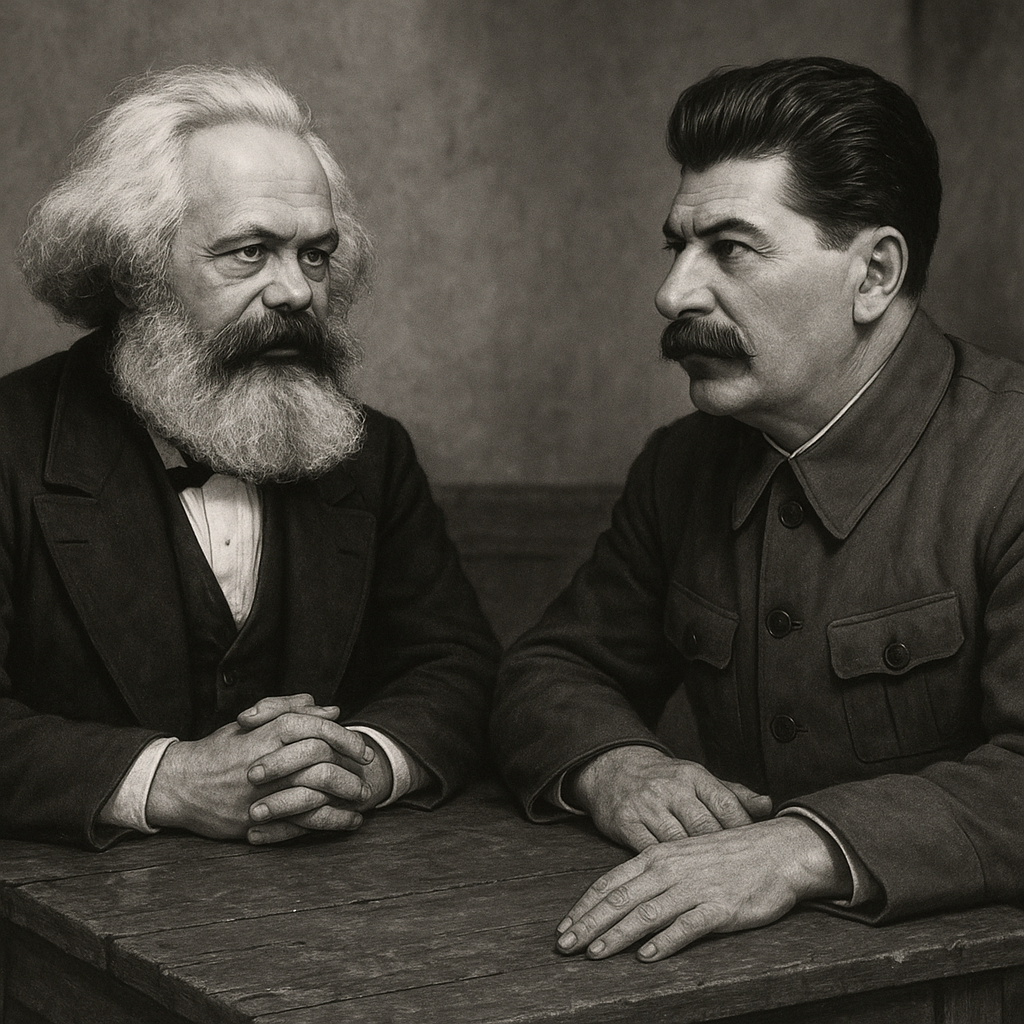
  • Soviet Union (Communism): The Soviet Union under Joseph Stalin provides a clear example of a totalitarian communist state. The government abolished private property, collectivized agriculture, and implemented central planning. Political repression was severe, with millions of people imprisoned, starved to death or executed during Stalin’s purges.  It is important to recognize that Stalinist communism differed significantly from the theoretical communism of Karl Marx.

Conclusion

Fascism and communism, despite their profound differences, share certain similarities in practice, particularly in their authoritarianism and intolerance of dissent. However, their philosophical foundations and goals are fundamentally different: fascism seeks to elevate the nation above all else, while communism theoretically aims to create a classless society. Understanding these ideologies and their historical manifestations is crucial for anyone interested in the political history of the 20th century and its lasting impact on the world today. 

We can use our understanding of fascism and its comparison to democracy to ask important questions. What kind of government do we want?  Are there any possible crossovers or compromises between the two? And, importantly, should there be?

Postscript

Many of the ideas in this post were inspired by two excellent books on the subject, “The Origins of Totalitarianism” by Hannah Arendt and “Fascism: A Warning” by Madeleine Albright.

Don’t Forget Climate Change

It Affects Us All

Climate change, one of the most critical challenges facing humanity in the 21st century, seems to be forgotten in all the controversy surrounding DOGE. Regardless of everything else going on, we can’t ignore climate change because it affects global temperatures, weather patterns, ecosystems, and economies. The overwhelming scientific consensus is that human activities—primarily the burning of fossil fuels—are driving climate change.

The existence of climate change and the impact of human activity, like any other field of science, includes areas of disagreement among researchers. One of the principal areas of disagreement is about the sensitivity of the climate to the increase in CO2 production and the rate at which global warming will occur. There’s also discussion about how effective climate models may be with some arguing that the models may either overestimate or underestimate certain effects. A significant area of disagreement is over what is known as the “tipping points”. This is a debate about when or if certain events such as ice sheet collapse, permafrost thaw or ocean circulation changes might occur. Some argue these events could trigger rapid self-reinforcing climate shifts while others believe changes will be more gradual. Even with this disagreement there is broad acceptance that climate change has increased the frequency and intensity of heat waves, heavy rain and extreme weather.

As intense as some of these scientific debates maybe, they pale in significance beside the political debates being generated around climate change.

When the possibility of climate change was first recognized in the 1970s and 1980s there was bipartisan support to address possible remediation of long-term impacts. Republican President Richard Nixon signed landmark environmental laws including the Clean Air Act.

During the 1990s climate change became more polarized. President George H. W. Bush begin to frame climate change policy as an economic threat. George W. Bush rejected the Kyoto Protocol to avoid “economic hindrance”.

By 2008 the partisan divide had significantly increased. Republicans increasingly dismissed climate risks while Democrats amplified the urgency of taking action. By 2023, 78% of Democrats prioritized climate policy, but only 21% of Republicans viewed climate action as urgent despite increasing climate risks in some  GOP dominated states such as Florida and Texas.

The partisan gap expanded as conservative science skeptics continued to raise issues about rates of change, economic impacts and potential solutions. These conservatives tend to view climate policies as government overreach, while progressives hold the position that the government led initiatives are essential to combat environmental threats.

As they have in many other issues, the media have lined up into conservative and progressive camps. The conservative leaning media downplays climate risks while the liberal leaning media emphasizes the danger and need for urgent action. As with many other things this leads to a “echo chamber” effect simply reinforcing political beliefs without adding anything new of significance to the debate.

The Trump administration has signaled its desire to undo many of the climate change initiatives put in place by Democratic administrations. On January 20, 2025, President Trump signed Executive Order 14162 directing the immediate withdrawal of the United States from the Paris Climate Agreements and related international climate commitments. He has declared a “National Energy Emergency” to accelerate fossil fuel development and ease restrictions on the construction of new oil and gas projects. As part of this effort, he has weakened environmental reviews. This is expected to significantly increase fossil fuel consumption and associated greenhouse gas emissions. The Trump administration has begun the rollback of environmental regulations. Lobbyists for the oil, gas and chemical industries have been appointed to the Environmental Protection Agency to reverse climate regulations and pollution controls.

The administration is withdrawing funding for clean energy initiatives including those aimed at reducing carbon emissions and promoting renewable energy resources. The administration has initiated a review of the “legality and continued applicability” of the EPA’s endangerment finding which is the basis of most federal regulations on greenhouse gas.  The administration rolled back regulations limiting methane emissions from oil and gas operations. The definition of “waters of the United States” under the Clean Water Act was narrowed, potentially allowing increased pollution in streams and wetlands.

We can expect increases in severe weather because of Trump’s environmental policies.  These policy decisions collectively hinder efforts to mitigate climate change, potentially leading to increased greenhouse emissions and global warming. Reduction in funding for climate change research and the rollback of environmental regulations will have long term adverse effects on both domestic and global environmental health.

Significant budget cuts and layoffs within agencies like the National Oceanic and Atmospheric Administration (NOAA) could impair the ability to forecast and respond to severe weather events. For instance, the reduction of meteorologists and environmental scientists may hinder critical forecasting services, affecting public safety during events like hurricanes, tornados and floods.

The U.S. withdrawal from international climate initiatives, such as the Loss and Damage Fund, reduces financial support for developing countries dealing with climate-induced disasters. This could lead to inadequate infrastructure and preparedness in vulnerable regions, potentially increasing the severity of weather-related impacts.

While it is challenging to attribute specific future weather events to current policy changes directly, the administration’s environmental policies will likely contribute to conditions that favor more frequent and intense extreme weather events. The combination of increased greenhouse gas emissions together with weakened environmental regulations, reduced climate research capabilities, and diminished global climate cooperation collectively enhance the likelihood and impact of severe weather phenomena. This damage to our environment needs to be prevented!  Once it occurs it will be difficult to ever reverse and our children and grandchildren will suffer as a result.

Don’t Cut and Run on Ukraine

Like many Americans, my wife and I were both embarrassed and disgusted by the Oval Office ambush of Ukrainian President Volodymyr Zelenskyy by Donald Trump and JD Vance.  We were so upset by this disgraceful treatment of the visiting president of a sovereign nation, that we followed the lead of a friend and immediately ordered “I Stand With Ukraine”  T-shirts.

The oval office meeting held on February 28, 2025, was ostensibly intended to finalize a mineral rights agreement between the United States and Ukraine. The deal was seen as a strategic move to reduce US dependence on Chinese rare earth minerals and to support Ukraine’s economy amidst its ongoing conflict with Russia.

In what appeared to be a planned attack, Vice President Vance berated President Zelenskyy, making false claims of ingratitude on the part of Ukraine. President Trump quickly escalated the situation by criticizing Zelenskyy’s approach to the war and asserting that the Ukraine was “gambling with World War III.”   He then demanded that President Zelenskyy admit that he was responsible for the war and could end it at any time by making a deal.  Trump further demanded that Zelenskyy admit that it was Ukraine that was responsible both for initiating and prolonging the war.

If there is any doubt this was a planned and likely scripted meeting on the part of the Trump administration, you only have to look at Donald Trump’s closing statement for the meeting.  “I think we’ve seen enough. This is going to be great television.”

The fallout from this event has significant implications for international diplomacy and the ongoing conflict in Eastern Europe. The suspension of U.S. military aid to Ukraine following the meeting has raised concerns about Ukraine’s ability to defend itself against Russian advances. Ukrainian officials expressed disappointment but remained defiant with one military official stating, “we will fight with or without their help.”

President Trump has labeled Zelenskyy a dictator who is unwilling to negotiate peace. He claims that the Ukraine initiated hostilities against the Russian speaking population, requiring Russia to intervene. These claims have long since been debunked, yet Donald Trump continues to repeat them. It has been interesting this past week to watch Trump nominees try to avoid saying whether they believed Russia has invaded Ukraine. They evaded questions by saying they didn’t have all the facts, or it wasn’t appropriate for them to respond, when obviously they did not want to lie under oath and claim that Russia had not invaded Ukraine.

Russian officials and state media reacted with approval to the Oval Office clash.  China, Syria, North Korea and Iran also supported the Trump administration’s approach. 

The French President and the British Prime Minister both reaffirmed their commitment to Ukrainian sovereignty and condemned the manner in which the meeting was conducted.

Decide with whom you prefer to have the United States aligned, our long-standing allies and other democratic governments, or with autocrats and dictators. 

We invite you to join us and proudly proclaim “I STAND WITH UKRAINE.”

Oppression in Politics: Totalitarian and Authoritarian Systems

Since January 20th there has been extensive use of the terms authoritarian and totalitarian to refer to the actions of the current administration.  While totalitarian and authoritarian are often used interchangeably, they represent similar but distinct forms of governance with critical differences. If we’re going to hold rational discussions about these theories, we should be using the same terminology.

A totalitarian government seeks to control every aspect of public and private life, including political, economic, social, and cultural domains. The government uses a specific ideology to unify and dominate society. The government strives to regulate all aspects of life, leaving no room for personal freedoms or independent thought.  A guiding ideology is central, often enforced by propaganda, indoctrination, and censorship.  The government frequently relies on widespread surveillance, police state tactics, and brutal suppression of dissent.  All institutions, media, education, economy, and religion are state-controlled.

Examples include Nazi Germany, unified under an ideology of racial purity and Stalin’s Soviet Union, ostensibly organized under a Marxist ideology.  Both governments maintained control of their population through propaganda, brutal police actions, terror and murder.

 An authoritarian government is characterized by strong central power with limited political freedoms, but it does not seek to control all aspects of life.  Unlike totalitarian regimes, authoritarian states often allow some degree of personal freedom in areas like culture, business, or religion, as long as these do not challenge political authority.  Typically, these regimes are pragmatic and focused on maintaining power, not enforcing an all-encompassing ideology.  They are more likely to be organized around the personality of the dictatorial leader.  While repression is common, it is often less pervasive and targeted primarily at political opponents.

Franco’s Spain had limited political freedoms but allowed religious and cultural autonomy.  Putin’s Russia allows limited economic freedom for members of the Russian oligarchy.

The main distinction lies in the scope of control.  Totalitarian regimes seek to control all aspects of life and demand ideological conformity.  Authoritarian regimes primarily focus on political power and allow some personal autonomy as long as it does not threaten the regime.

In summary, all totalitarian governments are authoritarian, but not all authoritarian governments are totalitarian.

Waiting For The Reichstag Fire

On the evening of February 27th, 1933 the German Reichstag burst into flames. This attack on the German national parliament building was viewed by many as an attack on Germany itself.

A Dutchman named Marinus van der Lubbe was found and arrested at the scene almost immediately after the fire erupted. The Nazis quickly claimed that the fire was part of a broader communist uprising and used this claim to push for emergency powers.

 Van der Lubbe confessed to setting the fire alone, but the Nazi Party quickly claimed that it was part of a widespread communist conspiracy. Many people believe that the Nazis may have set the fire themselves and used it as a pretext to declare emergency rule.

 Adolf Hitler persuaded German President Paul von Hindenburg to issue the “Decree for the Protection of the People and the State” which suspended civil liberties, including freedom of speech, press and assembly. It allowed for the arrest and detention of political opponents without due process. Thousands of communists and socialists were arrested.

Within a month new elections were held. While the Nazis did not win an outright majority, they used the fire to create fear that led to passage of the “Enabling Act” on March 23, 1933. The act gave Hitler dictatorial powers, effectively ending democracy in Germany.

The Reichstag Fire was a crucial point in world history. Whether it was a Nazi engineered false flag operation or the act of a alone arsonist, it provided Hitler with the excuse he needed to dismantle democracy and establish a totalitarian dictatorship. This is a chilling example of how fear and propaganda can be weaponized to erase freedom; a lesson that remains relevant today.

Hijacked Healthcare- A System In Crisis 

For more than 30 years I have watched our health care system become increasingly more politicized. As a physician I have become concerned with the direction it has recently taken. 

Until the early 20th century healthcare was mostly private, and medical expenses were out of pocket. Early calls for national health insurance began with labor organizations and were quickly joined by progressive politicians. President Franklin Roosevelt wanted to include health insurance in the Social Security Act of 1935 but was unable to get it passed. President Harry Truman also proposed a National Health Insurance program in 1945, but it was denounced as socialized medicine.  All these efforts were opposed by business interests, conservative politicians — particularly southern— and surprisingly, the American Medical Association. 

Finally in the 1960s as part of his “Great Society” programs President Lyndon Johnson pushed for the passage of both Medicare and Medicaid. Rising costs of health care under President Richard Nixon led to the introduction of Health Maintenance Organizations (HMOs) as an attempt to encourage cost efficiency. President Ronald Reagan reduced federal health care spending and pushed for more privatization. In the 1990s President Bill Clinton attempted to introduce universal health coverage but it was met by fierce opposition from the insurance industry, business, and the Republican Party who labeled it as government “overreach”. Finally in 2010 President Obama’s Affordable Care Act (ACA) also called “Obamacare” became the most significant health care reform since Medicare and Medicaid. It also faced legal challenges and political resistance with the Republicans consistently attempting to repeal it. During his first term, President Donald Trump reduced ACA funding and repealed the individual mandate penalty that had required people who did not maintain health insurance to pay a fee. The elimination of the penalty weakened the law and reduced the number of people who sought coverage.  We can expect further efforts to weaken the provisions of the ACA but given that it is well entrenched in the US healthcare system now is unlikely that it will be completely repealed. 

While early health care programs faced significant controversy and strong debate, progress in providing expanded coverage and improved care was continuous.  I’m concerned that we’re about to enter an era where many of our gains in public health are going to be reversed.  The United States remains unique among wealthy nations as the only one without universal health care and I fear that we will begin to lose what gains we have made over the past several decades. 

I’ve written previously about my concerns with vaccine resistance and the elimination of vaccination requirements for school children. I believe that this is an impending public health disaster and I’m afraid there are even greater disasters on the horizon. 

Robert F. Kennedy Jr has been nominated by President Trump to be the secretary of Health and Human Services and by the time you read this he may well have been confirmed. During his confirmation hearings Kennedy has made a few positive statements. He’s expressed an intent to increase focus on chronic diseases such as diabetes and obesity. He has indicated support for rural hospitals. He would like to increase training for physicians in addiction care and increase access to treatment programs. He is also indicated plans to improve American diet by targeting ultra processed foods, contaminants in food, and placing restrictions on food additives. He also has proposed reforms to include stricter FDA oversight of the food supply. 

However, there are several very troubling aspects to his nomination. He has a history as a vaccine denier although he is currently denying that denial. He said he is not anti vaccine but is pro safety. He has stated he will support polio and measles vaccines and that all his children have been vaccinated. (In 2020, while speaking on the podcast of his nonprofit organization Children’s Health Defense, Kennedy said that he would do anything, pay anything to be able to go back in time to avoid giving his children the vaccines that he gave them.)  Given his history of anti vaccine statements and the fact that he profits from anti vaccine litigation it’s likely he will return to previous anti vaccine positions once confirmed.   

He has proposed significant changes to both the CDC and the NIH including significant staff changes. He has proposed redirecting funding to preventative/alternative medicine. 

Most troubling is his poor understanding of Medicare and Medicaid programs. During questioning he showed a lack of understanding of the funding sources and statutory requirements of the two programs. 

The Centers for Disease Control (CDC) faces considerable threat. House Republicans have proposed a $1.8 billion cut (22%) to CDC’s budget. These budget cuts target programs that address opioid overdoses, firearm injuries and food safety monitoring. This budget conflicts with Kennedy’s statements about his priorities and it remains to be seen how this will be resolved. The Heritage Foundation’s Project 2025 has advocated splitting the CDC into two separate entities: one for data collection and another for limited public health guidance. The intent is to reduce its influence on social policies. The administration has already imposed communications restrictions, requiring that CDC announcements, social media posts and scientific reports undergo political review. There is currently a proposal to reduce the in-house reviews of medical research; there is even a proposal to “deputize the public” to challenge scientific findings used in regulations. This would leave medical research open to review by the least qualified. Unfortunately, he current nominee for CDC director, David Weldon, a physician and former republican congressman, has signaled his intent to narrow the agency’s scope and his support for administration policies. 

Highly contentious issues such as gender affirming care and reproductive health have already been severely restricted. It is likely that these areas will come under continued attack by the current administration. 

This administration also poses a threat to global health. By executive order the US was withdrawn from the World Health Organization. Additionally, the US Agency for International Development (USAID) has been significantly reduced with all major programs placed on hold. Not only does USAID support foreign aid programs, but it is also a major player in global health. 

USAID sponsored programs identify and monitor disease outbreaks, provide treatment and preventive measures for local populations and provide global disease alerts that help protect United States citizens.  We are already seeing the beginnings of a worldwide humanitarian healthcare emergency.  Not only will this affect healthcare systems but eventually the economic systems in countries who have lost their access to modern medical assistance.  We will lose the advanced notice about disease outbreak and spread.  Without this remote surveillance, it is possible that we may be caught unaware by the next pandemic until it is ravaging our population. 

This administration claims to support “the average American” yet it seems to be intent on destroying all our health. 

Ignorance Redux

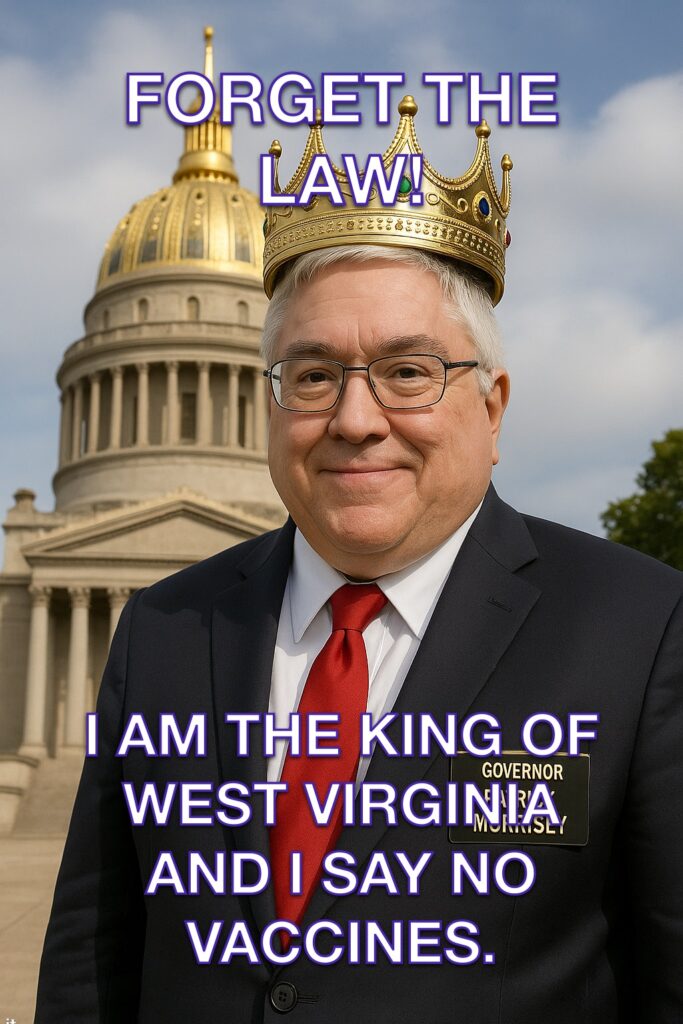
On his first day in office, the new far right governor of West Virginia issued an executive order allowing for extensive exemptions from the school vaccination mandate. When taken with the nomination of a virulent anti vaxxer for Secretary of Health and Human Services, I am concerned that we are in a rush to allow our children to die of easily preventable diseases. With this in mind, I’m reposting my article The Triumph of Ignorance from last April. At that time—as you will see in the first paragraph—I had some hope. Those hopes have since been dashed.

“There are two ways to be fooled. One is to believe what is not true; the other is to refuse to believe what is true.”– Søren Kierkegaard

Saturday morning, I was reading in the newspaper about the resurgence of measles in West Virginia. I find it appalling that this disease should be returning, given that we have safe and effective vaccinations.  What is next, polio, smallpox, or even plague?  It is only through the unexpected veto by our governor that the ill-advised bill passed by our legislature to make all vaccinations virtually optional did not become law.

Some people may wonder why vaccinations are important. There are two principal reasons to ensure that a large portion of the population is vaccinated against communicable diseases. The first is that it reduces the individual vulnerability to disease. The person who is vaccinated is protected. But there is also a second, sometimes not well-understood, reason.  That is herd immunity.

Communicable diseases require a large susceptible population to spread. When a significant portion of the population has been vaccinated the disease does not have the core of potential victims to allow spreading. This means that the vaccinated are protecting the non-vaccinated. However, it does require a large portion of the population to be vaccinated. The idea is that herd immunity will protect those who are unable to be vaccinated either due to age, allergies, or other medical conditions that would prohibit vaccination. It is never going to protect a large proportion of the population who just choose not to be vaccinated.  For example, about 90-95% of the population needs to be vaccinated against measles to provide herd immunity.

So why do people who otherwise can be vaccinated choose not to be?

There are, of course, those who have true religious objections to vaccination.  There are others who object to vaccination on the basis of personal autonomy. They believe their right to refuse vaccination outweighs any consideration of the health concerns of the frail members of our community.

There are many who mistrust the medical system. There were some cases in the past where unethical studies were conducted on unsuspecting populations. Given the rigorous oversight of medical research now, this no longer happens. Information about research into vaccinations and their safety and efficacy can be found on websites for the Centers for Disease Control and Prevention and the World Health Organization among others. (Website references are provided at the end of this post.)

What concerns me most are those who refuse to believe reputable medical authorities, government agencies, and mainline news services. They prefer to get their information from anonymous websites or from conspiracy theory websites that still give credence to the now-discredited 1999 study linking the MMR vaccine to autism. They completely ignore the fact that 10 of the 11 reported co-authors disavowed any part in the conclusions of the study. They also ignore the fact that the principal author was found guilty of fraud for personal gain as he was employed by the manufacturer of rival drugs. They also ignore the fact that he lost his medical license over his falsifications in this study. Yet, he is still cited in anti-vaccine literature as an expert source.

Equally disturbing is the fact that vaccine resistance has become a part of political identification. Certain reactionary political groups have, for some unfathomable reason, decided that refusing vaccination is a badge of their political allegiance.  They seem to care more about maintaining their political purity than they care about science, public health, or even the welfare of their family and friends.  Politicizing public health is dangerous for all of us.  I’m not sure how we overcome this. It is easy to find the truth and verify it through fact-based studies, yet people refuse to do it.

I encourage everyone to work hard to ensure that our political leaders do not remove vaccination mandates for school children. For those of us of my age, we already have immunity through vaccination or prior exposure to the disease.  It is our grandchildren and their children and their children’s children who will suffer through the return of these deadly diseases.

SOURCES:

  World Health Organization: https://www.who.int/health-topics/vaccines-and-immunization#tab=tab_1

  CDC:  https://www.cdc.gov/vaccines/index.html   https://www.cdc.gov/vaccines/hcp/vis/index.html

   WV DHHR: https://oeps.wv.gov/immunizations/Pages/default.aspx

   Immunise.org:  https://www.vaccineinformation.org/

Page 5 of 6

Powered by WordPress & Theme by Anders Norén