How the Myth of 1950s America Is Being Weaponized by the Modern Right
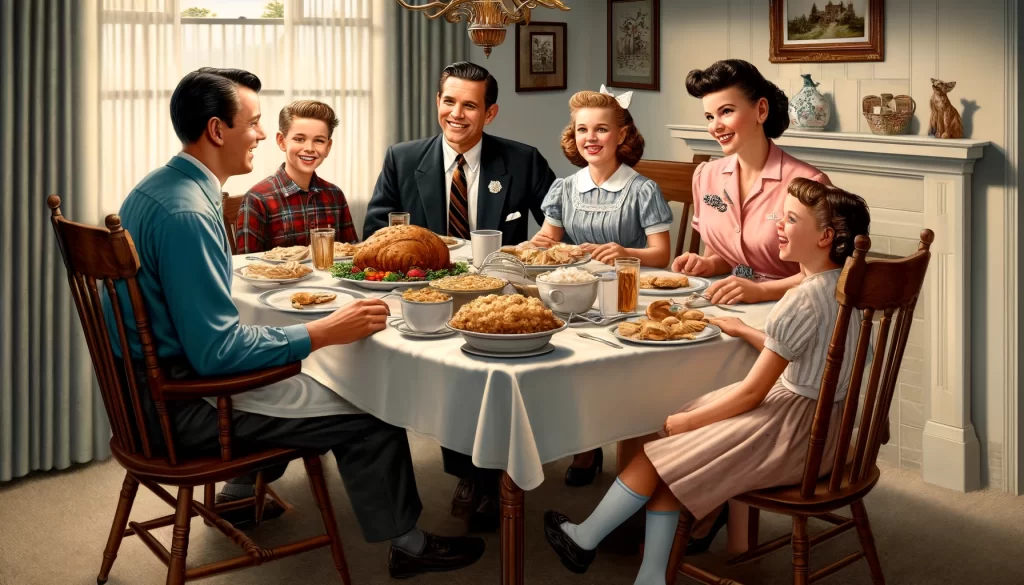
Not long ago, I was sitting in a waiting room waiting to get an X-ray done. They had MeTV on the television and Leave It To Beaver was playing. You know, the classic 1950s television show where dad went to work, mom stayed at home and did housework while wearing pearls, a dress and heels, and the kids were well behaved even though they may occasionally have been “scamps”. Few ideas exert a stronger pull on the American imagination than the belief that there was once a lost golden age—a time when the nation was more prosperous, more moral, more unified, and more secure than it is today.
Ask most Americans when the country was at its best and there’s a decent chance you’ll hear something like: ” the ’50s.” Clean neighborhoods. Stable families. Everyone going to church on Sunday. One income paying the bills. It’s a seductive image and it’s one that right-wing politicians and evangelical leaders have been selling hard for decades. The only problem is that it was never the whole truth. In 2025, the effort to resurrect that selective memory began the move from campaign rhetoric into actual governance.
Let’s take a close look at the mythology of postwar America and examine what the 1940s and 1950s actually looked like for the millions of Americans excluded from the postcard image and explore how modern conservative politicians and religious leaders are drawing on that mythology to reshape the country today.
The Legend: America’s Postwar Paradise
It’s easy to understand the emotional pull. After the trauma of World War II and the deprivation of the Great Depression, the late 1940s and 1950s did, for a particular slice of America, offer something genuinely new: suburban homes, new cars, television sets, and a sense of safety and prosperity that earlier generations couldn’t have imagined. For white, middle-class families in the northern and midwestern United States, the GI Bill opened the door to homeownership and college education. Real wages rose. Life expectancy improved. The birth rate climbed.
Televisions went from being owned by 12 percent of households in 1950 to over 90 percent by the end of the decade and beamed idealized domestic life straight into living rooms across the country. Programs like Father Knows Best and, of course, Leave It to Beaver were essentially aspirational advertising. Nobody was poor. Nobody was Black. Nobody was gay. Nobody was confused. Everyone’s lawn was neatly trimmed and their problems resolved in 22 minutes.
It is worth acknowledging that aspects of this nostalgia reflect real experience for a limited few. The cultural stability and sense of community that many Americans remember from the era were genuine features of daily life for some people in some places. Writer Alan Ehrenhalt, who wrote extensively about 1950s Chicago neighborhoods, documented the authentic bonds people formed and the coherent community life that anchored their lives. The nostalgia is not entirely manufactured. But the question is: whose nostalgia counts, and who pays the price for making it policy?
The Reality Check: Who Got Left Out
Here is what the postcard left out: the United States of the 1950s was a country of legally enforced racial segregation, economic exclusion, and profound gender inequality. It was, in many respects, a country operating an unofficial domestic system of apartheid.
Jim Crow laws governed daily life for Black Americans from the post-Reconstruction era through the mid-1960s. Schools, workplaces, public transportation, medical facilities, and parks were racially segregated across the South and informally segregated in much of the North. Poll taxes and literacy tests suppressed Black voting. Vagrancy laws effectively criminalized unemployment among Black men. Physical terror, including lynching and the threat of violence, was used as a tool of social control.
Black Americans in the 1950s faced a starkly different economic reality than white Americans. Discriminatory lending practices, including the federally sanctioned “redlining” that denied mortgages to Black families in certain zip codes, locked millions out of the very suburban prosperity that defines the nostalgic image of the era. The GI Bill, widely celebrated as the engine of postwar middle-class expansion, was administered locally and largely excluded Black veterans in the South through discriminatory implementation.
Women fared little better by today’s standards. The idealization of the 1950s housewife conceals the coercive nature of women’s domestic confinement in that era. Women were largely excluded from professional careers, could not obtain credit cards in their own names until 1974, and faced deeply limited legal recourse against workplace discrimination or domestic violence. The image of the contented housewife was, for many women, less a personal choice than the only option available to them.
The economy itself was more volatile than the mythology suggests. The United States suffered four recessions between 1949 and 1960. Average GDP growth during the Eisenhower years ran at about 2.5 percent — respectable, but hardly the sustained boom of legend. And when measured by real GDP per capita in today’s dollars, the average American is roughly 3.7 times better off financially now than in 1955, which complicates the argument that things were economically superior back then.
The period was also marked by intense Cold War anxiety. Americans conducted nuclear attack drills in schools and lived with the constant fear of atomic war. I can remember the “duck and cover” drills that we had in school, as if hiding under our desk would protect us from a nuclear blast. The era also witnessed the rise of McCarthyism, during which accusations of communist sympathies, most without proof, damaged careers and chilled political dissent.
In this version of history, America was once united, moral, prosperous, and respected. Something then went wrong—often identified as secularization, feminism, immigration, globalization, civil rights activism, cultural liberalism, or government expansion. The nation’s challenges are therefore attributed not to complex economic and social forces but to a departure from traditional values.
Building the Myth: The Role of Religion and Cold War Politics
One of the most significant and least understood aspects of 1950s nostalgia is how deliberately constructed it was at the time. The “Christian America” that modern evangelical conservatives point to as a foundational model was, in large part, a Cold War invention.
Historian Kevin Kruse, in his book “One Nation Under God,” documents in detail how business, political, and religious leaders worked during the 1940s and 1950s to fuse Christianity with American national identity in an explicit effort to distinguish the United States from “godless communism.” The phrase “under God” was inserted into the Pledge of Allegiance in 1954 following a lobbying campaign by the Knights of Columbus. “In God We Trust” was adopted as the national motto in 1956, replacing the unofficial but far more pluralistic “E Pluribus Unum” — “Out of Many, One.” Both initiatives had the explicit goal of defining American identity through religious contrast with the Soviet Union, not of recovering some ancient tradition.
President Eisenhower was the central political figure in this fusion of piety and patriotism. Though he had little religious affiliation for most of his life, in 1953 he was baptized in the Presbyterian Church and became active in what historians called the “religious revival” of 1950s America. He signed the National Association of Evangelicals’ “Statement of Seven Divine Freedoms” in 1953 and became what many regarded as a symbolic pastor-in-chief. The Advertising Council ran a nationwide “Religion in American Life” campaign encouraging church attendance. Corporate America joined in: Walt Disney incorporated explicitly patriotic and religious themes into his Anaheim park. The annual National Prayer Breakfast was institutionalized. Presidential speeches began ending with “God bless America” as a matter of course.
Kruse is careful to note that this represented something genuinely new, not the recovery of something original. The “Christian founding” narrative so beloved by modern evangelical conservatives is, in his assessment, more myth than history. What the 1950s actually produced was a strategic civil religion built for Cold War propaganda — a useful fiction that has since been mistaken for ancient truth.
For many voters, such appeals are less about historical accuracy than emotional reassurance. They promise stability amid rapid change and offer a sense of continuity in a world that often feels uncertain.
The Political Machinery: From Reagan to MAGA
“Make America Great Again” is not, as many people assume, a phrase that originated with Donald Trump. Ronald Reagan used it extensively during his 1980 presidential campaign. Its emotional logic — that there was a better time, that it was taken from us, that we can return to it — has been a structural feature of American right-wing politics for at least four decades.
What Trump did was amplify it and make the temporal reference more explicit. When pressed, Trump has pointed to the late 1940s and 1950s as the era he has in mind as a model of national greatness. And his supporters appear to share that view. A 2024 survey by the Public Religion Research Institute (PRRI) found that approximately 70 percent of Republicans believe that America’s culture and way of life has changed for the worse since the 1950s.
That survey finding is worth thinking about. Seven in ten members of one of the nation’s two major political parties believe the country was better when segregation was legal, women couldn’t get a credit card, and McCarthyism was destroying careers on the basis of rumor and suspicion. The longing is, of course, more selective than that, most of those respondents are thinking of the community, stability, and cultural coherence of the era, not its injustices. But the political machinery that exploits that nostalgia does not make those fine distinctions.
Project 2025, the 900-page policy blueprint produced by the Heritage Foundation and dozens of allied conservative organizations, is perhaps the most systematic expression of this restorationist project. Its stated goals include restoring “the family as the centerpiece of American life,” reducing federal government size, centralizing executive power, and returning to what it calls “foundational values.” The document explicitly frames the current moment as a crisis requiring urgent corrective action to restore something that has been lost: a rhetorical structure that assumes the loss of a golden past as its premise.
The Evangelical Revival: Reclaiming a Nation That Never Quite Was
For evangelical Christians in the MAGA coalition, the 1950s hold special significance because of the Eisenhower-era fusion of Christianity and national identity. The addition of “under God” to the Pledge and “In God We Trust” to the currency are treated as evidence of a deep historical tradition — proof that America has “always” been a Christian nation. As one analysis published in Mere Orthodoxy noted, among proponents of Christian nationalism, there is broad agreement that “the cultural Christianity of the Eisenhower era presents a model to which we should aspire.”
The political ambitions of this movement are not subtle. During the first year of Trump’s second term, a series of executive orders moved explicitly toward institutionalizing evangelical Christian priorities within the federal government. One established a task force to “eradicate Christian bias” from government. Another created a White House Faith Office. A third established a Religious Liberty Commission. The rhetorical framing was consistently restorative — “bringing back” religion, returning to foundational truths, recovering what was lost.
What this narrative omits, as historians of religion have carefully documented, is that the “Christian America” of the 1950s was itself a political construction, not an inherited tradition. The founders were, at best, a religiously mixed group whose Enlightenment-influenced constitutional framework was deliberately secular. As Americans United for Separation of Church and State ha noted, the Cold War-era religious symbols that Christian nationalists now treat as bedrock tradition would have been unfamiliar and to the actual founders.
The 1950s that evangelicals and Christian nationalists embrace as a Christian model was also the decade that ended with Supreme Court rulings in 1962 and 1963 prohibiting sponsored prayer and Bible reading in public schools. From the Christian nationalist perspective, those rulings mark the beginning of America’s moral decline. Which means the golden age they want to restore existed for, at most, a few years before it was, by their own account, already being dismantled.
Nostalgia as a Political Tool: The Psychology Behind the Appeal
None of this is to say that nostalgia is inherently dishonest or manipulative. Research in psychology consistently shows that people misremember the past by emphasizing positive personal experiences and filtering out context that complicates the picture. This is normal human cognition, not bad faith. For working-class white Americans who experienced the 1950s as a period of genuine stability and upward mobility, the memory is not false. The problem arises when personal memory is converted into universal history and then into policy prescription.
Political movements have always understood the emotional power of a remembered golden age. The appeal to restoration allows politicians to diagnose the present as fallen and to promise recovery without having to specify precisely what they’re recovering. It is a rhetorically flexible tool: it can mean lower taxes, stronger churches, tougher borders, whiter neighborhoods, or simply the vague sense that things made more sense once and someone took them away from you. The ambiguity is a feature, not a bug. It allows a coalition of people with different specific grievances to unite around a shared emotional posture.
What makes the current moment distinctive is the ambition and specificity of the institutional project. Earlier iterations of “Make America Great Again” were largely rhetorical. Project 2025, Christian nationalism’s White House offices, and the executive order campaign of Trump’s second term represent an attempt to translate nostalgic sentiment into durable structural change. The mythology is no longer just a campaign slogan. It is becoming, or attempting to become, a governing framework.
What Gets Left Out When We Go Back
The practical consequences of any serious attempt to restore something like 1950s governance deserve direct examination. The America of that era did not inadvertently exclude Black citizens, women, LGBTQ+ Americans, and religious minorities from full participation in public life. It excluded them by law and by deliberate institutional design. Any genuine “return” to the social order of that era would require actively undoing the legal and social progress of the intervening seven decades.
Some elements of the contemporary right’s agenda move explicitly in that direction: challenges to voting rights provisions, rollbacks of civil rights protections for LGBTQ+ Americans, attacks on DEI programs, restrictions on reproductive autonomy, and pressure on the constitutional separation of church and state. Whether these specific policies will achieve their stated goals is a matter of legitimate political debate. But the historical record of the 1950s for the Americans who were not white, male, heterosexual, and Protestant is not ambiguous. For them it was not a golden age, not even close.
Perhaps the most honest thing one can say about the 1950s is what the historical record shows: it was a complex, contradictory decade. For some Americans, it genuinely offered stability, community, and opportunity. For others, it was a system of legal oppression maintained by violence and economic exclusion. Both things are true. A serious engagement with the era requires recognizing that contradiction. A political mythology that acknowledges only one of those truths is not history. It is propaganda.
A Final Thought
The golden age of America is a powerful story. It has the great advantage of being partly true — enough to feel authentic to those who experienced it, enough to resonate with people who wish the present were simpler and more coherent. But it is a partial truth that has been shaped, amplified, and in some cases invented to serve political ends. The religious symbolism of the Eisenhower era was a Cold War construction, not an ancient tradition. The prosperity of the postwar years was real for some but radically unequal. The community stability that people remember was purchased, in part, through the enforced subordination of millions of Americans.
Understanding all of this doesn’t require abandoning the genuine good things of that era — community, stability, the importance of family and neighborhood. It requires being honest about the terms on which those good things were available and for whom. And it requires asking whether the politicians and religious leaders invoking that era’s memory are interested in what made it work for many Americans and extending those benefits to everyone, or whether they are more interested in what made it work specifically for white, Christian, heterosexual men.
History does not go backward. But it can be selectively remembered in ways that carry serious consequences for the present. That is worth thinking carefully about.
Sources
1. Petit, K. (2025). “The Myth of the American Golden Age.” Medium
2. Cochrane, J. H. (2026). “The 1950s: A Not-So-Golden Age.” Coolidge Review
3. Kabaservice, G. (2025). “Populism and Working-Class Nostalgia for the 1950s.” Niskanen Center
4. Americans United for Separation of Church and State. (2020). “Trapped in a Time Warp: Christian Nationalists Pine for the 1950s.” au.org
5. Fea, J. (2015). “One Nation Under God.” Review of Kruse, K., “One Nation Under God: How Corporate America Invented Christian America.” Christianity Today
6. Americans United for Separation of Church and State. (2025). “In God We Trust: Don’t Blame It on the Founders.” au.org
7. Baptist News Global. (2023). “Christian Nationalism: How Evangelical Christianity Became a Political Religion.” baptistnews.com
8. Homeaddict.io. (2025). “19 Myths About the 1950s.” homeaddict.io
So why should we consider myths as anything but an anachronistic curiosity since we consider ourselves a rational and scientific society? Because the willingness to believe in myths is as strong today as it has ever been. While belief in Olympian gods, elves, and fairies has faded away new myths have arisen. Since the late 1800s, at least two new myths have spread in the United States.
The Golden Age of America
Our political situation today has much to do with belief in the Myth of the Golden Age of America. I strongly believe that the United States has been and continues to be the best hope for personal freedom in the world today. But the idea that at some time in the recent past everything was wonderful for everyone is a myth. In this “Golden Age” to which some people wish to return, women, minorities, gays, and the disabled were clearly discriminated against.
One key contributor to the Golden Age Myth was the economic boom that followed World War II. The United States was a global industrial leader and the economy showed significant gains in jobs, wages, and consumer goods. The middle class was expanded, college education rose due to the GI Bill, and home ownership reached new levels. However, these advantages did not reach all members of our society.
Racial minorities continued to be actively discriminated against. Segregation, particularly under the Jim Crow laws in the South, limited economic, social, and political opportunities for our Black citizens. Women’s roles and opportunities similarly were significantly constrained. Women were expected to take a domestic role over professional or personal aspirations. Even women who obtained advanced college degrees were expected to stay at home and raise their family or to take “appropriate” jobs such as secretaries, teachers, or nurses.
Reaction to the Golden Age Myth led to movements such as women’s liberation and the civil rights movement, both followed shortly by gay rights and the advocacy for the disabled. The Golden Age seems to have existed principally in popular television shows such as Ozzie and Harriet or Father Knows Best. In short, this “Golden Age” was not golden for everyone.
The Lost Cause
This myth arose in the South in the late 19th and early 20th centuries though it had its origins while the war still raged. According to the Myth of the Lost Cause, the Civil War had nothing to do with slavery. It had to do with the southern states fighting for their individual state rights and their prerogatives of self-government. They were fighting against northern aggression that was trying to destroy the southern way of life. Most Confederate soldiers were poor farmers who neither owned nor could afford slaves. They had to be convinced that they were fighting for their way of life against a malicious union army that was intent on invading their homes and forcing “northern ways” on them. The soldiers had to be distracted from the fact that they were fighting, suffering, and dying to protect the way of life of the wealthy slave owning aristocracy.
The evolution of legend was also involved in the creation of this myth. Robert E. Lee and Stonewall Jackson were idealized as true southern gentlemen struggling in a glorious but doomed battle against overwhelming odds.
Of course, it completely ignores the fact that the southern way of life and those state rights were predominantly based on slavery. A critical element in this myth is that slavery was good for the slaves. We continue to hear this stunning falsehood from politicians today as they try to describe slavery as a little more than job training.
Many historians today agree this myth is an intentional distortion of historical facts. The Lost Cause Myth reached its fully developed form in the years surrounding the turning of the 20th century and was intended to change the historical narrative of the South’s role in the Civil War by minimizing the central role of slavery in the origin of the conflict. This revisionism was part on the broader social effort used to justify segregation, Jim Crow laws, and white supremacy.
The Lost Cause is a compelling example of history being reshaped by myth and legend. It shows how over time people can come to accept those things that most support their personal beliefs despite evidence to the contrary. It continues to dominate much of our current debate about race relations, voting rights and social welfare policies. However, today open advocacy of the Lost Cause Myth is in the background and it is seldom mentioned by name though its tenents are reflected in the opinions and statements of many .
Why believe in myths?
So why do we have a widespread belief in these myths? There are several reasons people persist in a false belief even after it has been largely disproven.
The most obvious reason is that myths meet emotional needs. They can be deeply ingrained in a person’s identity, beliefs, and values. When the myth is tied to political or religious beliefs people will be resistant to change even in the face of contradictory evidence. Admitting a previous error of belief is, in some ways, viewed as a form of weakness.
There is also a condition called confirmation bias. People are inclined to seek out and accept without question things that confirm their pre-existing beliefs and opinions. They ignore anything that is not consistent with an already held position.
When presented with information that conflicts with previously held opinions, people can experience what is known as cognitive dissonance. This is the emotional distress that people feel when attempting to hold two contradictory ideas or when trying to reconcile new information that challenges their behaviors or previously held ideas. To reduce this distress people either ignore or in some cases violently reject anything that conflicts with what they previously believed.
Critical thinking skills involve objectively evaluating evidence, identifing inconsistencies, and appling reasoning skills. Critical thinking isn’t always a natural process. When I was in high school, we were expected to memorize facts and then duplicate them on tests. I don’t remember even hearing the term critical thinking until I was in graduate school. Even then, I’m not really sure I understood how important it is to develop a personal understanding of facts and events and how difficult it would be to aquire those skills.
Teachers now make an effort to teach critical thinking skills. But it can be difficult for students to translate those skills into their life outside the classroom. Perhaps many of them may think of critical thinking the way they think of algebra, something they must do in school but won’t ever use in their everyday life. A well-informed citizenship requires all of us to encourage critical thinking practices. We need to ensure that our young people are reading and listening and using those skills outside the classroom. It’s easy to say, but venturing out of our comfort zone can take strength and purpose for all of us.
We can quickly fall into the habit of listening to or reading only a narrow range of opinions from a limited number of sources. It is particularly easy when those sources don’t challenge us to think or to analyze. It is too easy to reject new information rather than trying to evaluate and reconcile it with our previously held beliefs.
Obviously, these reasons are not mutually exclusive and are melded into a continuum of reasons for the rejection of fact in favor of myth.
Both the Lost Cause Myth and the Golden Age Myth arose much quicker and for a more limited purpose than did the classic myths. In this way the evolution of these myths has much in common with the concepts of propaganda. In my next post I will be looking at the difference between lies and myths and how both relate to propaganda and how it has evolved in modern times.

The Golden Age That Never Was
By John Turley
On July 14, 2026
In Commentary, History, Politics
How the Myth of 1950s America Is Being Weaponized by the Modern Right
Not long ago, I was sitting in a waiting room waiting to get an X-ray done. They had MeTV on the television and Leave It To Beaver was playing. You know, the classic 1950s television show where dad went to work, mom stayed at home and did housework while wearing pearls, a dress and heels, and the kids were well behaved even though they may occasionally have been “scamps”. Few ideas exert a stronger pull on the American imagination than the belief that there was once a lost golden age—a time when the nation was more prosperous, more moral, more unified, and more secure than it is today.
Ask most Americans when the country was at its best and there’s a decent chance you’ll hear something like: ” the ’50s.” Clean neighborhoods. Stable families. Everyone going to church on Sunday. One income paying the bills. It’s a seductive image and it’s one that right-wing politicians and evangelical leaders have been selling hard for decades. The only problem is that it was never the whole truth. In 2025, the effort to resurrect that selective memory began the move from campaign rhetoric into actual governance.
Let’s take a close look at the mythology of postwar America and examine what the 1940s and 1950s actually looked like for the millions of Americans excluded from the postcard image and explore how modern conservative politicians and religious leaders are drawing on that mythology to reshape the country today.
The Legend: America’s Postwar Paradise
It’s easy to understand the emotional pull. After the trauma of World War II and the deprivation of the Great Depression, the late 1940s and 1950s did, for a particular slice of America, offer something genuinely new: suburban homes, new cars, television sets, and a sense of safety and prosperity that earlier generations couldn’t have imagined. For white, middle-class families in the northern and midwestern United States, the GI Bill opened the door to homeownership and college education. Real wages rose. Life expectancy improved. The birth rate climbed.
Televisions went from being owned by 12 percent of households in 1950 to over 90 percent by the end of the decade and beamed idealized domestic life straight into living rooms across the country. Programs like Father Knows Best and, of course, Leave It to Beaver were essentially aspirational advertising. Nobody was poor. Nobody was Black. Nobody was gay. Nobody was confused. Everyone’s lawn was neatly trimmed and their problems resolved in 22 minutes.
It is worth acknowledging that aspects of this nostalgia reflect real experience for a limited few. The cultural stability and sense of community that many Americans remember from the era were genuine features of daily life for some people in some places. Writer Alan Ehrenhalt, who wrote extensively about 1950s Chicago neighborhoods, documented the authentic bonds people formed and the coherent community life that anchored their lives. The nostalgia is not entirely manufactured. But the question is: whose nostalgia counts, and who pays the price for making it policy?
The Reality Check: Who Got Left Out
Here is what the postcard left out: the United States of the 1950s was a country of legally enforced racial segregation, economic exclusion, and profound gender inequality. It was, in many respects, a country operating an unofficial domestic system of apartheid.
Jim Crow laws governed daily life for Black Americans from the post-Reconstruction era through the mid-1960s. Schools, workplaces, public transportation, medical facilities, and parks were racially segregated across the South and informally segregated in much of the North. Poll taxes and literacy tests suppressed Black voting. Vagrancy laws effectively criminalized unemployment among Black men. Physical terror, including lynching and the threat of violence, was used as a tool of social control.
Black Americans in the 1950s faced a starkly different economic reality than white Americans. Discriminatory lending practices, including the federally sanctioned “redlining” that denied mortgages to Black families in certain zip codes, locked millions out of the very suburban prosperity that defines the nostalgic image of the era. The GI Bill, widely celebrated as the engine of postwar middle-class expansion, was administered locally and largely excluded Black veterans in the South through discriminatory implementation.
Women fared little better by today’s standards. The idealization of the 1950s housewife conceals the coercive nature of women’s domestic confinement in that era. Women were largely excluded from professional careers, could not obtain credit cards in their own names until 1974, and faced deeply limited legal recourse against workplace discrimination or domestic violence. The image of the contented housewife was, for many women, less a personal choice than the only option available to them.
The economy itself was more volatile than the mythology suggests. The United States suffered four recessions between 1949 and 1960. Average GDP growth during the Eisenhower years ran at about 2.5 percent — respectable, but hardly the sustained boom of legend. And when measured by real GDP per capita in today’s dollars, the average American is roughly 3.7 times better off financially now than in 1955, which complicates the argument that things were economically superior back then.
The period was also marked by intense Cold War anxiety. Americans conducted nuclear attack drills in schools and lived with the constant fear of atomic war. I can remember the “duck and cover” drills that we had in school, as if hiding under our desk would protect us from a nuclear blast. The era also witnessed the rise of McCarthyism, during which accusations of communist sympathies, most without proof, damaged careers and chilled political dissent.
In this version of history, America was once united, moral, prosperous, and respected. Something then went wrong—often identified as secularization, feminism, immigration, globalization, civil rights activism, cultural liberalism, or government expansion. The nation’s challenges are therefore attributed not to complex economic and social forces but to a departure from traditional values.
Building the Myth: The Role of Religion and Cold War Politics
One of the most significant and least understood aspects of 1950s nostalgia is how deliberately constructed it was at the time. The “Christian America” that modern evangelical conservatives point to as a foundational model was, in large part, a Cold War invention.
Historian Kevin Kruse, in his book “One Nation Under God,” documents in detail how business, political, and religious leaders worked during the 1940s and 1950s to fuse Christianity with American national identity in an explicit effort to distinguish the United States from “godless communism.” The phrase “under God” was inserted into the Pledge of Allegiance in 1954 following a lobbying campaign by the Knights of Columbus. “In God We Trust” was adopted as the national motto in 1956, replacing the unofficial but far more pluralistic “E Pluribus Unum” — “Out of Many, One.” Both initiatives had the explicit goal of defining American identity through religious contrast with the Soviet Union, not of recovering some ancient tradition.
President Eisenhower was the central political figure in this fusion of piety and patriotism. Though he had little religious affiliation for most of his life, in 1953 he was baptized in the Presbyterian Church and became active in what historians called the “religious revival” of 1950s America. He signed the National Association of Evangelicals’ “Statement of Seven Divine Freedoms” in 1953 and became what many regarded as a symbolic pastor-in-chief. The Advertising Council ran a nationwide “Religion in American Life” campaign encouraging church attendance. Corporate America joined in: Walt Disney incorporated explicitly patriotic and religious themes into his Anaheim park. The annual National Prayer Breakfast was institutionalized. Presidential speeches began ending with “God bless America” as a matter of course.
Kruse is careful to note that this represented something genuinely new, not the recovery of something original. The “Christian founding” narrative so beloved by modern evangelical conservatives is, in his assessment, more myth than history. What the 1950s actually produced was a strategic civil religion built for Cold War propaganda — a useful fiction that has since been mistaken for ancient truth.
For many voters, such appeals are less about historical accuracy than emotional reassurance. They promise stability amid rapid change and offer a sense of continuity in a world that often feels uncertain.
The Political Machinery: From Reagan to MAGA
“Make America Great Again” is not, as many people assume, a phrase that originated with Donald Trump. Ronald Reagan used it extensively during his 1980 presidential campaign. Its emotional logic — that there was a better time, that it was taken from us, that we can return to it — has been a structural feature of American right-wing politics for at least four decades.
What Trump did was amplify it and make the temporal reference more explicit. When pressed, Trump has pointed to the late 1940s and 1950s as the era he has in mind as a model of national greatness. And his supporters appear to share that view. A 2024 survey by the Public Religion Research Institute (PRRI) found that approximately 70 percent of Republicans believe that America’s culture and way of life has changed for the worse since the 1950s.
That survey finding is worth thinking about. Seven in ten members of one of the nation’s two major political parties believe the country was better when segregation was legal, women couldn’t get a credit card, and McCarthyism was destroying careers on the basis of rumor and suspicion. The longing is, of course, more selective than that, most of those respondents are thinking of the community, stability, and cultural coherence of the era, not its injustices. But the political machinery that exploits that nostalgia does not make those fine distinctions.
Project 2025, the 900-page policy blueprint produced by the Heritage Foundation and dozens of allied conservative organizations, is perhaps the most systematic expression of this restorationist project. Its stated goals include restoring “the family as the centerpiece of American life,” reducing federal government size, centralizing executive power, and returning to what it calls “foundational values.” The document explicitly frames the current moment as a crisis requiring urgent corrective action to restore something that has been lost: a rhetorical structure that assumes the loss of a golden past as its premise.
The Evangelical Revival: Reclaiming a Nation That Never Quite Was
For evangelical Christians in the MAGA coalition, the 1950s hold special significance because of the Eisenhower-era fusion of Christianity and national identity. The addition of “under God” to the Pledge and “In God We Trust” to the currency are treated as evidence of a deep historical tradition — proof that America has “always” been a Christian nation. As one analysis published in Mere Orthodoxy noted, among proponents of Christian nationalism, there is broad agreement that “the cultural Christianity of the Eisenhower era presents a model to which we should aspire.”
The political ambitions of this movement are not subtle. During the first year of Trump’s second term, a series of executive orders moved explicitly toward institutionalizing evangelical Christian priorities within the federal government. One established a task force to “eradicate Christian bias” from government. Another created a White House Faith Office. A third established a Religious Liberty Commission. The rhetorical framing was consistently restorative — “bringing back” religion, returning to foundational truths, recovering what was lost.
What this narrative omits, as historians of religion have carefully documented, is that the “Christian America” of the 1950s was itself a political construction, not an inherited tradition. The founders were, at best, a religiously mixed group whose Enlightenment-influenced constitutional framework was deliberately secular. As Americans United for Separation of Church and State ha noted, the Cold War-era religious symbols that Christian nationalists now treat as bedrock tradition would have been unfamiliar and to the actual founders.
The 1950s that evangelicals and Christian nationalists embrace as a Christian model was also the decade that ended with Supreme Court rulings in 1962 and 1963 prohibiting sponsored prayer and Bible reading in public schools. From the Christian nationalist perspective, those rulings mark the beginning of America’s moral decline. Which means the golden age they want to restore existed for, at most, a few years before it was, by their own account, already being dismantled.
Nostalgia as a Political Tool: The Psychology Behind the Appeal
None of this is to say that nostalgia is inherently dishonest or manipulative. Research in psychology consistently shows that people misremember the past by emphasizing positive personal experiences and filtering out context that complicates the picture. This is normal human cognition, not bad faith. For working-class white Americans who experienced the 1950s as a period of genuine stability and upward mobility, the memory is not false. The problem arises when personal memory is converted into universal history and then into policy prescription.
Political movements have always understood the emotional power of a remembered golden age. The appeal to restoration allows politicians to diagnose the present as fallen and to promise recovery without having to specify precisely what they’re recovering. It is a rhetorically flexible tool: it can mean lower taxes, stronger churches, tougher borders, whiter neighborhoods, or simply the vague sense that things made more sense once and someone took them away from you. The ambiguity is a feature, not a bug. It allows a coalition of people with different specific grievances to unite around a shared emotional posture.
What makes the current moment distinctive is the ambition and specificity of the institutional project. Earlier iterations of “Make America Great Again” were largely rhetorical. Project 2025, Christian nationalism’s White House offices, and the executive order campaign of Trump’s second term represent an attempt to translate nostalgic sentiment into durable structural change. The mythology is no longer just a campaign slogan. It is becoming, or attempting to become, a governing framework.
What Gets Left Out When We Go Back
The practical consequences of any serious attempt to restore something like 1950s governance deserve direct examination. The America of that era did not inadvertently exclude Black citizens, women, LGBTQ+ Americans, and religious minorities from full participation in public life. It excluded them by law and by deliberate institutional design. Any genuine “return” to the social order of that era would require actively undoing the legal and social progress of the intervening seven decades.
Some elements of the contemporary right’s agenda move explicitly in that direction: challenges to voting rights provisions, rollbacks of civil rights protections for LGBTQ+ Americans, attacks on DEI programs, restrictions on reproductive autonomy, and pressure on the constitutional separation of church and state. Whether these specific policies will achieve their stated goals is a matter of legitimate political debate. But the historical record of the 1950s for the Americans who were not white, male, heterosexual, and Protestant is not ambiguous. For them it was not a golden age, not even close.
Perhaps the most honest thing one can say about the 1950s is what the historical record shows: it was a complex, contradictory decade. For some Americans, it genuinely offered stability, community, and opportunity. For others, it was a system of legal oppression maintained by violence and economic exclusion. Both things are true. A serious engagement with the era requires recognizing that contradiction. A political mythology that acknowledges only one of those truths is not history. It is propaganda.
A Final Thought
The golden age of America is a powerful story. It has the great advantage of being partly true — enough to feel authentic to those who experienced it, enough to resonate with people who wish the present were simpler and more coherent. But it is a partial truth that has been shaped, amplified, and in some cases invented to serve political ends. The religious symbolism of the Eisenhower era was a Cold War construction, not an ancient tradition. The prosperity of the postwar years was real for some but radically unequal. The community stability that people remember was purchased, in part, through the enforced subordination of millions of Americans.
Understanding all of this doesn’t require abandoning the genuine good things of that era — community, stability, the importance of family and neighborhood. It requires being honest about the terms on which those good things were available and for whom. And it requires asking whether the politicians and religious leaders invoking that era’s memory are interested in what made it work for many Americans and extending those benefits to everyone, or whether they are more interested in what made it work specifically for white, Christian, heterosexual men.
History does not go backward. But it can be selectively remembered in ways that carry serious consequences for the present. That is worth thinking carefully about.
Sources
1. Petit, K. (2025). “The Myth of the American Golden Age.” Medium
2. Cochrane, J. H. (2026). “The 1950s: A Not-So-Golden Age.” Coolidge Review
3. Kabaservice, G. (2025). “Populism and Working-Class Nostalgia for the 1950s.” Niskanen Center
4. Americans United for Separation of Church and State. (2020). “Trapped in a Time Warp: Christian Nationalists Pine for the 1950s.” au.org
5. Fea, J. (2015). “One Nation Under God.” Review of Kruse, K., “One Nation Under God: How Corporate America Invented Christian America.” Christianity Today
6. Americans United for Separation of Church and State. (2025). “In God We Trust: Don’t Blame It on the Founders.” au.org
7. Baptist News Global. (2023). “Christian Nationalism: How Evangelical Christianity Became a Political Religion.” baptistnews.com
8. Homeaddict.io. (2025). “19 Myths About the 1950s.” homeaddict.io
9. Mitchell, D. (2024). “The 1950s Economic Golden Age Is a Myth.” Foundation for Economic Education
10. ACLU. (2026). “Project 2025, Explained.” aclu.org
11. Heritage Foundation. (2023). “Mandate for Leadership: The Conservative Promise.” heritage.org
12. Salon.com. (2025). “Trump’s MAGA Coalition Is Showing Cracks Over Religion.” salon.com
13. Mere Orthodoxy. (2024). “The ‘New’ Christian Nationalism.” mereorthodoxy.com
14. Oxford Academic. (2024). “Jim Crow and Black Economic Progress after Slavery.” Quarterly Journal of Economics. academic.oup.com
15. Newsweek. (2026). “Project 2025 Group Has Plan for Next 250 Years of America.” newsweek.com