
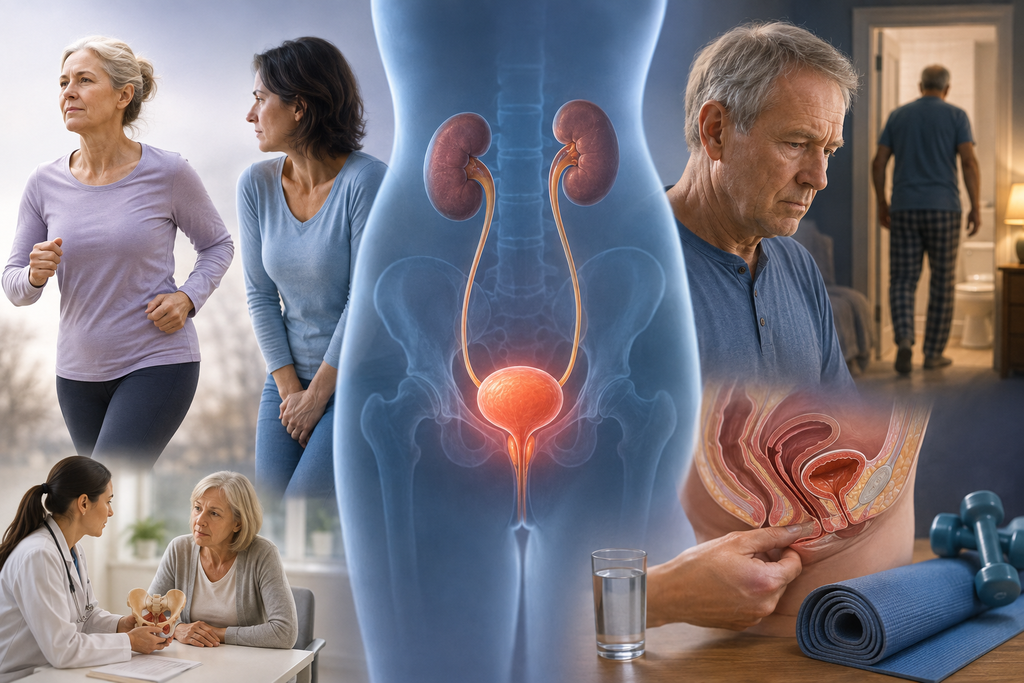
If you’ve ever laughed a little too hard, sprinted across the street, or simply gotten older, you may have noticed your bladder has developed opinions of its own. You’re suddenly chagrined to discover that you’ve developed more than a passing acquaintance with urinary incontinence. Since my own prostate surgery, a little over 10 years ago, I’ve become all too familiar with the inconvenience and the embarrassment of urinary incontinence.
It’s one of those conditions that’s extraordinarily common and yet still gets talked about in whispers, if it gets talked about at all. That’s a shame, because it’s rarely something people simply have to live with. Roughly six in ten women and about one in seven men will deal with some form of it at some point. The reasons range from childbirth to prostate surgery to the ordinary business of getting older.
The bladder is essentially a muscular storage reservoir. As urine enters the bladder, the bladder muscle—the detrusor—normally remains relaxed while the urinary sphincter and pelvic floor help keep the outlet closed. When we decide to urinate, a coordinated neurologic process causes the bladder to contract and the sphincter to relax.
Incontinence is a disruption, either structural or physiological, of this process.
Let’s walk through the main types, how the picture differs for men and women, what surgery can do to bladder control, and why aging tilts the odds toward leakage without making it inevitable.
The Main Types, and Why the Distinction Matters
Doctors sort urinary incontinence into a handful of categories, and getting the category right matters because the treatments diverge from one type to the next.
Stress incontinence is the leakage that shows up during a cough, a sneeze, a laugh, or a heavy lift. It can occur at any moment when pressure inside the abdomen spikes and overwhelms a weakened sphincter or a poorly supported urethra.
Urge incontinence is a different animal entirely. It’s the sudden, hard-to-ignore need to go, often followed by leakage before you can get to a bathroom. It traces back to a bladder muscle that contracts on its own schedule rather than yours.
Plenty of people have some of both, which is fittingly called mixed incontinence and is in fact the most common pattern among women with bladder symptoms.
Then there’s overflow incontinence, a steady dribble that happens when the bladder never quite empties and eventually overflows. Frequently something, often an enlarged prostate in men, is partially blocking the outlet.
Functional incontinence isn’t really a bladder problem at all It happens when the bladder and urethra work fine but a physical or cognitive barrier, arthritis, dementia, an unfamiliar building, keeps you from reaching a toilet in time.
Reflex incontinence, less commonly discussed, involves the bladder contracting without any warning sensation at all, usually the result of nerve damage from conditions like multiple sclerosis or spinal cord injury.
How the Picture Differs Between Women and Men
Sex matters quite a bit here, both in how common incontinence is and in which type shows up. In women, stress incontinence is the single most common variety, and pregnancy and vaginal childbirth are the biggest reasons why. They stretch and sometimes injure the pelvic floor muscles and connective tissue that ordinarily keep the urethra snugly closed.
Menopause adds another layer, since declining estrogen thins the urethral lining and can weaken sphincter function further. Cleveland Clinic data estimate roughly 62 percent of women age twenty and older experience some form of incontinence, a striking number that reflects just how common, and how underreported, this condition is.
Men have a lower overall rate, on the order of 14 percent, but their pattern looks different. Because men don’t have the childbirth-related stresses on the pelvic floor, stress incontinence in men is less common on its own and shows up mainly after prostate surgery, which we’ll get to shortly.
Overflow incontinence is proportionally more of a male problem, since an enlarging prostate gland can squeeze the urethra and prevent the bladder from emptying completely.
Urge incontinence and overactive bladder symptoms affect both sexes and become more common with age regardless of gender.
What Hysterectomy Does to Bladder Control
Hysterectomy is one of the most common major surgeries performed on women, and extensive research has looked at what it does to the bladder over the years following surgery. The short version: removing the uterus appears to modestly raise the long-term risk of stress incontinence, likely because the surgery can disturb the nerves, ligaments, and connective tissue that support the bladder neck and urethra. These structures sit close to the uterus and cervix.
A large systematic review found that during the first decade after hysterectomy, women faced a higher likelihood of urinary incontinence of any type, and stress incontinence specifically, compared with women who hadn’t had the surgery. Beyond ten years out, the gap widens further for stress incontinence.
A nationwide Finnish cohort that followed five thousand women for over a decade found that about one in fifty ultimately needed a surgical procedure to correct stress incontinence, with the risk running somewhat higher after vaginal or laparoscopic hysterectomy than after the abdominal approach.
It’s worth remembering that most women who have a hysterectomy never develop significant incontinence. Surgery is often the right choice for the underlying problem being treated, whether that’s fibroids, heavy bleeding, or cancer. But the association is real enough that it belongs in the conversation that women have with their surgeons beforehand. Particularly if they have already had vaginal deliveries, since that appears to carry extra risk.
What Prostatectomy Does to Bladder Control
For men, radical prostatectomy, the surgical removal of the prostate gland, most often performed for prostate cancer, is by a wide margin the leading cause of urinary incontinence. Nearly every man leaks to some degree immediately after the catheter comes out, which sounds alarming but reflects basic anatomy. The prostate normally works alongside the external sphincter to hold urine back, and removing it shifts the entire job onto that external sphincter, which needs time to adapt to the extra workload.
Continence rates climb steadily over the following year, with studies reporting roughly a quarter to half of men fully continent by three months, somewhere around two-thirds to three-quarters by six months, and the large majority continent by twelve months.
The American Urological Association’s guidelines note that incontinence is expected in the short term and generally improves toward baseline by a year after surgery, though for a minority, often cited as around a third of patients, some degree of leakage persists longer and occasionally requires further treatment such as pelvic floor therapy or, less often, a surgical procedure. Surgical technique matters too: preserving the nerve bundles that run alongside the prostate and maintaining a longer stretch of urethra during the operation are both associated with faster, more complete recovery of continence.
Late onset urinary incontinence effects approximately 10 to 15 percent of men who regained continence after a radical prostatectomy. It can begin anywhere from 5 to 15 years after surgery. This is frequently believed to be exacerbated by age-related changes.
The Effects of Ordinary Aging
Even without surgery in the picture, the bladder changes as we get older, and those changes tilt the odds toward incontinence for both sexes. Bladder capacity tends to shrink somewhat, meaning it fills to an uncomfortable point sooner.
The detrusor muscle, the smooth muscle that squeezes urine out, becomes more prone to firing off contractions on its own rather than only when you decide it’s time to go. This is a big part of what drives urge incontinence in later life.
The bladder also tends to leave more urine behind after each trip to the bathroom, called increased residual volume, raising the risk of both overflow symptoms and urinary tract infections that can trigger or worsen leakage.
The details diverge a bit by sex. In women, the drop in estrogen after menopause thins and shortens the urethral lining, loosening the seal the sphincter can form and compounding whatever pelvic floor weakening already occurred from childbirth.
In men, incontinence related to aging alone tends to show up later, generally after the seventh decade of life, and often travels alongside prostate enlargement. This is a nearly universal feature of male aging that can produce overflow-type symptoms even without prior surgery.
Incontinence prevalence rises sharply after age 65, and some nursing-home studies put rates as high as two-thirds among residents in their late eighties. Women’s rates consistently outpace men’s at every stage of later life.
None of this means incontinence is simply the toll of aging and that nothing can be done about it. While the physiological changes make leakage more likely, they don’t make it unavoidable. The same toolkit used with younger patients, pelvic floor exercises, bladder training, medications, and in some cases surgery, works for older adults too.
The bigger obstacle tends to be that people, especially older adults, often wait years before mentioning symptoms to a doctor, quietly reorganizing their lives around bathroom access instead of asking for help that’s readily available.
The Bottom Line
Urinary incontinence is sometimes dismissed as an embarrassing inconvenience, but its consequences can be substantial. People may stop exercising, traveling, attending social events, or even leaving home because they are worried about finding a bathroom. Older adults rushing to the toilet at night may also increase their risk of falling.
While urinary incontinence is common, it’s rarely discussed as openly as it deserves to be, and it is seldom explained to patients in plain language.
The consistent message across the research is that this is a treatable condition rather than a life sentence, and the first step toward treatment is usually just being willing to bring it up.
Illustration generated by author using ChatGPT
Medical Disclaimer
The information provided in this article is intended for general educational and informational purposes only and does not constitute medical advice. It should not be used as a substitute for professional medical advice, diagnosis, or treatment.
Always seek the guidance of a qualified healthcare provider with any questions you may have regarding a medical condition or treatment. Never disregard professional medical advice or delay seeking it because of something you have read here.
If you are experiencing a medical emergency, call 911 or your local emergency number immediately.
The author of this article is a licensed physician, but the views expressed here are solely those of the author and do not represent the official position of any hospital, health system, or medical organization with which the author may be affiliated.
Sources
1. Urinary Incontinence, StatPearls, National Library of Medicine. https://www.ncbi.nlm.nih.gov/books/NBK559095/
2. Definition & Facts for Bladder Control Problems (Urinary Incontinence), National Institute of Diabetes and Digestive and Kidney Diseases (NIDDK). https://www.niddk.nih.gov/health-information/urologic-diseases/bladder-control-problems/definition-facts
3. Urinary Incontinence: Causes, Leakage, Types & Treatment, Cleveland Clinic. https://my.clevelandclinic.org/health/diseases/17596-urinary-incontinence
4. Types of urinary incontinence, Harvard Health Publishing. https://www.health.harvard.edu/bladder-and-bowel/types-of-urinary-incontinence
5. Urinary Incontinence in Women, Johns Hopkins Medicine. https://www.hopkinsmedicine.org/health/conditions-and-diseases/urinary-incontinence/urinary-incontinence-in-women
6. Associations between hysterectomy and pelvic floor disorders: a systematic review and meta-analysis, American Journal of Obstetrics & Gynecology. https://www.ajog.org/article/S0002-9378(25)00164-4/abstract
7. Stress urinary incontinence after hysterectomy: a 10-year national follow-up study, Archives of Gynecology and Obstetrics (PMC). https://www.ncbi.nlm.nih.gov/pmc/articles/PMC8967811/
8. Hysterectomy and risk of stress-urinary-incontinence surgery: nationwide cohort study, The Lancet (PubMed). https://pubmed.ncbi.nlm.nih.gov/17964350/
9. Incontinence after Prostate Treatment: AUA/GURS/SUFU Guideline, American Urological Association. https://www.auanet.org/guidelines-and-quality/guidelines/incontinence-after-prostate-treatment
10. The location of the bladder neck in postoperative cystography predicts continence convalescence after radical prostatectomy, BMC Urology (PMC). https://www.ncbi.nlm.nih.gov/pmc/articles/PMC5977542/
11. Duration and Influencing Factors of Postoperative Urinary Incontinence after Robot-Assisted Radical Prostatectomy in a Japanese Community Hospital, PMC. https://www.ncbi.nlm.nih.gov/pmc/articles/PMC10001515/
12. Effects of Aging on the Urinary Tract, Merck Manual Consumer Version. https://www.merckmanuals.com/home/kidney-and-urinary-tract-disorders/biology-of-the-kidneys-and-urinary-tract/effects-of-aging-on-the-urinary-tract
13. Incontinence in the elderly, ‘normal’ ageing, or unaddressed pathology?, Nature Reviews Urology. https://www.nature.com/articles/nrurol.2017.53
14. Neurogenic mechanisms in bladder and bowel ageing, PMC. https://www.ncbi.nlm.nih.gov/pmc/articles/PMC4361768/
15. Prevalence of Incontinence Among Older Americans, National Center for Health Statistics, Centers for Disease Control and Prevention. https://www.cdc.gov/nchs/data/series/sr_03/sr03_036.pdf