
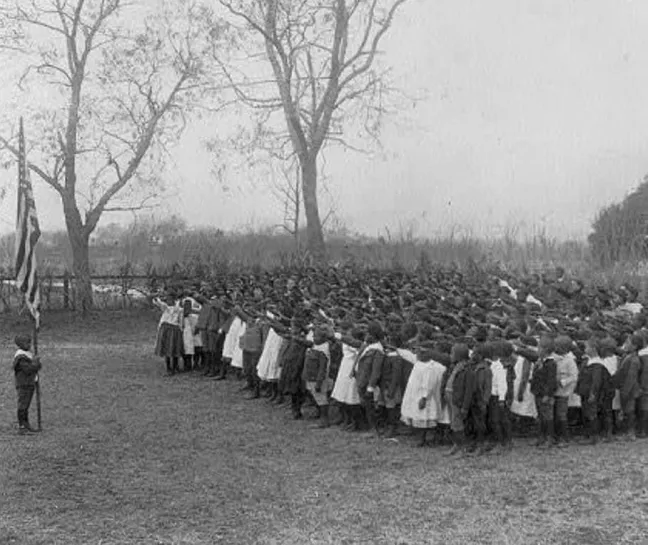
Library of Congress Photography Collection
Here’s a story that most Americans never learned in school and it’s one worth knowing.
When we think about Memorial Day, we typically picture a date set by Congress, a general’s order, or some official act of government. What we don’t picture is a group of newly freed Black Americans in post-Civil War Charleston, South Carolina, quietly reburying the dead and making sure they weren’t forgotten. But that’s exactly what happened — and it may be the closest thing we have to the true origin of Memorial Day.
A Racetrack Turned Prison Turned Cemetery
Before the Civil War, the Washington Race Course and Jockey Club in Charleston was the kind of place where the Southern planter class went to be seen — horse racing, socializing, a symbol of antebellum wealth. By the war’s final year, the Confederate Army had repurposed it into something far grimmer: an open-air prison for captured Union soldiers.
The conditions were brutal. More than 257 Union prisoners of war died there from disease and exposure, and when the Confederates abandoned Charleston in early 1865, they left the bodies in a hastily dug mass grave in the infield. It was an ugly end for men who had fought to hold the country together.
What Happened Next Was Extraordinary
Less than a month after the Confederacy surrendered, a group of roughly two dozen Black volunteers did something remarkable. They went to that racetrack, exhumed the bodies one by one, and gave each man a proper individual burial. Then they built a ten-foot white fence around the entire site. Above the entrance, they hung a hand-painted sign that read: “Martyrs of the Race Course.”
They didn’t stop there. Together with Black schoolchildren, mutual aid societies, Union troops, Black ministers, and white northern missionaries, the community organized a formal ceremony for May 1, 1865. Nearly ten thousand people showed up — mostly freedmen — and most of them brought flowers.
The New York Tribune was there to cover it, describing the scene as “a procession of friends and mourners as South Carolina and the United States never saw before,” with gravesites that looked like “one mass of flowers.”
Why It Matters
Historian David W. Blight, who uncovered this story in a Harvard archive in the late 1990s, framed the significance of that day in striking terms: “What you have there is Black Americans recently freed from slavery announcing to the world with their flowers, their feet, and their songs what the war had been about. What they basically were creating was the Independence Day of a Second American Revolution.”
That’s not a small claim. And yet it’s grounded in documented newspaper accounts, archival records, and careful historical research. Blight laid it all out in his 2001 book Race and Reunion: The Civil War in American Memory — a work that brought this story back from near-total obscurity.
The moment that perhaps best captures the weight of this rediscovery came after Blight gave a talk at the Smithsonian. An older Black woman approached him afterward. “You mean that story is true?” she asked. “I grew up in Charleston, and my granddaddy used to tell us this story of a parade at the old racetrack, and we never knew whether to believe him or not.”
How the Story Got Buried
The Charleston ceremony didn’t disappear by accident. During the post-Reconstruction era, groups like the United Daughters of the Confederacy worked systematically to reshape public memory of the Civil War. Books were rewritten, narratives were shifted, and the Black-led origins of what would become Memorial Day were quietly erased from the historical record. White organizers were credited in their place.
This wasn’t unusual. It fits a much broader pattern in American history in which Black contributions to the nation’s military and civic life — from the Revolutionary War through both World Wars — were minimized or simply left out of the story that got told in schools and textbooks.
A Note on Competing Claims
It’s worth being fair about the history here: towns like Waterloo, New York, and Columbus, Georgia also claim early Memorial Day commemorations, and historians continue to debate which event was truly “the first.” Waterloo, in fact, holds the official congressional designation as the birthplace of Memorial Day.
But the Charleston ceremony of May 1, 1865, stands as one of the most thoroughly documented early observances — and arguably the most meaningful in its context. What makes the Charleston ceremony especially significant is that it linked remembrance of the war dead directly to emancipation and Black citizenship. To the participants, honoring fallen Union soldiers also meant honoring the destruction of slavery itself. It was organized by people who had the most personal stake in honoring those deaths: the men and women who had been enslaved, and who understood better than anyone what those Union soldiers had given their lives for.
The Bottom Line
Memorial Day didn’t begin with an act of Congress. One of its earliest and most powerful expressions came from a community of recently freed Black Americans in Charleston, South Carolina, who spent two weeks exhuming the dead, burying them properly, and organizing a ceremony that ten thousand people attended.
They did it with flowers, hymns, and their presence — and then history buried the story much as the Confederates had buried the soldiers. It took a box of old newspaper clippings in a Harvard archive to bring it back.
That’s worth remembering, too.
Sources
History.com — One of the First Memorial Days Was Held by Freed Slaves
African American Registry — The First American Memorial Day Is Commemorated
Time Magazine — The Forgotten Black History of How Memorial Day Started
The Black Wall Street Times — The True Story of Memorial Day
EURweb — The First Memorial Day Was in Charleston, Led by Freed African Americans
New York Historical — The First Memorial Day with David W. Blight
SDARJ — Black History of Memorial Day
Charleston ASALH — Decoration Day & Charleston’s Gullah Community
Leave a Reply