
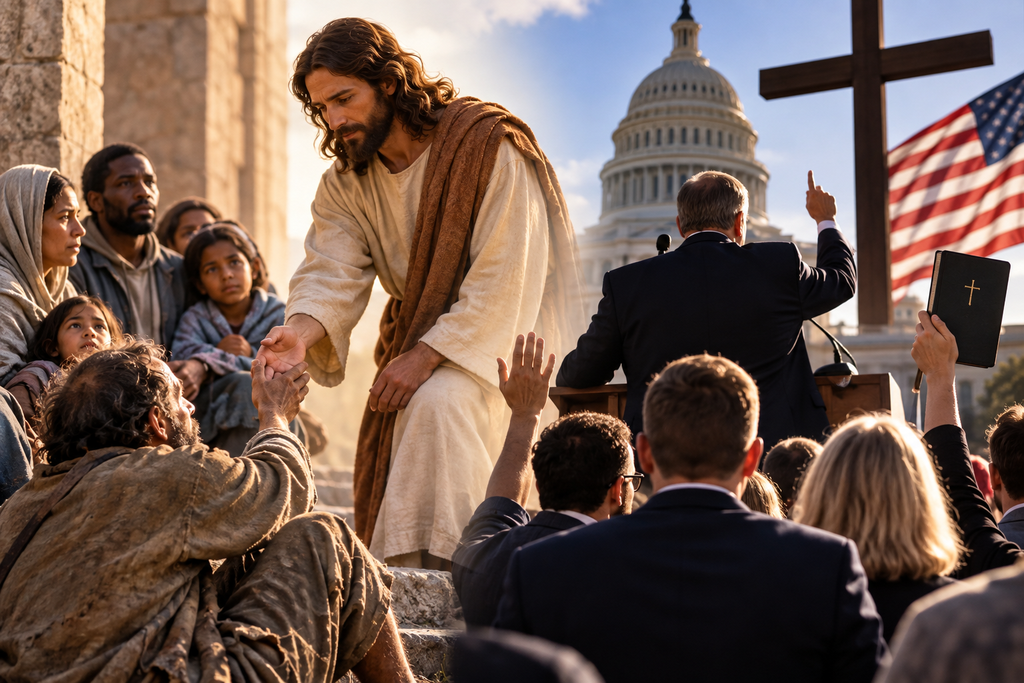
American conservative evangelical Christianity has become one of the most influential political forces in the United States. Over the past several decades, and particularly since the rise of Donald Trump, a large and highly visible portion of white evangelical Protestantism has aligned itself closely with the Republican Party. Its political agenda has emphasized opposition to abortion and LGBTQ rights, stricter immigration enforcement, gun rights, religious liberty, traditional gender roles, and, increasingly, the claim that the United States was founded as a Christian nation.
This raises an uncomfortable but legitimate question: How closely does this political movement resemble the teachings of Jesus as recorded in the Gospels?
The “conservative evangelical church” is not a single institution with a single political agenda. It encompasses Southern Baptists, nondenominational megachurches, Reformed Christians, Pentecostals, charismatics, and many independent congregations. Millions of people in evangelical congregations do not always agree with one another or even with their pastors on all political issues.
Polls usually focus on the segment most visible in American politics, white conservative evangelical Protestants. They make up a population of roughly twenty-five million adults whose voting behavior and political opinions have been extensively studied. This is the group I will focus on.
We shouldn’t assume they represent all evangelicals. Black and Latino evangelicals, for example, often share many of the same theological beliefs while differing substantially in their political opinions.
I’m not going to discuss if evangelicals are “hypocrites.” That accusation generates more heat than light. A more useful approach is to compare documented evangelical political positions with specific teachings attributed to Jesus and ask where the two fit comfortably and where they do not.
What Did Jesus Actually Teach?
Whatever you believe about the historical Jesus or the theological claims made about him, the Gospels present a recognizable and consistent ethical message.
The Sermon on the Mount praises the meek and merciful and commands followers to love their enemies and to pray for those who persecute them. The Good Samaritan makes a despised outsider the model of what it means to be a neighbor. People are judged according to whether they fed the hungry, clothed the needy, welcomed the stranger, and cared for the imprisoned.
Jesus also repeatedly warns about the love of wealth. In one case, he tells a rich man that his possessions are an obstacle to following him and declares that no one can serve both God and money. In another case he says, “Where your treasure is, there your heart will be also.” Jesus never says that money is evil, and he recognizes that it can be used to do good for the less fortunate. He warned against greed and accumulating wealth for its own sake.
These are not obscure theological interpretations. They are among the best-known passages in Christian scripture.
The difficulty comes when Christians try to translate the teachings of a first-century itinerant Jewish rabbi into the policies of a twenty-first-century nation-state. Jesus never developed a federal budget, immigration code, tax schedule, or health-care program.
Christians can agree that they should help the poor while disagreeing about whether it should be done by government or private charity. They can value compassion toward immigrants while also believing that nations have a legitimate right to control their borders.
Christians have struggled with this distinction between personal morality and governmental responsibility since the fourth century when Christianity began to expand their political power. We should be cautious about declaring that any particular modern policy is obviously “what Jesus would do.”
Where the Fit Is Closer Than Critics Admit
Several aspects of conservative evangelicalism deserve consideration before we look at the contradictions.
The first is opposition to abortion. Evangelicals generally understand their pro-life position to be protection of vulnerable human life. Whether you agree with their conclusions about when personhood begins, the argument itself is not difficult to connect with a Christian obligation to protect those who cannot protect themselves.
Second, evangelicals have a substantial tradition of charitable giving. Practicing evangelicals tend to donate generously to churches and charities. Evangelical organizations have played important roles in disaster relief, international development, food assistance, adoption services, and care for the poor. Charitable giving is an important part of evangelical religious practice and has an obvious connection with the Gospel emphasis on caring for people in need.
Immigration provides a third, more complicated example. Surveys suggest that many evangelicals hold positions more nuanced than their political reputation would suggest. Some support secure borders and enforcement of immigration laws while simultaneously opposing the separation of families and favoring some form of legal status or pathway to citizenship for undocumented immigrants already living in the United States.
This is not necessarily inconsistent. You can believe both that a nation requires secure borders and that immigrants should be treated humanely. The difficulty arises when enforcement becomes punitive.
Where the Fit Becomes Strained
White evangelicals have been unusually supportive of aggressive immigration enforcement, increased funding for Immigration and Customs Enforcement, detention of undocumented migrants, and mass-deportation proposals. They also tend to view ICE more favorably than other major religious groups.
The story of The Good Samaritan is instructive on many levels. On the surface this is a story of someone considered to be an outsider showing compassion and caring for an unfortunate person. Samaritans were considered disreputable by Jews and the fact that a Samaritan would offer unequivocal love and concern for the less fortunate while Jews did not is significant on its own.
There’s another layer to this story. The “expert in the law” who questioned Jesus about whom he should see as his neighbor has long been considered to be a minor character who simply sets up the question so Jesus can provide a story. But a deeper reading reveals that the expert may be the object of the story. Rather than trying to understand who his neighbor is, he is attempting to set boundaries around those to whom he must show love. Jesus doesn’t ridicule him or directly point out his errors. He merely allows him to conclude that everyone is his neighbor regardless of any preconceived notions about them. Whether this changes the expert or not we aren’t told. We can only hope that it does.
This passage doesn’t tell us how governments should regulate immigration, but it makes it difficult to argue that the suffering of foreigners should be morally irrelevant to Christians.
An even more striking controversy has developed within evangelicalism over empathy.
Some conservative Christian writers, including Pastor Doug Wilson and theologian Joe Rigney, have warned that empathy can become morally dangerous when it causes people to identify so completely with another person’s suffering that they abandon moral judgment. They distinguish empathy from sympathy or compassion and argue that Christians should resist the former when it undermines their political objectives.
Their evangelical critics regard this as a remarkable reversal of traditional Christian priorities. Compassion for people who suffer is hardly peripheral to the ministry of Jesus. He repeatedly responded to sickness, hunger, grief, exclusion, and poverty with compassion and empathy.
The significance of this debate is that the criticism is no longer simply coming from secular liberals attacking conservative Christianity. Evangelicals themselves are arguing about whether their political culture has made them suspicious of one of Christianity’s central virtues.
Wealth, Poverty, and Selective Morality
Jesus repeatedly describes love of wealth as spiritually dangerous. He warns against storing treasures on earth and says that people cannot serve both God and money.
Jesus did not propose an economic system. Nothing in the Gospels tells us whether the top marginal tax rate should be 25 percent or 50 percent. It is simplistic to claim that Christianity requires support for a particular welfare program or tax policy.
But it is equally difficult to reconcile the Gospels with a Christianity that celebrates wealth while treating poverty as evidence of personal failure.
This leads to a broader question of selective morality. Why do abortion and sexual orientation receive enormous political attention while greed, pride, dishonesty, cruelty, contempt for foreigners, and indifference toward the poor receive comparatively less? Jesus certainly discussed sexual morality, but he also spoke repeatedly about money, hypocrisy, mercy, forgiveness, pride, and care for society’s outcasts.
A political Christianity that concentrates heavily on some sins while overlooking others risks reshaping the Gospel around the priorities of a political coalition.
Romans 13 and the Power of Government
The tension is especially visible in the Trump administration’s family-separation policy of 2018. Attorney General Jeff Sessions invoked Romans 13, Paul’s admonition to submit to governing authorities, as defense of their enforcement of immigration law.
The argument cannot simply be dismissed as theological fabrication. But Romans 13 also carries historical baggage. Appeals to obey governmental authority have repeatedly been used to defend unjust political systems and even slavery. These arguments generally ignore the fact that the same chapter concludes by describing love of one’s neighbor as fulfillment of the law.
There is also an historic Christian theological tradition behind this argument. Martin Luther’s “Two Kingdoms” theology distinguished between the responsibilities of individual Christians and those of civil government. Individuals may be commanded to forgive enemies, while governments still require police, courts, prisons, and armies. A government cannot literally turn the other cheek when confronted with violent crime or invasion.
Christianity contains these two obligations and they are often in tension — respect for legitimate civil authority and resistance to injustice. Emphasizing only the first can turn obedience to government into a religious virtue regardless of what government does. It’s important to remember Jesus’ commandment to render under Caesar that which is Caesar’s and unto God that which is God’s. Unfortunately, many modern conservative evangelicals seem to confuse Caesar and God.
Trump, Cyrus, and the Question of Character
Some evangelical leaders have compared Trump with Cyrus, the Persian king described in Isaiah. Cyrus was not an Israelite and did not worship Israel’s God, but the biblical narrative presents him as an instrument through whom God carried out a larger purpose.
Applied to Trump, the argument is straightforward. A political leader does not need to be personally virtuous to accomplish outcomes Christians consider desirable. Polling suggests that many white evangelicals make precisely this distinction. They express reservations about Trump’s personal behavior while strongly approving of his presidency and policies.
This is nothing new. Voters have routinely supported politicians they consider personally flawed because they prefer their policies to the alternative.
But for Christians, it creates another tension. The New Testament places considerable emphasis on honesty, fidelity, humility, self-control, and personal character. If those virtues matter when evaluating pastors, teachers, neighbors, and ordinary church members, Evangelical Christians need to explain why they are less important when evaluating political leaders.
Christian Nationalism
Perhaps the greatest departure from the teaching of Jesus comes with Christian nationalism. This is the idea that Christianity should enjoy a privileged relationship with the American state and that American law should explicitly reflect Christian identity.
The problem is not that Christians participate in politics. Christianity has influenced political movements ranging from the abolition of slavery and civil rights to temperance and opposition to abortion. Religious citizens have the same right as everyone else to bring their moral convictions into public debate.
The danger arises when Christianity becomes identified with a particular nation, party, or political leader and when Christian groups insist that the government must reflect only their religious convictions.
Jesus consistently resisted attempts to transform his religious mission into conventional political power. When questioned by Pilate, he declared that his kingdom was “not of this world.” His followers may participate vigorously in earthly politics, but the Gospel does not easily support the proposition that any modern nation is itself God’s kingdom.
A church shaped by Jesus should be capable of criticizing every political party, including the one supported by most of its members. It should be suspicious when electoral victory is described as divine victory and equally suspicious when political opponents are treated as enemies of God.
A Church Arguing With Itself
American evangelicalism is already having this debate internally. Walter Kim, president of the National Association of Evangelicals, has warned that mass deportation could separate an enormous number of families and has urged evangelicals to approach immigration through a more explicitly Christian framework.
Ordinary evangelical Christians are more divided than either their harshest critics or their most politically vocal leaders like to acknowledge. The story is not simply one of a monolithic church abandoning the teachings of its founder. It is the story of a large and diverse religious movement struggling with an ancient problem. How should a religion built around mercy, sacrifice, forgiveness, and love of neighbor fit within a political system built around power, law, coercion, and competing interests?
Evangelicals invoking Romans 13, and other teachings of Jesus, believe they are interpreting scripture faithfully. They may not be correct about every political conclusion, or any conclusion, but they have not invented the argument from nothing.
Perhaps the best test is not whether conservative evangelicals can find biblical passages supporting their positions; almost any political movement can do that. The important question is what receives the greatest emphasis.
If someone encountered American Christianity without ever having read the Gospels, what would they conclude Jesus cared about most? Abortion? Sexuality? Immigration enforcement? Religious control of government? Or would they recognize a teacher who spoke relentlessly about mercy, humility, forgiveness, hypocrisy, wealth, and care for outsiders and the poor?
That is a question worth asking not only of conservative evangelicals, but of every Christian movement that seeks political power.
Illustration generated by author using ChatGPT
Sources
1. Pew Research Center, “White evangelicals remain among Trump’s strongest supporters, but less so than a year ago” (Feb. 9, 2026). https://www.pewresearch.org/short-reads/2026/02/09/white-evangelicals-remain-among-trumps-strongest-supporters-but-theyre-less-supportive-than-a-year-ago/
2. Pew Research Center, “Americans’ Views of Religion’s Role in Government and Christian Nationalism” (May 14, 2026). https://www.pewresearch.org/religion/2026/05/14/how-americans-feel-about-religions-influence-in-government-and-public-life/
3. PRRI, “Immigration Enforcement, ICE, and Civil Liberties in the Second Trump Administration” (March 26, 2026). https://prri.org/research/americans-views-on-immigration-enforcement-ice-and-civil-liberties-in-the-second-trump-administration/
4. PRRI, “The New Immigration Crackdown: Where Americans Stand” (Dec. 9, 2025). https://prri.org/research/the-new-immigration-crackdown-where-americans-stand/
5. Lifeway Research / Evangelical Immigration Table, “Evangelicals Want Secure Borders and Citizenship Pathway for Immigrants” (2025 study). https://research.lifeway.com/2025/02/05/evangelicals-want-secure-borders-and-citizenship-pathway-for-immigrants/
6. Religion News Service / Word&Way, “Evangelical Groups Warn Trump’s Deportations Could Leave 1.3M ‘Torn Apart’ From Families” (May 5, 2026). https://wordandway.org/2026/05/05/evangelical-groups-warn-trumps-deportations-could-leave-1-3m-torn-apart-from-families/
7. The Banner, “U.S. Evangelicals Divided Over What Faith Demands as Immigration Tensions Deepen” (Feb. 6, 2026). https://www.thebanner.org/news/2026/02/us-evangelicals-divided-over-what-faith-demands-as-immigration-tensions-deepen
8. PBS News, “Is empathy a sin? Some conservative Christians argue it can be” (Aug. 21, 2025). https://www.pbs.org/newshour/politics/is-empathy-a-sin-some-conservative-christians-argue-it-can-be
9. The Gospel Coalition, “Navigating Empathy” (Themelios, Dec. 7, 2021). https://www.thegospelcoalition.org/themelios/article/navigating-empathy/
10. Texas Observer, “The Little-Known Theology Behind White Evangelical Support of Donald Trump” (April 20, 2019). https://www.texasobserver.org/the-little-known-theology-behind-white-evangelical-support-of-donald-trump/
11. HuffPost, “Evangelicals Keep Misusing The Same Bible Verses To Give Trump A Pass” (June 20, 2018). https://www.huffpost.com/entry/evangelicals-keep-misusing-the-same-bible-verses-to-give-trump-a-pass_n_5b297b7fe4b0a4dc9921e6e8
12. Commonweal Magazine, “Rationalizing Trump” (Feb. 24, 2025). https://www.commonwealmagazine.org/rationalizing-trump
13. Providence, “Romans 13 and ICE under the Trump Administration” (Feb. 24, 2026). https://providencemag.com/2026/03/romans-13-and-ice-under-the-trump-administration/
14. Grey Matter Research, “Giving Is Down among Evangelicals” (Sept. 10, 2024). https://greymatterresearch.com/the-giving-gap/
15. Lifeway Research, “What Sparks Evangelical Generosity? Discipleship” (Jan. 14, 2022). https://research.lifeway.com/2022/01/14/are-evangelicals-generous-enough/
16. MinistryWatch, “Christians are Most Charitable, Giving Drives Happiness” (Dec. 18, 2024). https://ministrywatch.com/christians-are-most-charitable-giving-drives-happiness/
Leave a Reply