
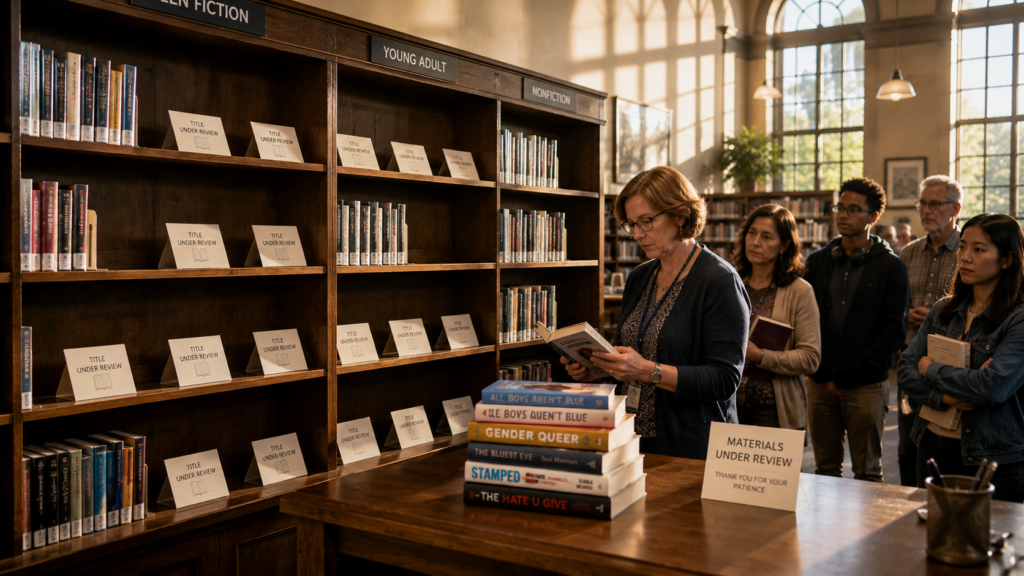
If you thought book banning was a relic of the past, think again. The United States is experiencing the most intense wave of book challenges in modern memory. Over the last four years, thousands of books have been removed from school and library shelves, sparking a national debate about parental rights, free expression, education, and the role of government.
At the center of the controversy is a simple but powerful question: Who gets to decide what children and communities are allowed to read?
We were casually looking for books to read with our grandson this year. He loves baseball so we were looking for books on that topic. Somehow we got on a site about banned books and, yes, there was a baseball story on the list, curiosity got us. The book is Baseball Saved Us by Ken Mochizuki and Dom Lee. This is the story about a baseball field that was created in a Japanese internment camp in during World War II and the prejudice they faced when they returned home after the war. The story, written on a fourth grade reading level, is about how the boys played baseball during their internment and how it helped them to survive. This is a banned book?? Why??
This made us wonder what it means to be on a “banned book list”. Just because it’s on the list does every library or school have to ban it? The answer is no, thank goodness. Members of library boards and school boards and parents play an important role and they have a lot to consider. Here are some interesting details about book banning in its current evolution.
The Scale of the Movement
The numbers are striking. According to PEN America, nearly 23,000 book bans have occurred in public schools since 2021. During the 2023–24 school year alone, more than 10,000 individual book bans were recorded. The following year saw nearly 7,000 additional bans affecting more than 3,700 unique titles.
Florida has led the nation in book removals for three consecutive years, followed by Texas and Tennessee. The American Library Association (ALA) documented more than 4,200 unique titles challenged in 2025, making it one of the highest years ever recorded.
Not every challenge results in a permanent ban. Some books are removed temporarily while review committees evaluate complaints. Others are eventually restored to shelves. Yet the sheer volume of challenges has significantly reduced access to books for many students and library users.
Supporters argue these actions protect children from inappropriate material. Critics view them as a growing campaign of censorship.
Which Books Are Being Targeted?
The books most frequently challenged share common themes.
According to the ALA, many complaints focus on books that discuss race, racism, gender identity, sexuality, or LGBTQ+ experiences. Others involve sexual content, abuse, violence, or mental health issues.
Among the most challenged books in recent years are Gender Queer by Maia Kobabe, The Perks of Being a Wallflower by Stephen Chbosky, Looking for Alaska by John Green, and several novels by Sarah J. Maas.
Classic works have also been caught in the controversy. Schools and districts in several states have removed or restricted books such as The Bluest Eye by Toni Morrison, The Kite Runner by Khaled Hosseini, and even George Orwell’s 1984.
Critics of the banning movement note that many of these books have been available in schools for years or even decades. They argue that the current challenges are less about newly discovered concerns and more about broader cultural and political disagreements.
Who Is Driving the Challenges?
One of the most significant developments is the changing source of complaints.
The ALA reports that in 2025, 92 percent of book challenges originated from organized groups, government officials, or political activists rather than individual parents. Twenty years earlier, most challenges came from local citizens raising concerns about specific books.
This shift suggests that book challenges have become part of a larger political movement rather than isolated local disputes.
Among the most visible organizations is Moms for Liberty, founded in Florida in 2021. Originally focused on opposition to COVID-19 school policies, the group later turned its attention to curriculum issues and library books. It now claims chapters in dozens of states and has become a major force in school board elections and library controversies.
Other organizations, including No Left Turn in Education, Citizens Defending Freedom, and various state-based groups, have pursued similar goals. These organizations often share lists of books to challenge, provide guidance to local activists, and coordinate campaigns across multiple communities.
Supporters describe these efforts as parental advocacy. Critics see them as organized attempts to impose political and ideological restrictions on public education.
The Political Connection
The book-banning movement has become closely associated with broader conservative politics, particularly the MAGA movement.
Moms for Liberty has maintained ties with the Heritage Foundation, the conservative think tank that developed Project 2025. The Heritage Foundation has sponsored Moms for Liberty events and honored the organization with awards recognizing its activism.
The relationship became even more visible when Moms for Liberty co-founder Tiffany Justice left the organization to lead the Heritage Foundation’s parental-rights initiative.
Former President Donald Trump has also embraced many of the same themes. He appeared at a Moms for Liberty national summit and has frequently criticized educational institutions, libraries, and schools that he believes promote what he describes as inappropriate or politically biased material.
Supporters view these alliances as part of a broader effort to restore parental control over education. Opponents argue they demonstrate that book challenges have become deeply intertwined with national political agendas.
Project 2025 and Libraries
Much attention has focused on Project 2025, the policy blueprint produced by the Heritage Foundation.
The document calls for stronger action against what its authors characterize as inappropriate materials in schools and libraries. Critics have highlighted language suggesting that educators and librarians who provide access to certain materials could face legal consequences.
Supporters argue that such proposals are intended to protect children from explicit content. Opponents contend that they would create a chilling effect, discouraging educators and librarians from offering books dealing with controversial subjects.
The debate reflects a broader disagreement about where the line should be drawn between protecting minors and preserving intellectual freedom.
How Libraries and Schools Are Responding
Responses vary widely across the country.
Some school districts remove challenged books immediately. Others establish review committees consisting of teachers, librarians, administrators, parents, and sometimes students. These committees examine books in their entirety before making recommendations.
Public libraries have generally been more resistant to removing books. Most rely on formal collection-development policies and challenge procedures designed to balance community concerns with principles of intellectual freedom.
Many libraries have retained challenged books after review, arguing that public libraries serve diverse populations and that parents should make reading decisions for their own children without limiting access for others.
At the same time, librarians in some states report increasing pressure from elected officials and advocacy groups. Concerns about funding, employment consequences, and potential legal liability have led some libraries to avoid purchasing controversial titles altogether.
Critics refer to this phenomenon as “preemptive censorship” because books disappear before formal challenges even occur.
State Governments Enter the Fight
Several states have moved beyond local challenges and enacted statewide policies.
Utah, South Carolina, and Tennessee have adopted mechanisms that allow certain books to be removed from schools statewide. Florida has expanded parental authority over educational materials and library collections.
Supporters argue these measures provide consistency and protect children across entire states. Critics counter that statewide restrictions eliminate local decision-making and reduce access to books for students whose families may have no objections to the material.
The controversy has occasionally reached dramatic levels. In Randolph County, North Carolina, county commissioners dissolved the public library board after it refused to remove a children’s book featuring a transgender character.
Such disputes illustrate how library policy has become a flashpoint in cultural conflicts.
The Courts Push Back
Many of these policies have faced legal challenges and the results have been mixed.
In Iowa, a federal judge blocked portions of a state law that prohibited books containing descriptions of sexual activity, ruling that the restrictions likely violated First Amendment protections. In the Rutherford County, Tennessee case, the first legal challenge to that state’s expanded book statute — a federal judge declined to issue a preliminary injunction, writing that a school board “has not prohibited students from reading the books or acquiring them elsewhere; instead, it has merely opted not to carry them on school library bookshelves.”
Courts have often struggled to balance competing interests. School boards possess significant authority over educational materials, while students have constitutional protections related to access to information.
The legal outcomes remain uncertain, but the judiciary has become one of the primary battlegrounds in the debate.
Voters Respond
School board elections have become another arena for the conflict.
In several Texas districts during 2025, voters removed incumbents who had championed aggressive book-removal policies. Similar results appeared in other states, suggesting that many voters are uncomfortable with the scope of current restrictions. At the same time, candidates supporting stricter controls continue to win elections in other communities.
The mixed results indicate that Americans remain deeply divided on the issue.
A Growing Countermovement
Opposition to book bans has generated its own political response. Organizations such as PEN America, the Authors Guild, the ALA, and numerous local advocacy groups have organized campaigns defending intellectual freedom. Several states have considered legislation designed to make book removals more difficult.
Minnesota, for example, has considered legislation that would prohibit the removal of books based primarily on ideological objections and would place greater authority in the hands of professional librarians.
Supporters argue such laws protect access to information. Critics contend they diminish parental influence and local control.
The Bottom Line
The modern book-banning movement is unlike anything seen in recent decades. Its scale is unprecedented, its organization is sophisticated, and its connections to broader political movements are well documented.
Supporters view the effort as a legitimate exercise of parental rights and community standards. Critics see it as an organized campaign to restrict access to ideas, experiences, and viewpoints that some groups find objectionable.
The debate is unlikely to disappear anytime soon. It touches fundamental questions about education, democracy, free speech, and the role of public institutions.
Who should decide what belongs on library shelves? Parents? Librarians? Teachers? School boards? Legislatures? Courts?
Americans have not reached a consensus on those questions. Until they do, the battle over books is likely to remain one of the most visible fronts in the nation’s ongoing culture wars.
Illustration generated by author using Chat GPT
Sources
PEN America — Book Bans Overview
PEN America — The Normalization of Book Banning (2024–25 Report)
American Library Association — Censorship by the Numbers
NPR — ALA Releases 2025 Most Challenged Books
NPR — PEN America 2024–25 Report
Authors Guild — Voters Reject Book Restrictions, 2025
Washington Post — Trump, Moms for Liberty, Heritage Foundation
New Jersey Monitor — M4L Summit and Project 2025 Ties
GLAAD — Moms for Liberty and Book Bans
EveryLibrary Institute — Project 2025 and Libraries
Leave a Reply