
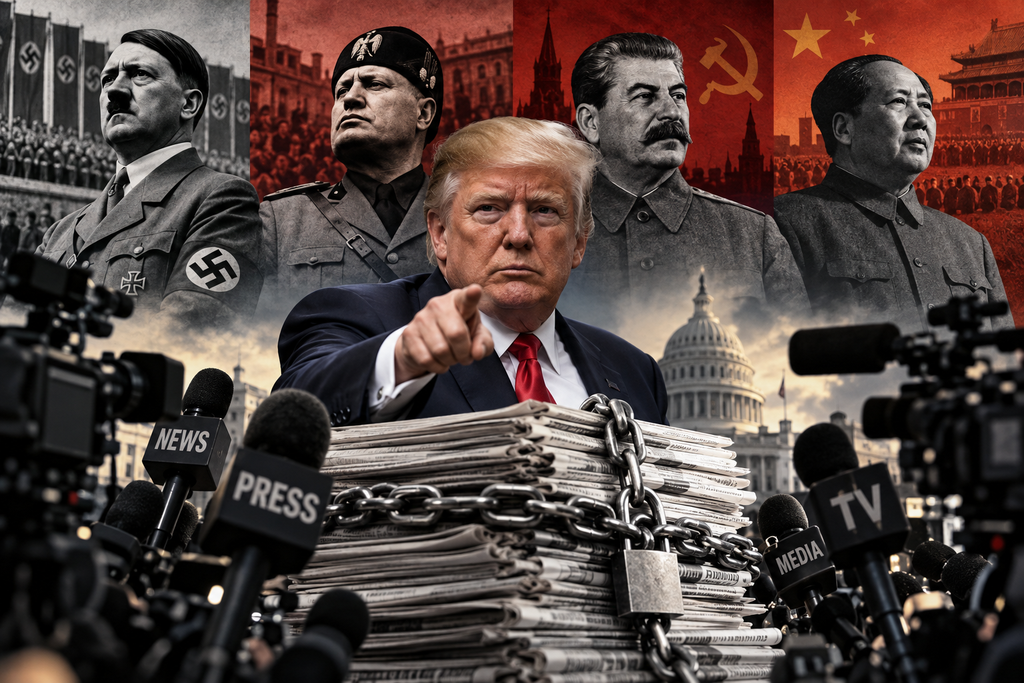
Donald Trump’s recent battle with CNN, MS NOW, and Politico is just the latest in a long list of conflicts with the press over what he views as unfavorable or inaccurate coverage. Many people believe his actions are becoming increasingly authoritarian. Some are quick to reach for the term Nazi or fascist when describing his actions. I know this can be tempting because I’ve done it myself.
While his actions are becoming increasingly authoritarian-like, have they really reached the level of previous totalitarian dictatorships? Let’s look at a few totalitarian regimes from the last 100 years and see how the Trump administration’s approach to the press stacks up against theirs. While there are many examples to choose from, I’m going to look at two familiar and one not so familiar example — Nazi Germany, Communist China, and Viktor Orbán’s Hungary.
Nazi Germany
Prior to Hitler’s rise to power, Germany had a free and diverse press. In 1933 there were more than 4,700 newspapers in Germany covering almost every political, social and religious segment of society. Less than three percent of newspapers were controlled or heavily influenced by the Nazis.
Hitler rapidly seized control of the German press through a series of emergency decrees and laws he justified through a series of trumped-up events such as the infamous Reichstag fire. Hitler blamed the fire on the communists despite any clear evidence that they were involved.
Hitler also used it to justify mass arrests of political opponents and to issue emergency decrees suspending basic civil liberties and he made it illegal to criticize the government. Within just a few months, communist and social democratic newspapers had been shut down and their printing presses confiscated. Independent newspapers faced increasing pressure to comply “voluntarily” with government restrictions on their reporting.
In March 1933, the Nazis created the Reich Ministry of Public Enlightenment and Propaganda under Joseph Goebbels. He quickly took control of film, radio, theater, and newspapers. The Editor’s Law of October 1933 required every editor and journalist to register with the government. It excluded Jews and anyone married to a Jew, or anyone considered politically or racially unacceptable from taking part in either newspaper writing or publishing.
Editors were given specific instructions about what they would be allowed to report and how stories should be prepared. They were ordered to omit anything “calculated to weaken the strength of the Reich abroad or at home.” Acceptable content was provided through weekly press conferences in Berlin and was relayed to local newspapers. Those who didn’t comply could lose their jobs or even face the concentration camps. By the middle of 1941, the Nazis controlled approximately 80% of German newspapers. By the beginning of 1942, independent newspapers had virtually ceased to exist.
Communist China
China is an important example of media control in the digital age. They have found an effective way of controlling information in a society where almost everyone has a smartphone and almost anyone can post content.
China is not new to the game of media control. The Chinese Communist Party first established the Central Propaganda Department in 1921 and has been in total control of the country’s media since 1949. It found a way to effectively control a commercial media market by allowing some private ownership of closely controlled media companies.
What China has created is an effective system of self-censorship where media outlets employ their own in-house content managers who review all published items based on censorship guidelines from the Central Propaganda Department that are updated on a weekly basis. Publication rights can be granted, revoked, or restricted at the discretion of the party. There is no appeal of decisions.
The party has the “Great Firewall” that blocks foreign platforms and scrubs all sensitive topics from the Chinese internet. Websites can be blocked, social media posts removed, and accounts deleted. In 2016 Xiao Jinping stated, “all the work by the party’s media must reflect the party’s will, safeguard the party’s authority, and safeguard the party’s unity.”
According to nonprofit democracy watchdog groups, Freedom House, and The Committee to Protect Journalists, China has the world’s most restrictive media environment, and it is the world’s most aggressive jailer of journalists, holding at least 50 in prisons.
Hungary
Hungary is important to consider because it is a 21st century example of a state attempting to establish authoritative style control over national media. It’s equally important because it’s an example of an authoritative style government being voted out of office and actually leaving office.
Viktor Orbán used a strategy in Hungary this been referred to as “media capture”. He used organizations meant to provide oversight and protection for journalists and society at large and turned them into instruments of political influence; it’s the way he built and maintained his political power.
He cultivated friendly relationships with wealthy media owners, he made targeted advertising expenditures, and he exerted pressure on independent journalists. He assisted wealthy supporters in acquiring media organizations and provided them with favorable regulatory decisions. Without ever formally banning the opposition press, he wound up with indirect but nonetheless effective control of about 75% of the Hungarian media.
Orbán also worked tirelessly spreading propaganda through news outlets. His government regularly portrayed the opposition media as spreading false information and working for foreign governments. He seems to have a particular fascination with the Hungarian-born American businessman and philanthropist George Soros, something he shares with many American Republicans.
Media outlets that were favorable to Orbán enjoyed institutional and financial support. Critical organizations operated with greater difficulty. The combination of friendly ownership, public spending, and reduced regulatory authority gave an advantage to Orbán’s supporters. While Orbán made sure the competition was unequal, Hungary still retained some independent journalism as is evidenced by his recent election defeat.
How Trump Fits The Pattern
To be fair, I cannot say that Trump is completely replicating the authoritarian management of the press seen in countries such as Nazi Germany, fascist Italy, the Soviet Union, or modern authoritarian states. The legal, regulatory, and social environment in the United States makes that kind of overt government control of the press extremely difficult. But within the constraints of the American legal and political system, I believe Trump is applying some of the same principles wherever possible.
One example is his effort to control access to news events. The White House does not control reporters or what they write, but it has considerable control over who gets access to the president and his administration. It can influence who attends certain press events, who travels aboard Air Force One, and who receives interviews with the president, cabinet members, and other high-ranking officials. Privileged access is a powerful tool for rewarding friendly coverage and discouraging hostile reporting.
Trump has also benefited from the growing importance of friendly media ownership. Wealthy individuals and corporations increasingly control major news organizations, and their political and business interests can potentially influence editorial decisions. Jeff Bezos’s ownership of The Washington Post and the Ellison family’s influence over CBS and its corporate parent have raised questions about how ownership may affect coverage. An even more direct example is Truth Social, Trump’s preferred social-media platform, in whose parent company he holds a substantial financial interest.
Trump is also skilled at using delegitimizing language, a favorite tactic of authoritarian governments. Repeated attacks on journalists and news organizations can weaken the public’s willingness to defend an independent press. Trump’s frequent use of terms such as “fake news” and “the enemy of the American people” does not, by itself, facilitate the creation of an authoritarian program and rhetoric alone does not create a dictatorship. Historically, however, authoritarian movements have often attacked the credibility and legitimacy of the independent press before attempting to restrict its influence or bring it under greater control.
Perhaps the strongest parallel is the use—or threatened use—of government licensing, regulation, investigations, and litigation as instruments of pressure. Even when direct government action does not follow, repeated threats of lawsuits, license challenges, investigations, or adverse regulatory decisions can influence the behavior of media executives. Companies with billions of dollars at stake in mergers, licenses, acquisitions, and other government decisions may become more cautious about pursuing stories or commentary likely to antagonize the administration.
No single action constitutes government control of the press, and many individual actions may fall within existing law. But when media companies make concessions to the government while seeking favorable regulatory decisions, settling lawsuits, or protecting other corporate interests, the cumulative effect can be significant. Control of the press does not necessarily arrive through censorship laws or government seizure of newspapers and television stations. It can develop gradually, as economic pressure, political intimidation, restricted access, and regulatory uncertainty encourage media organizations to become increasingly cautious and compliant.
How He Doesn’t Fit
The most significant way Trump does not fit the traditional authoritarian pattern is legal. Authoritarian governments typically move quickly to suppress or abolish a free press, either by law or decree. In the United States, however, the First Amendment remains intact, and—for now—the courts continue to serve as an important check on presidential power. Numerous actions by the Trump administration have been challenged in court, and the administration does not have the legal authority simply to abolish freedom of the press. This is an essential distinction that cannot be ignored, even by those who are highly critical of Trump’s attempts to influence the news media.
There is also no equivalent in the United States to the systematic physical coercion employed by many authoritarian governments. Totalitarian regimes have imprisoned journalists, closed newspapers and broadcasting facilities, seized printing presses, and, in some cases, tolerated or encouraged violence against journalists. Whatever the seriousness of Trump’s attacks on the press, the United States has not reached that point.
Most authoritarian governments also attempt to establish centralized control over propaganda, censorship, and the distribution of information. The fragmented nature of the American media makes that extraordinarily difficult. Competing newspapers, television networks, radio stations, internet publications, podcasts, social media, and independent journalists provide Americans with an enormous variety of information. The ready availability of foreign news sources provides another safeguard against any government effort to monopolize information.
There is also an important difference in the speed and effectiveness of government action. Authoritarian regimes often move rapidly against an independent press. The Bolsheviks began closing opposition newspapers within days of taking power, while the Nazis largely brought the German press under their control within the first few years of Hitler’s rule. By contrast, Trump’s efforts to exert greater influence over the American media have encountered resistance from the courts, journalists, media organizations, political opponents, and civil society. The historical pattern of a rapid conquest of the press has not occurred in the United States, and it remains more of an ongoing contest.
Most importantly, Americans keep the ability to change their government through elections. Trump continues to have a substantial political base, but opposition parties and candidates remain free to organize, campaign, criticize the president, and compete for political power. As long as genuinely competitive elections, an independent judiciary, and constitutional protections for speech and the press remain intact, there are substantial barriers to comprehensive media control.
Where Do We Go From Here?
The more relevant comparison for the future may be not Nazi Germany or China, but Viktor Orbán’s Hungary, creating an American version of “media capture.”
The Trump administration may continue moving in that direction. It could place pressure on media owners through regulatory decisions, licensing disputes, government investigations, or the threat of litigation. Lawsuits and threatened lawsuits may also make media organizations more cautious about particularly aggressive coverage. Efforts to reduce or eliminate federal support for public broadcasting could further alter the media landscape.
Several potential developments deserve particularly close attention. Will the administration comply with adverse court rulings, or will it attempt to circumvent or delay them through prolonged litigation? Will the FCC use licensing or regulatory authority in ways that appear connected to the political content of news coverage? Will the Justice Department investigate or prosecute journalists for legitimate news gathering activities rather than for conduct involving clearly established violations of law? And will government power increasingly be used to reward friendly media organizations while imposing economic or regulatory costs on hostile ones?
These questions matter because authoritarian control of the press does not necessarily arrive in a single dramatic act. It can develop gradually as political leaders weaken independent institutions, intimidate critics, reward friendly owners, and make journalists increasingly cautious about challenging those in power.
For that reason, the most useful approach is neither to declare that the United States has already become an authoritarian state nor to assume that its constitutional protections make such a development impossible. It is better to watch what happens to the institutions that stand between political power and control of information: the courts, independent media organizations, regulatory agencies, opposition parties, and ultimately the electorate.
Trump’s relationship with the press clearly does not duplicate Hitler, Mussolini, Stalin, Mao, or Orbán. The question is whether the safeguards that distinguish the American system from those regimes remain strong enough to resist political pressure.
Illustration generated by author using ChatGPT
Sources
- Committee to Protect Journalists. “Alarm Bells: Trump’s First 100 Days Ramp Up Fear for the Press, Democracy.” May 12, 2025.
- Associated Press. “Paramount Settles with Trump for $16 Million over ’60 Minutes’ Interview.” July 2, 2025.
- Reuters. “Democratic FCC Commissioner Blasts Paramount Settlement with Trump as ‘Desperate’ Move.” July 2, 2025.
- Reuters. “CNN, MS NOW and Politico Sue Trump, Challenging White House Ban.” September 21, 2026.
- Reuters. “White House Media Ban Faces Long Odds in Court, Legal Experts Say.” September 22, 2026.
- Associated Press. “A White House Press Ban Was Lifted This Week. But the …” September 25, 2026.
- American Civil Liberties Union. “Trump’s Attacks on Press Freedom Escalate: NPR, PBS Funding Cuts Explained.” August 5, 2025.
- United States Holocaust Memorial Museum. “The Press in the Third Reich.” Holocaust Encyclopedia.
- United States Holocaust Memorial Museum. “Nazi Propaganda and Censorship.” Holocaust Encyclopedia.
- United States Holocaust Memorial Museum. “Editors Law.” Holocaust Encyclopedia.
- United States Holocaust Memorial Museum. “What Was Nazi Propaganda?”
- Council on Foreign Relations. “Media Censorship in China.”
- Freedom House. “China: Freedom in the World 2025 Country Report.”
- Freedom House. “China: Freedom on the Net 2025 Country Report.”
- U.S.-China Economic and Security Review Commission. Censorship Practices of the People’s Republic of China. Prepared by Exovera’s Center for Intelligence Research and Analysis. February 20, 2024.
- Committee to Protect Journalists. “2025 Journalist Jailings Remain Stubbornly High; Harsh Prison Conditions Pervasive.”

Who Gets to Decide? The Modern Battle Over Books in America
By John Turley
On June 19, 2026
In Commentary, Politics
If you thought book banning was a relic of the past, think again. The United States is experiencing the most intense wave of book challenges in modern memory. Over the last four years, thousands of books have been removed from school and library shelves, sparking a national debate about parental rights, free expression, education, and the role of government.
At the center of the controversy is a simple but powerful question: Who gets to decide what children and communities are allowed to read?
We were casually looking for books to read with our grandson this year. He loves baseball so we were looking for books on that topic. Somehow we got on a site about banned books and, yes, there was a baseball story on the list, curiosity got us. The book is Baseball Saved Us by Ken Mochizuki and Dom Lee. This is the story about a baseball field that was created in a Japanese internment camp in during World War II and the prejudice they faced when they returned home after the war. The story, written on a fourth grade reading level, is about how the boys played baseball during their internment and how it helped them to survive. This is a banned book?? Why??
This made us wonder what it means to be on a “banned book list”. Just because it’s on the list does every library or school have to ban it? The answer is no, thank goodness. Members of library boards and school boards and parents play an important role and they have a lot to consider. Here are some interesting details about book banning in its current evolution.
The Scale of the Movement
The numbers are striking. According to PEN America, nearly 23,000 book bans have occurred in public schools since 2021. During the 2023–24 school year alone, more than 10,000 individual book bans were recorded. The following year saw nearly 7,000 additional bans affecting more than 3,700 unique titles.
Florida has led the nation in book removals for three consecutive years, followed by Texas and Tennessee. The American Library Association (ALA) documented more than 4,200 unique titles challenged in 2025, making it one of the highest years ever recorded.
Not every challenge results in a permanent ban. Some books are removed temporarily while review committees evaluate complaints. Others are eventually restored to shelves. Yet the sheer volume of challenges has significantly reduced access to books for many students and library users.
Supporters argue these actions protect children from inappropriate material. Critics view them as a growing campaign of censorship.
Which Books Are Being Targeted?
The books most frequently challenged share common themes.
According to the ALA, many complaints focus on books that discuss race, racism, gender identity, sexuality, or LGBTQ+ experiences. Others involve sexual content, abuse, violence, or mental health issues.
Among the most challenged books in recent years are Gender Queer by Maia Kobabe, The Perks of Being a Wallflower by Stephen Chbosky, Looking for Alaska by John Green, and several novels by Sarah J. Maas.
Classic works have also been caught in the controversy. Schools and districts in several states have removed or restricted books such as The Bluest Eye by Toni Morrison, The Kite Runner by Khaled Hosseini, and even George Orwell’s 1984.
Critics of the banning movement note that many of these books have been available in schools for years or even decades. They argue that the current challenges are less about newly discovered concerns and more about broader cultural and political disagreements.
Who Is Driving the Challenges?
One of the most significant developments is the changing source of complaints.
The ALA reports that in 2025, 92 percent of book challenges originated from organized groups, government officials, or political activists rather than individual parents. Twenty years earlier, most challenges came from local citizens raising concerns about specific books.
This shift suggests that book challenges have become part of a larger political movement rather than isolated local disputes.
Among the most visible organizations is Moms for Liberty, founded in Florida in 2021. Originally focused on opposition to COVID-19 school policies, the group later turned its attention to curriculum issues and library books. It now claims chapters in dozens of states and has become a major force in school board elections and library controversies.
Other organizations, including No Left Turn in Education, Citizens Defending Freedom, and various state-based groups, have pursued similar goals. These organizations often share lists of books to challenge, provide guidance to local activists, and coordinate campaigns across multiple communities.
Supporters describe these efforts as parental advocacy. Critics see them as organized attempts to impose political and ideological restrictions on public education.
The Political Connection
The book-banning movement has become closely associated with broader conservative politics, particularly the MAGA movement.
Moms for Liberty has maintained ties with the Heritage Foundation, the conservative think tank that developed Project 2025. The Heritage Foundation has sponsored Moms for Liberty events and honored the organization with awards recognizing its activism.
The relationship became even more visible when Moms for Liberty co-founder Tiffany Justice left the organization to lead the Heritage Foundation’s parental-rights initiative.
Former President Donald Trump has also embraced many of the same themes. He appeared at a Moms for Liberty national summit and has frequently criticized educational institutions, libraries, and schools that he believes promote what he describes as inappropriate or politically biased material.
Supporters view these alliances as part of a broader effort to restore parental control over education. Opponents argue they demonstrate that book challenges have become deeply intertwined with national political agendas.
Project 2025 and Libraries
Much attention has focused on Project 2025, the policy blueprint produced by the Heritage Foundation.
The document calls for stronger action against what its authors characterize as inappropriate materials in schools and libraries. Critics have highlighted language suggesting that educators and librarians who provide access to certain materials could face legal consequences.
Supporters argue that such proposals are intended to protect children from explicit content. Opponents contend that they would create a chilling effect, discouraging educators and librarians from offering books dealing with controversial subjects.
The debate reflects a broader disagreement about where the line should be drawn between protecting minors and preserving intellectual freedom.
How Libraries and Schools Are Responding
Responses vary widely across the country.
Some school districts remove challenged books immediately. Others establish review committees consisting of teachers, librarians, administrators, parents, and sometimes students. These committees examine books in their entirety before making recommendations.
Public libraries have generally been more resistant to removing books. Most rely on formal collection-development policies and challenge procedures designed to balance community concerns with principles of intellectual freedom.
Many libraries have retained challenged books after review, arguing that public libraries serve diverse populations and that parents should make reading decisions for their own children without limiting access for others.
At the same time, librarians in some states report increasing pressure from elected officials and advocacy groups. Concerns about funding, employment consequences, and potential legal liability have led some libraries to avoid purchasing controversial titles altogether.
Critics refer to this phenomenon as “preemptive censorship” because books disappear before formal challenges even occur.
State Governments Enter the Fight
Several states have moved beyond local challenges and enacted statewide policies.
Utah, South Carolina, and Tennessee have adopted mechanisms that allow certain books to be removed from schools statewide. Florida has expanded parental authority over educational materials and library collections.
Supporters argue these measures provide consistency and protect children across entire states. Critics counter that statewide restrictions eliminate local decision-making and reduce access to books for students whose families may have no objections to the material.
The controversy has occasionally reached dramatic levels. In Randolph County, North Carolina, county commissioners dissolved the public library board after it refused to remove a children’s book featuring a transgender character.
Such disputes illustrate how library policy has become a flashpoint in cultural conflicts.
The Courts Push Back
Many of these policies have faced legal challenges and the results have been mixed.
In Iowa, a federal judge blocked portions of a state law that prohibited books containing descriptions of sexual activity, ruling that the restrictions likely violated First Amendment protections. In the Rutherford County, Tennessee case, the first legal challenge to that state’s expanded book statute — a federal judge declined to issue a preliminary injunction, writing that a school board “has not prohibited students from reading the books or acquiring them elsewhere; instead, it has merely opted not to carry them on school library bookshelves.”
Courts have often struggled to balance competing interests. School boards possess significant authority over educational materials, while students have constitutional protections related to access to information.
The legal outcomes remain uncertain, but the judiciary has become one of the primary battlegrounds in the debate.
Voters Respond
School board elections have become another arena for the conflict.
In several Texas districts during 2025, voters removed incumbents who had championed aggressive book-removal policies. Similar results appeared in other states, suggesting that many voters are uncomfortable with the scope of current restrictions. At the same time, candidates supporting stricter controls continue to win elections in other communities.
The mixed results indicate that Americans remain deeply divided on the issue.
A Growing Countermovement
Opposition to book bans has generated its own political response. Organizations such as PEN America, the Authors Guild, the ALA, and numerous local advocacy groups have organized campaigns defending intellectual freedom. Several states have considered legislation designed to make book removals more difficult.
Minnesota, for example, has considered legislation that would prohibit the removal of books based primarily on ideological objections and would place greater authority in the hands of professional librarians.
Supporters argue such laws protect access to information. Critics contend they diminish parental influence and local control.
The Bottom Line
The modern book-banning movement is unlike anything seen in recent decades. Its scale is unprecedented, its organization is sophisticated, and its connections to broader political movements are well documented.
Supporters view the effort as a legitimate exercise of parental rights and community standards. Critics see it as an organized campaign to restrict access to ideas, experiences, and viewpoints that some groups find objectionable.
The debate is unlikely to disappear anytime soon. It touches fundamental questions about education, democracy, free speech, and the role of public institutions.
Who should decide what belongs on library shelves? Parents? Librarians? Teachers? School boards? Legislatures? Courts?
Americans have not reached a consensus on those questions. Until they do, the battle over books is likely to remain one of the most visible fronts in the nation’s ongoing culture wars.
Illustration generated by author using Chat GPT
Sources
PEN America — Book Bans Overview
PEN America — The Normalization of Book Banning (2024–25 Report)
American Library Association — Censorship by the Numbers
ALA — Most Challenged Books
NPR — ALA Releases 2025 Most Challenged Books
NPR — PEN America 2024–25 Report
Authors Guild — Voters Reject Book Restrictions, 2025
Washington Post — Trump, Moms for Liberty, Heritage Foundation
New Jersey Monitor — M4L Summit and Project 2025 Ties
GLAAD — Moms for Liberty and Book Bans
EveryLibrary Institute — Project 2025 and Libraries
I Love Libraries — Book Challenges Update
Freedom to Learn Foundation — 2025 State of Book Banning