
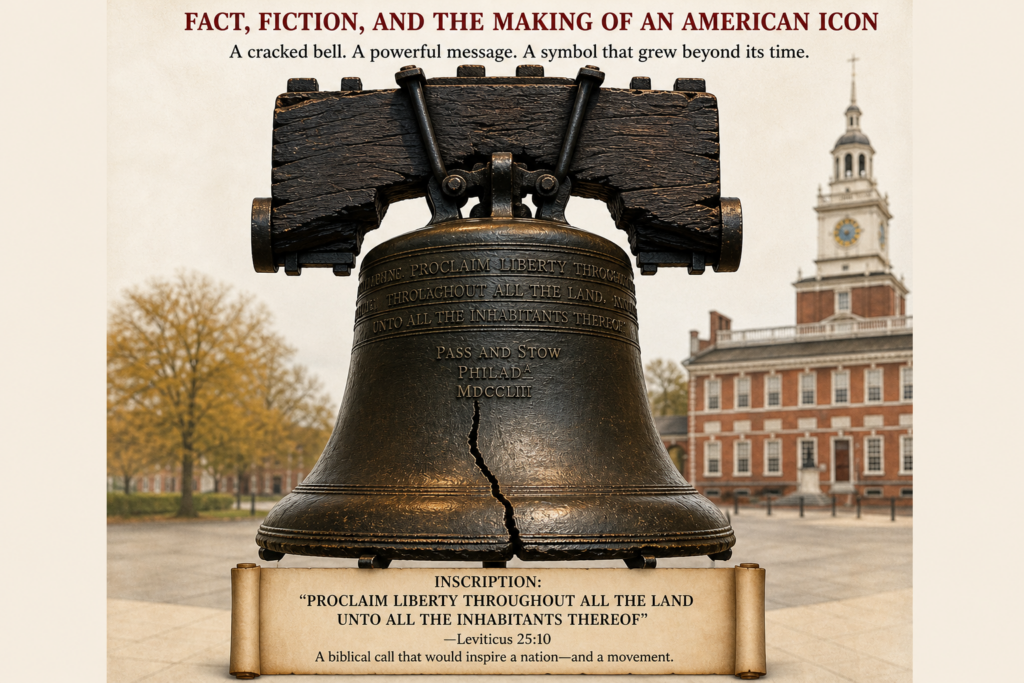
There it sits in a climate-controlled room in Philadelphia, drawing roughly 1.5 million visitors a year — a 2,080-pound bronze bell with a crack running through it that everyone recognizes and almost no one fully understands. The Liberty Bell is arguably the most mythologized object in American history, which is saying something in a country that has turned its founding era into something close to civic religion.
But here’s the thing: the myths aren’t just harmless embellishments. Many of the most beloved stories about the Liberty Bell — when it rang, why it cracked, how it got its name — turn out to be products of 19th-century fiction writers, political activists, and the particular American genius for turning complicated history into a clean, inspirational tale about how a relatively obscure object became one of the most powerful symbols in American culture.
Before It Was the Liberty Bell
Let’s start with a basic fact that surprises most people: the bell wasn’t originally called the Liberty Bell at all. For the better part of a century, it went by the rather mundane name of the State House Bell, because that’s exactly what it was, the bell that hung in the steeple of the Pennsylvania State House, now known as Independence Hall.
The bell was commissioned in 1751 by the Pennsylvania Provincial Assembly to mark the 50th anniversary of William Penn’s 1701 Charter of Privileges, Pennsylvania’s founding constitutional document. It was cast by the Whitechapel Bell Foundry in London and arrived in Philadelphia in 1752. The inscription it carried — “Proclaim LIBERTY Throughout all the Land unto all the Inhabitants Thereof” — comes from Leviticus 25:10, a biblical passage about the Jubilee Year, during which debts were forgiven and slaves were freed. It was selected by Quaker Isaac Norris, speaker of the Assembly, as a fitting tribute to Penn’s legacy of religious tolerance.
The bell didn’t become the Liberty Bell until the 1830s, when anti-slavery activists seized on that Leviticus inscription as a powerful rallying cry. It first appeared as the “Liberty Bell” in an 1835 abolitionist publication, and the name was subsequently popularized through William Lloyd Garrison’s The Liberator. Ironically, the object that Americans associate most with the founding of a free nation earned its famous name not from the Revolution, but from the fight to end slavery, a cause the Revolution had conspicuously left unfinished.
Did It Actually Ring on July 4th?
Here’s the myth most Americans carry around: the Liberty Bell rang out joyfully on July 4, 1776, to announce the adoption of the Declaration of Independence. It’s a great image. Practically cinematic. And historians are fairly confident it didn’t happen.
The problem is straightforward: the Declaration wasn’t publicly announced on July 4th. The Continental Congress voted on independence, but the first public readings of the Declaration didn’t take place until four days later, on July 8, 1776. It was on that date that Philadelphians gathered to hear the document read aloud and yes, bells around the city were reportedly rung in celebration. Whether the State House Bell was among them is genuinely unknown.
There’s an additional wrinkle: historians believe the State House steeple was in poor condition at the time, possibly too deteriorated to support bell-ringing. As John C. Paige noted in a historical study for the National Park Service, there simply is no way to confirm whether the steeple was structurally sound enough to ring the bell that day.
So where did the famous image of the bell ringing on the Fourth come from? Mostly from one man: a journalist named George Lippard. In January 1847, he published a short story in the Saturday Courier depicting an elderly bellman waiting anxiously in the steeple, doubting that Congress would have the courage to declare independence, until his grandson bursts in crying “Ring, Grandfather! Ring!” It was fiction and was presented as fiction, but it was republished repeatedly, eventually winding up in history books and school primers as if it were fact. That’s how myths work.
The Mystery of the Crack
The crack is the bell’s most defining feature, and its origin is almost as murky as the ringing story. What we know for certain is that the bell has cracked multiple times.
The first crack came almost immediately — the bell cracked during its initial testing after arriving in Philadelphia in 1752. It was judged unusable and recast twice by local metalworkers John Pass and John Stow (whose names you can still see on the bell today). Their second casting is what we look at today.
The later, more famous crack, the wide fissure visible in every photograph, developed sometime in the first half of the 19th century after roughly 90 years of use. Popular tradition long held that the bell cracked in 1835 while tolling for the funeral of Chief Justice John Marshall. It’s a great story but historians largely reject it. The evidence points more convincingly to February 1846, when the bell was rung to celebrate Washington’s Birthday. In an attempt to prevent the crack from spreading, metalworkers widened it — a repair technique of the era and ironically created the wide, distinctive fissure we recognize today. The repair didn’t hold, and the bell has been silent ever since.
The Road Trip Nobody Talks About
This is the part of the Liberty Bell’s history that tends to get overlooked in favor of the Revolutionary founding mythology. Between 1885 and 1915, the cracked bell was loaded onto railroad cars and sent on seven separate tours around the United States, stopping in cities and towns so that ordinary Americans could see it up close.
The post-Civil War tours were explicitly about national healing. After the devastation of that war, the Liberty Bell became a symbol of unity: a reminder of something Americans had once fought for together. Crowds mobbed the bell at every stop. In Biloxi, Mississippi, Jefferson Davis, the former President of the Confederacy, visited the bell and gave a speech calling for national unity. That’s a remarkable image: the Confederacy’s leader paying homage to a symbol of American liberty. Whatever you make of his sincerity, it illustrates how powerfully the bell had been woven into the country’s emotional fabric.
The 1915 tour to San Francisco was the last. By then it was clear the bell’s condition couldn’t withstand further travel, and it has stayed in Philadelphia ever since.
Movements, Meanings, and the Justice Bell
One of the most interesting things about the Liberty Bell’s history is how many different movements claimed it as their own. After abolitionists gave it its name, suffragists were next. In 1915, the Pennsylvania Woman Suffrage Association commissioned a replica called the Justice Bell, with the same inscription as the Liberty Bell but two extra words — “establish justice” — borrowed from the Preamble to the Constitution. The clapper was chained so it couldn’t ring, symbolizing women’s silenced political voice. When the 19th Amendment passed in 1920, the Justice Bell finally rang at Independence Hall. It’s now at the Washington Memorial Chapel at Valley Forge.
Later in the 20th century, civil rights activists gathered at the Liberty Bell. It became a backdrop for Cold War messaging about American freedom. During the 1960s it was a site for protests of various kinds. The bell has proven remarkably elastic as a symbol — capable of representing almost any cause that frames itself in the language of liberty.
What’s Actually True
To be fair, some important facts about the Liberty Bell are both true and underappreciated. It did ring for significant events during its functional lifetime — not just vaguely, but for specific occasions: the signing of the Constitution, and the deaths of Benjamin Franklin, George Washington, Alexander Hamilton, and Thomas Jefferson. It was genuinely used for decades as a civic alarm clock, summoning legislators to session and citizens to public meetings.
And when the British occupied Philadelphia in 1777, Patriots really did smuggle the bell out of the city, along with other bells, and hide it in the floorboards of the Zion Reformed Church in Allentown, Pennsylvania. The concern was legitimate. British forces routinely seized metal church bells and melted them down for cannon shot. The Liberty Bell sat hidden there for nearly a year before returning to Philadelphia after the British withdrew.
The Bell We Deserve
The real lesson of the Liberty Bell’s history might be this: the gap between its legend and its reality says as much about American culture as the bell itself does. Americans in the 19th century needed a tangible symbol of their founding ideals, and the bell, already old, already cracked, already inscribed with a verse about proclaiming liberty, was right there waiting to be mythologized.
The abolitionists who named it, the fiction writer who gave it its most famous story, and the railroad men who carted it around the country in the 1880s were all, in their different ways, helping to construct a national icon that could absorb whatever freedom meant in their particular moment. The Liberty Bell is not important because it rang at a specific hour in 1776—there is little evidence that it did. It is important because Americans, over generations, chose to invest it with meaning. That’s not a cynical observation. It’s inspiring that a cracked, imperfect bell became the symbol of a cracked, imperfect republic still trying to live up to its inscription.
Image generated by the author using ChatGPT
Sources
Wikipedia – Liberty Bell: https://en.wikipedia.org/wiki/Liberty_Bell
Constitution Center – 10 Fascinating Facts About the Liberty Bell: https://constitutioncenter.org/blog/10-fascinating-facts-about-the-liberty-bell
USHistory.org – The Liberty Bell: https://www.ushistory.org/libertybell/
Encyclopedia of Greater Philadelphia – Liberty Bell: https://philadelphiaencyclopedia.org/essays/liberty-bell/
Visit Philadelphia – Liberty Bell Center: https://www.visitphilly.com/things-to-do/attractions/the-liberty-bell-center/
Professor Buzzkill – Liberty Bell Myths: https://professorbuzzkill.com/2016/07/07/liberty-bell-myths/
Study.com – The Liberty Bell: History & Importance: https://study.com/academy/lesson/the-liberty-bell-facts-history.html
Sky History – Debunking Famous Myths About the Declaration of Independence: https://www.history.co.uk/articles/debunking-famous-myths-about-the-declaration-of-independence
Philadelphia Visitor Center – Liberty Bell: https://www.phlvisitorcenter.com/libertybell
Mr. Local History Project – Weird Facts About the Liberty Bell: https://mrlocalhistory.org/liberty-bell/
Leave a Reply