
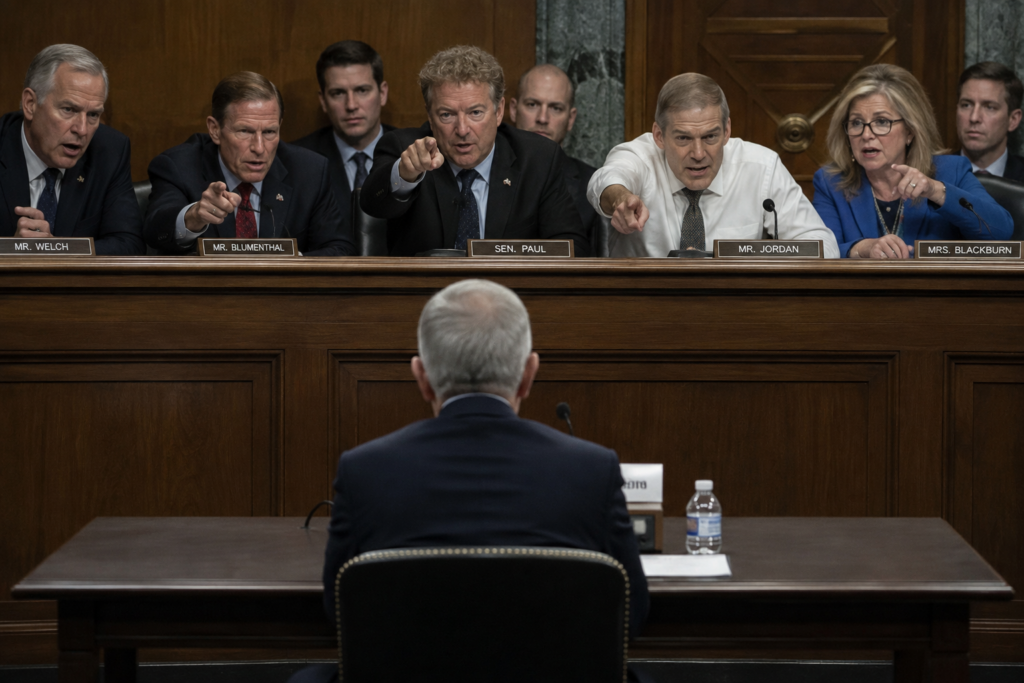
Last week, an 85-year-old physician sat before a Senate committee and, for the first time in more than 250 congressional appearances spanning five decades of public service, declined to answer. Dr. Anthony Fauci invoked his Fifth Amendment right against self-incrimination over one hundred times, telling the panel that its chairman’s “evident obsession with calling for my prosecution” left him with no other reasonable choice. He was invoking his Fifth Amendment right against self-incrimination, not because he believed he had committed a crime, but because he no longer trusted that anything he said would be treated as testimony rather than ammunition. It was a stunning scene, and it should trouble anyone who cares about how this country treats its public servants once the politics of a crisis outlast the crisis itself.
Fauci’s career is, by any fair measure, one of the most consequential in the history of American medicine. He joined the National Institutes of Health in 1968 and led the National Institute of Allergy and Infectious Diseases from 1984 until his retirement in 2022, advising seven presidents from Reagan to Biden. He was, for two decades, among the most cited scientists on earth. He helped transform HIV/AIDS from a near-certain death sentence into a manageable chronic condition, and his work undergirded PEPFAR, the President’s Emergency Plan for AIDS Relief, which is credited with saving more than 25 million lives worldwide. For that work, President George W. Bush — a Republican — awarded him the Presidential Medal of Freedom in 2008. Doctor Francis S. Collins, former director of the National Institutes of Health, has called Dr. Fauci “a national treasure” and has stated that “Dr Fauci is the most dedicated public servant I have ever known. His contributions have saved countless lives from HIV/AIDS, Ebola and SARS-CoV-2, and will stand as a profoundly significant gift to humanity.” None of that is in dispute even by his fiercest critics.
What is in dispute is his conduct during COVID-19, when he became the public face of a federal response that asked Americans to accept school closures, business shutdowns, masking, and eventually vaccine mandates. Senator Rand Paul, who now chairs the Senate committee investigating him, has spent years arguing that the National Institutes of Health funded research in Wuhan China contributed to the virus’s emergence, and that Fauci misled Congress about it under oath.
Ahead of last week’s hearing, Paul released more than 1,100 pages of Fauci’s pandemic-era diary entries, obtained after an eight-month search led by Health and Human Services Secretary Robert F. Kennedy Jr. Paul argued that what Fauci wrote privately differs from what he told the public. Paul has now pledged to seek a contempt-of-Congress vote, which he says could open the door to Justice Department prosecution. Neither Paul nor Kennedy seems to understand that a diary entry is a statement fixed in time and may involve personal musing and speculation and that opinion and public statements can evolve as new knowledge becomes available. Or perhaps they don’t care.
Reasonable people can criticize specific decisions made during the pandemic. Some restrictions may have lasted too long. Officials could have communicated uncertainty more clearly. Public health agencies sometimes failed to explain why recommendations changed, allowing confusion and mistrust to spread. The shifting public health guidance that so many Americans remember as evidence of dishonesty is, to most working scientists, simply what science looks like in real time: recommendations changed because the evidence changed, not because anyone was hiding the truth. But that is not to say those criticisms don’t deserve serious discussion.
What deserves equal recognition, however, is the unprecedented uncertainty confronting public health officials. They faced a rapidly evolving virus, incomplete data, overloaded hospitals, political polarization, and an information environment saturated with misinformation. Perfect decisions were impossible.
The main issue in contention is Senator Paul’s accusation that Dr. Fauci falsely testified that NIH never funded gain-of-function research at the Wuhan virology lab. The element of funding is a technical issue. NIH did not directly fund research at the Wuhan lab; they provided a grant to a group known as EchoHealth who in turn funded research at Wuhan. The second element requires a brief explanation of gain-of-function research.
Gain-of-function is laboratory research that deliberately alters a virus or other pathogen to give it new or enhanced biological properties—such as increased transmissibility, infectivity, or the ability to infect a new host—in order to better understand disease mechanisms, improve surveillance, or develop vaccines and treatments. Senator Paul contends that the research did meet the gain-of-function definition while Dr. Fauci contends that it did not meet the federal guidelines in effect at that time and further that the research was not conducted on the SARS-CoV-2 virus and did not result in COVID-19. He continues to maintain that his testimony accurately reflected NIH policy and definitions. Federal reviews, including one commissioned by the National Institutes of Health, have concluded that the specific EcoHealth-funded research did not meet the technical definition of gain-of-function in place at the time, a conclusion Fauci’s critics dispute but have not conclusively rebutted.
As these hearings have pointed out, there is not a single definition of gain-of-function among virologists or microbiologists. Some argue for a tighter definition while others do not. To further add confusion to the question, the American Society for Microbiology has called for a more precise, evidence-based definition of the term gain-of-function.
It is worth being precise about what has and has not been shown. No evidence has emerged that the coronavirus was engineered or leaked from a laboratory; the scientific consensus still points toward a natural spillover event from a wild source.
The elements of perjury require two things: the person knowingly gave false testimony and did so with intention to deceive. Testifying to something that is believed to be true but is later proven to be false does not make the previous testimony perjury. Because the underlying definitions in this charge are under intense debate in the scientific community, the basis for a perjury charge is extremely weak. But we know from recent experience with the reflecting pool that the lack of evidence does not stop the Trump administration from making unfounded criminal charges.
The perjury allegations remain only allegations, litigated in hearing rooms, press conferences, and cable news segments rather than in courts. And Fauci already received a preemptive pardon from President Biden before leaving office specifically to protect him from prosecution over pandemic-era statements — a fact Paul acknowledged, raising the question of exactly what additional legal jeopardy this pursuit is meant to produce.
That question points toward the real story here, which is less about virology than about power. Since President Trump’s return to the White House, several of Fauci’s most vocal critics — Kennedy chief among them — occupy positions from which they can direct the machinery of government at a single retired scientist. A congressional hearing that features senators trying to provoke Fauci by asking about tie colors and the day of the week, his attorney forcibly removed from the room, and a gallery of Trump-aligned activists standing by to testify about vaccine mandates is not a forum for discovering facts.
It is a stage for finishing an old argument by other means. They are attempting to turn a pandemic that killed more than a million Americans, into the fault of one man rather than a shared national failure, much of which occurred on Trump’s watch. And part of it may be personal, given how frequently Fauci found himself publicly correcting a president who does not forget being corrected.
This seems to me to be a case of selective persecution and part of the Trump revenge program.
Fauci may have been an imperfect messenger, and reasonable people can fault his early missteps on masking guidance or his sometimes brusque certainty in front of cameras. But there is a meaningful difference between legitimate oversight of pandemic policy — which Congress should absolutely conduct — and a years-long campaign whose stated goal, in Fauci’s own paraphrase of his chief antagonist, is to see him “behind bars.” When a senator with subpoena power spends a hearing pursuing a scientist’s diary rather than debating the substance of research policy, the effort looks less like accountability and more like retribution dressed up as investigation. It is incredible to me that any reasonable person would believe that a man who spent his entire professional career trying to protect the American public from viral diseases would suddenly and intentionally try to trick them into wearing face masks and closing schools.
The American public deserves a legitimate, evidence-based scrutiny of pandemic-era policies . What the country has gotten instead, at least in the current hearings, looks less like accountability than theater, and neither a scientist’s record nor the public’s understanding of what actually happened is served by a proceeding that produced a great deal of heat and, by most independent accounts, no new facts.
Public servants who make consequential decisions under uncertain conditions deserve scrutiny, not immunity from criticism. But they also deserve a process that seeks truth rather than a scalp. A man who spent fifty years fighting AIDS, Ebola, and a novel coronavirus should not have to plead the Fifth to protect himself from the country he served. That he felt compelled to do so says less about Anthony Fauci than it does about the politics that have consumed the men now pursuing him. This is just one more in a string of embarrassments caused by the Trump administration that have brought shame to the American people in the eyes of the world.
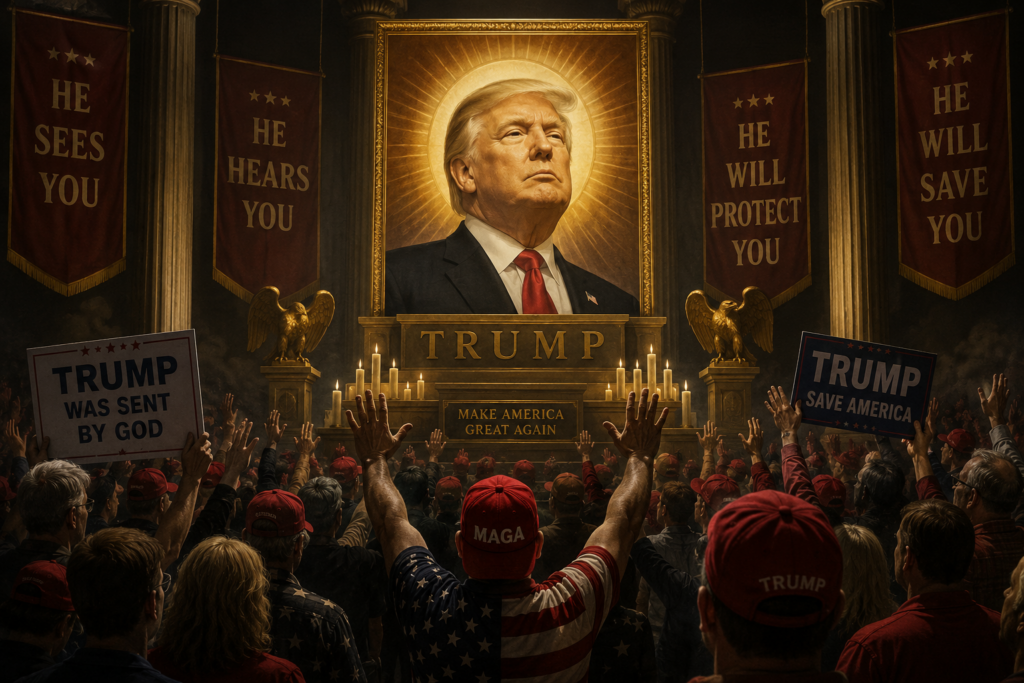
Image generated by author using ChatGPT.
Sources:
1. NBC News, “Anthony Fauci invokes Fifth Amendment right not to answer questions at GOP-led Covid hearing” (July 29, 2026): https://www.nbcnews.com/politics/congress/anthony-fauci-5th-amendment-testify-covid-hearing-rand-paul-rcna589793
2. NewsNation, “Republican COVID-19 allegations against Dr. Anthony Fauci explained”: https://www.newsnationnow.com/health/what-fauci-is-accused-of/
3. The Washington Post, “Fauci’s critics have power. They’re coming after his pandemic record.” (August 2, 2026): https://www.washingtonpost.com/politics/2026/08/02/faucis-critics-have-power-theyre-coming-after-his-pandemic-record/
4. TIME, “Fauci Pleads the Fifth at Senate Hearing on COVID, Escalating Long-Running Clash With Republicans” (July 29, 2026): https://time.com/article/2026/07/29/fauci-fifth-amendment-senate-hearing-covid-rand-paul-republicans/
5. The Washington Post, “Rand Paul threatens to hold Fauci in contempt after he declines to answer questions” (July 29, 2026): https://www.washingtonpost.com/politics/2026/07/29/fauci-set-face-rand-paul-senate-gop-after-release-his-covid-diary/
6. AOL News, “Republicans ramp up attacks on Fauci”: https://aol.com/republicans-ramp-attacks-fauci-100000419.html
7. NIH MedlinePlus Magazine, “Meet Anthony S. Fauci, M.D., former Director of NIAID”: https://magazine.medlineplus.gov/article/meet-anthony-s-fauci-m.d-former-director-of-the-national-institute-of-allergy-and-infectious-diseases
8. Academy of Achievement, “Anthony S. Fauci, M.D.” (career timeline): https://achievement.org/achiever/anthony-s-fauci-m-d/
9. PBS American Masters, “Anthony Fauci biography and career timeline”: https://www.pbs.org/wnet/americanmasters/anthony-fauci-biography-and-career-timeline/26116
10. Encyclopaedia Britannica, “Anthony Fauci”: https://www.britannica.com/biography/Anthony-Fauci




Trump, MAGA, and the Politics of Permission
By John Turley
On July 18, 2026
In Commentary, Politics
Donald Trump did not invent a new American bigotry. He did something more subtle—and perhaps more consequential. He transformed long-standing resentments into a political identity and gave many people permission to express views they had previously kept private.
The central question surrounding the Make America Great Again movement is: has it created a new ethical worldview, or has it simply exposed attitudes that have long existed beneath the surface of American society? The answer is probably: both.
The resentments themselves are not new. Long before Trump entered politics, historians and political scientists documented the enduring influence of racial resentment, nativism, religious nationalism, and cultural anxiety. Many Americans believed their country was changing too quickly and that immigration, globalization, and shifting social norms threatened a way of life they once took for granted.
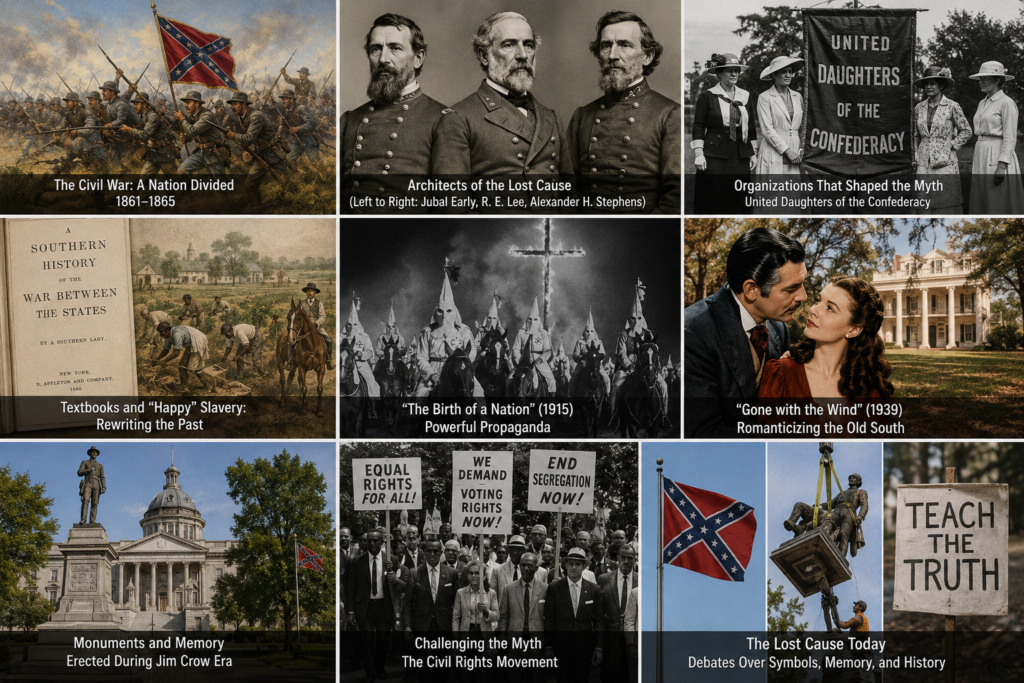
American history offers countless examples. Anti-immigrant movements flourished in the nineteenth century. Segregation and white supremacy were embedded in law for generations. George Wallace’s “law and order” campaigns, Pat Buchanan’s culture-war speeches, and the Tea Party’s reaction to Barack Obama’s presidency all reflected recurring fears that “real America” was slipping away.
Obama’s election encouraged hopes that the nation had entered a post-racial era, yet research continued to show that racial and cultural anxieties remained powerful undercurrents. Trump did not create those sentiments. He recognized them, embraced them, and gave them a simple narrative.
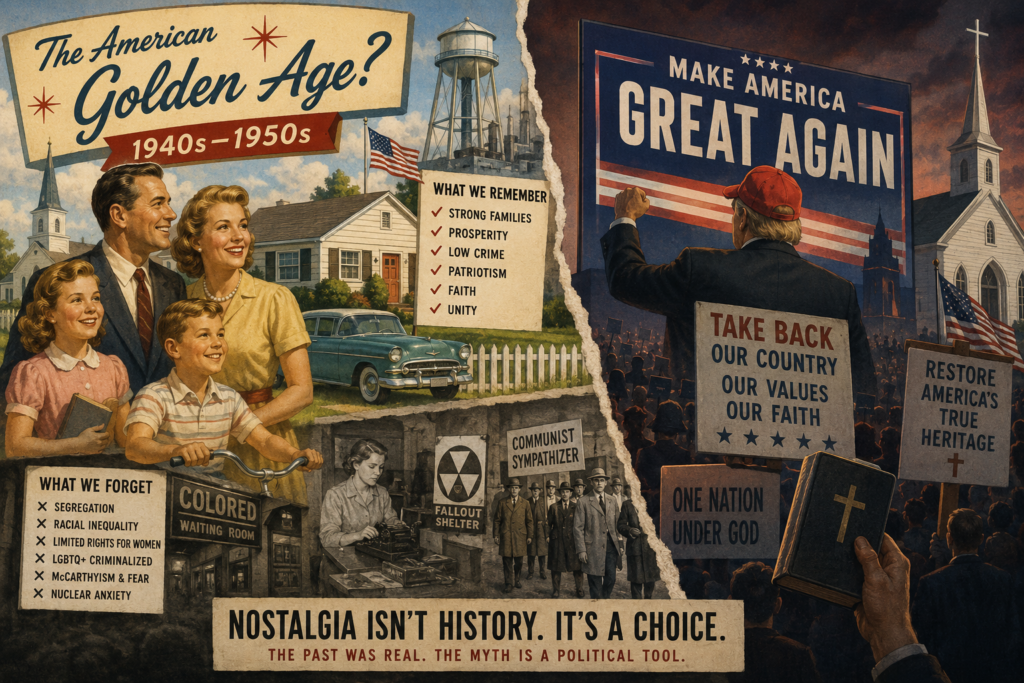
“Make America Great Again” is more than a campaign slogan. It tells a story of loss, restoration, and retribution. It suggests that something valuable has been taken away and that reclaiming it is both necessary and morally justified. For many supporters, it became less about policy than identity.
Trump’s most significant innovation was not ideological but cultural. Previous politicians often relied on coded language while preserving at least the appearance of restraint. Trump discarded those conventions. He mocked opponents, encouraged inflammatory chants, proposed banning Muslims from entering the country, and described immigrants as “poisoning the blood” of America. Many supporters interpreted this not as recklessness but as authenticity—a rejection of what they viewed as the constraints of political correctness.
That shift changed more than political rhetoric. It altered the boundaries of acceptable public behavior. Conduct once viewed as disqualifying became, for many supporters, evidence of courage and honesty. Loyalty increasingly outweighed character. Offending critics became proof that one was willing to stand up to elite opinion.
Political scientists describe this process as norm erosion. Laws remain the same, but the unwritten rules governing public life gradually weaken. Loyalty becomes more important than truth, institutions are trusted only when they favor one’s own side, and democratic restraints come to be seen as obstacles rather than safeguards.
Trump did not invent this dynamic. Populist movements throughout history have divided society into virtuous insiders and corrupt outsiders. His contribution was to make that style of politics a daily spectacle. Political conflict became a struggle between patriots and traitors, real Americans and dangerous enemies. Once politics is framed in existential terms, compromise becomes betrayal and restraint begins to look like weakness.
It would be inaccurate to say Trump created prejudice from nothing. A more persuasive argument is that he reduced the social cost of expressing it. Social norms matter because they define the boundaries of acceptable conduct. When prominent public figures use inflammatory language or repeat conspiracy theories without losing support from their followers, those boundaries inevitably shift.
Supporters who might once have hesitated can now dismiss criticism as media bias or political correctness. The line between prejudice and plain speaking becomes increasingly blurred.
This may prove to be Trump’s most enduring legacy. Even if his personal political influence fades, the standards governing public discourse may not return to where they once were. Future politicians can imitate the style—its confrontation, norm-breaking, and appeals to grievance—even if they reject parts of Trump’s agenda.
That is why the distinction between creating prejudice and legitimizing it matters. If Trump merely invented these impulses, defeating one political leader might solve the problem. But if he tapped into deeper currents already present in American society, then the challenge extends far beyond one election.
Trump is best understood as both symptom and accelerant. He gave shape to existing resentments, transformed them into a powerful political identity, and lowered the barriers against openly expressing them. The prejudices themselves were not new. The confidence with which they could be publicly displayed—and sometimes celebrated—was.
Whether that change proves temporary or enduring may become one of the defining questions facing American democracy.