
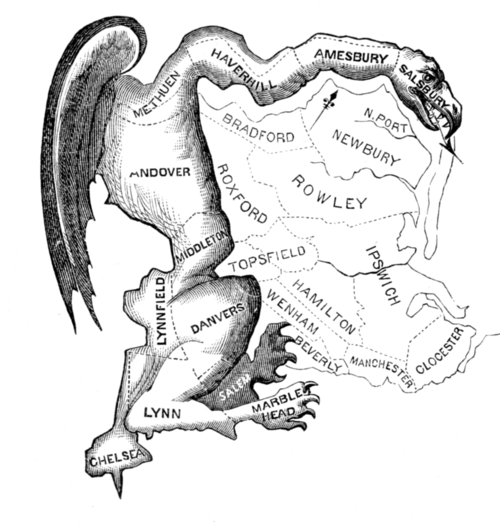
Wikimedia Commons: Elkanah Tisdale (1771-1835) (often falsely attributed to Gilbert Stuart), public domain
Picture this: It’s 1812 in Massachusetts, and Governor Elbridge Gerry has just approved a redistricting plan that creates such a bizarrely shaped legislative district that when a local newspaper editor saw it on a map, he thought it looked like a salamander. The editor sketched wings and claws onto the district, and someone quipped that it looked more like a “Gerry-mander” than a salamander. The term stuck, and more than two centuries later, we’re still dealing with the same problem that inspired that joke.
What Gerrymandering Actually Means
At its core, gerrymandering is the practice of drawing electoral district boundaries to give one political party or group an unfair advantage over its opponents. It’s a form of political manipulation that allows those in power to essentially choose their voters, rather than letting voters choose their representatives. Think of it as a sophisticated form of gaming the system—perfectly legal in many cases, but profoundly anti-democratic in spirit.
The mechanics are surprisingly straightforward. There are two main techniques: “cracking” and “packing.” Cracking involves splitting up concentrations of opposing voters across multiple districts so they can’t form a majority anywhere. Packing does the opposite—cramming as many opposing voters as possible into a few districts so they waste their votes winning by huge margins in just a couple of places, leaving the rest of the districts safely in your column. These techniques can be deployed together to engineer a decisive partisan advantage.
A History of Creative Mapmaking
The practice didn’t start with Gerry, of course. The Founding Fathers—for all their lofty rhetoric about representative democracy—weren’t above putting their thumbs on the electoral scales. But gerrymandering really came into its own in the 20th century as advances in census data, and statistics combined with the addition of newly available computing power made it possible to draw districts with surgical precision.
The 2010 redistricting cycle marked a watershed moment. Single-party control of the redistricting process gave partisan line drawers free rein to craft some of the most extreme gerrymanders in American history often down to the level of individual city blocks. Republicans, having won control of many state legislatures in the 2010 midterms, used sophisticated computer modeling to create maps that locked in their advantages for a decade. Democrats did the same where they had the power, though Republicans controlled more state legislatures and thus wielded greater gerrymandering capability overall.
The 2024-2025 Gerrymandering Wars
Here’s where things get really interesting—and deeply concerning. The situation has exploded into what some are calling “gerrymandering wars” following the 2020 census and a critical Supreme Court decision in 2019. In Rucho v. Common Cause, the Supreme Court ruled that partisan gerrymandering constitutes a non-justiciable “political question” where federal court intervention is unsuitable. Translation: The federal courts won’t stop partisan gerrymandering because they claim there’s no objective standard to measure it.
This opened the floodgates. The Brennan Center estimates that gerrymandering gave Republicans an advantage of around 16 House seats in the 2024 race to control Congress compared to fair maps. But here’s the kicker: we’re not even done with this decade’s redistricting.
In an unprecedented move, President Donald Trump has pushed Republican state lawmakers to further gerrymander their states’ congressional maps, prompting Democratic state lawmakers to respond in kind. In August 2025, during a special session, Texas’s legislature passed a redistricting plan that weakens electoral opportunities for Black and Hispanic voters. California has threatened to respond with its own gerrymander, creating a tit-for-tat dynamic that could spiral out of control.
North Carolina provides perhaps the most dramatic example. After the state supreme court reversed its position on policing partisan gerrymandering, the Republican-controlled legislature redrew the map, and after the 2024 election, three Democratic districts flipped to Republicans—enough to give control of the U.S. House to the GOP by a slim margin.
The situation has gotten so extreme that both parties are now openly engaging in mid-decade redistricting—something that traditionally only happened after each ten-year census. California, Missouri, North Carolina, Ohio, Texas and Utah have all adopted new congressional maps in 2025, with new maps also appearing possible in Florida, Maryland and Virginia.
The Racial Dimension
It’s crucial to note that gerrymandering comes in two flavors: partisan and racial. While partisan gerrymandering is currently legal thanks to the Supreme Court, racial gerrymandering—drawing districts specifically to dilute the voting power of racial minorities—violates the Voting Rights Act of 1965. The line between the two can get blurry, though, since partisan voting patterns often correlate with race.
In May 2025, a federal court ruled that Alabama’s 2023 congressional map not only violates Section 2 of the Voting Rights Act but was enacted by the Alabama Legislature with racially discriminatory intent. Similar battles are playing out in Louisiana, Mississippi, and other states. The legal landscape here is complex, with courts sometimes walking a tightrope between ensuring fair representation for communities of color and avoiding the creation of what could be challenged as racial gerrymanders.
What Can Be Done About It?
The most popular reform proposal is the creation of independent redistricting commissions—bodies of citizens (not politicians) who draw district maps according to neutral criteria. Currently, several states including Colorado, Michigan, Ohio and Virginia use redistricting commissions to draw congressional and state legislative maps, ranging from political commissions with elected officials to completely independent commissions that bar all elected officials from serving as commissioners.
Do they work? The evidence is mixed but generally positive. According to a Redistricting Report Card published with the Princeton Gerrymandering Project, the states that had some form of commission drew “B+” maps on average, while states where partisans controlled the process drew “D+” maps. California’s independent commission is often held up as the gold standard, though it’s not perfect—even fairly drawn maps can produce lopsided results due to how voters cluster geographically.
Another proposal focuses on clear, enforceable criteria: compactness, contiguity, respect for existing political boundaries, and transparency in the mapping process. Advances in statistical analysis also make it possible to compare proposed maps against thousands of neutral alternatives to detect extreme outliers, a method increasingly discussed in academic and legal circles.
Federal legislation has been proposed repeatedly. The Redistricting Reform Act of 2025 would prohibit states from mid-decade redistricting and would require every state to adopt nonpartisan, independent redistricting commissions. Similar provisions were included in the “For the People Act” that Democrats passed in the House in 2021, but it died in the Senate. Getting such legislation through Congress would require bipartisan cooperation, which seems unlikely given that both parties see gerrymandering as a political weapon and they believe they can’t afford to unilaterally disarm.
Some reformers advocate for more radical solutions. Proportional representation systems, where the share of votes equals the share of seats, would end boundary-drawing battles altogether and make democracy more representative. Under such a system, if Democrats win 60% of the vote in a state, they’d get roughly 60% of that state’s congressional seats. It’s intuitive and fair, but it would require a fundamental restructuring of American electoral systems—something that’s probably not politically feasible in the near term.
State courts have emerged as a potential backstop. At least 10 state supreme courts have found that state courts can decide cases involving allegations of partisan gerrymandering, even though federal courts won’t touch them. This means that state constitutional provisions against gerrymandering could provide meaningful protection—though as North Carolina demonstrated, state court compositions can change, and with them, their willingness to police gerrymandering.
The Bottom Line
Gerrymandering represents a fundamental tension in American democracy: How do we draw districts fairly when the people drawing them have every incentive to rig the game in their favor? The problem has ancient roots but ultra-modern manifestations, powered by big data and sophisticated computer modeling that would make Elbridge Gerry’s head spin.
The current moment feels particularly precarious. With Republicans’ razor-thin majority in the House and midterm elections traditionally being unfavorable for the party in power, the Republicans’ action amounts to a preemptive move to retain control of Congress. The Democrats threatened response could trigger an escalating cycle of partisan map manipulation that further entrenches our political divisions and makes elections less responsive to actual voter preferences.
Independent commissions offer a promising path forward, but they’re not a silver bullet. They work better than partisan control, but they can’t eliminate all the inherent challenges of translating votes into seats through geographic districts. More ambitious reforms like proportional representation could solve the problem more completely, but they face enormous political and practical obstacles.
For now, gerrymandering remains what that newspaper editor saw in 1812: a monstrous distortion of democratic principles, hiding in plain sight on our electoral maps. The question is whether we have the political will to slay the beast, or whether we’ll keep feeding it for another two centuries.
Sources:
Brennan Center for Justice – Gerrymandering Explained
https://www.brennancenter.org/our-work/research-reports/gerrymandering-explained
Brennan Center for Justice – How Gerrymandering Tilts the 2024 Race for the House
https://www.brennancenter.org/our-work/research-reports/how-gerrymandering-tilts-2024-race-house
American Constitution Society – America’s Gerrymandering Crisis
https://www.acslaw.org/expertforum/americas-gerrymandering-crisis-time-for-a-constructive-redistricting-framework/
ACLU – Court Cases on Gerrymandering
https://www.aclu.org/court-cases?issue=gerrymandering
Stateline – State Courts and Gerrymandering
https://stateline.org/2025/12/22/as-supreme-court-pulls-back-on-gerrymandering-state-courts-may-decide-fate-of-maps/
Campaign Legal Center – Do Independent Redistricting Commissions Work?
https://campaignlegal.org/update/do-independent-redistricting-commissions-really-prevent-gerrymandering-yes-they-do
RepresentUs – End Partisan Gerrymandering
https://represent.us/policy-platform/ending-partisan-gerrymandering/
Senator Alex Padilla – Redistricting Reform Act of 2025
https://www.padilla.senate.gov/newsroom/press-releases/watch-padilla-lofgren-introduce-legislation-to-establish-independent-redistricting-commissions-end-mid-decade-redistricting-nationwide/
Protect Democracy – How to End Gerrymandering
https://protectdemocracy.org/work/how-to-end-gerrymandering/







Lady Liberty: The Statue We Think We Know
By John Turley
On April 14, 2026
In Commentary, History, Politics
Collection of the author
Ask most Americans what the Statue of Liberty means and they’ll say the same thing: she welcomes immigrants. She is the “Mother of Exiles,” keeper of the golden door. That image is so deeply woven into the national identity that it has been quoted, protested, and debated for more than a century. The only problem is that it wasn’t what her creators originally intended.
The story begins in 1865, just weeks after the Civil War ended, at a dinner party near Versailles. The host was Édouard de Laboulaye, a French historian and president of the French Anti-Slavery Society. Laboulaye was one of France’s most passionate admirers of American democracy and was deeply moved by both Lincoln’s assassination and the abolition of slavery. He proposed that France present the United States with a colossal monument — one that would celebrate two things at once: the centennial of American independence and the end of slavery.
Sculptor Frédéric-Auguste Bartholdi was at that dinner and took the idea and ran with it. Early models from around 1870 show Lady Liberty with her right arm raised — familiar enough — but in her left hand she holds broken shackles, not a tablet. The anti-slavery message was unmistakable.
That symbolism didn’t entirely disappear from the final design — it just got moved. According to the National Park Service, Bartholdi placed a broken chain and shackle at the statue’s feet, hidden beneath the copper drapery. Most visitors never notice it. The left hand now holds a tablet inscribed with the date of the Declaration of Independence.
Why the change? NYU historian Edward Berenson points to the political climate of the 1880s. By the time the statue was dedicated in October 1886 — more than 20 years after Laboulaye’s dinner — Reconstruction had collapsed, Jim Crow was spreading, and the country was trying to paper over sectional wounds by quietly forgetting the war’s racial roots. Nobody at the dedication mentioned slavery. The abolitionist origins were simply buried.
The statue was formally named Liberty Enlightening the World and the message broadened toward Franco-American friendship and American liberty in general rather than emancipation specifically.
Then came Emma Lazarus, and the second transformation. In 1883, a fundraiser struggling to pay for the statue’s pedestal asked prominent writers to donate works for an auction. Lazarus, a Jewish-American poet, initially declined as she was then deeply involved in aiding Jewish refugees fleeing wide-spread and organized violence in Russia. A friend persuaded her that the statue, sitting at the entrance to New York Harbor, would inevitably be seen as a beacon by arriving immigrants. She wrote “The New Colossus” — fourteen lines that reimagined Lady Liberty entirely, as a “Mother of Exiles” beckoning the world’s tired and poor to America’s golden door.
Not like the brazen giant of Greek fame,
With conquering limbs astride from land to land;
Here at our sea-washed, sunset gates shall stand
A mighty woman with a torch, whose flame
Is the imprisoned lightning, and her name
Mother of Exiles. From her beacon-hand
Glows world-wide welcome; her mild eyes command
The air-bridged harbor that twin cities frame.
“Keep, ancient lands, your storied pomp!” cries she
With silent lips. “Give me your tired, your poor,
Your huddled masses yearning to breathe free,
The wretched refuse of your teeming shore.
Send these, the homeless, tempest-tost to me,
I lift my lamp beside the golden door!”
Strangely, the poem then vanished. It played no role at the statue’s 1886 dedication. Lazarus died in 1887, before Ellis Island even opened. It wasn’t until 1903 that a friend had the entire poem cast onto a bronze plaque that was mounted inside the pedestal——not engraved on the outside as many believe. By then, millions of immigrants had already sailed past the statue on their way to Ellis Island, and the association with immigration had taken hold in the public imagination.
The immigration meaning deepened through the early 20th century as the government used the statue’s image in campaigns to assimilate immigrant children, many of whom lived in ethnic enclaves in large eastern cities. Meanwhile, the abolitionist symbolism that had inspired the project in the first place faded almost entirely from public memory.
The broken shackles are still there, tucked under her robe, mostly invisible. Lady Liberty has been continuously reinterpreted for 160 years — by abolitionists, by a poet responding to a refugee crisis, by politicians, and by millions of people who looked up at that torch from the deck of a ship. Will Lady Liberty and her words continue to offer welcome and hope and be a source of national pride or is her meaning once again being rewritten as a symbol of American identity, dominance, and, perhaps, exclusion?
The Statue’s shackles and feet. National Park Service, Statue of Liberty NM, Public Domain
Sources
National Park Service – Statue of Liberty history: https://www.nps.gov/stli/learn/historyculture/statue-of-liberty.htm Library of Congress – Dedication and speeches: https://www.loc.gov/item/ihas.200197394/ Cleveland, Grover. Dedication Address (1886): https://www.nps.gov/stli/learn/historyculture/cleveland.htm Smithsonian Magazine – History of the Statue of Liberty: https://www.smithsonianmag.com/history/statue-liberty-180970340/