
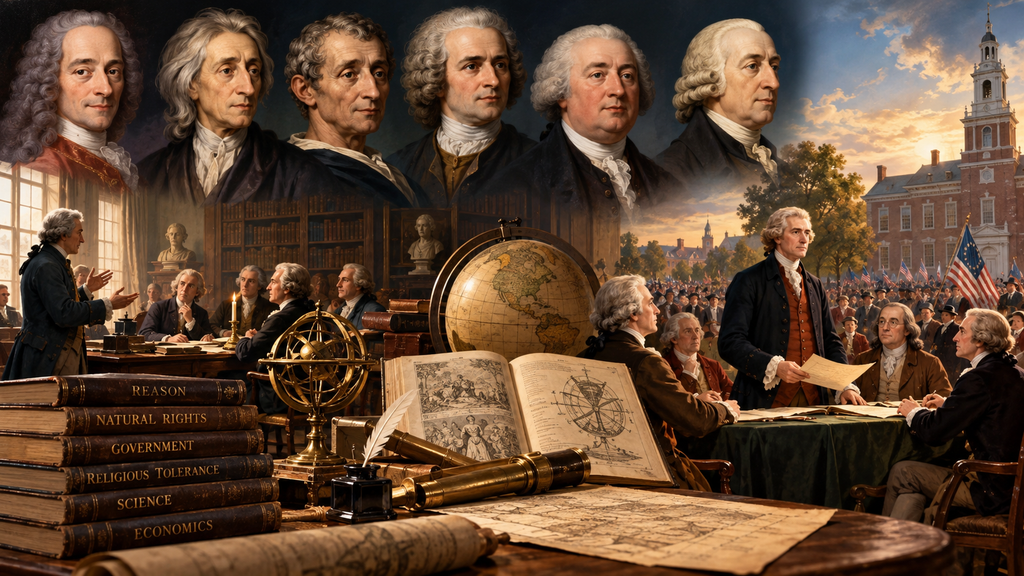
If you’re like me, the last time you gave any serious consideration to The Enlightenment was when you were in college. Even then, it seemed to me that it was a bunch of old men in powdered wigs sitting around saying painfully obvious things like, “I think, therefore I am”.
The more I learn about the American Revolution, the more I’ve come to realize that The Enlightenment was not the irrelevant philosophical exercise that I thought it was. It is, in fact, the basis for most modern social, political, and economic thought.
OK, What Exactly Was The Enlightenment?
It was an intellectual movement that began principally in Europe during the 17th and 18th centuries. It emphasized reason, science, liberty, and skepticism of inherited authority. Some of the smartest people in Europe reexamined everything they thought they knew. They questioned the nature of God, the foundations of knowledge, the rights of individuals and how they related to the purpose of government, and the relationships between the people with power and those without. Underneath it all was the core belief in the possibility of human progress.
Elements of the Enlightenment
There are several key elements that define The Enlightenment. Probably the most important was an almost religious devotion to the supremacy of reason. Prior to this, most Europeans accepted that the ultimate authorities in the world were the church and the monarchy. Enlightenment thinkers were the first to question those authorities. They argued that a human mind with its ability for observation, logic, and evaluation of evidence could discover the truth without having it dictated by the church or the king. They didn’t necessarily reject religion, but they questioned superstition, intolerance, and blind obedience. They thought that reason gave people the power to understand the universe and improve the human condition.
Closely related to this was their belief in empiricism and the scientific method. The Enlightenment came soon after the Scientific Revolution and was influenced by figures such as Isaac Newton who demonstrated that nature operated according to principles that could be discovered and understood and that true understanding came from observable experience rather than from inherited doctrine. René Descartes, whom I quoted somewhat cavalierly in my opening paragraph, is sometimes recognized as the philosophical godfather of the Enlightenment. His landmark work Discourse on the Method, published in 1637, gave rise to the practice of rejecting any belief that couldn’t be verified by rigorous inquiry.
Another central element is the belief in the natural rights of humanity. They believed that all people possess certain rights bestowed by nature. These include life, liberty, property, and security and that all people possess these rights simply because they live. Central to this is the idea that no government had granted those rights and therefore no government can legitimately revoke them. They viewed this as an implicit social contract between rulers and the people and not a gift of a sovereign. The key element of this idea is that the people could, at any time, withdraw their consent and reconstitute the government.
Other key elements of the Enlightenment included skepticism towards authority, and a questioning of the scripture as the final word on nature. They disputed the divine rights of kings. They also stressed religious toleration and proposed the conscience should not be coerced by the state. They had a strong belief in the ability of civilization to progress through education, science, and political reform. While all enlightenment thinkers did not have the exact same specific beliefs, they believed in the core element of the value of the improvement of humanity.
Who’s Who in The Enlightenment and the Revolution
There were many writers, scientists, and philosophers associated with The Enlightenment. They range from Adam Smith and his economic theories to Voltaire and his theories of tolerance and free thought. In an essay such as this it would be impossible for me to do justice to all these great thinkers. I’m going to focus on the two I believe had the greatest impact on the American Revolution: John Locke and Charles- Louise de Secondat, Baron de Montesquieu.
Locke was a physician, philosopher and political theorist and his works probably had a greater influence on revolutionary thought than those of anyone else. His central argument was that all individuals have a natural right to life, liberty and property and that those rights exist independent of any government and that no government possesses the right to violate them.
Montesquieu was a French judge and political philosopher whom many view as the architect of separation of powers. He wrote that tyranny is best prevented by dividing governmental authority among distinct branches—executive, legislative, and judicial—and that each will check the power of the other.
Likewise, almost every central player in the American Revolution was familiar with the works of The Enlightenment writers. I’m going to focus on the two whose work, I believe, most obviously reflects the thoughts of The Enlightenment, Thomas Jefferson and James Madison.
Jefferson, Locke, and the Declaration of Independence
Thomas Jefferson is, arguably, the member of the revolutionary generation most identified with the philosophy of John Locke. Other colonial writers such as George Mason in his June1776 Virginia Declaration of Rights and Samuel Adams in his 1772 The Rights of the Colonists, clearly reflected Lockean principles. In fact, Adams specifically mentioned Locke in his treatise. But it is Jefferson in his Declaration of Independence whose relationship to John Locke is most familiar to the American people.
Locke argued that all individuals possess natural rights that include life, liberty, and property and that governments exist solely to protect those rights. Jefferson incorporated Locke’s ideas almost in verbatim into the Declaration’s most famous passage excepting that he substituted “the pursuit of happiness” for Locke’s “property”. Jefferson likely intended to broaden the appeal of his arguments beyond just protection of wealthy landowners to include more universal human rights. The Declaration also included other elements that reflected Locke’s thoughts such as a listing of violations by the British government that caused it to forfeit its legitimate authority. Jefferson had turned Locke’s social contract theory into a statement of grievances against the British monarchy.
I think it’s also important to note that not all historians agree that John Locke was the sole or even principal influence on Jefferson’s thinking in the Declaration. Other enlightenment philosophers thought to have influenced Jefferson include Francis Hutchinson, Montesquieu, and Jean-Jacques Rousseau. Jefferson himself identified the ancient philosophers Aristotle and Cicero as being intellectual sources.
Some historians have proposed that the inclusion of Locke’s ideas in the Declaration of Independence was less the result of a deep philosophical study on the part of Jefferson then a recognition that Locke’s ideas had become widely accepted in the colonies by the 1770s. Jefferson himself later wrote that the declaration wasn’t meant to be a new philosophy but to reflect the “common sense of the subject”. Regardless of whether the influence was direct or indirect, I find it difficult not to see the ideas of John Locke throughout the Declaration of Independence.
James Madison, Montesquieu, and the Constitution
Montesquieu laid out his ideas for the separation of powers in his 1748 treatise The Spirit of the Laws. He was concerned that whoever holds power will tend to abuse it. He believed that the best protection for liberty is dividing governmental power among three co-equal groups: those who make the law (legislative), those who carry out the law (executive), and those who judge disputes (judicial). He further believed that if one of these groups held excessive power, freedom would be endangered because the same person could write laws to their own benefit, then enforce those laws as they saw fit and then render judgments in their own favor.
James Madison has often been called the “father of the Constitution”. I’ve never thought that was a very accurate description, mainly because I’m not sure what it means. There was no single author of the Constitution, it was a group effort that was based on compromise, debate, bargaining, threats, and endless rewriting.
I would call Madison the architect of the Constitution. While he didn’t come up with the idea of the three branches of government, it had been in wide circulation in the colonies for several years, he showed up at the Constitutional Convention with a plan. As a result, the convention wound up debating his plan as the basis for a new constitution. Madison’s “Virginia Plan” underwent extensive revisions at the hands of the convention, but its basic structure of three coequal branches of government, reflecting Montesquieu’s ideas, remained intact.
The Legacy of the Enlightenment
The Enlightenment had a profound effect on both political and intellectual thought in the western world. It influenced not only the American Revolution but later the French Revolution. Though largely unrecognized by other revolutionaries at the time, its philosophy influenced democratic movements around the world.
The ideas of constitutional government with its principles of freedom of speech, religious liberty, and human rights all trace directly back to Enlightenment ideas. The Enlightenment did have its own problems. Many of the thinkers, reflecting the social and political mores of the 17th and 18th centuries, excluded women, enslaved Africans, indigenous people, and the lower social and economic classes from their ideas of political and social equality. Perhaps ironically, their emphasis on reason and human progress eventually began to bring these other groups into full membership in democratic society.
Unfortunately, many of the Enlightenment principles that underpin our system of government are currently under attack by politicians and oligarchs attempting to consolidate their own power and wealth.
Image generated by author using ChatGPT.
Sources
Britannica: The Enlightenment
Wikipedia: Enlightenment Philosophy
Wikipedia: Age of Enlightenment
World History Encyclopedia: 12 Key Enlightenment Philosophers
Britannica: Key Figures of the Enlightenment
Britannica: John Locke
Stanford Encyclopedia of Philosophy: Locke’s Political Philosophy
Internet Encyclopedia of Philosophy: John Locke
History Hit: Heroes of the Enlightenment
U.S. Army: Impact of the Enlightenment on the American Revolution
usconstitution.net: Enlightenment’s Impact on U.S. Democracy
Albert.io: The Enlightenment and the American Revolution
Vaia: Philosophy of the Declaration of Independence
UGA Press: Montesquieu and the American Constitution
Wikipedia: Influence of the American Revolution on the French Revolution
Leave a Reply